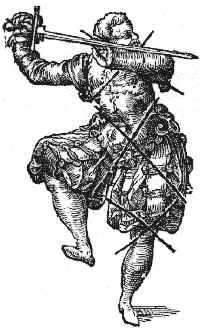
This I will have to argue with. Verolini's image differs quite clearly from that of Meÿer and Sutor. Sutor has two versions of this image, both show the right foot in the air, indicated by the fact that in one, there is no shadow on that foot (which all images of feet on the floor have) and in the other, the foot is above the floor/wall line.
In Meÿer's 1570 manual the fencer with the cutting lines, again there is no shadow for the right foot, indicating that it is in the air. As seen above.
In Meÿer's 1560 manual this stance is shown while actually fencing an opponent, again the right foot is lifted above the horizon, well into the air. No doubt what so ever.
A highly similar stance, but with the forward leg lifted is shown in Sutor, again with no shadow for the foot.
Meÿer has plenty of images showing combattants with one foot in the air, both in the longsword, dussack, rappier, dagger and staff/halberd.
I partially agree about the importance of Waage, although I do not 100% agree about the drawn conclusions and their implications. And these images really shouldn't be used as proof.
The image of Meÿer's staff fencer in the article is really not used properly either. An "in motion" image is confused with a stance and the stepping is completely misinterpreted. The angle is actually correct though.