1590 to 1603

For Historical European Fighting Arts, Weaponry, & Armor

Moderators: Webmaster, Stacy Clifford

Harry
Posts: 3
Joined: Sun Mar 11, 2012 11:30 am

1590 to 1603

Postby Harry » Sun Mar 11, 2012 12:46 pm

Hello there my name is Harry and I have recently become very interested in renaissance martial arts. This new interest stems from my passion for late 16th and early 17th century history.

As of the last 6 months I have begun a personal project of researching all areas of society and life in Elizabeth’s the 1st London in the last 13 years of her reign (1590-1603) and was interested to know what fencing styles were prevalent during this time in London and England as a whole? Also would you be able to tell me which fencing masters/teachers were based in London and where were their schools.

My 2nd question is what did rapiers look like during this period? Did styles change dramatically in these 13 years or did they generally keep to a consistent look, and would we have seen the Pappenheimer hilts alongside Swept hilts or other variations.

And last but not least I know George Silver was prominent during this time and advocated the use of the backsword so what did these backswords and basket hilts look like?

I look forward to your replies!

Kind regards,

Harry
Last edited by Harry on Tue Apr 16, 2013 4:59 am, edited 2 times in total.

User avatar
John Farthing
Posts: 179
Joined: Fri Aug 12, 2005 4:09 pm
Location: ARMA Middle Tennessee
Contact:

Re: 1590 to 1603

Postby John Farthing » Mon Mar 12, 2012 3:27 pm

Harry J J Gardner wrote:As of the last 6 months I have begun a personal project of researching all areas of society and life in Elizabeth’s the 1st London in the last 13 years of her reign (1590-1603) and was interested to know what fencing styles were prevalent during this time in London and England as a whole? Also would you be able to tell me which fencing masters/teachers were based in London and where were their schools.


One of the best sources of information available to us on this topic is the "Sloane" MS 2530. It was published a number of years ago in book format under the title 'The Noble Science' and presented by literary archaeologist, Herbert Berry.
-John Farthing, Free Scholar
ARMA Deputy Director

User avatar
Corey Roberts
Posts: 223
Joined: Sat May 07, 2005 6:11 pm
Location: Pyeongtaek, South Korea

Postby Corey Roberts » Mon Mar 12, 2012 8:23 pm

Hi Harry, Silver doesn't' actually talk about backsword very much, but he does talk about the "shorte sword" quite frequently. This type of sword is what we generically refer to as a "cut and thrust" sword now. It would have had a compound hilt, but with a blade wider than that of the rapier so that it could cut, which rapiers do not do very well if at all. Silver is extremely critical of the rapier style which came to England from Italy and Spain. Rapiers were typically longer, (as long as if not longer than some longswords) more slender, and with a hexagonal cross section without a significant cutting edge. They are extremely agile in point control and thrusting, and rapier manuals show them able to penetrate through a human head. Also testing with them shows they go through flesh easier than butter.

Silver was a competitor and critic of an Italian instructor named Vincentio Saviolo who came to England to teach rapier fencing. A good proportion of Silver's work is aimed at a rebuttal of the new continental rapier style of fence, and promotion of the older English martial arts. Silver wrote Paradoxes of Defence which was published in 1599 (exactly in your era of study) and can be found here:
http://www.umass.edu/renaissance/lord/collection.html

You will also note that Vincentio Saviolo's "His Practice in Two Books" is also available for download from the same site.

Various different hilt types of rapier would have existed and been used simultaneously. Rapiers do not necessarily even have to have a compound hilt but can even feature a small simple crossguard, all the way to very complex and fully enclosing hilt styles.

As far as styles go there was the earlier cut and thrust sword style, which existed simultaneously to the newer rapier style. The rapier sword form looks like this:

http://mac9.ucc.nau.edu/manuscripts/pca ... alunga.jpg

Notice the very long and very narrow blade, this is what makes a rapier what it is. Historical rapier blades are also very stiff, and do not have significant sharp edges.

Now look at this picture from Silver:
http://mikemonaco.files.wordpress.com/2 ... silver.gif

Although this sword too has a compound hilt it features a wider "cuttier" blade and is shorter than the true rapier. These swords were more nimble in point control and thrusting than earlier medieval swords, but retained a wide and flat enough blade cross section to deliver significant cuts.

--Scholar-Adept
Pyeongtaek
Republic of Korea

Harry
Posts: 3
Joined: Sun Mar 11, 2012 11:30 am

Re: 1590 to 1603

Postby Harry » Tue Mar 13, 2012 2:00 pm

John Farthing wrote:
Harry J J Gardner wrote:As of the last 6 months I have begun a personal project of researching all areas of society and life in Elizabeth’s the 1st London in the last 13 years of her reign (1590-1603) and was interested to know what fencing styles were prevalent during this time in London and England as a whole? Also would you be able to tell me which fencing masters/teachers were based in London and where were their schools.


One of the best sources of information available to us on this topic is the "Sloane" MS 2530. It was published a number of years ago in book format under the title 'The Noble Science' and presented by literary archaeologist, Herbert Berry.


Thanks John I will definitely hunt down that book! Would you also be able to comment on Aylward J D book The English Master of Arms? That's another one I see referenced alot.

Thanks again!

Harry
Posts: 3
Joined: Sun Mar 11, 2012 11:30 am

Postby Harry » Tue Mar 13, 2012 2:23 pm

Corey Roberts wrote:Hi Harry, Silver doesn't' actually talk about backsword very much, but he does talk about the "shorte sword" quite frequently. This type of sword is what we generically refer to as a "cut and thrust" sword now. It would have had a compound hilt, but with a blade wider than that of the rapier so that it could cut, which rapiers do not do very well if at all. Silver is extremely critical of the rapier style which came to England from Italy and Spain. Rapiers were typically longer, (as long as if not longer than some longswords) more slender, and with a hexagonal cross section without a significant cutting edge. They are extremely agile in point control and thrusting, and rapier manuals show them able to penetrate through a human head. Also testing with them shows they go through flesh easier than butter.

Silver was a competitor and critic of an Italian instructor named Vincentio Saviolo who came to England to teach rapier fencing. A good proportion of Silver's work is aimed at a rebuttal of the new continental rapier style of fence, and promotion of the older English martial arts. Silver wrote Paradoxes of Defence which was published in 1599 (exactly in your era of study) and can be found here:
http://www.umass.edu/renaissance/lord/collection.html

You will also note that Vincentio Saviolo's "His Practice in Two Books" is also available for download from the same site.

Various different hilt types of rapier would have existed and been used simultaneously. Rapiers do not necessarily even have to have a compound hilt but can even feature a small simple crossguard, all the way to very complex and fully enclosing hilt styles.

As far as styles go there was the earlier cut and thrust sword style, which existed simultaneously to the newer rapier style. The rapier sword form looks like this:

http://mac9.ucc.nau.edu/manuscripts/pca ... alunga.jpg

Notice the very long and very narrow blade, this is what makes a rapier what it is. Historical rapier blades are also very stiff, and do not have significant sharp edges.

Now look at this picture from Silver:
http://mikemonaco.files.wordpress.com/2 ... silver.gif

Although this sword too has a compound hilt it features a wider "cuttier" blade and is shorter than the true rapier. These swords were more nimble in point control and thrusting than earlier medieval swords, but retained a wide and flat enough blade cross section to deliver significant cuts.


Thanks for clearing that up Corey. That post proved very helpful and clear!

With a little more research I have done since my first post I have gleamed that prominent Italian masters/teachers during this period would of included Rocco Bonetti's son Geronimo, Vincentio Saviolo and Giacomo id Grassi but what of the Germans, French or Spanish? Bearing in mind the political climate between Spain and England but I have read of a Rowland Yoke intoducing Spanish rapier play to England in 1587 on his return from fighting for the Spanish in the low countries. Was it possible that Spanish fencing schools were around in London from 1590 onwards?

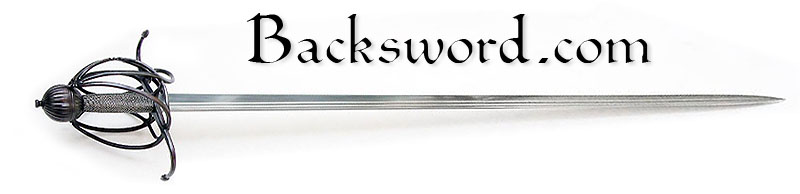
One last thing you say that various different hilt types of rapier would have existed and been used simultaneously. Do we know if the Pappenheimer, cup and cage hilts were about? Could we have seen fully enclosed basket hilts also like the link below:

http://www.backsword.com/images/backsword.jpg

I realise in some cases alot of swept hilts could mimic these others types as there seems to be a bit of variety in swept hilts with some also incorporating sword breaker designs.

Kind regards!

Jonathan Hill
Posts: 111
Joined: Fri Sep 25, 2009 3:01 pm

Postby Jonathan Hill » Wed Mar 14, 2012 8:05 pm

The short answer is these represent varying degrees of hand protection. A swept hilts are a vast improvement over a cross guard and it allows you to put your finger over the guard to give you better point control and not let your hand be targeted as easily. But your hand can still be a target by a skilled opponent who thrusts you through the rings. Thus the move to find ‘more hand protection;’ The Italians would use a more withdrawn guard position which did not allow the hand to be targeted as easily while the Spanish favored a fully extended arm, which made the hand an easy target thus the full cup hilt to protect your hand, but your hand doesn’t have as much ability to wiggle around in there. Pappenheimer is a middle ground that gives you half the protection and better ability to wiggle your hand.

Your link is a basket hilted backsword or broadsword. It is a different beast entirely from the Rapier and we do see them around the 16th Century. It is closer in usage to the Side Sword but the characteristics of the basket hilt dictate slightly different usage. The defining characteristic on that blade is there is no protection past the cross guard thus your grip will stay behind the cross guard. A rings of a swept hilt extend past cross guard allowing your grip to be ‘over’ the cross and still be protected.


Return to “Research and Training Discussion”

Who is online

Users browsing this forum: No registered users and 6 guests


Note: ARMA - The Association for Renaissance Martial Arts and the ARMA logo are federally registered trademarks, copyright 2001. All rights reserved. No use of the ARMA name or emblem is permitted without authorization. Reproduction of material from this site without written permission of the authors is strictly prohibited. HACA and The Historical Armed Combat Association copyright 1999 by John Clements. All rights reserved. Contents of this site 1999 by ARMA.