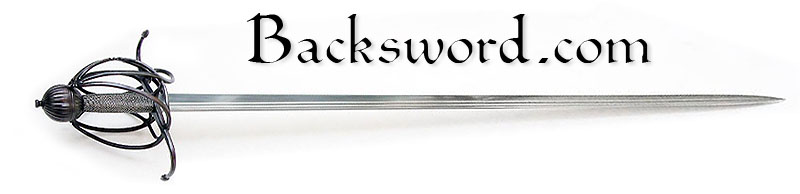
Hi Harry, Silver doesn't' actually talk about backsword very much, but he does talk about the "shorte sword" quite frequently. This type of sword is what we generically refer to as a "cut and thrust" sword now. It would have had a compound hilt, but with a blade wider than that of the rapier so that it could cut, which rapiers do not do very well if at all. Silver is extremely critical of the rapier style which came to England from Italy and Spain. Rapiers were typically longer, (as long as if not longer than some longswords) more slender, and with a hexagonal cross section without a significant cutting edge. They are extremely agile in point control and thrusting, and rapier manuals show them able to penetrate through a human head. Also testing with them shows they go through flesh easier than butter.
Silver was a competitor and critic of an Italian instructor named Vincentio Saviolo who came to England to teach rapier fencing. A good proportion of Silver's work is aimed at a rebuttal of the new continental rapier style of fence, and promotion of the older English martial arts. Silver wrote Paradoxes of Defence which was published in 1599 (exactly in your era of study) and can be found here:
http://www.umass.edu/renaissance/lord/collection.html
You will also note that Vincentio Saviolo's "His Practice in Two Books" is also available for download from the same site.
Various different hilt types of rapier would have existed and been used simultaneously. Rapiers do not necessarily even have to have a compound hilt but can even feature a small simple crossguard, all the way to very complex and fully enclosing hilt styles.
As far as styles go there was the earlier cut and thrust sword style, which existed simultaneously to the newer rapier style. The rapier sword form looks like this:
http://mac9.ucc.nau.edu/manuscripts/pca ... alunga.jpg
Notice the very long and very narrow blade, this is what makes a rapier what it is. Historical rapier blades are also very stiff, and do not have significant sharp edges.
Now look at this picture from Silver:
http://mikemonaco.files.wordpress.com/2 ... silver.gif
Although this sword too has a compound hilt it features a wider "cuttier" blade and is shorter than the true rapier. These swords were more nimble in point control and thrusting than earlier medieval swords, but retained a wide and flat enough blade cross section to deliver significant cuts.