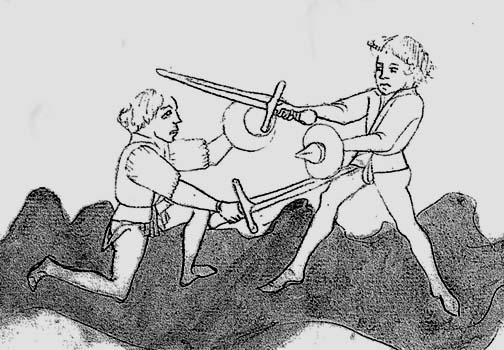
I.33 and Falling Under the Sword & Shield

For Historical European Fighting Arts, Weaponry, & Armor

Moderators: Webmaster, Stacy Clifford

User avatar
Vincent Le Chevalier
Posts: 166
Joined: Mon Dec 31, 2007 5:18 am
Location: Paris, France

Postby Vincent Le Chevalier » Wed Aug 19, 2009 6:54 am

I. Hartikainen wrote:I agree that the author of course knew what he was trying to convey, but I think what Vincent was after is that it is possible, even likely, that we won't be able to with 100% certainty be conclusive about an interpretation today - at least in some cases. Sometimes it is even possible that two different interpretations both follow the text, and can be made work under antagonistic pressure. Then we can look into internal structures in the treatise itself in order to find evidence of which would be more likely. Still that would likely not bring us to certainty.

That's pretty much what I had in mind indeed. The author meant a specific thing, of course, but probably acknowledged the fact that there were other slightly different ways to make things work. Anyway I don't think it's possible to prove with absolute certainty that we do what he wanted his students to do, not given the level of detail of the manual. There are enormous gaps, in particular we lack the basic knowledge, the art of the common fighter. The whole footwork is missing... Of course we can go for the most intuitive solutions, but the most intuitive solution is not always the correct one. I don't think the sword and buckler actions shown are really intuitive, nevertheless they were the elected answers to the situations.

To sum up, yes there is one truth, but we can't prove that we have it. Hence two dissenting interpretation can have equal chances of being the correct one.

If you think about it, against 1st ward, the buckler is on the left side of the sword arm. Against 2nd ward the buckler is held to the right side (schutzen). By closing the line by turning both weapons outwards this brings greater protection and gives a reason to holding the buckler on the opposite side from the opponent's weapon.


Additionally, holding the oppositions like this puts the edge of the buckler in the direction of the most likely strikes. Perhaps this was found to be a better defence than presenting the flat?

User avatar
Randall Pleasant
Posts: 872
Joined: Mon Sep 23, 2002 3:35 pm
Location: Flower Mound, Texas, USA

Postby Randall Pleasant » Wed Aug 19, 2009 9:09 am

I. Hartikainen wrote:I meant no offense to you.

No problem. I felt no offense at all. This discussion with you, Vincent, and others has been nothing but a joy. More importantly it has push me to go a back and take a hard look at a number of things in the I.33 manual.

I agree that the author of course knew what he was trying to convey, but I think what Vincent was after is that it is possible, even likely, that we won't be able to with 100% certainty be conclusive about an interpretation today - at least in some cases. Sometimes it is even possible that two different interpretations both follow the text, and can be made work under antagonistic pressure. Then we can look into internal structures in the treatise itself in order to find evidence of which would be more likely. Still that would likely not bring us to certainty.

Vincent is right that we will never know with 100% certainty that any interpretation is correct. I'm sorry if I came off as sounding like I had "The Answer". I think I have a better answer than those perviousely presented but only the author if I.33 had The Answer.

The sidestep and cut to the arm can be made very difficult, or I should perhaps say, an unlikely choice by aligning the sword and shield slightly towards the right side.

If you think about it, against 1st ward, the buckler is on the left side of the sword arm. Against 2nd ward the buckler is held to the right side (schutzen). By closing the line by turning both weapons outwards this brings greater protection and gives a reason to holding the buckler on the opposite side from the opponent's weapon.

You suggest that this turning would make half-shield something other than half-shield, but where do you base this statement? Nowhere is it said that half-shield should stand in the centerline, as far as I know.


I don't think the student holding Half-Shield slightly to the right is going to significantly affect the priest's ability to cut to the student's arm. If the student holds Half-Shield far enough to the right to significantly affect the priest's ability to cut hte student's arm then the student will be holding Half-Shield so far to the right that we can say that he is no longer in Half-Shield. In other words, the student would be presenting enough of his left side to the priest that the priest would have new options for attacking. Hope that makes sense.

In Half-Shield and Covering the exposed hand is protected with the sword, not the buckler, because we are seeking the over-bind. Plus this ensures that our sword arm is free and not bound by our own buckler. I think a key principle of I.33 is "the right arm over the left arm" as we seen in Covering and at the end of "Falling Under the Sword & Shield". Of course when a person starts with their right arm under their left arm they can still perform a successful Shield-Strike and cut/thrust but it's does require that they get their sword free first.


Slightly off-topic, but since you mentioned it, I'm curious about the new revelations Mr Clements has had - but the post is rather cryptic. Is there going to be any other news on this soon?

I truely hope so but I no real idea when. My understanding is that JC and Aaron Pynenberg do have a book in the works showning the basics of the new interpretations. Althought I had seen his Vaage footwork and Krumphau interpretation earlier, I just recently got my first look at all of the new interpretations during the recent ARMA International Event back in July.
Ran Pleasant

User avatar
Randall Pleasant
Posts: 872
Joined: Mon Sep 23, 2002 3:35 pm
Location: Flower Mound, Texas, USA

Postby Randall Pleasant » Wed Aug 19, 2009 10:04 am

Vincent Le Chevalier wrote:Out of curiosity, what is your description of a correct halfshield, and why do you think it's a good position to be in against a first or a third? Why do you think it is described as better than longpoint?

Thankfully the image on page 3 of I.33 gives us the correct posture for Half-Shield. From this image we can see that the hands are held just under the line of sight. A major mistake that I see people make is lowering their hands until they are really no longer in Half-Shield but are in something like Pflug. This problem can been see in the video by Sean Hays. This Pflug position makes it possible for Sean to get a bind against the weak of his adversary's blade. If the adversary had been in the actual Half-Shield guard then Sean would have been binding against the strong of the blade. Holding the hands high ensures that your head is protected by your strong, thus I.33 says that the upper parts (openings) cannot be reached. If a person is looking past the weak of their blade they are not in Half-Shield. In the image on page 3 we also see that the body is leaning forward with the head almost over the forward knee. Lowering the hands as discussed above usually happens when a person stands straight up while in the guard. Without doubt Half-Shield is not the same as Pflug!

Half-Shield is a good counter to the Under-Arm and Left-Shoulder because an over-bind aginst strikes from those guards will leave the sword arm free and the buckler in a good position for a Shield-Strike. Plus, Half-Shield makes it very hard for a person in those guards to get an over-bind against it.
Ran Pleasant

User avatar
Vincent Le Chevalier
Posts: 166
Joined: Mon Dec 31, 2007 5:18 am
Location: Paris, France

Postby Vincent Le Chevalier » Wed Aug 19, 2009 1:29 pm

Hi Randall,

Thanks for explaining in depth how you see the half-shield position. So, if I understood correctly, you see it as a sort of provocation for the bind? That is, the position does not protect the right arm in itself, in order to entice the warder to strike there and counterbind him?

That's an interesting theory. I have my doubts about it, given that half-shield seems to be adopted by common fighters as well, even though they do not bind. To me the oppositions belong to the repertoire of common fencers; their functionality should be understood without linking them to actions that are described as specific to the Priest. I'm more convinced by Ikka's idea of pointing the weapons to the right; true, you can hit the arm with stepping, and you can hit the head/left arm by bringing your weapon around, but both options will take a longer time during which the opposer will be able to nail you. Your most direct and quick attack is negated and you have to go to a more advantageous position and gain some control before hitting something.

I get your point about the height of weapons, and agree with it against first ward. But look at the special longpoint (page 46) and how suddenly halfshield is drawn lower... I think the shield goes into the line of likely attack, which is not always as high as on page three.

On the bottom of the same page, I've just found another argument in favour of the interpretation that it's not the sword that falls:
Hic ponit se sacerdos sub gladium scolaris quod sepius prius tactum est. Unde Versus: Dum ducitur halpschilt, cade sub gladium quoque scutum
Here the priest sets himself under the Student's sword, which has been discussed frequently before. Hence the verse: "When half-shield is adopted, fall under the sword and shield".
(trans. J. Forgeng)

And note how much more sense it makes if half-shield is not in line. You have to move yourself under the edge of the opposer's sword, and put your sword on his not in order to cut, but in order to establish a structure that will allow you to diplace the expectable strike from halfshield. I even wonder if you have to make it look like a cut or if it's not better to just throw the sword forward as if it was a stick without any concern of edge alignment...

Indeed if half-shield is held full forward there is no need to fall under the student's sword, because you're already there.

Many many thanks for the discussion! Whether we convince one another or not, we read the manuscript with new eyes and this is the important thing!

User avatar
Randall Pleasant
Posts: 872
Joined: Mon Sep 23, 2002 3:35 pm
Location: Flower Mound, Texas, USA

Postby Randall Pleasant » Wed Aug 19, 2009 4:24 pm

Vincent Le Chevalier wrote:I get your point about the height of weapons, and agree with it against first ward. But look at the special longpoint (page 46) and how suddenly halfshield is drawn lower... I think the shield goes into the line of likely attack, which is not always as high as on page three.


There is a difference in the height at which Half-Shield is held between page 3 and page 46. However, I don't think it is a significant difference. Clearly the student is not in a Pflug like position. In the bottom image we see that the priest's weak is at the same height as the student's strong.

On the bottom of the same page, I've just found another argument in favour of the interpretation that it's not the sword that falls:
Hic ponit se sacerdos sub gladium scolaris quod sepius prius tactum est. Unde Versus: Dum ducitur halpschilt, cade sub gladium quoque scutum
Here the priest sets himself under the Student's sword, which has been discussed frequently before. Hence the verse: "When half-shield is adopted, fall under the sword and shield".
(trans. J. Forgeng)

I'm not reading anything significantly different on page 46 then what was said on page 3. The priest does the same move and he is either under the student's over-bind or he can mutate by moving under the student's sword & shield. On page 47 we see another method in which the student can attack the priest if the priest fails to mutate. I'm not seeing anything on page 46 that makes me rethink my analysis of page 3 thru page 6.

Many many thanks for the discussion! Whether we convince one another or not, we read the manuscript with new eyes and this is the important thing!

You are most welcome. The discussion has been most enjoyable and regardless of what degree we agree and disagree it has pushed me deeper into this wonderful manuscript.
Ran Pleasant

User avatar
Vincent Le Chevalier
Posts: 166
Joined: Mon Dec 31, 2007 5:18 am
Location: Paris, France

Postby Vincent Le Chevalier » Thu Aug 20, 2009 3:27 am

Randall Pleasant wrote:I'm not reading anything significantly different on page 46 then what was said on page 3. The priest does the same move and he is either under the student's over-bind or he can mutate by moving under the student's sword & shield. On page 47 we see another method in which the student can attack the priest if the priest fails to mutate. I'm not seeing anything on page 46 that makes me rethink my analysis of page 3 thru page 6.

The significant difference is not about the position depicted or the tactical possiblities offered to both fighters, which are clearly the same and the manuscript says so. The significant difference is that the text describes the action as the priest himself, not his sword, moving under the student's sword.

One key part of your argumentation is that "falling under" cannot apply to just the initial action without a form of mutation, because the priest's sword is not moving under the student's weapon, and the sword is logically the only thing that can fall under. The text here shows that it's the priest that sets himself under the student's sword, and that weakens your point in my opinion.

Mutation is not the only way out either, particularly against general fighters, even if you disregard the passage about the three options that the priest has. Another one seems to be shown on page 49.

Regards,

User avatar
I. Hartikainen
Posts: 81
Joined: Wed Jun 01, 2005 1:44 pm
Location: Finland
Contact:

Postby I. Hartikainen » Thu Aug 20, 2009 4:40 am

Ok, we've all got it wrong. And it seems the author of I.33 got it wrong as well, since obviously this is the true form of falling under the sword and shield:

Image

:D

Seriously speaking, I think we will have to agree to disagree on the protection of the hand aspect, as I don't see how aligning the sword and shield differently makes the half-shield stop being half-shield, since it is not defined as standing in the centerline. I am not saying that it was not possible to strike the arm, but less likely. The sword would then, as you point out as well, protect the hand from the outside, and the buckler from the inside.

I take your point on the hands held high in half-shield. That is a good and an important point, making any action against the blade less useful (beat, bind, whatever).

Yours,
Ilkka

- Ilkka

User avatar
Stacy Clifford
Posts: 1126
Joined: Fri May 14, 2004 11:51 am
Location: Houston, TX
Contact:

Postby Stacy Clifford » Thu Aug 20, 2009 8:44 am

I think Randall is looking at the definition of half-shield from a functional perspective as well as a physical one. If half-shield is specifically intended to perform a certain function down the centerline (such as drawing attacks to the sword arm because the buckler arm is too well defended), then drawing your arms off to the right opens up new lines of attack that half-shield is not supposed to allow. Therefore, if your guard is not in position to perform the intended function of half-shield (shielding half of you?), then holding your weapons together the same way somewhere else does not a guard make. Correct me if I'm reading you wrong here, Ran.
0==[>>>>>>>>>>>>>>>>>
Stacy Clifford
Free-Scholar
ARMA Houston, TX

User avatar
Randall Pleasant
Posts: 872
Joined: Mon Sep 23, 2002 3:35 pm
Location: Flower Mound, Texas, USA

Postby Randall Pleasant » Thu Aug 20, 2009 9:32 am

Stacy Clifford wrote:I think Randall is looking at the definition of half-shield from a functional perspective as well as a physical one. If half-shield is specifically intended to perform a certain function down the centerline (such as drawing attacks to the sword arm because the buckler arm is too well defended), then drawing your arms off to the right opens up new lines of attack that half-shield is not supposed to allow. Therefore, if your guard is not in position to perform the intended function of half-shield (shielding half of you?), then holding your weapons together the same way somewhere else does not a guard make. Correct me if I'm reading you wrong here, Ran.


Yes, that was basically what I was trying to say.

Strangely I had never thought of Half-Shield as "shielding half of you" but that is just what it does. Nice observation! The author of I.33 clearly liked very descriptive names.
Ran Pleasant

User avatar
Vincent Le Chevalier
Posts: 166
Joined: Mon Dec 31, 2007 5:18 am
Location: Paris, France

Postby Vincent Le Chevalier » Thu Aug 20, 2009 3:53 pm

Well I think all of us here look at half-shield from a functional perspective, it's just that depending on the function assumed (the function is never described in the manual as far as I know) you can end up with different positions.

If you look at half-shield functionaly as an invitation for the warder to hit the exposed right armor even right side, it makes sense to hold the weapons right to the middle. If you look at half-shield as something that is meant to close the lines of likely attacks from the guard, then it should protect the right side, perhaps more so than the left that is relatively less threatened.

I personally just don't fancy the idea of stepping in merrily with a gaping opening to my sword arm right into the line of likely and powerful attack. Seems too big of a gamble to me.

I'm not really convinced by the "shields half of the body" explanation either. I know close to nothing about German but half-sword seems to be a pretty close construct and I'm pretty sure it's not about swording half of anything ;)

User avatar
Randall Pleasant
Posts: 872
Joined: Mon Sep 23, 2002 3:35 pm
Location: Flower Mound, Texas, USA

Postby Randall Pleasant » Fri Aug 21, 2009 10:03 am

Vincent Le Chevalier wrote:Well I think all of us here look at half-shield from a functional perspective, it's just that depending on the function assumed (the function is never described in the manual as far as I know) you can end up with different positions.

If you look at half-shield functionaly as an invitation for the warder to hit the exposed right armor even right side, it makes sense to hold the weapons right to the middle. If you look at half-shield as something that is meant to close the lines of likely attacks from the guard, then it should protect the right side, perhaps more so than the left that is relatively less threatened.

I personally just don't fancy the idea of stepping in merrily with a gaping opening to my sword arm right into the line of likely and powerful attack. Seems too big of a gamble to me.

I'm not really convinced by the "shields half of the body" explanation either. I know close to nothing about German but half-sword seems to be a pretty close construct and I'm pretty sure it's not about swording half of anything ;)
Vincent

Neither Stacy or I are suggesting that Half-Shield only protects the left side and leaves the right side unprotected. We are saying that only the left side is protected by the buckler, thus the name "Half-Shield". The right side is extremely well protected by the sword. Remember that against Half-Shield neither the upper or lower openings can be attacked from the Under-Arm guard. When the student assumes Half-Shield at the start of the "Falling Under the Sword & Shield" play the student does not bait the priest into attacking his arm. Instead the student has put the priest into a situation where attacking the student's arm is the best option.
Ran Pleasant

User avatar
Vincent Le Chevalier
Posts: 166
Joined: Mon Dec 31, 2007 5:18 am
Location: Paris, France

Postby Vincent Le Chevalier » Fri Aug 21, 2009 1:34 pm

Hi Randall,

Randall Pleasant wrote:Neither Stacy or I are suggesting that Half-Shield only protects the left side and leaves the right side unprotected. We are saying that only the left side is protected by the buckler, thus the name "Half-Shield". The right side is extremely well protected by the sword. Remember that against Half-Shield neither the upper or lower openings can be attacked from the Under-Arm guard. When the student assumes Half-Shield at the start of the "Falling Under the Sword & Shield" play the student does not bait the priest into attacking his arm. Instead the student has put the priest into a situation where attacking the student's arm is the best option.

I think I'll have to make further practical experimentation. At the moment I'm fairly convinced that you can assume half-shield such that even hitting the arm is not an option without taking a step. In that case half-shield would
a) block the direct lines of attack to your right side with the buckler's edge and the strong of the sword
b) make the sword stronger by resting it on the buckler (kind of how half-sword makes the sword stronger)
c) force the opponent to go through another ward if he wants to hit the left side (especially arm) because the nearly vertical sword is in the way (and it is made stronger)
d) protect the lower opening by keeping them far enough

But this is just me testing in front of a mirror... In a way you'd hide the right arm behind the buckler and the sword protects the left arm because the adversary can't strike through it. I believe Ikka is thinking of a somewhat similar option. Not as simple as "sword protects right side, shield protects left" but the weapons work in a combination.

Food for thoughts anyway,

User avatar
Randall Pleasant
Posts: 872
Joined: Mon Sep 23, 2002 3:35 pm
Location: Flower Mound, Texas, USA

Postby Randall Pleasant » Fri Aug 21, 2009 3:44 pm

Vincent Le Chevalier wrote:At the moment I'm fairly convinced that you can assume half-shield such that even hitting the arm is not an option without taking a step.
Vincent

I agree with you on this. Holding Half-Shield slighting to the right as Ilkka suggested would indeed make it much harder to hit the arm without taking a passing step. Sorry if it appeared that I suggested otherwise earlier. I almost always perform "Falling Under the Sword & Shield" with a pass to the left.
Ran Pleasant

User avatar
Matt Bryant
Posts: 133
Joined: Sun Jul 17, 2005 9:34 pm
Location: Tulsa, Oklahoma
Contact:

Postby Matt Bryant » Sat Aug 22, 2009 10:28 pm

Now this is a good discussion. Very educational!
Matt Bryant
Scholar Adept
ARMA Associate Member - Tulsa, Oklahoma

"Keepe the point of your Staffe right in your enemies face..." -Joseph Swetnam


Return to “Research and Training Discussion”

Who is online

Users browsing this forum: No registered users and 18 guests


Note: ARMA - The Association for Renaissance Martial Arts and the ARMA logo are federally registered trademarks, copyright 2001. All rights reserved. No use of the ARMA name or emblem is permitted without authorization. Reproduction of material from this site without written permission of the authors is strictly prohibited. HACA and The Historical Armed Combat Association copyright 1999 by John Clements. All rights reserved. Contents of this site 1999 by ARMA.