I. Hartikainen wrote:I agree that the author of course knew what he was trying to convey, but I think what Vincent was after is that it is possible, even likely, that we won't be able to with 100% certainty be conclusive about an interpretation today - at least in some cases. Sometimes it is even possible that two different interpretations both follow the text, and can be made work under antagonistic pressure. Then we can look into internal structures in the treatise itself in order to find evidence of which would be more likely. Still that would likely not bring us to certainty.
That's pretty much what I had in mind indeed. The author meant a specific thing, of course, but probably acknowledged the fact that there were other slightly different ways to make things work. Anyway I don't think it's possible to prove with absolute certainty that we do what he wanted his students to do, not given the level of detail of the manual. There are enormous gaps, in particular we lack the basic knowledge, the art of the common fighter. The whole footwork is missing... Of course we can go for the most intuitive solutions, but the most intuitive solution is not always the correct one. I don't think the sword and buckler actions shown are really intuitive, nevertheless they were the elected answers to the situations.
To sum up, yes there is one truth, but we can't prove that we have it. Hence two dissenting interpretation can have equal chances of being the correct one.
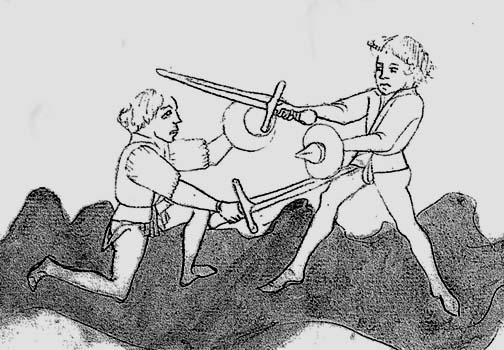
If you think about it, against 1st ward, the buckler is on the left side of the sword arm. Against 2nd ward the buckler is held to the right side (schutzen). By closing the line by turning both weapons outwards this brings greater protection and gives a reason to holding the buckler on the opposite side from the opponent's weapon.
Additionally, holding the oppositions like this puts the edge of the buckler in the direction of the most likely strikes. Perhaps this was found to be a better defence than presenting the flat?