Hi Roger!
-"Well, I don't really see any reason to argue if Low Vom Tag," Right, nobody is arguing the low vom tag just the lazy vom tag (LVT) that is resting on the shoulder!!!!
"CAN be interpreted as putting your sword against, beside or next to the shoulder. We simply do not know for sure." yeap, but is it what the masters suggest? Is there evidence of the Masters suggesting resting? Yeap this is the core of our discussion!!!!
From what I have learned from The ARMA I have different interpretions of what are the core assumptions, and core principles and understand differently concepts like zufechten from your interpretation…
-"I think our cutting mechanics are different." yes, they are, from what I understand you first transition to kron and then cut from kron, technicly speaking you are cutting from kron… did I understood well your mechanics? This is not bad at all on the contrary, but IMO there can be better ways to cut from VT, cutting from kron is very important don't miss understand me but it has is place just as cutting full arm has it's own place
-"This is also of course closely tied to footwork" yes, and reading JC article on a complex yet easy footwork is exciting, have you seen the videos that come with the article? (sorry this is an aside question from the matter at hand)
-" If you are in between huts, you are not as well protected and may be attacked in nachreissen", I don't think so as you are transitioning from guard to guard you are cutting, I'm protecting myself with a cut, if you get near you might get cut… the Masters suggest this...
-"Regarding the actual resting on the shoulder, this whole question revolves around how long you rest." Absolutly!!!
-"Constant moving between huts will confuse your opponent but will also leave you exposed when in between guards if you are not attacking with intent and just moving for the sake of moving." uppps no disagree, transitioning between hut you cut, and is exactly what the masters advice... below I'll post my reasoning...
-"keep moving your feet to find a good distance and angle for defense and offense and change guards at the "safe" distance of Zufechten. In krieg however, you keep moving by constantly attacking with cuts and thrusts to maintain the Vor." Not only your feet but the whole body as again the Masters suggest, either in zufechten, krieg, or ringen am schwert, the problem with how you are explaining is that it only takes into consideration what you do, and not what your opponent does, so what is your are looking to place yourself in the posi.... ohhhh my opponent has just leaped to krieg attacking me and his zorn is moving to my left hear and he is traversing and I'm in this position with the sword resting on my right shoulder... see my point...
-"I said SCHIEL hau not scheitelhau." yes I understood well, the question remains, where specifically says that a sheilhau displaces a zorn?
Here are some quotes from Cod.HS.3227a (Lindholm)and some thoughts:
"is simple in all things without holding back or being restricted" about the Art that is one and how should we understand it, for me here Master L is saying don't tighten yourself in attacking and defending, this implies movement to me… even while being at a guard
"be able to grip it well with both hands, between the cross guard and the pommel since you will then be safer than if you did grip it with one hand on the pommel. And you will also strike harder and truer, with the pommel" this about to question about if we should make strong cuts, for Master L was important, he even advices on how to grab a sword to hit harder, even though grabbing the sword differently might cut, he is concerned with cutting hard.
"And what you would try readily in earnest or in play, should be hidden from him so that he does not know what you intend to try against him." being motion (feet, body and even the guard) conceals more my intentions that moving only with my feet and sword resting in the shoulder, me thinks
"Fencer, do this and the art will become clear. From the sword, do good and wide covers." a vom tag resting on the shoulder would not wide covers… hmmm, I know you argue that that can be done cutting, but lets see what else Master L has to say…
"Motion/movement [Motus], note that word well, it is to the fencing a heart and a crown, it is the very matter of fencing" I think this includes guards, so resting on the shoulder doesn't quit fits here
"Here note that constant motion [Frequens motus] holds the beginning, middle and the end of all fencing according to this art and teaching. That is you should quickly do the beginning, the middle and the end without delay and without any hindrances from the opponent and not letting him strike at you." Well same as above why wouldn't this consider guards? and again resting a sword on the shoulder doesn't quite goes with this teaching
"Do not strike at the sword but wait for the openings." Probably the translation, but wait for the openings? But I can see the three openings if you are resting a sword on the shoulder. But if the guard was moving I would need to look for an opening…
"Do with the entire body what you wish to do firmly." Should I only consider cuts? Should "entire body "consider moving hands, arms, wrists… guard? Or only feet? Or only when cutting?
"reason, secrecy, reach, foreknowing and readiness" where am I more ready with a sword resting on the shoulder or not resting on the shoulder?
"Also when you want to fence strongly, then fence from the left side with the whole body and with full force to the head and to the body wherever you can hit" well this is from yesterday when we debated as to "supreme force"

yes I see Master L is saying force and power on a cut is important, even though the Art is not founded just on power or force, but is important to deliver powerful cuts...
"but always work and remain in motion so the he cannot come to blows." more movement!!! Can I only prevent my opponent from coming to blows against me by using movement of my feet? Or resting the sword on the shoulder? Or just cutting?...
"And always be in motion, this will force the opponent to be on the defence and not be able to come to blows" not sometimes, but always, this again goes against resting thw sword on the shoulder in VT, as I understand…
"the basic tenet of swordsmanship: that a man is always in motion and never at rest" this is pretty direct… same questions, should we only consider feet? Is resting the sword on the shoulder is being always in motion never at rest?
"Just act according to this teaching, and always be in motion, whether you hit him or not, so that he cannot come to blows." does this applies only to cutting?why wouldn't we consider while guarding in VT? Or any other guard or transitioning through guards?
"If you know how to seek the four openings [Blossen]? So Master L is talking all through his teachings about moving, then he says this, we need to seek the four openings… if someone is resting his sword on the shoulder why do I need to "seek", they are are pretty open, but if VT was not on the shoulder, ready to strike with movement (just as boxers do)...
"from one side to the other, above and below continuously and without any interruptions so that you are in constant motion and the opponent can not come to blows." so is it just cutting… can it be guarding with moving guards? Resting the sword on the shoulder... never mind... IMO =)
"But before all things, remember that you should not remain too long in one guard. Liechtenauer has a saying “He who is still, is dead, he who moves will live”." so the question remains? With all the above advices and this one how can I argue that the sword rests on the shoulder in VT?
"And from these guards comes the understanding that you should move in swordplay, and not wait in a guard and thus waste your chance." well they actually wrote it down, no waiting in a guard, how can resting the sword on the shoulder in VT fit in these teachings?
"But I do advice everybody not to remain standing right in front of him (the opponent) unless you want to be a looser, but someone who hits." this can be interpreted just as moving your feet while resting the sword on the shoulder or collar bone, but it comes shortly after the above quote, should we dismiss movement in the guard and rest the sword on the shoulder?
Hi Jonathan,
-"the difference between SVT and LVT is less than half an inch" yes and no the VT guard is not stationary
"-"Lazy VT is the result of people not liking the idea that the blade is resting, but a lower version of VT is a real guard no matter if you do not like to use it or not."" The low VT does exist within the context of constant motus and I actually use it, however the vom tag resting on the shoulder nop, I don't like because the Masters advice movement not stationary and resting on the shoulder, as for me my guard is in constant motus be it high or low, near or far...
"
"-""so yes cuts are a transition from guard to guard, and this type of cut is not lacking in power I trust Roger has satisfied that. "" Me thinks there is a better way to develop more power and reach and be in constant motus as the Masters said… to guard myself and be in ""readiness"" and in ""secrecy"" and to do not let other come to blows and... as the Masters teach...
"
-"and no evidence in the text to support either claim, still state with the highest level of certainty that no guards rest the sword on the shoulder" I have quoted Grand Master Lichtenauer above and Master Hanko Dobringer, and Ringeck makes commentaries on Master L teachings... they all do suggest always in motion, not resting, moving, guarding... Fiore does not contradict anyhow this... if so, please post where Fiore or Vadi or DiGrassi or George Silver or any Master suggests anyhow to remain resting a sword on the shoulder... I have not read any Master that contradicts being in motion including guarding including Fiore...
-"nor have an advantage or disadvantage" Master L is pretty clear as to why constnt motus… and the disadvantages of standing still….
-" I believe so as we have done test cutting with the ‘levering cut’ and it has been enough. " but do you have enough power to leverage to your favor (displace) a full arm full force zorn going at your head? We done test cutting too, but can you displace cuts that the Masters advice to throw against you full force so they are difficult to displace and can cut you even if you make a bind (weak bind of course)?
"-""These things are not philosophical, and I am still wondering if a good solid mechanical advantage can be found in not resting the blade. At this point I do not believe it matters. "" see the quotes from Master L he explains IMO beautifully why resting the sword is a disadvantage...
"
-"The debate I’ll state here is constant movement of what? Does this mean entire body, feet, arms, everything at once?" well the source teaching from the Masters answer this question… take for instance the quotes from Master L I just copied… I'm sure Fiore has some as well as Vadi... (sorry at the moment I just have HS 3227a at hand)
-"Why must constant motion involve the arms as well at all times, when it may only be appropriate to move the feet? " see the above quotes from Master L, he teaches all is moving… I'm pretty sure Vadi, DiGrassi , Pietro Monte, Fiore do not contradict constan movement of all body (including arms)...
-"If I am in a strong guard and am not in a position to attack because of distance or angle why should I change guards?" we understand differently the teachings of the Masters, however Master L takes about initiative, and Master Fiore about audacia… pretty similar IMO... I don't see guards as strong (you mean stabile or what), I just see movement, a dynamic art of defence, that tries to negate the opponent to come to blow but lets me control the violence
-"I need to move my feet not my arms." Nope all your body incluiding arms, that means the sword cannot be resting in the shoulder, collar bone… Masters advice this…
"-""not just moving because master told me to move around. "" I will not comment on this, it is your choice, however they advice and teached you move and gave reasons for doing so….
"
-"I am a big fan of ‘questioning authority’ for this that means questioning the masters." yes I have seen =) if that is the way you learn it is ok, how ever you do need to be sure you make the right questions to "authority" (Masters)…
-"This is how you find out why they wrote it down and thus you can make better use of that information." Not me, in ARMA we have a different approach, and speaking personally I do have a different way of learning...
"-""This is also why Roger ‘punches’ out at shoulder height to perform his cuts, not at waist height, because he can use that right angle to get the maximum reach. Nothing I say in my remedy to a descending blow from HVT affects this, in fact I use it against you."" we use a different mechanic when doing a zorn, that yes passes through kron (corona) but as we don't rest the sword on the shoulder we can start tu cut from VT instead of starting to cut from corona (kron)... I would be glad to test it against you =)
"
"If you target my head and extend to attack my head, your arms are about two feet in front of your body. If move my body out of distance of your attack (and preferably take an angel on you) and I target your arms, I am still able to hit you because your arms are closer to me, roughly two feet closer than your body." Glad to test it against you, the point you miss is even though you step my sword is already there with a follow through hitting your arms before they can get high enough to hit mine the best opportunity you have is a double hit... One question, how have you done trying to hit a zorn with a different mechanic than Rogers zorn? how many double hits? you know double hit are not good.... yes you hit me but ohhh you got hit, is this the art of Fiore? I don't think so.... If you come to Mexico, please contact me so we can go and experiment, glad to try it....
-"I don’t need a master to tell me this, I need a training partner to make a bunch of cuts at me while I practice. This is one way to answer a descending blow from HVT, every action has a counter action. If you cut at me with a zornhau, I still have the option of getting out of the way. Isn’t that what constant movement can accomplish for me, I move out of the way of your attack" it is your study group, if you feel you don't need any source material that is your bet... If get out of the way is your answer to a zorn good for you (we would like to see it), however Fiore teached being audiciuos.... Constant movement is much more than than trying to move out of the way of a cut... It depends on what you consider are the core principles of fighting, if getting out of the way is one, well that your assumption, it is not for me, we consider other concepts core principles that are in Fiore, Master L, vDanzing, Monte, Capo Ferro, Ringeck, Mair , Meyer, some anonymous authors, Auswald, .... etc
-"I agree with Roger here that many of you are not interested in using L/SVT as a real guard. That is fine but that does not mean it cannot or was not used that way and it was not a real guard. Many people do use it to great efficiency, and hopefully we will all have a chance to fight as some point and we can learn from each other that way!" First low vom tag we use it in terms of constant movement, and I'm (and I think The ARMA is not interested too, but as for this moment I speak for myself) are not interested in a guard that rest on the shoulder, whether you call it VT, Posta di Donna, Zornhut, Schlussen, because the masters never teached resting a sword on the body. Many people is not a reason to take it as a correct interpretation, many people smoke and are happy with it does that makes it healthier? Sure hope we can get down to test it...
As at this moment no one has presented a source teaching, or quoted a Master saying to rest the sword on the shoulder or for that matter in any part of the body, the source material, and it doesn't matter if it is german, italian, bolognese, spanish, french, russian, mexican, does not suggest resting the sword on the collar bone or shoulder, they suggest motion, motion of the guards, advicing to cut with power to overcome and displace or not be displaced, and advice to have the most reach... is there a source teaching saying rest the sword on the shoulder, don't move your body, be in a static posture/guard , rest your vom tag at the shoulder? Masters on the contrary teached to move your guard to cover your opening, move your feet, move your body (all of it)...
What I understand about the ARMA and JC, they suggests a dynamic, a fluid Art, based on core principles and core asumptions (that the Master of Defense teached) that is very violent and brutal, not an Art that is composed of posing and snipping, and only counter timing attacks, or resting a sword on the shoulder...
Finally, I take full responsability for what I have said, and I speak only for myself as a scholar, I'm not the official voice for the ARMA...
Regards,
Jorge


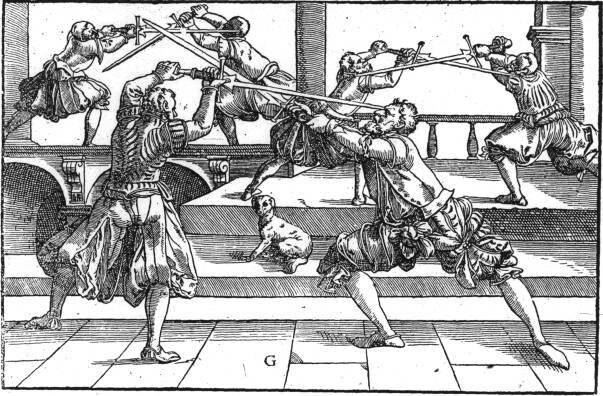

 ) then a simple movement from the upper body helps you see he is going to do something (even feinting)... cut or thrust, posing with your guard and just moving your feet when ever I see a movement from your upper body I know something is happening, but if your opponent was already moving all of his body (in analogy to what boxers do), including hands and arms (this where the ARMA and JC see as a better interpretion to DO NOT rest the sword on the collar bone or shoulder) , well then how could I predict....? The Masters from The Noble Science of Defense knew that predicting was well almost impossible and wrote that the Art is about concealing your intentions thus frequens motus and controlling violence...
 Also read the article : Fighting Skeptic - Of Martial Arts and Magic Arts...
