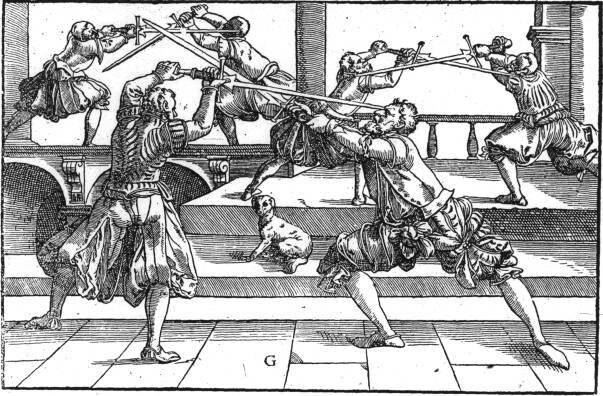
Question on vom tag

For Historical European Fighting Arts, Weaponry, & Armor

Moderators: Webmaster, Stacy Clifford

Roger Norling
Posts: 140
Joined: Fri Nov 13, 2009 5:57 am
Location: Gothenburg, Sweden

Postby Roger Norling » Wed Oct 06, 2010 11:27 pm

Hi Jorge, and others!

Well, I don't really see any reason to argue if Low Vom Tag was used. It clearly was, as several of us have shown. The whole question revolves around if it ever rested on the shoulder, with the flat or the edge. Danzig's image can definitely be interpreted as on the flat, considering that the blade is between the shoulder and the hair. And as I showed in the link previously, several manuscripts CAN be interpreted as putting your sword against, beside or next to the shoulder. We simply do not know for sure.

Me, I think of it as an advice to keep your body tight, not keeping your Vom Tag too far ahead of your body in Zufechten, since it leaves your hands vulnerable and gives you less force and leverage.

http://www.hroarr.com/temp/leger/

Here is a clip showing cuts with the edge resting on the shoulder:

http://www.youtube.com/watch?v=mjT4JepA-Vc

And a few resting on the flat:

http://www.youtube.com/watch?v=-07_kit2eBQ

http://www.youtube.com/user/Kunstdesfec ... Uy29FjqLDc

http://www.youtube.com/user/Kunstdesfec ... P_U5V01u24

Regarding the limitations of cutting lines with the various versions of VT, I really don't see them. It is not so difficult to cut a left zwerch from the right Low Vom Tag and that is the only one that is a little bit trickier. AND you are clearly advised against attacking from your weak side in the Vorschlag: If you are right handed, attack from the right. Choosing not to might be clever, but also more risky.

I think our cutting mechanics are different. The way we do most cuts is like a punch to the opponent's shoulder or above it, with the leading hand, and quite late a pulling motion with the rear hand. This hides your intent and gives you really strong "push & pull"-leverage,as both your hands are at shoulder height and the leading hand moves in a straight line. With both hands starting very low or high, this leverage gets weaker and the cut inevitably a wee bit slower since your hands can't move in opposite directions as well. Still, that possible difference in speed matters little, I think.

Starting above the head in HVT gives you a weaker leverage (force & speed) initially, but eventually added force from pushing with both arms. Also the point will have travelled a larger distance, which can give you more force.

Here are two clips with a friend that shows cuts from the left and right shoulder, not left cuts from the right shoulder, but you get the idea about the cutting mechanics. The left zwerchhau is not much different the krumphau, really. Or a schielhau, for that matter.

http://www.youtube.com/watch?v=RvsONhKaj7s

http://www.youtube.com/watch?v=RmvWYAP3Bno

http://www.youtube.com/watch?v=2lcOpxxUwOY

To me, it seems as if you are slower initially with HVT, but on the other hand you have a slight advantage in the fact that it is harder to interpret which side you will be coming from, since most using the right Low Vom Tag tend to cut from the right. Not everyone though.

This is also of course closely tied to footwork, and no matter what version of VT you use, it is hard to cut "against" your leading leg. Your feet will most likely reveal which side your vorschlag will come from. So this negates quite a bit of the HVT's advantage in hiding your intent. That will only work at shorter distance where you are within range with a simple step.

And to be clear, it is basically the vorschlag from the guard Vom Tag in Zufechten we are speaking of. The nachschlag usually comes from outstretched arms in Langenort/Hengen, in or out of a bind, or from Alber. Not commonly from the shoulder. That is an important aspect to note with the Low Vom Tag. And this also relates to constant movement and leger. It is good to keep moving to keep the pressure and the Vor. But, the huts are also places that protect you. If you are in between huts, you are not as well protected and may be attacked in nachreissen. Thus the importance of Langenort of which everything revolves according to the masters.

Regarding the actual resting on the shoulder, this whole question revolves around how long you rest. It is called a "leger" for a reason. The word actually means a provisory, temporary place to rest while travelling. How long you stay there can depend on several reasons. Constant moving between huts will confuse your opponent but will also leave you exposed when in between guards if you are not attacking with intent and just moving for the sake of moving. It is an excellent opportunity for your opponent to move in in nachreissen, as mentioned above.

This does not mean you should stand still. On the contrary, keep moving your feet to find a good distance and angle for defense and offense and change guards at the "safe" distance of Zufechten. In krieg however, you keep moving by constantly attacking with cuts and thrusts to maintain the Vor. This is not quite the same as continuous movement in zufechten.

Also, leaving an opening by waiting in a guard can lure your opponent into attacking that opening so you can attack them in nachreissen with a counterstrike or thrust. Against some opponents that might be the better option, provided you now how they fence. "One trick-hand snipers", for instance.

Finally, regarding what cuts are designed for countering forceful zornhaus, I said SCHIEL hau not scheitelhau. The more force your opponent uses with the zorn, the more exposed he will be, especially if he goes with both hands to alber, as long as you time your bind correctly on his weak. A zwerchhau works just the same and is a very similar cut, although at an opposite angle and with a "bind" closer to the strong. Even a zornhau can be done similarly.

This is essential and just a simple continuation of the Winden principles. Pretty much all counterstrike meisterhaus are winding cuts at the least, and if the bind is closer to your weak will knock the opponent's sword forcefully aside (although most master appear to seek the bind) or if it is closer to your strong will displace it for a direct strike or thrust. They manipulate force by working the weak and strong with timing, footwork and angles. Power is a minor part in this calculation, since leverage, timing and speed are more important. Therefore it is not the most powerful zornhau that wins. It is the one with the best angle, timing and bind.

Why you think a HVT has more reach than a Low Vom Tag I don't really understand. If anything, the point gets stretched out quicker from a Low Vom Tag, in my opinion. I think you have the mechanics of a cut from Low Vom Tag wrong. It starts as a punch straight out and cuts to langenort ending with a pommel twist as seen in the clips above. That also makes it quite natural to move into a zornort or Ochs.

And, I don't see any physical danger in cutting TO Low Vom Tag and letting the blade rest on the shoulder either, since I don't cut unterhaus to Vom Tag. I cut to Langenort and then move back to a guard, either high or low, for thrusting or cutting. Likewise I often try to cut a zornhau to langenort so I can keep the point in line, not to Alber or wechselhut.

Once again. Both versions of VT are good and offer different advantages and disadvantages. And both were certainly recommended as can be seen in the manuscripts.

Got to run off to leave the kids at school now, so more later. :)

EDIT: Just found this clip that goes well with what I said above.

http://www.youtube.com/watch?v=qmUqhrcSkY4
Quarterstaff instructor
Gothenburg Free Fencers Guild
http://www.gffg.se

Member of MFFG
http://www.freifechter.com

Member of HEMAC
http://www.hemac.org

HROARR
http://www.hroarr.com

Jonathan Hill
Posts: 111
Joined: Fri Sep 25, 2009 3:01 pm

Postby Jonathan Hill » Thu Oct 07, 2010 3:43 pm

Let me see if I understand something right; the difference between SVT and LVT is less than half an inch, unless there is a whole other guard we are talking about here. Lazy VT is the result of people not liking the idea that the blade is resting, but a lower version of VT is a real guard no matter if you do not like to use it or not.

I do a fendente almost exactly as Roger is showing his cut, some minor variations happen but I expect that will happen from one school to the next. You start in Woman’s guard, move to falconi, extend to long guard, and bring it down to middle iron door…so yes cuts are a transition from guard to guard, and this type of cut is not lacking in power I trust Roger has satisfied that.

I say philosophy because of comments like ‘It’s lazy’, ‘it’s unmartial,’ or people who, after being shown many pictures that are inconclusive and no evidence in the text to support either claim, still state with the highest level of certainty that no guards rest the sword on the shoulder. These things are philosophical and cannot be argued with nor have an advantage or disadvantage that can be measured. Power generation is something that can be measured but it is debatable if it is a factor, how much power do I need to cut your head in half? Can I generate that from a resting position at my shoulder with a levering cut? I believe so as we have done test cutting with the ‘levering cut’ and it has been enough. These things are not philosophical, and I am still wondering if a good solid mechanical advantage can be found in not resting the blade. At this point I do not believe it matters.

Constant movement is also a philosophy but it has benefits that can be measured. The debate I’ll state here is constant movement of what? Does this mean entire body, feet, arms, everything at once? In the article “why are you standing still” The title indicates footwork, and while guard changing is still addressed the main theme is footwork. Even stated in the beginning of the article ‘So, why then do we see so many students of weapon arts today sparring while keeping relatively stationary?’ Isn’t moving the feet motion? Why must constant motion involve the arms as well at all times, when it may only be appropriate to move the feet? Transitioning between guards is useful to set up your opponent and control them. Do I want to encourage them to attack, do I want to push them around, do I want to maneuver them into a guard I know is weak against a different guard so I can assume the strong guard and attack when he has not real option of defense? If I am in a strong guard and am not in a position to attack because of distance or angle why should I change guards? I need to move my feet not my arms. Even boxers coaches tell them to have a reason to weave and bob around, they are supposed to get the feel of their opponent, finding their range, seeing what they react to, trying to make them attack when they have no real chance of hitting. This is what needs to be done, moving the guards and body with a plan not just moving because master told me to move around.

This video Roger linked to shows great examples of people fighting in only one guard, LVT and generally in constant movement (although you can’t tell much with the video editing.) http://www.youtube.com/watch?v=mjT4JepA-Vc

I am a big fan of ‘questioning authority’ for this that means questioning the masters. This is how you find out why they wrote it down and thus you can make better use of that information. When the masters tell you that you have more reach attacking from above this is mere geometry. A right angle from your shoulder will be the farthest point away from your body that can be reached. Your arm pivots on a circle and this point is the longest range you will ever have. This is a basic understanding in Destreza as well, thus why they extend their arm strait out and get that right angel. So yes you have the best range with a descending cut and the arms outstretched. This is because it passes through that 90 degree point at your shoulder. This is also why Roger ‘punches’ out at shoulder height to perform his cuts, not at waist height, because he can use that right angle to get the maximum reach. Nothing I say in my remedy to a descending blow from HVT affects this, in fact I use it against you.

What I am meaning with stepping to the side and attacking the arms is different targeting at your maximum range. If you target my head and extend to attack my head, your arms are about two feet in front of your body. If move my body out of distance of your attack (and preferably take an angel on you) and I target your arms, I am still able to hit you because your arms are closer to me, roughly two feet closer than your body. I don’t need a master to tell me this, I need a training partner to make a bunch of cuts at me while I practice. This is one way to answer a descending blow from HVT, every action has a counter action. If you cut at me with a zornhau, I still have the option of getting out of the way. Isn’t that what constant movement can accomplish for me, I move out of the way of your attack.

I agree with Roger here that many of you are not interested in using L/SVT as a real guard. That is fine but that does not mean it cannot or was not used that way and it was not a real guard. Many people do use it to great efficiency, and hopefully we will all have a chance to fight as some point and we can learn from each other that way!

User avatar
Jorge Cortines
Posts: 25
Joined: Mon Feb 09, 2009 8:45 pm
Location: Mexico

Postby Jorge Cortines » Fri Oct 08, 2010 12:11 am

Hi Roger!

-"Well, I don't really see any reason to argue if Low Vom Tag," Right, nobody is arguing the low vom tag just the lazy vom tag (LVT) that is resting on the shoulder!!!!
"CAN be interpreted as putting your sword against, beside or next to the shoulder. We simply do not know for sure." yeap, but is it what the masters suggest? Is there evidence of the Masters suggesting resting? Yeap this is the core of our discussion!!!!
From what I have learned from The ARMA I have different interpretions of what are the core assumptions, and core principles and understand differently concepts like zufechten from your interpretation…
-"I think our cutting mechanics are different." yes, they are, from what I understand you first transition to kron and then cut from kron, technicly speaking you are cutting from kron… did I understood well your mechanics? This is not bad at all on the contrary, but IMO there can be better ways to cut from VT, cutting from kron is very important don't miss understand me but it has is place just as cutting full arm has it's own place
-"This is also of course closely tied to footwork" yes, and reading JC article on a complex yet easy footwork is exciting, have you seen the videos that come with the article? (sorry this is an aside question from the matter at hand)
-" If you are in between huts, you are not as well protected and may be attacked in nachreissen", I don't think so as you are transitioning from guard to guard you are cutting, I'm protecting myself with a cut, if you get near you might get cut… the Masters suggest this...
-"Regarding the actual resting on the shoulder, this whole question revolves around how long you rest." Absolutly!!!
-"Constant moving between huts will confuse your opponent but will also leave you exposed when in between guards if you are not attacking with intent and just moving for the sake of moving." uppps no disagree, transitioning between hut you cut, and is exactly what the masters advice... below I'll post my reasoning...
-"keep moving your feet to find a good distance and angle for defense and offense and change guards at the "safe" distance of Zufechten. In krieg however, you keep moving by constantly attacking with cuts and thrusts to maintain the Vor." Not only your feet but the whole body as again the Masters suggest, either in zufechten, krieg, or ringen am schwert, the problem with how you are explaining is that it only takes into consideration what you do, and not what your opponent does, so what is your are looking to place yourself in the posi.... ohhhh my opponent has just leaped to krieg attacking me and his zorn is moving to my left hear and he is traversing and I'm in this position with the sword resting on my right shoulder... see my point...
-"I said SCHIEL hau not scheitelhau." yes I understood well, the question remains, where specifically says that a sheilhau displaces a zorn?

Here are some quotes from Cod.HS.3227a (Lindholm)and some thoughts:
"is simple in all things without holding back or being restricted" about the Art that is one and how should we understand it, for me here Master L is saying don't tighten yourself in attacking and defending, this implies movement to me… even while being at a guard
"be able to grip it well with both hands, between the cross guard and the pommel since you will then be safer than if you did grip it with one hand on the pommel. And you will also strike harder and truer, with the pommel" this about to question about if we should make strong cuts, for Master L was important, he even advices on how to grab a sword to hit harder, even though grabbing the sword differently might cut, he is concerned with cutting hard.
"And what you would try readily in earnest or in play, should be hidden from him so that he does not know what you intend to try against him." being motion (feet, body and even the guard) conceals more my intentions that moving only with my feet and sword resting in the shoulder, me thinks
"Fencer, do this and the art will become clear. From the sword, do good and wide covers." a vom tag resting on the shoulder would not wide covers… hmmm, I know you argue that that can be done cutting, but lets see what else Master L has to say…
"Motion/movement [Motus], note that word well, it is to the fencing a heart and a crown, it is the very matter of fencing" I think this includes guards, so resting on the shoulder doesn't quit fits here
"Here note that constant motion [Frequens motus] holds the beginning, middle and the end of all fencing according to this art and teaching. That is you should quickly do the beginning, the middle and the end without delay and without any hindrances from the opponent and not letting him strike at you." Well same as above why wouldn't this consider guards? and again resting a sword on the shoulder doesn't quite goes with this teaching
"Do not strike at the sword but wait for the openings." Probably the translation, but wait for the openings? But I can see the three openings if you are resting a sword on the shoulder. But if the guard was moving I would need to look for an opening…
"Do with the entire body what you wish to do firmly." Should I only consider cuts? Should "entire body "consider moving hands, arms, wrists… guard? Or only feet? Or only when cutting?
"reason, secrecy, reach, foreknowing and readiness" where am I more ready with a sword resting on the shoulder or not resting on the shoulder?
"Also when you want to fence strongly, then fence from the left side with the whole body and with full force to the head and to the body wherever you can hit" well this is from yesterday when we debated as to "supreme force" :) yes I see Master L is saying force and power on a cut is important, even though the Art is not founded just on power or force, but is important to deliver powerful cuts...
"but always work and remain in motion so the he cannot come to blows." more movement!!! Can I only prevent my opponent from coming to blows against me by using movement of my feet? Or resting the sword on the shoulder? Or just cutting?...
"And always be in motion, this will force the opponent to be on the defence and not be able to come to blows" not sometimes, but always, this again goes against resting thw sword on the shoulder in VT, as I understand…
"the basic tenet of swordsmanship: that a man is always in motion and never at rest" this is pretty direct… same questions, should we only consider feet? Is resting the sword on the shoulder is being always in motion never at rest?
"Just act according to this teaching, and always be in motion, whether you hit him or not, so that he cannot come to blows." does this applies only to cutting?why wouldn't we consider while guarding in VT? Or any other guard or transitioning through guards?
"If you know how to seek the four openings [Blossen]? So Master L is talking all through his teachings about moving, then he says this, we need to seek the four openings… if someone is resting his sword on the shoulder why do I need to "seek", they are are pretty open, but if VT was not on the shoulder, ready to strike with movement (just as boxers do)...
"from one side to the other, above and below continuously and without any interruptions so that you are in constant motion and the opponent can not come to blows." so is it just cutting… can it be guarding with moving guards? Resting the sword on the shoulder... never mind... IMO =)
"But before all things, remember that you should not remain too long in one guard. Liechtenauer has a saying “He who is still, is dead, he who moves will live”." so the question remains? With all the above advices and this one how can I argue that the sword rests on the shoulder in VT?
"And from these guards comes the understanding that you should move in swordplay, and not wait in a guard and thus waste your chance." well they actually wrote it down, no waiting in a guard, how can resting the sword on the shoulder in VT fit in these teachings?
"But I do advice everybody not to remain standing right in front of him (the opponent) unless you want to be a looser, but someone who hits." this can be interpreted just as moving your feet while resting the sword on the shoulder or collar bone, but it comes shortly after the above quote, should we dismiss movement in the guard and rest the sword on the shoulder?

Hi Jonathan,
-"the difference between SVT and LVT is less than half an inch" yes and no the VT guard is not stationary
"-"Lazy VT is the result of people not liking the idea that the blade is resting, but a lower version of VT is a real guard no matter if you do not like to use it or not."" The low VT does exist within the context of constant motus and I actually use it, however the vom tag resting on the shoulder nop, I don't like because the Masters advice movement not stationary and resting on the shoulder, as for me my guard is in constant motus be it high or low, near or far...

"
"-""so yes cuts are a transition from guard to guard, and this type of cut is not lacking in power I trust Roger has satisfied that. "" Me thinks there is a better way to develop more power and reach and be in constant motus as the Masters said… to guard myself and be in ""readiness"" and in ""secrecy"" and to do not let other come to blows and... as the Masters teach...

"
-"and no evidence in the text to support either claim, still state with the highest level of certainty that no guards rest the sword on the shoulder" I have quoted Grand Master Lichtenauer above and Master Hanko Dobringer, and Ringeck makes commentaries on Master L teachings... they all do suggest always in motion, not resting, moving, guarding... Fiore does not contradict anyhow this... if so, please post where Fiore or Vadi or DiGrassi or George Silver or any Master suggests anyhow to remain resting a sword on the shoulder... I have not read any Master that contradicts being in motion including guarding including Fiore...
-"nor have an advantage or disadvantage" Master L is pretty clear as to why constnt motus… and the disadvantages of standing still….
-" I believe so as we have done test cutting with the ‘levering cut’ and it has been enough. " but do you have enough power to leverage to your favor (displace) a full arm full force zorn going at your head? We done test cutting too, but can you displace cuts that the Masters advice to throw against you full force so they are difficult to displace and can cut you even if you make a bind (weak bind of course)?
"-""These things are not philosophical, and I am still wondering if a good solid mechanical advantage can be found in not resting the blade. At this point I do not believe it matters. "" see the quotes from Master L he explains IMO beautifully why resting the sword is a disadvantage...
"
-"The debate I’ll state here is constant movement of what? Does this mean entire body, feet, arms, everything at once?" well the source teaching from the Masters answer this question… take for instance the quotes from Master L I just copied… I'm sure Fiore has some as well as Vadi... (sorry at the moment I just have HS 3227a at hand)
-"Why must constant motion involve the arms as well at all times, when it may only be appropriate to move the feet? " see the above quotes from Master L, he teaches all is moving… I'm pretty sure Vadi, DiGrassi , Pietro Monte, Fiore do not contradict constan movement of all body (including arms)...
-"If I am in a strong guard and am not in a position to attack because of distance or angle why should I change guards?" we understand differently the teachings of the Masters, however Master L takes about initiative, and Master Fiore about audacia… pretty similar IMO... I don't see guards as strong (you mean stabile or what), I just see movement, a dynamic art of defence, that tries to negate the opponent to come to blow but lets me control the violence
-"I need to move my feet not my arms." Nope all your body incluiding arms, that means the sword cannot be resting in the shoulder, collar bone… Masters advice this…
"-""not just moving because master told me to move around. "" I will not comment on this, it is your choice, however they advice and teached you move and gave reasons for doing so….
"
-"I am a big fan of ‘questioning authority’ for this that means questioning the masters." yes I have seen =) if that is the way you learn it is ok, how ever you do need to be sure you make the right questions to "authority" (Masters)…
-"This is how you find out why they wrote it down and thus you can make better use of that information." Not me, in ARMA we have a different approach, and speaking personally I do have a different way of learning...
"-""This is also why Roger ‘punches’ out at shoulder height to perform his cuts, not at waist height, because he can use that right angle to get the maximum reach. Nothing I say in my remedy to a descending blow from HVT affects this, in fact I use it against you."" we use a different mechanic when doing a zorn, that yes passes through kron (corona) but as we don't rest the sword on the shoulder we can start tu cut from VT instead of starting to cut from corona (kron)... I would be glad to test it against you =)
"
"If you target my head and extend to attack my head, your arms are about two feet in front of your body. If move my body out of distance of your attack (and preferably take an angel on you) and I target your arms, I am still able to hit you because your arms are closer to me, roughly two feet closer than your body." Glad to test it against you, the point you miss is even though you step my sword is already there with a follow through hitting your arms before they can get high enough to hit mine the best opportunity you have is a double hit... One question, how have you done trying to hit a zorn with a different mechanic than Rogers zorn? how many double hits? you know double hit are not good.... yes you hit me but ohhh you got hit, is this the art of Fiore? I don't think so.... If you come to Mexico, please contact me so we can go and experiment, glad to try it....
-"I don’t need a master to tell me this, I need a training partner to make a bunch of cuts at me while I practice. This is one way to answer a descending blow from HVT, every action has a counter action. If you cut at me with a zornhau, I still have the option of getting out of the way. Isn’t that what constant movement can accomplish for me, I move out of the way of your attack" it is your study group, if you feel you don't need any source material that is your bet... If get out of the way is your answer to a zorn good for you (we would like to see it), however Fiore teached being audiciuos.... Constant movement is much more than than trying to move out of the way of a cut... It depends on what you consider are the core principles of fighting, if getting out of the way is one, well that your assumption, it is not for me, we consider other concepts core principles that are in Fiore, Master L, vDanzing, Monte, Capo Ferro, Ringeck, Mair , Meyer, some anonymous authors, Auswald, .... etc
-"I agree with Roger here that many of you are not interested in using L/SVT as a real guard. That is fine but that does not mean it cannot or was not used that way and it was not a real guard. Many people do use it to great efficiency, and hopefully we will all have a chance to fight as some point and we can learn from each other that way!" First low vom tag we use it in terms of constant movement, and I'm (and I think The ARMA is not interested too, but as for this moment I speak for myself) are not interested in a guard that rest on the shoulder, whether you call it VT, Posta di Donna, Zornhut, Schlussen, because the masters never teached resting a sword on the body. Many people is not a reason to take it as a correct interpretation, many people smoke and are happy with it does that makes it healthier? Sure hope we can get down to test it...
As at this moment no one has presented a source teaching, or quoted a Master saying to rest the sword on the shoulder or for that matter in any part of the body, the source material, and it doesn't matter if it is german, italian, bolognese, spanish, french, russian, mexican, does not suggest resting the sword on the collar bone or shoulder, they suggest motion, motion of the guards, advicing to cut with power to overcome and displace or not be displaced, and advice to have the most reach... is there a source teaching saying rest the sword on the shoulder, don't move your body, be in a static posture/guard , rest your vom tag at the shoulder? Masters on the contrary teached to move your guard to cover your opening, move your feet, move your body (all of it)...

What I understand about the ARMA and JC, they suggests a dynamic, a fluid Art, based on core principles and core asumptions (that the Master of Defense teached) that is very violent and brutal, not an Art that is composed of posing and snipping, and only counter timing attacks, or resting a sword on the shoulder...

Finally, I take full responsability for what I have said, and I speak only for myself as a scholar, I'm not the official voice for the ARMA...

Regards,
Jorge

Roger Norling
Posts: 140
Joined: Fri Nov 13, 2009 5:57 am
Location: Gothenburg, Sweden

Postby Roger Norling » Fri Oct 08, 2010 3:47 am

Damn, wer're writing a whole book on the VT alone... :)

With the risk of repeating myself a bit, here goes:

Again,WHEN and how LONG you rest is important. No one is saying to stand still and keep your sword resting on your shoulder constantly. But, what I and others are claiming, is that under certain circumstances you can certainly let the sword rest on your shoulder. It does not make things more complex, more limited or weaker.

If you can't displace a powerful zornhau with the Vier Versetzen from Low Vom Tag (no matter if it is resting on the shoulder or not) then I would suggest that something is wrong. A Schielhau and a Zwerchhau does this quite well, as does a Zornhau if you move your feet, arms and body right and time your bind correctly. It all depends on if you bind with your weak or strong against his weak or strong. If anything, resting on the shoulder kan make the Zornhau even more powerful than both other variants, since the point often is aimed somewhat to the back, giving the point more distance to travel.

But again, with regards to power, all this comes down to just that: handling the weak and strong which Hs.3227a and many other manuscripts quite explicitly emphasizes, even stating that the whole Art lies in manipulating these.

".. Weak against strong, hard against soft and vice versa . Because when it is strong against strong, the stronger one will always win. That is why Liechtenauer’s swordsmanship is a true art that the weaker wins more easily by use of his art than the stronger by using his strength. Otherwise what use would the art be?"

As for a quote regarding Schielhau breaking a zornhau, Ringeck, Goliath, Gladiatoria and other manuscripts advise that the Schiel counters oberhaus and thrusts especially from puffels that rely mostly on force. Just try it. It works, just as it does against langenort and pflug. Here it is from Hs3227a again.

"And this strike breaks what the buffalo [a peasant that is] can strike from above to below, as they are wont to do. Just as the cross strike [Twerhaw] breaks the same, as is described before"

Meyer, who only mentions High Vom Tag shows it here:
Image

It can even be transformed into a Mutieren against Ochs or Kron, if you time it right and let the point pass to the outside.

Constant motion relates strongly to distance. I'll borrow your Hs.3227a-quote Jorge:

"But before all things, remember that you should not remain too long in one guard."

This actually says you CAN remain in guard. Just not too long...

So, looking at distance; In Zufechten you should constantly move to seek openings. Changing guards frequently in Zufechten IS good since it will confuse your opponent, But you don't need to move like a rabbit on crack... More important is to move around your opponent and try to find a blossen, something which happens, for instance, when he is changing guards, has struck past you, has attacked out of range, or moves back into a guard after an attack. That's when you attack in nachreissen. Of course there are blossen in any guard that your opponent stands in, but with any training he is aware of them and prepared to defend them. That is why Nachreissen can be more effective and also why the Nachschlag is so important.

After the Vorschlag you should keep moving to maintain the Vor. Then we are not speaking of solely primary guards any more. Instead you are using a combination of strikes, thrusts and secondary guards. The primary guards Vom Tag and Alber are not as useful here, except as the outer corners of your cutting arcs. Ochs and Pflug are a little different though.
This is, in my opinion, why Liechtenauer, according to Hs.3227a, does not put much emphasis on the Huten. They are not as important when you have the Vor and are attacking. Also, they are not as important while defending. The are mainly useful in Zufechten before the attack or after, when you have withdrawn into Zufechten again.

All connects to taking the Vor. Moving in Zufechten and in Krieg are two quite different things. But as taking the Vor is what you are strongly advised to do, you do not stay in Zufechten for long. However, in practicality we all wait a little to see how the opponent moves and acts. Most manuscripts also advise you to move in and out of zufechten, since krieg is too dangerous.

"...guards or postures are a graceful but also necessary positioning and comportment of the whole body with the sword, in which the combatant places and positions himself when he is the first to come to his opponent in the place of encounter" - Joachim Meyer, regarding guards and "Onset" (Zufechten).

Regarding how we cut a zornhau from the shoulder. No cuts pass through Kron. The leading hand moves in a straight line from the shoulder to its final position, just as my friend showed in the clip on Verborgene Haw. The real difference in making a cut comes from the pommel work. That is what defines the execution of the meisterhaus.

The point moves the shortest possible way, as if tied with a string to its target, just as the masters advise. Wide cuts are clearly advised against, so staying close to langenort and then moving to pflug is "better" than cutting straight to Alber. Atleast in the early manuscripts. Meyer is a different thing though.

"...in this righteous fencing do not make wide or ungainly parries or fence in large movements by which people restrict themselves." -Hs.3227a

But, what I think you are after, and what I tried to clarify earlier, is that the nachschlag does not come from Vom Tag normally. Instead it commonly comes from outstretched arms with something that is more similar to Langenort or at shorter distance, yes from Kron, in other words from the bind. And, only if he presses strongly, that is. Otherwise you would just thrust, sometimes while winding, or duplieren or any other suitable technique for Krieg.

As for quotes, I have quoted source material. Look again at the links I provided earlier. German "An" can mean "at, "close to", "against" or even "beside". There is no way to know for sure. Stating that they never rested the sword against the shoulder is jumping to conclusions on no proper basis but your own experimentation. And again, the Danzig image certainly looks suspicious. And people seem to be able to make it work quite well. I know people who do lightning fast zornhaus from shoulder resting VT. So fast that I couldn't even see the cuts coming. Of course I was standing too close...

Finally, some short sparring clips of friends that sometimes rest their swords on their shoulders in Vom Tag. And they seem to manage quite well... Standing still is not quite what characterizes them.

http://www.youtube.com/watch?v=Jv8HyBo_SF0

http://www.youtube.com/user/marozzo#p/u/3/TuyKqzYMrZg

Got to work a little now. Good discussion though! It helps to sometimes be forced to formulate your thoughts and opinions in a more clear form.

EDIT: A small update. Hs3227a also includes the Low Vom Tag, although only implicitly in the text, where the Zornhau is described as a cut from the shoulder. See:

hie merke und wisse das lichtnawer / eynen o[e]berhaw
slecht von der achsel / heisset der czornhaw
/ wen eynem itzlichem in syme gryme und czorne
zo ist im keyn haw als bereit / als der selbe
aberhaw slecht von der achsel / czum mane

http://www.hroarr.com/temp/leger/
Last edited by Roger Norling on Fri Oct 08, 2010 12:13 pm, edited 1 time in total.
Quarterstaff instructor
Gothenburg Free Fencers Guild
http://www.gffg.se

Member of MFFG
http://www.freifechter.com

Member of HEMAC
http://www.hemac.org

HROARR
http://www.hroarr.com

Alex Bourdas
Posts: 20
Joined: Sat Sep 04, 2010 10:11 am

Postby Alex Bourdas » Fri Oct 08, 2010 12:06 pm

Okay, to summarise the anti-resting arguments:
1) It apparently reduces power
I don't see how this is the case, have never found reduced power from LVT, and lots of other people haven't. This may not be a point we're going to agree on.

2) It apparently reduces your cutting angles
As Roger and Greg pointed out, only doing the left Zwerchau is difficult, and even then, it's not really that difficult. Having said that, I have found problems with resting the flat on the shoulder. I have never found any problems resting the edge on the shoulder.

3) It is apparently un-martial
A lot of you have used an analogy to boxing. So I will return to boxing here.
http://media.photobucket.com/image/boxi ... ingRCF.gif
Here we can see a boxing stance, in which we are explicitly told to touch our hand to our face. If you want another source, here's a quote from Mark Hatmaker's No Holds Barred: Savage Strikes "fists clenched loosely with the rear-hand touching the cheek". If boxers consider it perfectly martial to touch their fists against their cheek, why do we consider it unmartial to touch our sword to our shoulder?

4) By resting the sword on the shoulder, we apparently cannot be in constant motion
Touching your sword to your shoulder does not stop your hands moving. Nor does it stop your sword moving. You can still circle your hands quite comfortably while resting the sword. All that happens is the point where the sword rests becomes a pivot point that the rest of the sword moves around.

5) Resting the sword on the shoulder leaves openings
It does, but this is not relevant. In zufechten, the purpose of the guards should be to launch attacks, or counter-attacks, not to directly block. Alber leaves much more of an opening, but no one would ever criticise it for that. Taking a LVT in krieg would be tantamont to suicide, but in zufechten, where the opponent must step before he can hit you, the openings LVT leaves is not a problem.

Anyway, great discussion. And great videos Roger, I really enjoyed them.

Roger Norling
Posts: 140
Joined: Fri Nov 13, 2009 5:57 am
Location: Gothenburg, Sweden

Postby Roger Norling » Fri Oct 08, 2010 12:22 pm

Very short reply this time, since I have to put my son to bed.

Regarding problems with striking from resting on the flat. One trick is to keep a "loose" grip with the leading hand and letting the rear hand define which edge should be the long edge.

So, with the sword resting on the right shoulder, on the flat. Striking a long edge zornhau from the right will be with the edge pointing to the right, and vice versa.

Not saying that this is necessary how it was done or that I even like to rest the flat on my shoulder, but a loose and "live" grip is recommended by swordsmen like Talhofer and Musashi alike. Quite commonly the index finger or the thumb is held straight across the cross guard on the outside, and sometimes both. It can even be seen in Codex Wallerstein, Hans Medel, Joachim Meyer, Andreas Paurnfeindt and others.

http://www.hroarr.com/temp/swordgrips/index.html

When I took a few naginata-classes, the grip was very specific, and was similar to what is often seen in the illustrations. You press the finger tips to the side of the grip and do not wrap the whole hand around it. You only really use three fingers, if I remember correctly. Musashi says something similar, regarding fencing with two swords.

The rear hand also moves around a lot and sometimes is held close to the leading hand, and sometimes gripping the pommel. Here to0, movement is very important.

But this is another topic... Sorry for sidetracking. :)

Still, you are clearly advised not to take the Vorschlag from the left if you are right handed... So the issue of limited attack lines from LVT in Zufechten is irrelevant.
Last edited by Roger Norling on Fri Oct 08, 2010 3:19 pm, edited 3 times in total.
Quarterstaff instructor
Gothenburg Free Fencers Guild
http://www.gffg.se

Member of MFFG
http://www.freifechter.com

Member of HEMAC
http://www.hemac.org

HROARR
http://www.hroarr.com

Jonathan Hill
Posts: 111
Joined: Fri Sep 25, 2009 3:01 pm

Postby Jonathan Hill » Fri Oct 08, 2010 1:24 pm

I also forgot to mention this link: http://www.youtube.com/watch?v=mjT4JepA-Vc Is not sparring, it’s video interpretations of Kunst des Fechten, just like these…
http://www.youtube.com/watch?v=EKM_tXlY ... re=related
http://www.youtube.com/watch?v=nKEdcCSz_8c
http://www.youtube.com/watch?v=7p7AKnB66dw
they are all different in the subtleties, but are plays from the text, not feeplay. In the ones where the sword rests, no disadvantages are shown, on the contrary they are showing the best ‘martial intent.’

Roger has done a very eloquent job and is able to discuss German to German concepts while I look at things from Itallian/Fiorian concepts. We are told not to attack into a prepared position but to attack while you are moving. This is because you cannot move and defend yourself at the same time, if your movement is not the correct defense against what I am attacking with. For this reason extraneous movement is discouraged and movement with a purpose is encouraged. You move to take an advantage of guard, to invite an attack that you know you can counter or to discourage an attack. You move with the same intent as a chess player moves his pieces thinking many steps ahead and setting up the fight. You would no more make a movement just to move than a chess player would move to ‘see what happens.’

Jorge, you seem to be smart and rational in all of this and I would be honored to train and fight with you any time you are in Northern California. If I make it to your area I trust you are willing!

-" I believe so as we have done test cutting with the ‘levering cut’ and it has been enough. " but do you have enough power to leverage to your favor (displace) a full arm full force zorn going at your head?

1. The wisest counter to you would be to circle step and cut you while evading the blow and guarding the line against your blow with my blade (a true cross.) Note that what I consider the best option doesn’t even have our blade touch although my blade would be in a position to cross blades with you if your blade wandered over.
2. Next would generally be stesso tempi, circle step and cut at you in one motion intersecting and displacing your blade. Because of the type of cut you are making it would not be wise to act in stesso tempi with an attack to your body we would probably double hit.
3. A due tempi (two tempo) strike would be next best and I could displace your blade by timing and angle. It is not a question of can I, but what angle do I need to take.
4. Every action has a counter, you just need to find it.

I don't see guards as strong (you mean stabile or what), I just see movement, a dynamic art of defence, that tries to negate the opponent to come to blow but lets me control the violence"

Strong guard meaning having an advantage over the other guard in available ‘options,’ this has nothing to do with the stationary position of the guard but what attacks and transitions to other guards are available from that position. Some guards are just a ‘better idea’ against other guards, while some are a ‘bad idea.’ Naturally you seek the position that gives you better options against what you face.

“Glad to test it against you,” - any time amigo. We have done this and it’s really fun against the local ‘German school,’ we don’t double hit. I don’t want to write too many essays but we both are moving and the person who moved first betrayed the most of their intentions, movement and strike. This is an Italian concept as well, thus why you are told to not show your intentions so that I may not be able to counter them.

Sripol Asanasavest
Posts: 133
Joined: Fri Oct 05, 2007 9:31 am

Postby Sripol Asanasavest » Sat Oct 09, 2010 1:53 am

How do you guys predict how the opponent(s) is going to swing the sword(s)? Do you guys look at the opponent's eyes like Japanese and Chinese fencing?

I was told by a Krabi Krabong instructor to stare at the clavicles to get the full range of motion of the opponent when he makes a move and just react like instinct. Like when you touch a hot pan, you pull your hand back without even thinking about it. That's how they are taught to make the movement and attack become like instinct, or something like that.... I don't translate very well. You just got to get the feel for it. That's how they are able to react so quickly.... European martial arts might be different--I don't know....

Roger Norling
Posts: 140
Joined: Fri Nov 13, 2009 5:57 am
Location: Gothenburg, Sweden

Postby Roger Norling » Sat Oct 09, 2010 4:05 am

It's a bit off-topic I think, but I'll try to answer anyways.

This is one of the reasons why you should strike first and keep attacking ( although not thoughtlessly so, but with a plan and when you see an opening). It is hard to react quick enough, especially if you are too close. So, distance management is incredibly important here, as is trying to find an opening, by moving around. Myself, I commonly misjudge when my younger and lighter opponents are within reach with a leap, since I am stiffer and heavier myself. As a result I need to use other strategies against those. :)

Another factor is that most people attack from their "natural" side. A right handed person normally does not first attack from the left. And vice versa. Thus, a left-handed fencer has an advantage in that he is used to fencing right handed fencers and the right handed is not used to lefties. What makes it trickier, is that a right cut can come straight from above, diagonally down or horisontally to the head, arms and legs, or from below. Still a lot of room for making mistakes...

Also, it is a trained reflex to respond to a recognizable stimuli without thinking. Practicing anything that requires reflexes will better your reflexes in any situation. Nowadays I catch stuff that fall out of our fridge without thinking and I am convinced it comes from fencing. Even my wife has noticed this. :)

The main strikes, the meisterhau are designed to protect. The zornhau, the zwerchhau, the krumphau and the schielhau all protect well against powerful strikes from above. The schielhau in particular is a favourite. The zornhau and the zwerchhau are both vulnerable to the zwerchhau. But all cuts work to different degree against each other and can be made to work very well if you are just skilled enough.

Personally, I suck at the first strike, the vorschlag, since my reach is often shorter than my opponent's and as a result I have to rely too much on the second strike, the nachschlag.

And one last reflection regarding the meisterhau. If your opponent surprises by attacking from the other side, it is only a small change in pommel work to change a meisterhau to a secondary guard like upper or lower hengen, kron or schrankhut.

Other reflections:

Looking at stance, the hands, their grip and the whole body position can reveal your opponent's intentions.

Movement of hands, sword, feet and shoulders can reveal your opponent's intentions. Especially if his timing is wrong and he moves before his hands or if he "flags" by pulling back the sword before striking or thrusting.

Looking at eyes probably was used, since some masters like Joachim Meyer advise to look at one body part but attack another. If it really was advised to look at the opponent's eyes is another matter. It might be something inexperienced fencers did and something you could use to fool them. Today, it is harder to do, since we are using fencing masks that hide our faces. It might just be an important aspect that we're missing and that makes our fencing a little bit more difficult. Transparent fencing masks would perhaps be a better choice.

In Jogo Do Pau, where you fence with short staffs, you look at the weapon's point, so you can parry strikes well. Naturally, this does not work well with thrusts. And since sword fencing should use a lot of those, it is not as usable here.
I have been thinking of trying this in sword fencing as well, but haven't really gotten around to it yet. With nylons I think the strikes will be too fast, so it will probably only have a chance of working with more forward heavy swords and blunts steel swords. Likely, the blade is too thin to make such observations possible. Perhaps with circular, diagonal cuts or cuts starting with the blade angled backwards.

Just some short reflections.
Quarterstaff instructor
Gothenburg Free Fencers Guild
http://www.gffg.se

Member of MFFG
http://www.freifechter.com

Member of HEMAC
http://www.hemac.org

HROARR
http://www.hroarr.com

User avatar
Stacy Clifford
Posts: 1126
Joined: Fri May 14, 2004 11:51 am
Location: Houston, TX
Contact:

Postby Stacy Clifford » Sat Oct 09, 2010 10:57 am

Sripol Asanasavest wrote:How do you guys predict how the opponent(s) is going to swing the sword(s)? Do you guys look at the opponent's eyes like Japanese and Chinese fencing?

I was told by a Krabi Krabong instructor to stare at the clavicles to get the full range of motion of the opponent when he makes a move and just react like instinct. Like when you touch a hot pan, you pull your hand back without even thinking about it. That's how they are taught to make the movement and attack become like instinct, or something like that.... I don't translate very well. You just got to get the feel for it. That's how they are able to react so quickly.... European martial arts might be different--I don't know....


Just a quick answer, but what we do is pretty similar, we generally advise to focus on the opponent's chest. Your central vision is more closely tied to the thinking part of the brain, which is slower to react, while your peripheral vision is more closely tied to the reflex nervous system because it is better at detecting motion in both light and dark. It's what allows you to react to danger "out of the corner of your eye." Letting the sides of your vision pick up the motion of your opponents arms and legs gives you better reaction time and often better accuracy. It's not so easy to train your eyes that way, but it works. I'm not sure if any of the manuals verifies this approach or not, but it's something we've had good experience with.
0==[>>>>>>>>>>>>>>>>>
Stacy Clifford
Free-Scholar
ARMA Houston, TX

User avatar
Jorge Cortines
Posts: 25
Joined: Mon Feb 09, 2009 8:45 pm
Location: Mexico

Postby Jorge Cortines » Sat Oct 09, 2010 7:39 pm

Sripol Asanasavest wrote:How do you guys predict how the opponent(s) is going to swing the sword(s)? Do you guys look at the opponent's eyes like Japanese and Chinese fencing?

I was told by a Krabi Krabong instructor to stare at the clavicles to get the full range of motion of the opponent when he makes a move and just react like instinct. Like when you touch a hot pan, you pull your hand back without even thinking about it. That's how they are taught to make the movement and attack become like instinct, or something like that.... I don't translate very well. You just got to get the feel for it. That's how they are able to react so quickly.... European martial arts might be different--I don't know....


Sripol and scholars!!!

Your question couldn't have arrived in a better time, I think it is pretty close to the thread...
First let me give some background...
In MARE (martial arts of Renaissance Europe) we can cut throught the 8 lines of the segno, using both edges, in the case of the discussion I can cut throught the 8 lines using either edges from vom tag, then we have a dynamic system of footstepping, constant motion, we also have thrusts low or high, right or left, then we have halfswording, slicing, cutting (hacking), kicking, punching, ringen or abrazzare... etc this makes that the number of ways I can "attack" be somehow limitless, for example, I'm in vom tag you see my chest or shoulder or collar bone move, but am I delivering a zorn, zwerch, shietel, shiel, krump, thrust, or am I transtioning to another guard? Hard to decifer... , so yes you see me move but actually be able to predict? hmmmm... not likely...

Being in zufechten doesn't help IMO, because you cannot control your opponent from leaping to krieg or just close in, cutting at me, and almost all of the teachings are about krieg, ringen am schwert... where the fun is...

This is part of the "Rossetta Stone", and the ARMA and JC has many articles on the works on this so I don't want to spoil...

My own opinion is:
The Masters as far as I know never really addressed prediction however they taught principles and concepts.... so this is where I'll try to connect your question with the vom tag thread...

The first questions would be why they didn't address predicting, well because: frequens motus... if you are holding a stance (resting a sword on the shoulder :D ) then a simple movement from the upper body helps you see he is going to do something (even feinting)... cut or thrust, posing with your guard and just moving your feet when ever I see a movement from your upper body I know something is happening, but if your opponent was already moving all of his body (in analogy to what boxers do), including hands and arms (this where the ARMA and JC see as a better interpretion to DO NOT rest the sword on the collar bone or shoulder) , well then how could I predict....? The Masters from The Noble Science of Defense knew that predicting was well almost impossible and wrote that the Art is about concealing your intentions thus frequens motus and controlling violence...

The Masters of Defense used concepts like this:
1. Frequens Motus (Master L was the first to write it down, but you can see it all through MARE), you can even see (IMO) in I.33 even though they do not explicity wrote it down
2. Master Fiore wrote about "coverta", again related to moving and guarding, but also in HS 3227a Master L and Master priest Hanko Dobringer, and Andreas Juden, Josts von der Nyseen and Niclas Prwessen wrote about useful similar concept /technics... and you can see similar concept/technics with other names all through MARE...
3. All Masters of Defense wrote more or less the quote if he cuts you cut, if he thrusts you thrust...
4. And very important they all talk about fuhlen in their own words
5. There are more concepts, principles this is just some that come to my mind...

My suggestion is start reading the source material in this case HS 3227a that you can find on the ARMA Historical Manuals, it is in english... you may find interesting concepts and principles... :lol: Also read the article : Fighting Skeptic - Of Martial Arts and Magic Arts...

Best regards,
Jorge

Sripol Asanasavest
Posts: 133
Joined: Fri Oct 05, 2007 9:31 am

Postby Sripol Asanasavest » Sat Oct 09, 2010 8:52 pm

In your opinion what is the best fighting style in Europe? I know Thai people say Krabi Krabong is the best! [chuckle] lol :lol: Well, Thailand has never been conquered by by Western Powers...the only country in Southeast Asia. When they had to fight, they said: the Thais fought so ferociously and bravely that it made the Burmese taste for war so bitter. The Burmese were supposed to be a warrior race. They say you have to train your men to think that killing is OK, so when you get into a real life and death situation and you're scared and the adrinalin is coursing through the body, you wouldn't hesitate to do what is necessary. It's like burned into you and becomes a second nature. Of course they always gave them a reason and cause to believe in what they are fighting for, so they fought better. That's how! [chuckle] :)

User avatar
Jorge Cortines
Posts: 25
Joined: Mon Feb 09, 2009 8:45 pm
Location: Mexico

Postby Jorge Cortines » Sat Oct 09, 2010 9:28 pm

Sripol Asanasavest wrote:In your opinion what is the best fighting style in Europe?


In ARMA we study MARE (martial arts of Renaissance Europe). I'll quote Master Lichtenauer "Here begins Master Liechtenauer's art of fencing with the sword, on foot and on horseback, in armour and without. And before all things you should know and understand that the sword is only one art and it was devised and thought out hundreds of years ago"

Only one Art.... I take it literal :D

Regards,

Jorge

Jonathan Hill
Posts: 111
Joined: Fri Sep 25, 2009 3:01 pm

Postby Jonathan Hill » Sat Oct 09, 2010 10:17 pm

You can never be 100% on what they will do but things can give clues, and you can figure what their ‘fastest’ action will be, if they choose a slower action then you also have more time. The art is to not give away your intentions, while you understand his.

Guards: every guard has a finite number of attacks that can come from it, some have many attacks some have few. Understanding what attacks can come from where is a beginning step.

Hands: how the blade is being held is can indicate what attack may come from it.

Body: where your weight is on your legs, hips, shoulders all this can indicate where you are intending to move to.

Now the longer you stand still/in a guard the longer I have to figure out what you will do, this can be used in your overall strategy in the fight. Naturally moving around will make it harder to figure out what you will do and when used with a plan I can maneuver you into a guard that is weak against my guard before I commit to a strike and get myself into any potential danger.

The best fighting style in Europe was the way of the gun…that’s what won isn’t it?

Weapons are tools and you use the right tool for the right job. A long sword is not very useful to cavalry, while the sabre is virtually useless against plate armor. A rapier has advantages over the long sword in unarmored single combat, but it is a poor choice for the battlefield. The same concepts that allow the Rapier to control the opponent’s blade are used in a bind. There is no best just best for each situation. A bind (emphasized in German schools) is great as long as you are in the right distance, move a half a step closer and you are grappling (emphasized in Italian schools.) The fighter than can do it all proficiently is well prepared for all.

Roger Norling
Posts: 140
Joined: Fri Nov 13, 2009 5:57 am
Location: Gothenburg, Sweden

Postby Roger Norling » Sun Oct 10, 2010 2:45 am

A few comments on your post, Jorge.

The number of ways I can attack is certainly not limitless, especially since the masters advise you to first attack from your strong side and you have to move from out of distance into distance. It is possible to attack from the left, but again, it shouldn't be your first choice or what you mostly do. Also, most inexperienced fencers will certainly choose to attack from the right, since it comes "natural".

How constant motion would make your opponent's attempts to interpret your intentions invalid is beyond me. Harder yes, but he will still be reading you, only in a different way. And as I said before, you are even advised to play on his reading of you.

"Frequent motion", as it perhaps should be translated, rather than "constant motion": Yes it helps and is good. But a good fencer will still recognize your options if you are in zufechten, no matter what position you are in, in your current movement, and he will even wait to find you at a disadvantage and attack in nachreissen. A good hand sniper can be a damn nuisance and really hard to get to. Frequent motion can make it harder for him to build a plan for attack, but will not necessarily change things when it comes to the first strike, the Vorschlag.

In krieg frequent motion relates to keeping the pressure and always keeping and retaking of initiative, ie the Vor. But then you have already been in a bind and have crossed swords. From there, there are only so many ways your opponent can go and you really work with force, weak or strong, here.

I think you are really missing the whole point of frequent movement and how it relates to distance. If you were supposed to do the Vorschlag in continuous motion from left to the right, why would you be told to first attack from your right side? Still, I find quite a few passages in the manuscripts a bit contradictory and open to interpretation.

Neither I believe that this means you should remain static. On the contrary I think you should keep moving around, seeking an opening and strike or thrust first and continue attacking.
And of course if you find an opening by cutting from the left first, then use it. But, it can be argued that it goes against the manuscripts and it has to be considered what this really means. Striking from the right and thrusting from any side with Ochs or Pflug, or striking a Streichen or unterhau to the arms all work well with what is advised in the manuscripts, for instance.

Zufechten does help, if you use it wisely. It is the whole definition of Zufechten: The distance where you can attack or defend with a step back or forth. The trick is to outsmart your opponent in Zufechten. Again, your are told not to rush to close combat, krieg, since it is much more dangerous and harder to control. Staying in Zufechten limits the ways your opponent can attack you.

Of course krieg involves the most technical stuff. That doesn't mean it is preferrable, even if we think it is cooler, while fencing with blunts and protection. Loose all equipment and do it with a sharp... Suddenly not rushing to the Krieg seems like a wise decision.
Krieg should also always involve a bind, and this can help you predict how your opponent will attack. Still, dangerous.

So, constant movement in Zufechten is what both protects you and gives you opportunities for attack. It is the key here. All fighters, no matter what style or weapon do this.

Predicting, or perhaps "reading" your opponents intentions and actions, was certainly done and consciously manipulated. If "reading" was advised is unclear to me, though. But, it can be traced in the manuscript's like with Meyer's third schielhau, or the various feints, or even nachreissen, or the advise to strike back and forth a few times and then strike from the same side, since your opponent will expect you to strike from the other side and repeat your pattern.

But the meisterhau and other aspects of the teachings try to make it easy to protect well and adapt to the situation. And they often involve some reading of your opponent.
And that is another point. The Verborgene Haw, the "hidden" cuts, are also designed to be hard to interpret. To give your opponent less time to figure out how to respond. At the same time they are also designed to protect well against several forms of attacks and can be changed easily to secondary guards like kron, schrankhut or hengen, or even primary guards like ochs or pflug. That is the beauty of them.

And they were likely initially designed to be used against people who didn't know of them. People who probably relied basically on diagonal cuts from above and horisontal cuts. First from the right and probably usually with the long edge. This we often forget.

As for the Rossetta Stone I can't comment on that, which is a shame. It would have been nice to be able to discuss it properly.

Finally, you always step off line, either at a direct angle, diagonally forward to the left or right, or straight backwards, when defending. This also helps you no matter how your opponent attacks, lessening the need to interpret what your opponent will do.

All things combine into giving you better chances of interpreting your opponent's intentions and offer you solutions when you misinterpret them.

Jonathan, good post. I agree with everything. :)
Quarterstaff instructor
Gothenburg Free Fencers Guild
http://www.gffg.se

Member of MFFG
http://www.freifechter.com

Member of HEMAC
http://www.hemac.org

HROARR
http://www.hroarr.com


Return to “Research and Training Discussion”

Who is online

Users browsing this forum: No registered users and 11 guests


Note: ARMA - The Association for Renaissance Martial Arts and the ARMA logo are federally registered trademarks, copyright 2001. All rights reserved. No use of the ARMA name or emblem is permitted without authorization. Reproduction of material from this site without written permission of the authors is strictly prohibited. HACA and The Historical Armed Combat Association copyright 1999 by John Clements. All rights reserved. Contents of this site 1999 by ARMA.