Postby John_Clements » Thu Dec 01, 2005 9:22 am
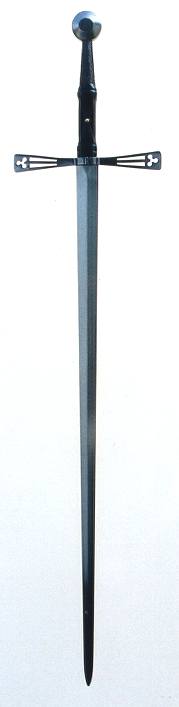
Well, this has been one of my favorite topics of research. Oakeshott relied on a 16th century French source that described it as neither a long nor a short sword, but in between, and this was also the definition given by a 1611 dictionary as well as by the fencing master Joseph Swetnam in his 1617 treatise (though, we should remember these swords were no longer really in use by that time). One early 16th century judicial account even noted they had short and thick blades. I once believed it referred more to those 16th century swords with specialized compound hilts and half-handles. But, as I was once able to discuss with Oakeshott, I discovered an English will from the year 1418 that specifically gave a description based not on length at all but on blade shape, that being a tapering and acutely pointed one (as opposed to the more common parallel-edged sword with rounder point). This makes sense in that the bastard sword was a newer design (generally thicker and stiffer useable by either one or two-hands) that appears suddenly in the 14th century in response to heavier armors. The name also has equivalents in other languages for this same type of unique blade shape. The word “bastard” interestingly itself once also referred to things out of the ordinary or of unusual shape or size—thus, differing from more traditional sword shapes. In my opinion a bastard-sword, like a longsword or short sword, can be of various lengths and widths and that it was the shape overall which defined it. Even this definition of a bastard-sword as being a blade for one or two hands is itself vague since it says nothing about blade shape, and we must wonder just how fighting men distinguished between their various swords types by name, since both tapering and non-tapering styles ranged in lengths and all were in wide use during the same period. As more and more swords became slender and tapering, I think the term eventually fell out of common use (also, as the later Victorians likely did not like saying the word “bastard” they apparently started to call them “hand and a half” swords, hence that term). One thing is clear though, those swords called by this term, or by “espee’ bastarde,” “spadone,” or “espadon,” all appear to be tapering blades.
All this and more will be in my book on Renaissance swords sometime in late 2006.
JC
Do NOT send me private messages via Forum messenger. I NEVER read them. To contact me please use direct email instead.