As my own study concentrates on bastard (or hand-and-a-half) sword I can not address greatsword specifically, however for your edification, here are two illustrations from Fiore (Getty MS) and Vadi on swords specifically designed for armored combat in plate armor (Oh, this posting has been edited).
http://www.getty.edu/art/collections/im ... 352401.jpg
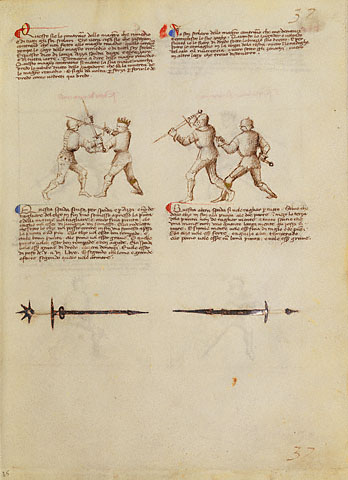
(sword and text at bottom of page, Fol 35R)
Text, first sword on left;
"This sword is used against sword and axe, and has no edge from the hilt ending one span, behind the point, and forward of that wants to cut and so has a fine point and the edge wants to be one span long. And the small round shield (small wheel) that is below/beneath the hilt should run one span, behind the point, and not more. And the hilt wants to be well tempered and have good points and the pommel wants to be heavy, and these points wants to be well tempered and sharp. And the sword wants to be heavier at the back than forward and wants to be 5 to 7 pounds in weight. And accordingly the man is large and strong; accordingly he wants to be armored."
Note 1; in Medieval times, one pound was generally only 12 ounces (increased to 16 ounces for merchant's goods), so today the weight described would actually be about 3.3 to 4.6 lbs.
Text, second sword on right;
"This other sword here wants to cut fully, except that from the hilt to the point are two parts, the middle third from the point does not cut, is smoother that one hand with one large glove (gauntlet) can enter (fit into). And similarly it wants to be fine of edge and point. And the hilt wants to be strong and sharp pointed and well tempered and the pommel wants to have a good point and wants to be heavy."
http://www.thearma.org/Manuals/VadiNewI ... d-jv3B.jpg
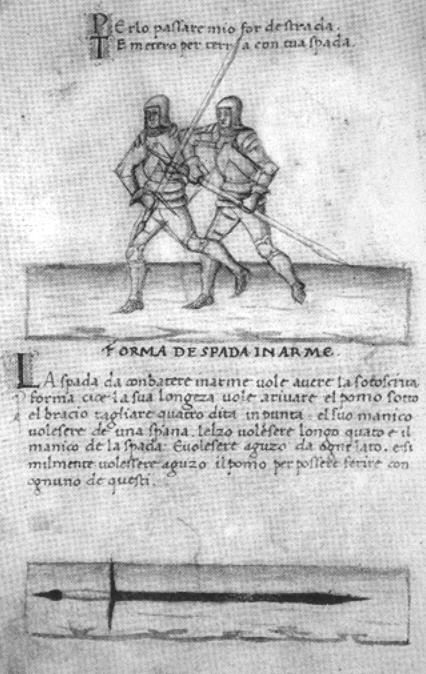
(see sword and text at bottom of page)
Text: "The sword for fighting in armor needs to have the form written below; its length should arrive underneath the arm, cutting four fingers to the point, its handle should be of one span. The hilt is as long as the handle of the sword, and should be acute (stabbing) on both ends, and similarly should be acute (stabbing) at the pommel, to give injury with any of these."
Note 2; "Fingers" are measured as approximately 3/4 of an inch. Therefore four fingers comes to only 3 actual inches. Seem s a bit short to me, but that's what the text says. Some folks translate each "finger" as a full inch, but I found no evidence to support that. I think Fiore's measurement of one "span" (about 8.5 to 9 inches) makes more sense to me for both thrusting and cutting with the point. It is possible Vadi only needs the very tip sharpened for thrusting and does not intend to cut.
Note 3; Translations are my own.
Cheers,
Ken