Armored Greatsword

For Historical European Fighting Arts, Weaponry, & Armor

Moderators: Webmaster, Stacy Clifford

User avatar
CalebChow
Posts: 237
Joined: Sun Oct 14, 2007 1:31 pm
Location: Philadelphia, Pennsylvania

Armored Greatsword

Postby CalebChow » Thu Jan 03, 2008 4:17 pm

Is there any fundamental difference between longsword and greatsword armored fighting?

Judging by the design of many greatswords I was under the impression that the greatsword has a bit more focus on thrusting instead of wrestling, but I don't really know--hence my question.

Thanks again!

LafayetteCCurtis
Posts: 421
Joined: Sat Nov 04, 2006 7:00 pm

Postby LafayetteCCurtis » Fri Jan 04, 2008 8:22 am

Hmm...well, greatswords primarily had their time during the age of mail, so I suspect their armored techniques involved a great deal more cutting blows that could still crush bone beneath the flexible mail even when the sword fails to cut through it (which was probably most of the time). But of course thrusts would also have had an important role. Grappling might not have received as much emphasis as in later techniques but it probably had an important role as well. The potential presence of a shield might have made quite a difference, or it might not--I don't know yet for sure, although there are probably others out there who have done more practical extrapolation work than I have and can therefore give better answers.

User avatar
CalebChow
Posts: 237
Joined: Sun Oct 14, 2007 1:31 pm
Location: Philadelphia, Pennsylvania

Postby CalebChow » Mon Jan 07, 2008 3:17 pm

I see--thanks for the response!

I've seen a couple greatsword videos by John Clements, and they look rather difficult to actually wrestle with. In addition to my initial question, has anyone here had any experience with that?

Michael Navas
Posts: 33
Joined: Mon Apr 30, 2007 8:50 pm

Postby Michael Navas » Thu Jan 10, 2008 11:02 am

Greatsword users would bang their edges at mail armour for the purpose of breaking bones within? I'm guessing the armour would be more sturdy than the blade, making that a rather damaging affair in the long run.

Surely this wasn't a very oft used technique?

User avatar
JeremyDillon
Posts: 122
Joined: Sun May 14, 2006 6:40 pm
Location: Cape Girardeau, MO

Postby JeremyDillon » Fri Jan 11, 2008 3:16 am

Michael Navas wrote:Greatsword users would bang their edges at mail armour for the purpose of breaking bones within? I'm guessing the armour would be more sturdy than the blade, making that a rather damaging affair in the long run.

Surely this wasn't a very oft used technique?


I think you may be underestimating the strength of a well made sword edge. If you look in the video section here, you'll find several videos in which fully sharpened weapons are "banged" against mail, resulting in damage to neither the blade nor the armor.

Michael Navas
Posts: 33
Joined: Mon Apr 30, 2007 8:50 pm

Postby Michael Navas » Sun Jan 13, 2008 7:07 pm

So what you are basically saying is that the next time I see a medieval movie where they hack away at each others plate armour, I should recognize the martial accuracy of the movie?

Sorry, but its just that after having unlearned a lot of popular myths, I return to find that a lot of them weren't so far off after all.

User avatar
Brent Lambell
Posts: 107
Joined: Thu Feb 15, 2007 3:02 pm
Location: Portland, OR

Postby Brent Lambell » Sun Jan 13, 2008 9:01 pm

I have read (which book I cannot recall) that there is no documented occurrence of a sword cutting through plate armor. If someone has heard otherwise, please let me know, Im only mostly sure on this one. As Mr Dillon noted, there are several videos on the ARMA website that show what happens when sword and armor meet at high speeds.

One of my favorites is Hank Reinhardt with a one handed blade hitting a large hunk of pork meat protected with riveted mail and quilted cloth to represent a gambeson. It was a solid strike, yet the mail remained mostly intact. But there was still very massive trauma to the flesh underneath. When I think of what that might do to an arm or leg let alone the torso, it made it clear that swords were awfully effective against mail even if they did not slice through it.

User avatar
JeremyDillon
Posts: 122
Joined: Sun May 14, 2006 6:40 pm
Location: Cape Girardeau, MO

Postby JeremyDillon » Sun Jan 13, 2008 11:30 pm

Michael Navas wrote:So what you are basically saying is that the next time I see a medieval movie where they hack away at each others plate armour, I should recognize the martial accuracy of the movie?

Sorry, but its just that after having unlearned a lot of popular myths, I return to find that a lot of them weren't so far off after all.


Oh no no no, you're absolutely right about that. The difference between breaking through mail and breaking plate is, obviously, quite large. The point of my post (and perhaps I should have emphasized this more) is that there is plenty of evidence to suggest that it's possible for a well made sword edge to impact mail with force without either the mail or the edge being damaged. The meat underneath, though, is another matter entirely.

LafayetteCCurtis
Posts: 421
Joined: Sat Nov 04, 2006 7:00 pm

Postby LafayetteCCurtis » Fri Jan 18, 2008 9:24 am

Although, of course, swinging at each other's helmets can be an acceptable method in the confusion of a massed battlefield, since a good whack on the head may still inflict severe concussion on the target even though it's extremely unlikely to cut through the plate at all. ;)

User avatar
CalebChow
Posts: 237
Joined: Sun Oct 14, 2007 1:31 pm
Location: Philadelphia, Pennsylvania

Postby CalebChow » Wed Feb 06, 2008 6:14 pm

Looking at some of the examples here,
http://www.thearma.org/essays/2HGS.html
It would look like halfsword/armor piercing techniques would have used the unsharpened section between the quillions and flukes (as seen in the pictures toward the bottom), but can anyone confirm if this was meant for armored combat or not (or both)?

User avatar
Grant Hall
Posts: 144
Joined: Wed Sep 28, 2005 7:11 am
Location: Australia, Victoria

Postby Grant Hall » Thu Feb 07, 2008 7:38 am

Just thought I'd stick my head in and say that it seems Mr. Navas might be getting confused with Mr. Dillon's use of the term Maile.

Just to clarify, Maile is refering to what is more commonly know (today) as "Chainmail".

I no documented source that I am aware of has a sword ever cut through Plate, however I have heard of (though I cannot for the life of me, site where) Sword atleast partially cutting through "Chainmail".

As stated earlier, the force from a sword blow against "Chainmail" even though it won't necesarilly "break thru" can still be devestating. I would suspect that this force is not nearly as great against plate, though you would have to ask someone like Shane, who actually own, and fight in, Plate armor.

Thanks for your time, I hope this helps in some way.

God Bless!
<<<<<<<<<<]==0
Grant Hall - Scholar
--ARMA Australia--
0==[>>>>>>>>>>

“The Nation that makes a great distinction
between its scholars and its warriors
will have its thinking done by cowards
and its fighting done by fools"
– Thucydides 5th c. BC

User avatar
Ken Dietiker
Posts: 98
Joined: Wed Jul 19, 2006 1:01 pm
Location: Tacoma, WA, USA

Postby Ken Dietiker » Thu Feb 07, 2008 9:24 am

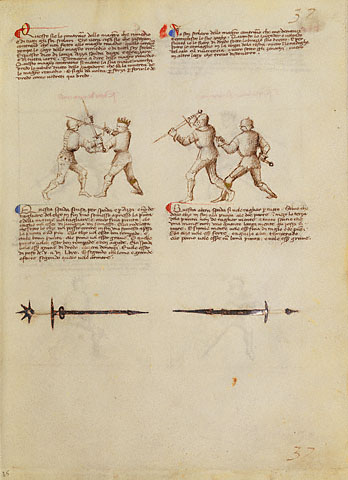
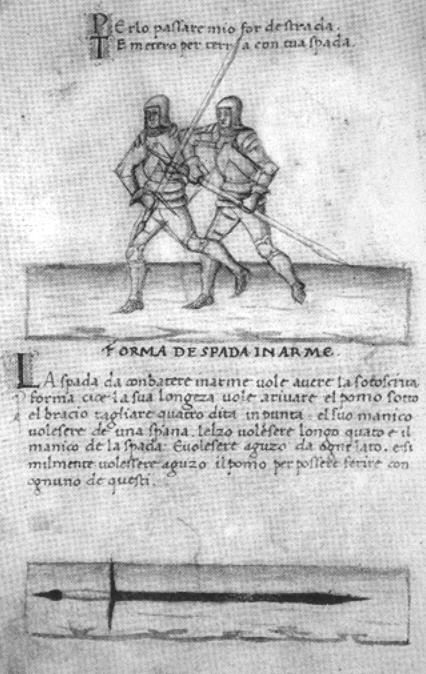
As my own study concentrates on bastard (or hand-and-a-half) sword I can not address greatsword specifically, however for your edification, here are two illustrations from Fiore (Getty MS) and Vadi on swords specifically designed for armored combat in plate armor (Oh, this posting has been edited).

http://www.getty.edu/art/collections/im ... 352401.jpg
(sword and text at bottom of page, Fol 35R)

Text, first sword on left;
"This sword is used against sword and axe, and has no edge from the hilt ending one span, behind the point, and forward of that wants to cut and so has a fine point and the edge wants to be one span long. And the small round shield (small wheel) that is below/beneath the hilt should run one span, behind the point, and not more. And the hilt wants to be well tempered and have good points and the pommel wants to be heavy, and these points wants to be well tempered and sharp. And the sword wants to be heavier at the back than forward and wants to be 5 to 7 pounds in weight. And accordingly the man is large and strong; accordingly he wants to be armored."

Note 1; in Medieval times, one pound was generally only 12 ounces (increased to 16 ounces for merchant's goods), so today the weight described would actually be about 3.3 to 4.6 lbs.

Text, second sword on right;
"This other sword here wants to cut fully, except that from the hilt to the point are two parts, the middle third from the point does not cut, is smoother that one hand with one large glove (gauntlet) can enter (fit into). And similarly it wants to be fine of edge and point. And the hilt wants to be strong and sharp pointed and well tempered and the pommel wants to have a good point and wants to be heavy."

http://www.thearma.org/Manuals/VadiNewI ... d-jv3B.jpg
(see sword and text at bottom of page)

Text: "The sword for fighting in armor needs to have the form written below; its length should arrive underneath the arm, cutting four fingers to the point, its handle should be of one span. The hilt is as long as the handle of the sword, and should be acute (stabbing) on both ends, and similarly should be acute (stabbing) at the pommel, to give injury with any of these."

Note 2; "Fingers" are measured as approximately 3/4 of an inch. Therefore four fingers comes to only 3 actual inches. Seem s a bit short to me, but that's what the text says. Some folks translate each "finger" as a full inch, but I found no evidence to support that. I think Fiore's measurement of one "span" (about 8.5 to 9 inches) makes more sense to me for both thrusting and cutting with the point. It is possible Vadi only needs the very tip sharpened for thrusting and does not intend to cut.

Note 3; Translations are my own.

Cheers,
Ken
Ken

-----
"They are ill discoverers that think there is no land,
when they can see nothing but the sea". ~Francis Bacon

Zach Palfreyman
Posts: 47
Joined: Wed Apr 06, 2005 11:37 am
Location: Springville, UT

Re: Armored Greatsword

Postby Zach Palfreyman » Fri Feb 29, 2008 4:49 pm

CalebChow wrote:Is there any fundamental difference between longsword and greatsword armored fighting?

Judging by the design of many greatswords I was under the impression that the greatsword has a bit more focus on thrusting instead of wrestling, but I don't really know--hence my question.

Thanks again!


Greatsword is more for cutting, a two-handed sword with extra thrust would be the bastard sword. Greatsword can thrust, but I think is not particuarly designed for it, and against chain, you are probably better off using a cut. With luck, you will tear open the links (that is why good chain is riveted instead of butted, less prone to tear). If on foot, you could also use a dagger, or a mace or lance on horseback. Obviously his armor will protect him somewhat, that is kind of the point.

Against plate, then you could try cutting at the crook of his elbow, wrist, back of the knee, armpit, or face. Or try a thrust to his face, crotch, or palm of the hand. If all goes your way, you could go to the halfsword and disarm the gentleman, toss him on the ground. Then pull out your rondel as you get on top of him, pull up his faceplate (if he's got one) and force him to surrender. Then randsom him back to his family. You'd still probably be better off with the bastard sword though, using halfsword.


Return to “Research and Training Discussion”

Who is online

Users browsing this forum: No registered users and 30 guests


Note: ARMA - The Association for Renaissance Martial Arts and the ARMA logo are federally registered trademarks, copyright 2001. All rights reserved. No use of the ARMA name or emblem is permitted without authorization. Reproduction of material from this site without written permission of the authors is strictly prohibited. HACA and The Historical Armed Combat Association copyright 1999 by John Clements. All rights reserved. Contents of this site 1999 by ARMA.