What can a crossguard tell you about a sword's use?

For Historical European Fighting Arts, Weaponry, & Armor

Moderators: Webmaster, Stacy Clifford

Andy Lee Chaisiri
Posts: 9
Joined: Tue Mar 26, 2013 4:32 am

What can a crossguard tell you about a sword's use?

Postby Andy Lee Chaisiri » Tue Apr 16, 2013 6:05 am

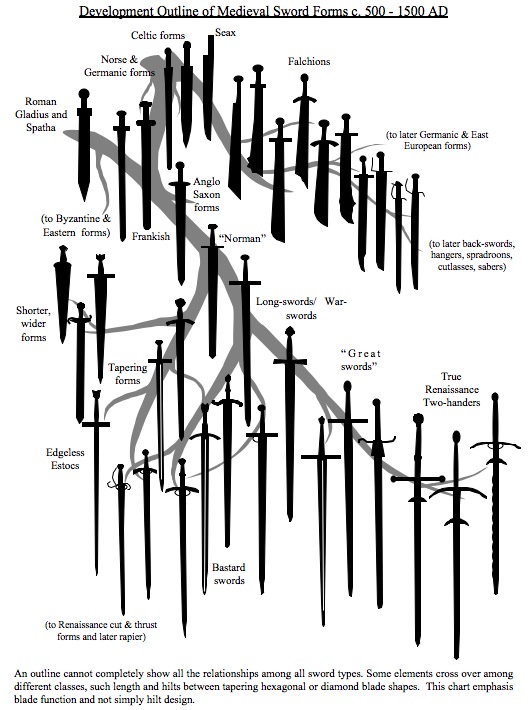
From what I can tell, Roman and Viking swords had quite a small crossguard, while swords associated with knights had that long cruciform shape that we are very familiar with.

Image

and then you have swords with loops extending to the side, or a cross guard bending downward, or straight up becoming a shell that covers your fist.


In China and Japan, cross guards for round and also extended out to the side:
Image

...but cross guards for Chinese straight swords (jian) do not extend to the side:
Image

Why wouldn't a jian have the same circular cross guard as the curved blades they were contemporary to?

Can their purpose be inferred just by looking at them? How exactly where they used in their time? Was it to stop a blade sliding down to cut your hand or did such actions actually never happen (or did they only happen in certain eras but not others?)

I've seen lots of murderstroke pictures with longswords that have extended crossguards, so where the crossguards longer BECAUSE they were a striking weapon, or was striking with them just a bonus?

User avatar
James Brazas
Posts: 229
Joined: Mon Jul 25, 2011 2:29 pm
Location: Virginia Beach, VA

Postby James Brazas » Tue Apr 16, 2013 9:23 am

I think this is a case of "form follows function" or as Master Dobringer said "No part of the sword was invented in vain."

For knightly blades such as the arming sword, longsword and later Renaissance designs like the side sword and rapier, long cross guards existed because they were an integral part of the fencing style.

The long cross guards were useful for off-setting your opponent's thrusts and/or trapping your opponent's blade between your blade and your cross-guard. This was called "binding" (though, technically, a "bind" is any time your blades are touching each other). Once the blades are in a bind, you can manipulate your opponents blade or maneuver your blade around your opponent's blade. This is called "winding."

You could off-set their point and counterthrust, you could push their blade off to the side and go in for close combat, you could push their blade aside and go for a cut, you could maneuver your blade around theirs to go for an attack to an unexpected opening, you could trap their blade and immediately go in to grappling, etc. All this time, your blade and its crossguard would protect your openings. When their blade is caught in your cross, you have severely limited the number of techniques they use since your blade and cross are blocking their movement in at least two directions.

At this point, both parties (if skilled swordsmen) will often each try to out maneuver the other with various winding and counter-winding techniques until one of them either disengages and backs off or is able to out-maneuver his opponent and get his strike in.

Yes, cross-guards were certainly used as offensive weapons - both in close-combat ("krieg" and especially "ringen an schwert" distance) and in the mordhau/murder stroke. Honestly, I don't know whether they were made long to help with that or whether that was just an added bonus. I've noticed that longswords used in the half-sword are used in a very similar way to pollaxes. So it's possible that any techniques devised for one weapon would be applied to the other. In this scenario, the cross would be used like the hammerhead, axe-head, spike or hook. It would be used both to strike with and to hook or bind/wind with.

To the best of my knowledge, we don't have any surviving Roman or Viking fencing manuals. So we don't know for sure how they used their small crossguards. Since form follows function, I'm guessing that binding and winding didn't play anywhere near as much of a role in their fencing than it did in the swordplay of their medieval and renaissance descendents.

As far as the Chinese jian/gim/straight sword, I've been given some very limited training with that weapon. It's a cool weapon and is used in a very elegant fencing style vaguely like the sidesword/cut-and-thrust sword (or, presumably, how one would use an arming sword alone), but at the same time very different. From my limited experience, they use their cross guard to protect the hands (in case their opponent's blade slides down theirs) and they have some binding and winding, but their styles don't really emphasize the bind in the same way. They still have binding and winding, but it's different, relies less on the crossguard and isn't as central to their art - whereas the bind is the "jewel of the art" in Medieval/Renaissance Europe. They have many of the same cuts, thrusts, guards, counter-cuts, etc. that we're used to in the West. They even have very similar pommel strikes. Jian are also occasionally used in both hands, making it even more similar since it then functions somewhat like a short longsword. I once saw exactly the same footwork, evasion and counter thrusts used in a jian sparring match and a sidesword/cut-and-thrust sword sparring match. This makes sense due to the fact that "function also follows form." (Perhaps most telling is that on the battlefield, the jian was often used to thrust into the joints and gaps of Chinese armor. Of course, the gaps in Chinese armor are much larger than in European full plate armor, which may explain why half-swording never developed in Imperial China.) When the jian is so similar in basic shape and design to an arming sword or short bastard sword, we can expect many similarities in sword style. But there are major differences. They don't really do as much binding and winding, preferring to focus more on "avoid and evade" tactics. They don't do halfswording, though some styles will use a "reverse grip" on occasion.
Last edited by James Brazas on Tue Apr 16, 2013 10:15 am, edited 3 times in total.

User avatar
James Brazas
Posts: 229
Joined: Mon Jul 25, 2011 2:29 pm
Location: Virginia Beach, VA

Postby James Brazas » Tue Apr 16, 2013 9:57 am

http://www.chinahistoryforum.com/index. ... se-armour/

Over the millenia, the Chinese have used Brigandine, lamellar, maille, coat of plates, etc.. But never full plate armor.

As you can see, even the most protective Chinese armors still left the face, hands, armpits, lower legs, and the bends of the elbows completely unprotected. Most armors left even more uncovered. Some were made of maille or other materials a good thrusting sword could pierce. So a skilled swordsman with a jian could thrust into the gaps without the need for Western style half-swording. A good comparison is the use of the European side-sword/cut-and-thust sword against the partial plate of 17th Century Europe.

The lack of steel plate armor and the presence of large gaps might also explain why the dao (chinese saber/curved cutting sword) remained very popular. In fact, the dao was much more popular for all but the very rich. The Jian was very expensive, took much more time to learn, and was best at thrusting into the gaps of the armor that other rich lords would be using.

But I think I'm getting off topic.

My points are the following:

Long cross guards were used as a key part of medieval/renaissance European swordmanship. They were used not only to protect the hands, but for off-setting thrusts, kron-binding cuts, binding, winding, striking, and hooking.

The Chinese jian uses its crossguard in much the same way, but nowhere near to the same degree as the Europeans. Chinese swordplay focuses more on evasion and less on the bind. This could possibly explain the shorter cross-guard.

Crossguards are especially good for off-setting thrusts and so are seen on blades well-suited for thrusting. They catch and redirect the thrust well. (My opinion)

Round guards aren't seen much in European weaponry, though it's likely that the nagel guard on a German Grosse Messer and the round guard on a Chinese Dao would be used in roughly the same way. Both are very similar curved, one-handed cutting swords with similar length. The Dao has a round guard whereas the Messer has a short crossguard with an extra nagel guard to cover the back of the hand. Most of the techniques I've seen with both are rather similar.

LafayetteCCurtis
Posts: 421
Joined: Sat Nov 04, 2006 7:00 pm

Postby LafayetteCCurtis » Wed Apr 17, 2013 3:56 am

James Brazas wrote:Round guards aren't seen much in European weaponry,


Not in the Middle Ages or the early Renaissance, perhaps, but the smallsword of the late 17th and 18th centuries relied more on its figure-eight/heart-shaped plates than upon its vestigial cross for protecting the wielder's hands. More to the point, 19th-century classical foils and epées as well as their modern descendants count almost exclusively upon their bell guards for protecting the sword hand as well as the deeper target areas behind it (almost like a miniature buckler permanently affixed to the sword.


Japanese swordplay styles aren't shy about exploiting the hand protection afforded by the tsuba in executing offensive techniques, especially in suriage and kiriotoshi actions where the two blades essentially slide past each other flat-to-flat. These are somewhat analogous to the binding-and-winding actions that longsword students (whether of the Liechtenauer or of the "Fiore" branches) would be familiar with, although the mechanics aren't exactly the same. My point here is that the idea of deliberately using the guard at the base of the blade to protect the hand (and the rest of the body) during offensive actions is as well understood in the East as in the West, although medieval and Renaissance European swordsmanship naturally seems to put a great deal more emphasis upon it.


In short, no, I don't think it is possible to figure out the exact manner of a sword's intended usage from the shape of its guard, since the same shape of guard can be shared by several very different sword types and swordsmanship systems while at the same time two swordplay styles with very similar fundamental principles can rely on two very different shapes of guards, sometimes with no obvious reasons apart from fashion or tradition. The one exception I've noticed is that parries and blocks tend to be squarer (i.e. the receiving sword needs to form an angle of close to ninety degrees with the attacking/incoming sword) when the swords have no guards at all because having the attacking sword sliding down towards the hilt of the defending blade becomes an undesirable even in these circumstances (as opposed to blades with guards, where letting the opponent's blade slide towards the forte/stronger half/portion closest to the hilt of the defending blade is usually an advantageous course of action).


The Roman gladius is an interesting case in point here. It does have a guard at the base of the blade, although a rather small one by rather medieval standards, while its short length and relatively light weight tends to inhibit single-time actions that defend and counterattack at the same time. This means relying heavily on the shield to defend not only the body but also the sword hand, and indeed some reenactment groups have gone so far as to posit swordplay systems where the legionary is supposed to crowd up against the enemy with his shield and never let the hilt of his gladius protrude past the shield except for dispatching a dying opponent. Other groups disagree and put forth a case for a more "active" method of swordsmanship. For all we know both viewpoints could be right since we have no evidence that the ancient Roman army swordsmanship system(s) was perfectly and totally uniform throughout the length and breadth of the Empire!

Return to “Research and Training Discussion”

Who is online

Users browsing this forum: No registered users and 33 guests


Note: ARMA - The Association for Renaissance Martial Arts and the ARMA logo are federally registered trademarks, copyright 2001. All rights reserved. No use of the ARMA name or emblem is permitted without authorization. Reproduction of material from this site without written permission of the authors is strictly prohibited. HACA and The Historical Armed Combat Association copyright 1999 by John Clements. All rights reserved. Contents of this site 1999 by ARMA.