James Brazas wrote:Round guards aren't seen much in European weaponry,
Not in the Middle Ages or the early Renaissance, perhaps, but the smallsword of the late 17th and 18th centuries relied more on its figure-eight/heart-shaped plates than upon its vestigial cross for protecting the wielder's hands. More to the point, 19th-century classical foils and epées as well as their modern descendants count almost exclusively upon their bell guards for protecting the sword hand as well as the deeper target areas behind it (almost like a miniature buckler permanently affixed to the sword.
Japanese swordplay styles aren't shy about exploiting the hand protection afforded by the
tsuba in executing offensive techniques, especially in
suriage and
kiriotoshi actions where the two blades essentially slide past each other flat-to-flat. These are somewhat analogous to the binding-and-winding actions that longsword students (whether of the Liechtenauer or of the "Fiore" branches) would be familiar with, although the mechanics aren't exactly the same. My point here is that the idea of deliberately using the guard at the base of the blade to protect the hand (and the rest of the body) during offensive actions is as well understood in the East as in the West, although medieval and Renaissance European swordsmanship naturally seems to put a great deal more emphasis upon it.
In short, no, I don't think it is possible to figure out the exact manner of a sword's intended usage from the shape of its guard, since the same shape of guard can be shared by several very different sword types and swordsmanship systems while at the same time two swordplay styles with very similar fundamental principles can rely on two very different shapes of guards, sometimes with no obvious reasons apart from fashion or tradition. The one exception I've noticed is that parries and blocks tend to be squarer (
i.e. the receiving sword needs to form an angle of close to ninety degrees with the attacking/incoming sword) when the swords have
no guards at all because having the attacking sword sliding down towards the hilt of the defending blade becomes an undesirable even in these circumstances (as opposed to blades with guards, where letting the opponent's blade slide towards the forte/stronger half/portion closest to the hilt of the defending blade is usually an advantageous course of action).
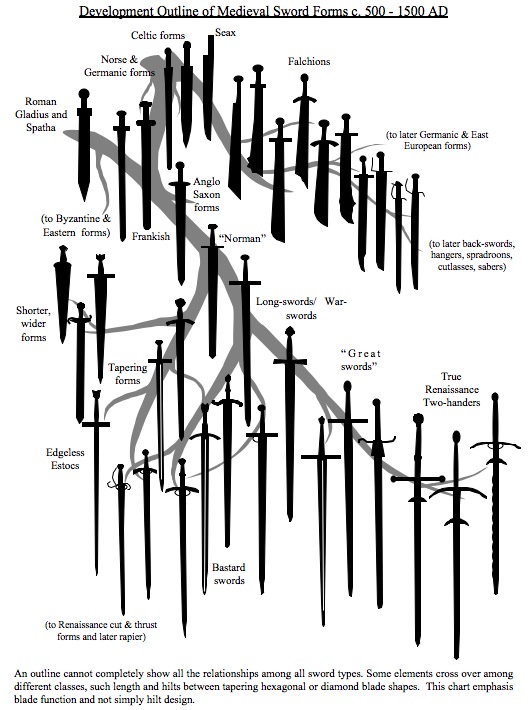
The Roman gladius is an interesting case in point here. It
does have a guard at the base of the blade, although a rather small one by rather medieval standards, while its short length and relatively light weight tends to inhibit single-time actions that defend and counterattack at the same time. This means relying heavily on the shield to defend not only the body but also the sword hand, and indeed some reenactment groups have gone so far as to posit swordplay systems where the legionary is supposed to crowd up against the enemy with his shield and never let the hilt of his gladius protrude past the shield except for dispatching a dying opponent. Other groups disagree and put forth a case for a more "active" method of swordsmanship. For all we know
both viewpoints could be right since we have no evidence that the ancient Roman army swordsmanship system(s) was perfectly and totally uniform throughout the length and breadth of the Empire!