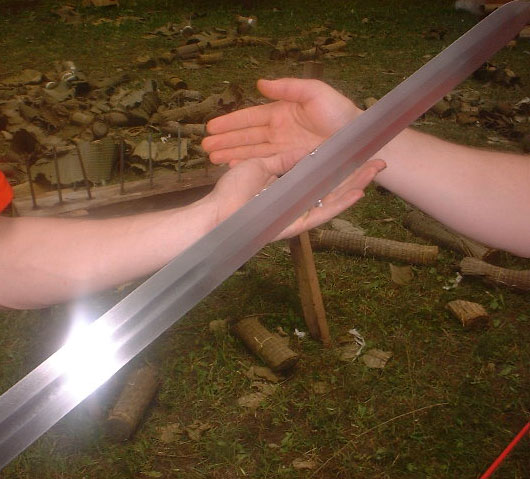
I appreciate the thought behind not making this public, but, I kinda feel that a sword fabricator should be able to discuss failures, as well as successes publicly....
For those unaware, Shane used his personal AT XIIIa test cutting a helmet during the first ARMA International Gathering.
The edge failed.
Of the three cuts Shane performed, the first left the edge undamaged. The second, rolled the edge where the contact was made. The third chipped off the edge where the contact was made. In fact, at the third point, the damage to the edge was such, that part of the edge could be flaked off with a fingernail.
I haven't seen the sword yet, Shane shipped it to me earlier today, it should take maybe a week to cross the continent.
The problem with the edge.... hmm. where to start.......
Well, for that heavy a sword, that is intended to be a 21st century look at a 14th century sword, the edge was way to thin. This sword was designed from the ground up to be a cutting sword, and frankly I didn't take into account that someone might want to smack a helmet on a pole with it.... *g*
Its also about 1.5 years old, one of the first swords I made with the "fine edges" that I've made a name for myself.
Realistically, if I'd have done this right with what I know now, the edge would have started approx .03 inch {.75mm} thick, and I would have ground and polished the edge from there.
The reality of the situation is that the main bevels touched when I was grinding the main bevels. And I very lightly put a secondary bevel on it. This sword's edges were prime for mat cutting, very puir for helmet striking........
This edge is appropriate for a light sword meant for "civil", or unarmored combat. It is not appropriate for an edge where a sword might contact plate armor.....
The main problem with Shane's sword, is that it is too early in my learning curve.
In the last year and a half, some five hundred swords, I've had two other edges fail. Both of the others were light bastard swords, where I feel the edges were appropriate for the intended use, the swords were abused. The edges however rolled, they did not chip out.....
Well frankly, striking a helmet on a pole {please someone correct me if this isn't what was done} could be considered abuse, in this instance. But on the other hand, a XIIIa warsword should be expected to contact some armor, even if accidentally. In otherwords, Shane's sword really shouldn't have had the edge fail the way they did.... but they did. The edges were to thin.
Starting about three months ago I started making "thicker edges" because of the influence of a couple sword smiths. I have since learned to form an edge that will stand up to more abuse, and still cut the way I feel a real sword should cut. That learning curve stuff.
From the verbal discription, I feel I can repair Shane's blade. I won't know for sure however, until I see it.
In the meantime, Shane as graciously volunteered to test a couple of pieces I have here. I have one sword here with edges like I do today, and Shane as graciously agreed to test it on some armor, and let me know how things turn out. He's also going to do some handling and cutting with a couple other swords I'm sending him.......
Gary Grzbek also has volunteered to assist me in improving my art..... so three swords will be headed his way soon also.
Angus Trim
 |
||||||||
|
|
||||||||