Follow up techniques to an elbow smash.

European historical unarmed fighting techniques & methods

Moderators: Webmaster, Stacy Clifford

User avatar
Randall Pleasant
Posts: 872
Joined: Mon Sep 23, 2002 3:35 pm
Location: Flower Mound, Texas, USA

Follow up techniques to an elbow smash.

Postby Randall Pleasant » Thu Sep 14, 2006 6:33 pm

A very good description of Fiore’s elbow smash technique is provided on page 111 in Jay Vail’s book Medieval and Renaissance Dagger Combat. Jay states that when this technique is used one should have a follow up technique in mind. After all, broken arm or not the adversary still has a dagger in his good hand. I am going to provide the follow up techniques that I know and like. But more importantly to me, I would also like to hear what other people have in mind as good follow up techniques. Hopefully, Jay will drop in and share his favorite follow up techniques to an elbow smash.

Because of the position of your hands at the end of the elbow smash I like Twisting Down techniques shown on page 115 of Jay’s book. This technique should be highly effective if the elbow has been previously injured.

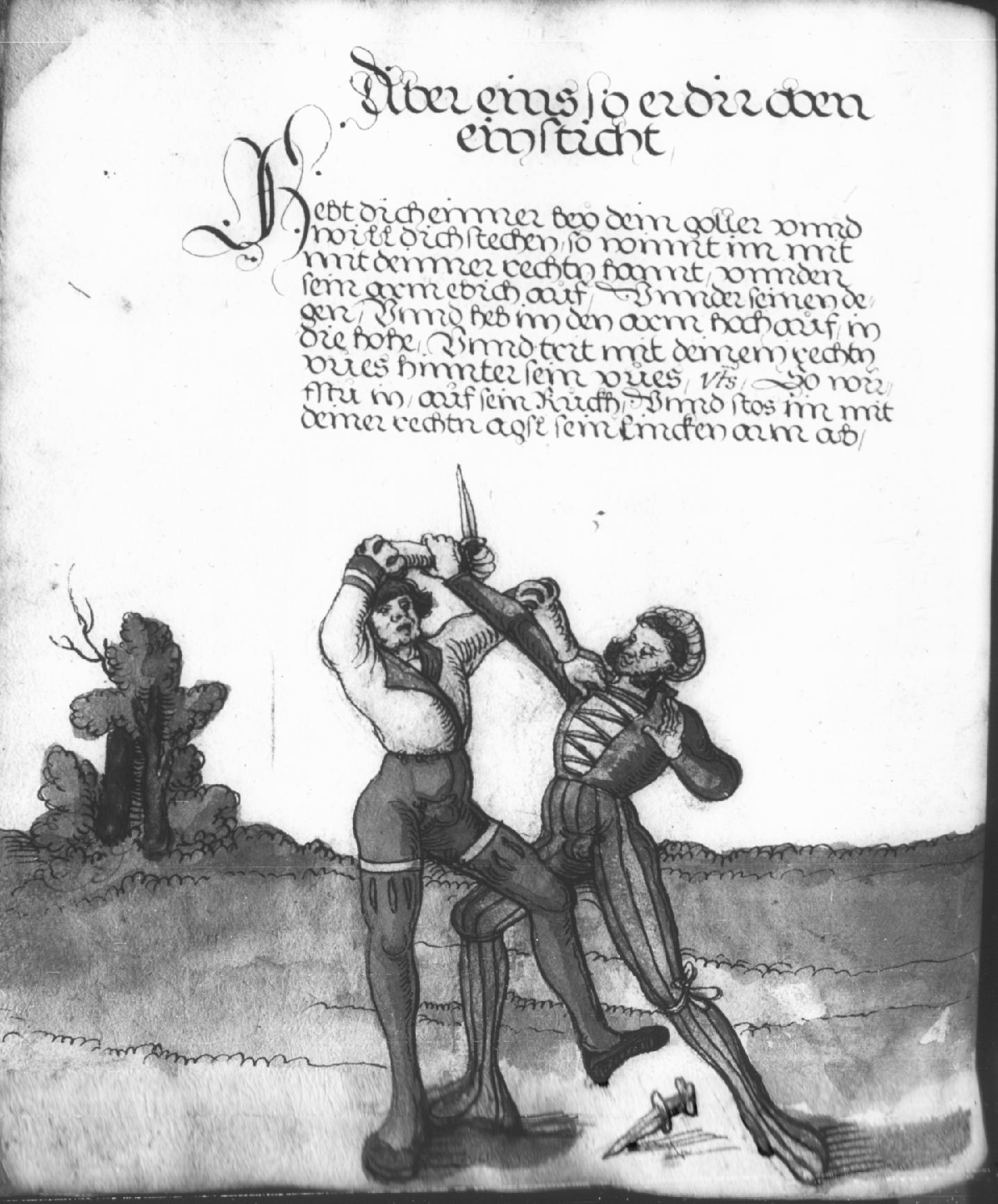
In Plate 187 of Goliath ( http://www.thearma.org/Manuals/Goliath/187.jpg ) the elbow smash technique is described:

Your opponent bore down on you while grabbing your collar. Grab his left wrist with your left hand. With your right arm, drive into his left elbow joint, and push [smash] through toward the ground, and step in with your entire right side as you push. Snatch the hand that's holding the dagger with your right, while still driving down into his elbow.
(Translation by Kirk Siemsen).


Thus, we see that another good follow up to an elbow smash is to reach over the adversary’s left arm and grab his right wrist. Once you have control of the adversary’s right wrist you can perform the Twisting Down technique using your forearm on the adversary's left elbow. With control of the right wrist you can also perform a Stright Arm Bar as descibed on page 86 of Jay’s book. Finally, you can also pushed the adversary's right wrist back over his head in order to make a throw similar to that described in Plate 188 of Goliath ( http://www.thearma.org/Manuals/Goliath/188.jpg ). By the way, Plate 188 of Goliath shows a nice alternative technique to the elbow smash when your body is too low to effectively perform an elbow smash.

The Breaking Loose technique shown on pages 112 & 113 of Jay’s book also looks like it would be an effective follow up to an elbow smash.

I am looking forward to hearing the opinions and wisdom of others but please keep all replies on topic.
Ran Pleasant

Jay Vail
Posts: 558
Joined: Thu Sep 26, 2002 2:35 am

Postby Jay Vail » Fri Sep 22, 2006 10:36 am

Randall, I’m sorry it’s taken so long to respond to your post. I’ve been out of town for the last two weeks and haven’t had the time to respond. Your observations are welcome and insightful. I especially liked your reference to the first Goliath picture. It was interesting to note that the defender is turning counterclockwise as he strikes his attacker’s elbow, a fact notable from the position of the feet. This is how I usually do this technique because it takes me out of range of the attacker’s dagger.

There is no prescribed follow up to the elbow smash in any of the manuals I am familiar with. This leaves us, as interpreters of the manuals, to speculate about what to do next. In my opinion, the follow up varies, depending on the damage that you do to the opponent’s arm. If you succeed in breaking the integrity of the elbow joint, the guy is pretty much out of action. This can occur if his arm is relatively straight when you strike it with your fist. If that happens, you don’t need a follow up. I know personally of instances in real fights where the attacker’s elbow was disabled from a blow not unlike that shown in the book, which for all practical purposes ended the fight.

However, in practice I typically follow of the smash with an arm bar, as depicted on pg. 114, using the defender’s forearm on the attacker’s elbow. You then drive the attacker to the ground and, if necessary, break his elbow while he is in the ground. I do that by placing my knee on the elbow and pulling up sharply on his wrist. Of course, this isn’t the only possible response.

Of note, I talked with a corrections department defensive tactics instructor this week who used a technique similar to that illustrated on pp. 84 and 85 of my book to frustrate an attack by a knifer. The stuff in the manuals really works.

Jason Erickson
Posts: 21
Joined: Mon Oct 09, 2006 5:56 pm
Location: Burnsville, MN, USA

Postby Jason Erickson » Tue Oct 24, 2006 6:38 pm

Note that the plates depict an armed opponent. They are intent upon killing the defender, so it is unrealistic to assume that dis-integrating the elbow joint would necessarily end the fight. If the person is in a high state of arousal, they might notice some difficulty doing things with that arm, but probably won't feel any significant pain or be slowed down. More likely than not, that knife hand will continue to threaten.

The counterclockwise step brings you off the line of attack, brings your far shoulder farther away from the knife hand, and adds to the body mechanics of the elbow smash. The very large circular step shown in the plate indicates an intention to continue drawing their left hand out while applying a forward circular pressure on the elbow. Whether injured or not, this may enable the defender to disrupt the attacker's balance and posture, possibly throwing them. Variations of this type of technique are common in aikido and other martial arts, and just last week I watched a cop use one to apprehend a suspect.

Altering the angle of the defender's body and applying the elbow smash at the proper angle may also dislodge the attacker's grip, opening an opportunity to pull the attacker forward to take their back or initiate a throw or trip.

The primary problem with all of the above is that they leave the knife in the attacker's hand. While you have a chance to do further damage, it is imperative that you establish control over the weapon (or remove it from the situation) ASAP. Knowing this, the original author recommends immediately going for control of the weapon arm following the elbow smash counter.

Depending on body positions and the attacker's functional status, the fight may be over or you may simply be in a better position from which to continue the fight. Judicious use of disarms, takedowns, additional strikes, or your own weapon (if handy) is indicated.
Jason Erickson

Daniel Pope
Posts: 6
Joined: Thu May 12, 2005 12:20 am

Postby Daniel Pope » Thu Oct 26, 2006 4:46 pm

I agree with the point previously made that the defender in this situation is moving around to the outside of the attacker's left arm. Continuation of this movement (which we can see is the clear intent in this diagram, as the defender is depicted midway through a step) would be sufficient to place the defender out of harm's way - it is difficult to attack someone across your own body, no matter what weapon you are using.

I'd also agree that a takedown and disarm is the logical follow-up to this technique, the simplest way being to secure the opponent's left wrist with both hands, and apply a wrist lock, followed by locking down of the elbow & shoulder. This locking action, along with the balance breaking through the circular motion, causes a take-down, at which point the defender is in the advantageous situation, and can finish off/disarm the attacker.

Of course, to pre-plan an actual encounter is foolish - there are at least 3 or 4 other techniques which would equally be applied depending on the individual.

The point here is to practice all techniques diligently so that you can apply them without thought, without trying to fix yourself into a single 'follow up'.

User avatar
JeffGentry
Posts: 1089
Joined: Tue Apr 20, 2004 8:35 am
Location: Columbus Ohio

Postby JeffGentry » Fri Oct 27, 2006 11:48 am

This particular move has so many potential follow up's it is hard to say which is best, I think it is more of a personal preference and how your opponent react's to the initial strike, you could hit a body lock and suplex the guy, go from the elbow to the face with a hammer fist, continue to hold the wrist and go to an outside one on one and and do a few throw's in Meyer, or continue to turn and drop him into a straight arm bar to further damage his arm.

So many choice's

Jeff
Semper Fidelis

Usque ad Finem

Grace, Focus, Fluidity

Jay Vail
Posts: 558
Joined: Thu Sep 26, 2002 2:35 am

Postby Jay Vail » Fri Oct 27, 2006 1:39 pm

Jason Erickson wrote:The primary problem with all of the above is that they leave the knife in the attacker's hand. While you have a chance to do further damage, it is imperative that you establish control over the weapon (or remove it from the situation) ASAP. Knowing this, the original author recommends immediately going for control of the weapon arm following the elbow smash counter.


Plays against the off hand, that is the nonweapon bearing hand, were not unknown to the old masters. Hans Cynner's manual in particular shows them employed against swordsmen. The key to employing such a defense is to take control of the off hand arm and drive the oppponent to the ground, breaking the off hand arm. It does not, as you argue, involve controlling the weapon. If you do the technique correctly, the opponent will not be in a position to strike you and you will have inflicted a debilitating injury. The old manuals do not describe what to do on the ground for the most part, aside from an illustration in Talhoffer, seven pinning techniques in the Gladiatoria, and some verses in Ringeck. However, it appears that the old masters intended you to place your opponent on the ground, break a limb if possible, and then deploy your own dagger to finish the encounter. In an off hand defense, your opponent is on the ground, should have his arm broken, and he should be vulnerable to a counterstab from your dagger -- without the need for you to control his arm. Controlling the weapon arm of course if preferable, but not always possible. The off hand techniques take that problem into account and provide a neat solution to it.

User avatar
JeffGentry
Posts: 1089
Joined: Tue Apr 20, 2004 8:35 am
Location: Columbus Ohio

Postby JeffGentry » Sat Oct 28, 2006 12:43 am

Jay Vail wrote:
Jason Erickson wrote:The primary problem with all of the above is that they leave the knife in the attacker's hand. While you have a chance to do further damage, it is imperative that you establish control over the weapon (or remove it from the situation) ASAP. Knowing this, the original author recommends immediately going for control of the weapon arm following the elbow smash counter.


Plays against the off hand, that is the nonweapon bearing hand, were not unknown to the old masters. Hans Cynner's manual in particular shows them employed against swordsmen. The key to employing such a defense is to take control of the off hand arm and drive the oppponent to the ground, breaking the off hand arm. It does not, as you argue, involve controlling the weapon. If you do the technique correctly, the opponent will not be in a position to strike you and you will have inflicted a debilitating injury. The old manuals do not describe what to do on the ground for the most part, aside from an illustration in Talhoffer, seven pinning techniques in the Gladiatoria, and some verses in Ringeck. However, it appears that the old masters intended you to place your opponent on the ground, break a limb if possible, and then deploy your own dagger to finish the encounter. In an off hand defense, your opponent is on the ground, should have his arm broken, and he should be vulnerable to a counterstab from your dagger -- without the need for you to control his arm. Controlling the weapon arm of course if preferable, but not always possible. The off hand techniques take that problem into account and provide a neat solution to it.


Hey Jay

I think were people have problem's is not in doing the technique correctly it is setting up the tecnique correctly, if it is not set up properly it will not work correctly thus you will be in trouble.

I see this all the time in sparring and it also happen's to me when i am learning or doing new technique's.

The setup is very important, because setting it up properly(attacking) is your defense so if your set up fail's so does your defense.

Non of these technique's are done in a vaccum and when we start moving around at 1/2, 3/4, full speed we need to know how to get into an outside one on one, then run off a failed outside one on one to a rear body lock and takedown or what ever, thing's change drasticly when we get faster and the setup become's even more important and difficult to do because the opponent is also moving faster and one setup can lead to success or a number of counter's.


Jeff
Semper Fidelis


Usque ad Finem


Grace, Focus, Fluidity

Jay Vail
Posts: 558
Joined: Thu Sep 26, 2002 2:35 am

Postby Jay Vail » Sat Oct 28, 2006 1:53 am

JeffGentry wrote:
Jay Vail wrote:
Jason Erickson wrote:The primary problem with all of the above is that they leave the knife in the attacker's hand. While you have a chance to do further damage, it is imperative that you establish control over the weapon (or remove it from the situation) ASAP. Knowing this, the original author recommends immediately going for control of the weapon arm following the elbow smash counter.


Plays against the off hand, that is the nonweapon bearing hand, were not unknown to the old masters. Hans Cynner's manual in particular shows them employed against swordsmen. The key to employing such a defense is to take control of the off hand arm and drive the oppponent to the ground, breaking the off hand arm. It does not, as you argue, involve controlling the weapon. If you do the technique correctly, the opponent will not be in a position to strike you and you will have inflicted a debilitating injury. The old manuals do not describe what to do on the ground for the most part, aside from an illustration in Talhoffer, seven pinning techniques in the Gladiatoria, and some verses in Ringeck. However, it appears that the old masters intended you to place your opponent on the ground, break a limb if possible, and then deploy your own dagger to finish the encounter. In an off hand defense, your opponent is on the ground, should have his arm broken, and he should be vulnerable to a counterstab from your dagger -- without the need for you to control his arm. Controlling the weapon arm of course if preferable, but not always possible. The off hand techniques take that problem into account and provide a neat solution to it.


Hey Jay

I think were people have problem's is not in doing the technique correctly it is setting up the tecnique correctly, if it is not set up properly it will not work correctly thus you will be in trouble.

I see this all the time in sparring and it also happen's to me when i am learning or doing new technique's.

The setup is very important, because setting it up properly(attacking) is your defense so if your set up fail's so does your defense.

Non of these technique's are done in a vaccum and when we start moving around at 1/2, 3/4, full speed we need to know how to get into an outside one on one, then run off a failed outside one on one to a rear body lock and takedown or what ever, thing's change drasticly when we get faster and the setup become's even more important and difficult to do because the opponent is also moving faster and one setup can lead to success or a number of counter's.


Jeff


Jeff, I'm not sure what you mean by set up. Typically, I don't "set up" a technique if by that term you mean maneuvering the opponent into a position where a technique can be applied. Usually, the choice of the technique is dictated by the opponent's position at the moment which reveals a vulnerability.

On the subject of off hand techniques, usually the opponent's off hand side will be presented to you and he will often be reaching toward you with that off hand (as in a grab). Extending that arm gives you an opportunity to apply ordinary wrestling against that arm. Properly applied, locks on the off arm should work so that the opponent does not have a chance to strike you with the weapon as he goes down and kisses the ground. If your off hand techniques are failing, you should consider whether you are applying the techniques properly.

Of course, none of this stuff is easy, and when the other guy has a weapon, it becomes more difficult still, because if the technique fails and you can't apply a follow up, you are in deep trouble.

User avatar
JeffGentry
Posts: 1089
Joined: Tue Apr 20, 2004 8:35 am
Location: Columbus Ohio

Postby JeffGentry » Sat Oct 28, 2006 4:23 am

Jay

By set up I mean to put your opponent in a compromising or dangerous position usually by trickery or deceit, to bring into active operation or use, if a technique is not set up properly it can not come into active operation or use and it will not put you opponent in a compromising or dangerous position, he will not put himself in that position willingly because he is trying to do the same thing to you.

As an example the technique in question the elbow smash.

He grab's your collar with the off hand(his left) in order to control your movement= his setup to stab you

You grab his left hand with your left pull him forward to off balance and turn him and compromise his ability to stab you and defend himself with his left hand= your setup to the elbow smash

If you do not off balance and turn him then the elbow smash will either fail or not be as effective allowing him to counter, that is a setup.

I see people who don't do the small thing's in preparation(setup) to doing a technique all the time and wonder why it doesn't work right or at all.

Another example, when someone put's a body lock on you the first thing to do is get your hip's out and down so it is more difficult for the opponent to lift you, then you use a technique to escape or throw the opponent or whatever you can, dropping the hip's down and out is a set up to many technique's to counter a body lock in unarmed combat.

Jeff
Semper Fidelis


Usque ad Finem


Grace, Focus, Fluidity

Jason Erickson
Posts: 21
Joined: Mon Oct 09, 2006 5:56 pm
Location: Burnsville, MN, USA

Postby Jason Erickson » Sun Oct 29, 2006 6:48 pm

Jeff makes some excellent points. Setting up and executing the movement correctly is critical to avoiding failure and a successful counterattack.

I must add that many of the takedowns available from this position can be countered or escaped. I've rolled out of many variations, sometimes directly back up to my feet, occasionally finding a simple counter-takedown available for the taking. A weapon in hand would have easily come into play, even if the other arm was damaged.
Jason Erickson

Jay Vail
Posts: 558
Joined: Thu Sep 26, 2002 2:35 am

Postby Jay Vail » Sat Nov 04, 2006 3:48 am

JeffGentry wrote:Jay

By set up I mean to put your opponent in a compromising or dangerous position usually by trickery or deceit, to bring into active operation or use, if a technique is not set up properly it can not come into active operation or use and it will not put you opponent in a compromising or dangerous position, he will not put himself in that position willingly because he is trying to do the same thing to you.

As an example the technique in question the elbow smash.

He grab's your collar with the off hand(his left) in order to control your movement= his setup to stab you

You grab his left hand with your left pull him forward to off balance and turn him and compromise his ability to stab you and defend himself with his left hand= your setup to the elbow smash

If you do not off balance and turn him then the elbow smash will either fail or not be as effective allowing him to counter, that is a setup.

I see people who don't do the small thing's in preparation(setup) to doing a technique all the time and wonder why it doesn't work right or at all.

Another example, when someone put's a body lock on you the first thing to do is get your hip's out and down so it is more difficult for the opponent to lift you, then you use a technique to escape or throw the opponent or whatever you can, dropping the hip's down and out is a set up to many technique's to counter a body lock in unarmed combat.

Jeff


We may be talking about different, unrelated conditions. I am referring to actual combat while your comments appear more pertinent to the context of the duel.

In actual combat, you generally do not have the time to “set up” someone. Rather, they set themselves up by the manner in which they commit themselves to a particular movement or attack. Your task in combat is to adapt your response to the enemy’s movement and to exploit the weakness inherent in that movement. Thus, in a real fight, if he grabs you and his arm is bent, there is no point in trying to straighten his arm so you can use the elbow smash. If he is strong, you may not be able to do that, the technique will fail, and if he is armed you will be stabbed. In any event, during the moments you waste trying to straighten his arm, he will feed his knife to your navel. Instead, your response must be one that is effective against a grab where the elbow is bent. One such response would be “wiping away,” which is good against any collar grab.

This consideration leads to a simple principle: if the arm is bent, attack the bent arm. If the arm is straight, attack the straight arm. This means that if the arm is bent, don’t bother to straighten it. If the arm is straight, don’t bother to bend it. (Although like any principle, there are exceptions which are noted in some of the manuals.)

The same is true of throwing in combat. In judo, Kano was known to say that the judoka should use his opponent’s momentum against him. Such momentum, however, usually only manifests itself in a committed attack, and does not usually occur by itself in randori or dueling. However, the committed attack is the hallmark of the street attack. So, you do not do off balancing as a set up per se on the street because your opponent has already off balanced himself by his movement against you. You adapt to it, exploit it, redirect that movement to the extent necessary, and throw him with the technique that is most effective under the circumstances. The choice of throw will depend on how he attacks, whether he extends an arm, which of his feet is forward, how big he is, and how you are standing at the time he attacks.

In a duel, such as freeplay, however, your opponent is unlikely to make a fully committed movement. Typically, he will be cautious, knowing that you are a danger to him, and he will not want to expose himself to an attack. Therefore, you must set him up by feints, kuzushi (off balancing) and so forth so that you can mount an effective attack.

In fairness, I would add, that do the extent that you are working in a clinch on the street, set ups are useful.

So, generally speaking, there is nothing wrong with “setting up.” But you must keep in mind that combat and dueling present very different dynamics and what is necessary in one sphere may not be necessary in another.

User avatar
JeffGentry
Posts: 1089
Joined: Tue Apr 20, 2004 8:35 am
Location: Columbus Ohio

Postby JeffGentry » Sat Nov 04, 2006 10:30 am

Jay

Well i think your Kano statement bear's out my point about setting it up correctly, It realy doesn't matter whether he set's himself up for your technique or you set it up, the key is to be able to recognize when you are in a position to bring into active operation or use(setup) a certain technique.

When ever you with stand the initial onslaught of an attack, it then become's more of a duel type situation.

Jeff
Semper Fidelis


Usque ad Finem


Grace, Focus, Fluidity

Jay Vail
Posts: 558
Joined: Thu Sep 26, 2002 2:35 am

Postby Jay Vail » Sun Nov 05, 2006 2:28 am

JeffGentry wrote:Jay

W

When ever you with stand the initial onslaught of an attack, it then become's more of a duel type situation.

Jeff


Yeh, I generally I'd agree. That often happens. Mike Cartier told me about his recent street experience at length this last week, and yeh, after the first clash it was a duel like situation.

After thinking about the matter further, I suppose, in the broadest sense, I set people up, as you use the term, in a street confrontation, if you consider kuzushi to be a set up, or bringing a partly extended arm to full extension. Although it does not feel like a deliberate set up to me, but the merging of my technique with the movement of my opponent and the exploitation of a vulnerability. So, okay. You win! :wink:

User avatar
JeffGentry
Posts: 1089
Joined: Tue Apr 20, 2004 8:35 am
Location: Columbus Ohio

Postby JeffGentry » Sun Nov 05, 2006 3:59 pm

Jay Vail wrote:
JeffGentry wrote:Jay

W

When ever you with stand the initial onslaught of an attack, it then become's more of a duel type situation.

Jeff


Yeh, I generally I'd agree. That often happens. Mike Cartier told me about his recent street experience at length this last week, and yeh, after the first clash it was a duel like situation.

After thinking about the matter further, I suppose, in the broadest sense, I set people up, as you use the term, in a street confrontation, if you consider kuzushi to be a set up, or bringing a partly extended arm to full extension. Although it does not feel like a deliberate set up to me, but the merging of my technique with the movement of my opponent and the exploitation of a vulnerability. So, okay. You win! :wink:


Hey Jay

I wasn't trying to win, I just like to see the big picture and think it is important to see the detail's because they can make or break what, when and how we do thing's.

When we do reconstruction work of this type, you like myself have probably discovered that a small turn of the wrist in a technique can get the most out of it and it may not be stated in the manual but upon further review of a drawing or woodcut you see the small twist that was not noticed initialy.

so some time's the minutia is important.


Jeff
Semper Fidelis


Usque ad Finem


Grace, Focus, Fluidity

User avatar
Mike Cartier
Posts: 594
Joined: Mon Sep 23, 2002 12:21 pm
Location: USA Florida

Postby Mike Cartier » Wed Nov 08, 2006 12:44 pm

You forgot the most important lesson from my street experience.
You can't always plan how you will fight.

My intention was purely striking but i was forced to grapple or be grappled. Without any knowledge of grappling i would have been on my back in the parking lot getting pounded.

My mantra has always been strike first and never seek the ground or even to grapple, but a determined grappler can make you fight his fight.
Mike Cartier
Meyer Frei Fechter
www.freifechter.com


Return to “Unarmed Skills Discussion”

Who is online

Users browsing this forum: No registered users and 14 guests


Note: ARMA - The Association for Renaissance Martial Arts and the ARMA logo are federally registered trademarks, copyright 2001. All rights reserved. No use of the ARMA name or emblem is permitted without authorization. Reproduction of material from this site without written permission of the authors is strictly prohibited. HACA and The Historical Armed Combat Association copyright 1999 by John Clements. All rights reserved. Contents of this site 1999 by ARMA.