I thought, that they rather wanted to prove longbow "formidable", just did
not really knew how to do that.

My assumption (based mostly on single number, which could be off) would be,
that they checked what kind of arrow could fly assumed 250 yards of longbow
range. But for longbow this is in the flight-shooting range.
Efficiency of a bow, regarded as simple machine, goes up as a weight of a
projectile goes up, which means that
light arrows are not efficient.
Also, an ability to penetrate (especially in soft tissues) depends more on
momentum of an arrow and much less on it's kinetic energy. Even momentum
does not predict an ability to penetrate very well, because resistance of
tissues increases with the square of velocity, but momentum increases
linearly with velocity.
What I mean is that slow heavy arrow penetrates much better than fast light
arrow.
So if they could pierce anything with flight-shooting projectile it is quite
astonishing. Maybe they lied in this show? - could be.
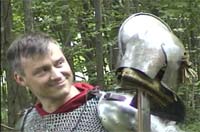
Guys in Czech obviously shot at [censored] breastplate, but they could do
some harm to it with some 60-pounders - laughably small bows as war-bows go.
Next question.
How good armor in the times of longbow really was?
I read some stuff from Osprey, and the author very often regarded armors
pictured in iconography and on sculptures as outdated. It was suspicious to
me. So much outdated armor?
Maybe armor then was not so perfect, after all?
Your experiences may show something, but I'm not sure what exactly. Sharp
lance could pierce a munition breastplate of a pikeman, as far as I know.
Even if it could do not much harm to an armor you have it still proves rather
little, because a horse travels some 5 times slower than even moderately
fast arrow. It would be hard to draw conclusions from such an extremely
distant situations.
Last thing, and I'm done.
I often find, that people tend to think that if they could pierce plate then
an attack of cavalry against archers must be a failure. Maybe, but I do not
think so. Bows are faster than muskets, but after all it comes to some
two/three arrows as opposed to just one salvo of musketry, when it comes to
charging infantry. I see no reason why cavalry charge must break after
couple of arrows shot per one guy. Most arrows will hit horses, and horses
will still run and will still try to stay together, so they will effectively
charge, until they are very dead.
Regards.