Schielhau of Doebringer

For Historical European Fighting Arts, Weaponry, & Armor

Moderators: Webmaster, Stacy Clifford

User avatar
Jeffrey Hull
Posts: 678
Joined: Wed Sep 25, 2002 3:40 pm
Location: USA

Re: Schielhau of Doebringer

Postby Jeffrey Hull » Wed Jun 08, 2005 1:56 pm

DC stated regarding Ringeck's Schieler versus Pflug:

*But [Tobler's] interpretation of that versetzen bothers me. It appears from the photos that his partner is holding pflug with the point aimed too high -- aimed over Tobler's head rather than pointing toward his face. If someone holds pflug in that way, there's no doubt that the versetzen as shown in the book would work fine. But with pflug held with the point lower, I don't see how a high schielhau ending in left ochs is going to successfully take my opponent's point offline, without risking getting changed through on or a double-kill.*

If that be the case, then Tobler's interpretation of Schieler would not be the one to make against an extremely low and well grounded version of Pflug -- such as that of Meyer.

Perhaps versus Einhorn? ;-)

JH
JLH

*Wehrlos ist ehrlos*

User avatar
David Craig
Posts: 81
Joined: Wed May 12, 2004 10:19 am
Location: New Jersey, U.S.

Re: Schielhau of Doebringer

Postby David Craig » Wed Jun 08, 2005 4:50 pm

Jeffrey,

I e-mailed Christian Tobler about his schielhau interpretation and posed the questions that I raised above. I forgot to ask for permission to post his response so I'll just summarize his main points:

1. All evidence from the manuscripts that illustrate schielhau show it ending in ochs.

2. Schielhau creates a threat to the opponent's face. If he goes to change through, you can just extend your arms and thrust.

3. If you are going to end the schielhau in pflug, you might as well strike a zornhau to accomplish the same effect

4. The advantage of ending in ochs is that it gives you the greater leverage of the ochs vs. pflug bind.

5. Timing is critical

6. Your point is a threat to your opponent the entire tempo of the schielhau

Also, he mentioned that the exact position of pflug isn't that important, since the opponent will lower the point a bit to thrust anyway.

David

User avatar
Jake_Norwood
Posts: 913
Joined: Thu Sep 19, 2002 11:46 am
Location: Clarksville, TN

Re: Schielhau of Doebringer

Postby Jake_Norwood » Wed Jun 08, 2005 6:48 pm

I can say that I agree with #1-3. 4 is iffy, but only because I need to lab it. 5 goes largely against my theories on the 5 strikes, but I may be splitting hairs. 6 is true, but at some point it needs to be more than a threat, but a strike. *what* that strike is is a large part of the issue.

Jake
Sen. Free Scholar
ARMA Deputy Director

User avatar
Jeffrey Hull
Posts: 678
Joined: Wed Sep 25, 2002 3:40 pm
Location: USA

Re: Schielhau of Doebringer

Postby Jeffrey Hull » Thu Jun 09, 2005 2:05 pm

David:

Thank you for relating that.

However, none of that information addresses how to effectively interpret the before-time versetzen of Pflug by Schielhau as per Ringeck's Vier Versetzen.

Further clarifying of that specific point is significant, as it is arguably the most important defensive aspect of Schielhau, as well as the most contentious to define for modern practitioners.

Good luck,

JH
JLH


*Wehrlos ist ehrlos*

User avatar
Jake_Norwood
Posts: 913
Joined: Thu Sep 19, 2002 11:46 am
Location: Clarksville, TN

Re: Schielhau of Doebringer

Postby Jake_Norwood » Thu Jun 09, 2005 4:51 pm

!!! Thank you for stating that more elegantly than I could!!!

Jake
Sen. Free Scholar

ARMA Deputy Director

User avatar
David Craig
Posts: 81
Joined: Wed May 12, 2004 10:19 am
Location: New Jersey, U.S.

Re: Schielhau of Doebringer

Postby David Craig » Thu Jun 09, 2005 7:14 pm

In fairness to Christian Tobler, he was responding to the specific points I raised, not giving his entire interpretation of the schielhau. I did give him a link to this thread, so hopefully he might come here and adress that point.

David

User avatar
Jake_Norwood
Posts: 913
Joined: Thu Sep 19, 2002 11:46 am
Location: Clarksville, TN

Re: Schielhau of Doebringer

Postby Jake_Norwood » Thu Jun 09, 2005 9:14 pm

Jeff's post got me thinking some. What makes a schiller a schiller? Is it the edge, the angle, the placement of the hands? What does it? Why is it a schiller? We've always said "downward with the short edge." While that's probably still true, it's too vague. None of the other cuts seem quite so vague.

A zwerch, as a versetzen or as a simple attack, is still a zwerch. A change in execution based on a strike or a guard is really unnecessary outside of minor indes adjustments. Why should the schiller be different? Do we have any images of the schiller ending in a near pflug position? Or textual references? How grounded in the manuals is that theory? Is it possible that the hands are always high (which is true with all the other cuts), and that only the position of the point changes based on the opponent's attack or guard?

I think so. I think that the hand must be high. I think that it is by lowering the point that the schiller breaks pflug, forcing a bind which is resistant to the durchwechseln, and which threatens the chest. I think that when a schiller is executed from the bind, with the hands relatively high, it is easy to strike the head or the right shoulder--and doing so against a cutting/binding opponent allows one to push the opponent's weapon to the right, removing the threat of the point in a way that striking to the left shoulder fails to do.

Thoughts? Rebuttals?

Jake
Sen. Free Scholar

ARMA Deputy Director

User avatar
philippewillaume
Posts: 336
Joined: Wed Apr 21, 2004 6:51 am
Location: UK, windsor
Contact:

Re: Schielhau of Doebringer

Postby philippewillaume » Fri Jun 10, 2005 2:39 am

Hello jack my take on that is what makes the shiller

This is the final position, so I agree with you with the bind bit. (I think that the bind bit can be as short as the blade contact when we strike) but I really believe that we try to achieve the same thing. I do not know if it is good (we may be both wrong)

I think the most important bit is the aligmenent of the articulation of the arm. This is where the strength of the structure is.

As for as where it ends up hand wise, I think it depends what you opponent is trying to do. In most of case, I have them shoulder high or slightly lower or higher according to what he gives me.
If you opponent is good there is a potential for a dupliren mutieren or changing through. Usually trying to prevent one uofront will give one of the other
I believe you can prevent any of them just by a small movement of your hands and that is what I mean by the final hand position thing
One Ringeck to bring them all In the Land of Windsor where phlip phlop live.

User avatar
John_Clements
Posts: 1167
Joined: Wed Sep 18, 2002 10:43 pm
Location: Atlanta area

Re: Schielhau of Doebringer

Postby John_Clements » Fri Jun 10, 2005 6:41 pm

Hey Jake,

I think you need to ask the question re the schiller: what does it do? what is it's nature? Answer: it strikes, it cuts, it impacts, it injures.

When performed against a living target where you seek to actually to penentrate forcefully, to bite into it, the completed action will differ from one merely going through empty air or deflecting a partner's weapon in the classroom. This consideration answers many questions.

Make sense?

JC
Do NOT send me private messages via Forum messenger. I NEVER read them. To contact me please use direct email instead.

User avatar
John_Clements
Posts: 1167
Joined: Wed Sep 18, 2002 10:43 pm
Location: Atlanta area

Re: Schielhau of Doebringer

Postby John_Clements » Fri Jun 10, 2005 7:07 pm

Comment re those three important guiding considerations mentioned by Jake: yes, these 3 truly must be involved in the evaluation of the instructions for historical fighting techniques: adherence to textual description, adherence to illustrated images, when available, and functionality in test performance. (This idea forms the basis of the ARMA’s interpretation-application approach to study of the source material).

JC
Do NOT send me private messages via Forum messenger. I NEVER read them. To contact me please use direct email instead.

User avatar
Jake_Norwood
Posts: 913
Joined: Thu Sep 19, 2002 11:46 am
Location: Clarksville, TN

Re: Schielhau of Doebringer

Postby Jake_Norwood » Sat Jun 11, 2005 12:56 am

I think you need to ask the question re the schiller: what does it do? what is it's nature? Answer: it strikes, it cuts, it impacts, it injures.


Yes, but not only. The "how" of the "not only" is the issue here.

Jake
Sen. Free Scholar

ARMA Deputy Director

User avatar
David Craig
Posts: 81
Joined: Wed May 12, 2004 10:19 am
Location: New Jersey, U.S.

Re: Schielhau of Doebringer

Postby David Craig » Sat Jun 11, 2005 12:12 pm

I think you need to ask the question re the schiller: what does it do? what is it's nature? Answer: it strikes, it cuts, it impacts, it injures.


But what is it supposed to strike when used as a versetzen vs. pflug? Does it strike your opponent's blade to take his point offline and set up a thrust? Or does it simply strike the man himself?

We went thru this today at ARMA NNJ and I attempted to put Phillipe's interpretation into effect. Here is what we found:

1. Against a static defender who doesn't thrust, it takes you offline, puts your point online and leaves you in an advantageous position.

2. Against an opponent that thrusts at your face/throat it deflects his thrust, leaving you in an ochs vs. pflug bind, with your point online, and his off.

3. But if the opponent lowers his point and thrusts for your stomach, groin or legs, there is no blade contact and a high probability of a double-kill, assuming one person isn't considerably faster than the other. Your blade will strike him in the head/shoulder/arms, but you are likely to take a killing thrust.

4. If the person in pflug steps well offline and thrusts at an angle back at your stomach, another double-kill situation is likely.

Overall, we are still unclear on how this versetzen breaks pflug better than A) a zornhau that slams his blade offline and leaves you in left pflug for a thrust, or B) a krumphau

David

User avatar
Jeffrey Hull
Posts: 678
Joined: Wed Sep 25, 2002 3:40 pm
Location: USA

Re: Schielhau of Doebringer

Postby Jeffrey Hull » Sat Jun 11, 2005 1:14 pm

What if we entertain this idea of the before-time versetzen of Schielhau versus Pflug whereby you end up in Schrank:

Tread right as you swing your blade laterally in such a way that it goes towards foe's right side yet means to strike his crossed arms with the short-edge as blade arcs towards the centerline.

You end up with advantage of crux higher than foe's, and his blade is blocked by your cross from snapping up into your head while his point is already safely past you.

If done well you have smitten his arms, and you are now standing not in Ochs or Pflug but in Schrank.

Outlandish, dumb, useful -- what do you think?

JH
JLH


*Wehrlos ist ehrlos*

User avatar
Bill Welch
Posts: 144
Joined: Fri Jun 04, 2004 8:39 am
Location: Knoxville, TN

Re: Schielhau of Doebringer

Postby Bill Welch » Sat Jun 11, 2005 6:48 pm

Jeffery, doesn't that move seem more like a krump than a Shiel.
Thanks, Bill
You have got to love the violence inherent in the system.
Your mother is a hamster and your father smell of Elderberries.

User avatar
Randall Pleasant
Posts: 872
Joined: Mon Sep 23, 2002 3:35 pm
Location: Flower Mound, Texas, USA

Re: Schielhau of Doebringer

Postby Randall Pleasant » Sat Jun 11, 2005 7:07 pm

Jake

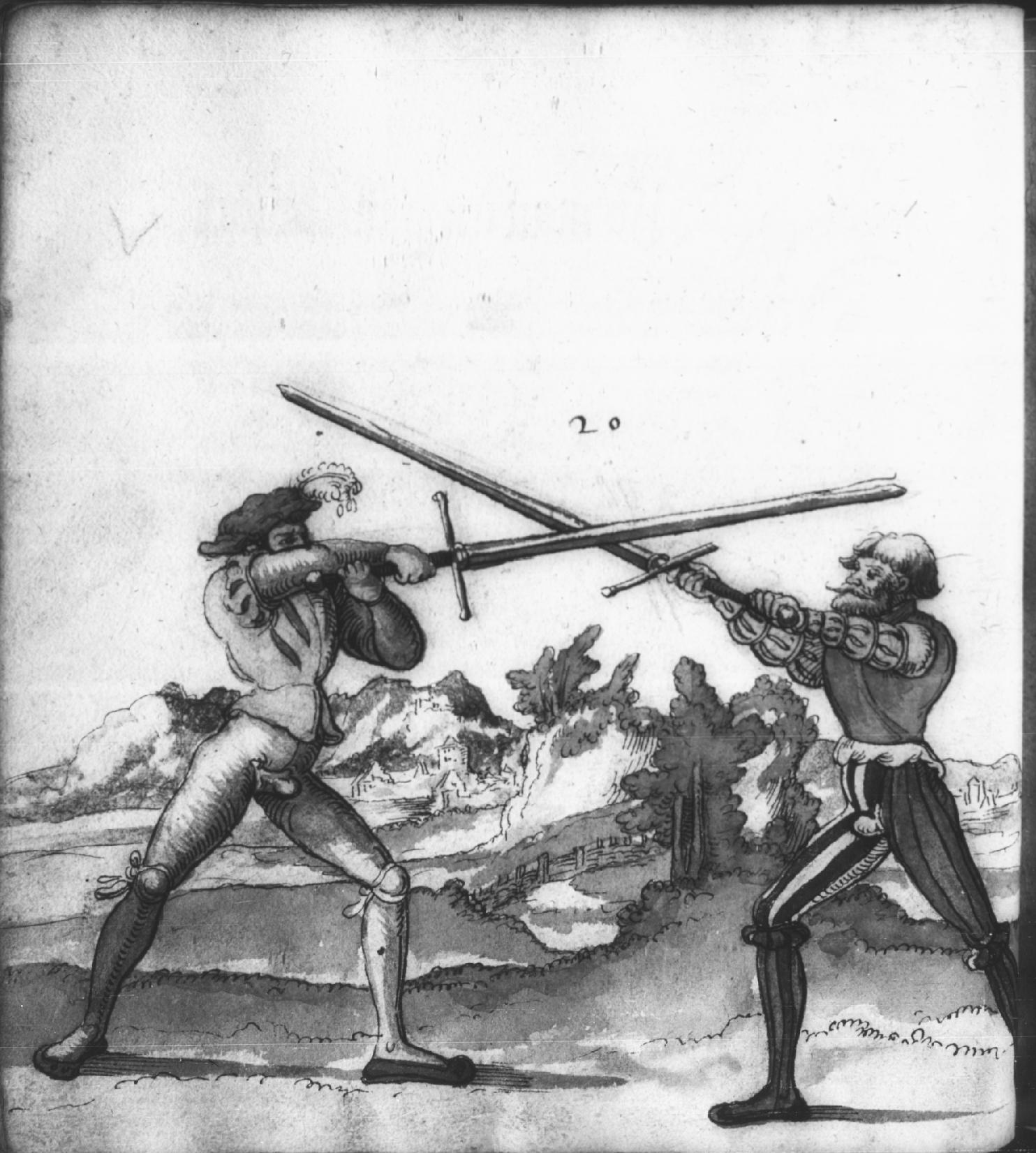
I think the answer is in basic geometry, a hypotenuse is longer than the right angle. Basically it works just like the Schaytler against Alber. In a related thread you asked, "How, given basic geometry, does this out-reach the long point, which is the full extention of a thrust from pflug?" The answer is that in almost all cases a thrust from Pflug <u>does not</u> result in a fully extended long point. A thrust from Pflug usually ends with the hands about chest hight. On the other hand, a Schielhau ends in a fully long point with the hands about face level. Thus, a thrust form Pflug forms a hypotenuse to the Schielhau. If all things are equal (arm length, sword length, etc.) the Schielhau should out reach a thrust from Pflug. Below is a link to one of the Goliath images of the Schielhau. Notice that the Schielhau by the man on the left will end not in Ochs but in a fully extended long point with the hands at face level.

Schielhau in Goliath

Thoughts?
Ran Pleasant


Return to “Research and Training Discussion”

Who is online

Users browsing this forum: No registered users and 36 guests


Note: ARMA - The Association for Renaissance Martial Arts and the ARMA logo are federally registered trademarks, copyright 2001. All rights reserved. No use of the ARMA name or emblem is permitted without authorization. Reproduction of material from this site without written permission of the authors is strictly prohibited. HACA and The Historical Armed Combat Association copyright 1999 by John Clements. All rights reserved. Contents of this site 1999 by ARMA.