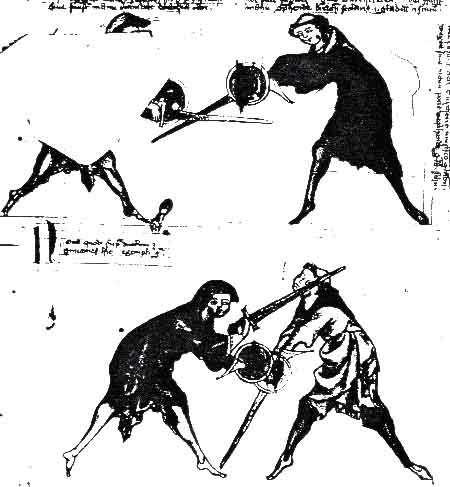
Here are some possible options off of the top of my head from my own experiences fighting a longsword with a sword and buckler.
1st option: pass the forward leg back to void the strike to your leg, quickly step in before your opponent recovers and bind his hands or forearms with your buckler and hit him at the same time.
2nd option: triangle or compass step to the side away from the strike and strike to his forearms or hands at the same time.
3rd option: block his strike to your leg with the ward known in the I.33 as the krucke or crutch, step towards your opponent while wrapping your buckler arm around both of his arms trapping them under your armpit and hit him in the head or stab him. The picture in the lower right hand corner of this picture is of the krucke being preformed by the priest. This ward can be held high or low.
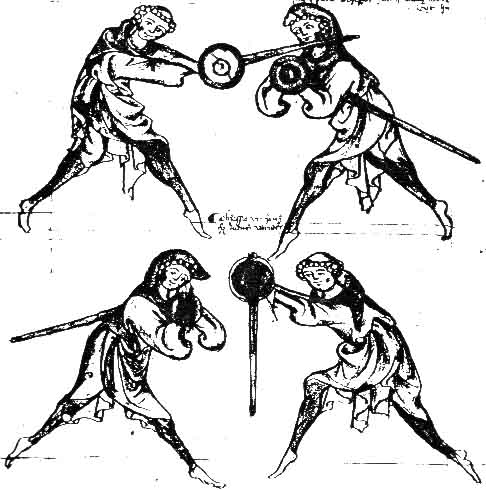
4th option: step inside his strike and drive in to bind his hands or forearms with your buckler and strike him or thrust him to the face or the body.
5th option: strike his strike down onto the earth with an upper strike of your sword, creating an overbind that stops his strike by forcefully driving it into the earth; step towards your opponent and hit him in the face with your buckler and follow it up with a strike or a thrust to his body or his face. (you can also choose to bind his hands or forearms with your buckler and then hit him with a strike or thrust.)
These are just a few responces that one could do to help protect against a leg strike. Several of these are based upon the I.33 technique known as a shield strike and also a thrust strike. One should generally keep your buckler exended out in front of you unless you are in a specific ward, such as 1st ward from the I.33 for a specific reason (ie. you plan to step to left in order to strike down onto your opponents sword while he is standing pflug in order to bind his sword and follow up with a shield strike). Your sword and buckler can track together to give you better leverage in a bind, or they can move more independent as in Talhoffer. Notice that the figures in the I.33 are up on the balls of their feet, and that they are bent forward at an angle from the waist over the lead leg. This allows one to better protect the forward leg from attack than if you are standing straight up at the waist. Remember that the buckler creates a cone like defensive area to hide behind, the closer the buckler is to your body, the less area it defends. Don't be afraid to bind with your sword against a longsword. It is effective and works, especially if you follow up your bind by placing your buckler onto his hands or forearms to further control your opponent and follow it up immediatly with a strike or a thrust. There are two over-binds one on the left and the other on the right. There are two under-binds also on the left and the right. The I.33 states that the overbind is more useful than the underbind.
hope this helps.
Brian Hunt
GFS