Cut and thrust, Short sword lengths

For Historical European Fighting Arts, Weaponry, & Armor

Moderators: Webmaster, Stacy Clifford

User avatar
Brad Patrick
Posts: 12
Joined: Fri Feb 10, 2006 4:08 pm
Location: Columbia, MD

Cut and thrust, Short sword lengths

Postby Brad Patrick » Wed Feb 15, 2006 1:22 pm

Hello,

At the suggestion of Gene (some months ago, admittedly) I'm finally taking advantage of the forums to try to pick up a few things from people more experienced than me. I have a question about the length of the 'cut and thrust sword' and 'short sword', as I'm having trouble finding the average lengths of these two online (I'm finding a lot more variation than I expected to according to several 'sources'), as well as the more commonly seen widths of the crossguards found on these weapons. Knowing this would make it a little easier to find a somewhat appropriate waster. Thanks much.


Brad Patrick
GFS ARMA Houston, TX

User avatar
Brian Hunt
Posts: 969
Joined: Thu Jan 23, 2003 2:03 am
Location: Price, Utah
Contact:

Re: Cut and thrust, Short sword lengths

Postby Brian Hunt » Wed Feb 15, 2006 5:53 pm

Hi Brad,

are we discussing one sword here or two? Are we discussing something that would be used with Marozzo or Agrippa, or something more approriate to Fiores single handed sword or the I.33?

please clariy for my tired brain.

Thanks

Brian Hunt
GFS
Tuus matar hamsterius est, et tuus pater buca sabucorum fundor!

http://www.paulushectormair.com
http://www.emerytelcom.net/users/blhunt/sales.htm

User avatar
Brad Patrick
Posts: 12
Joined: Fri Feb 10, 2006 4:08 pm
Location: Columbia, MD

Re: Cut and thrust, Short sword lengths

Postby Brad Patrick » Wed Feb 15, 2006 10:08 pm

Brian -

Sorry for the confusion, actually I was thinking of I.33 for an example of the 'cut and thrust' sword as I was envisioning it; in Marozzo and especially Agrippa they show what I had thought of as a proto-rapier or sword-rapier (if that is even a real term) although I have gotten the impression that the kind of swords in Marozzo with the slightly wider blade, were considered as 'cut and thrust' by some.

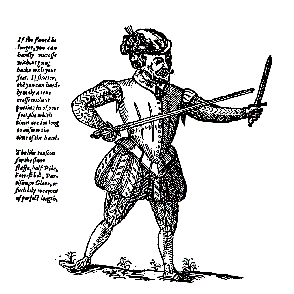
As far as 'short sword' I was thinking of the sword alluded to as such by Swetnam (though with much disdain) and shown in the one picture in the section, which because of the perspective is difficult for me to get an idea of its length (although he refers to people wearing "their short swords about their neckes in a string" so I'm thinking it's quite short and light). However I'm pretty unfamiliar with the 'short sword' so other than my notion that it's a different beast to the 'cut and thrust', I don't know of any other examples of it in a fechtbuch.


Brad Patrick
GFS ARMA Houston, TX

User avatar
Brian Hunt
Posts: 969
Joined: Thu Jan 23, 2003 2:03 am
Location: Price, Utah
Contact:

Re: Cut and thrust, Short sword lengths

Postby Brian Hunt » Thu Feb 16, 2006 8:08 am

Ahhh,

in that case, for the I.33 you want to look at a single handed sword that has a good balance with a blade that is 32 to 36 inches long. I can reccomend the long single handed waster from new stirling arms found at http://www.newstirlingarms.com/woodwasters-onehanded.html

Also, you will need a buckler if you are going to study the I.33. You can make one yourself with 1/2 inch plywood and by purchasing an steel umbo, or you can try and buy one. JC likes leather bucklers, but a good one is hard to find. Stewart Feil and myself (along with a lot of other ARMA members) have been using ABS black plastic bucklers that I make that can be used with paddeds, wasters, and steel blunts. As for steel blunts for the I.33, a good inexpensive one is the Paul Chen Practical knightly sword.

Currently I don't have any advice about the short sword spoken of by Swetnam. He hasn't really been in my area of study when it comes to rapier. I have been concentrating on Capo Fero, Alferi, Mair, Meyer, and Fabris.

Hope this helps.

Brian Hunt.
GFS
Tuus matar hamsterius est, et tuus pater buca sabucorum fundor!


http://www.paulushectormair.com

http://www.emerytelcom.net/users/blhunt/sales.htm

User avatar
Allen Johnson
Posts: 638
Joined: Fri Feb 20, 2004 1:43 am
Location: Columbia, SC

Re: Cut and thrust, Short sword lengths

Postby Allen Johnson » Thu Feb 16, 2006 3:27 pm

As I understand it...
Swetnams 'sword' must not be confused with his 'rapier' or his 'backe sword'. The Swetnam sword would be closer to what we would call a cut and thrust sword. A sword with a slender, tapering blade- not as slender as the rapier but not as wide as the backsword. It would have a fairly simple hilt with a possible handguard or knuckle bow on it. Maybe something like this:
http://www.myarmoury.com/albums/displayimage.php?album=17&pos=6
http://www.myarmoury.com/albums/displayimage.php?album=17&pos=74
http://www.myarmoury.com/albums/displayimage.php?album=17&pos=215
"Why is there a picture of a man with a sword in his head on your desk?" -friends inquiry

User avatar
Jon Pellett
Posts: 125
Joined: Mon Apr 04, 2005 12:15 pm
Location: Calgary, AB

Re: Cut and thrust, Short sword lengths

Postby Jon Pellett » Thu Feb 16, 2006 6:18 pm

According to Silver, a short sword usually has a blade of about 3 feet long, though it can be up to 40", if made for a very tall man. Anything longer than that is a long sword (in the English of Shakespeare's time long sword can mean either a two-hander or a one-hander.) Now that's Silver's preferred length, and may not apply to other authors. But it is worth noting that Queen Elizabeth issued a famous proclamation (several, actually) banning swords with blades longer than "a yard and half a quarter" (40.5"), so it is possible that there was something of a standard length. As for the design of the sword, Silver says that it should be good for both cutting and thrusting, and preferably would have a close (basket) hilt, though he complains that they usually don't. Something like a later Scottish broadsword might be about right, but then a "sidesword" would probably be fine too, as long as it cuts well.

Swetnam was not long after Silver (and in fact he mentions Silver as a supporter of the short sword when he bashes it), so he was quite likely talking about something similar. Swetnam himself says that a sword should be at least four feet long.

Allen, I suspect that it wasn't that important whether it was a backsword or a plain sword. In the English of the time it seems to be conventional to call single sword (i.e. with no off-hand weapon) play "backsword" and play with an off-hand weapon "sword and x". You very rarely see "backsword and x". For example, Silver usually calls his weapon a (short) sword, but then refers to his single sword chapter elsewhere as "the chapter of the backsword." I wouldn't swear to this, but it certainly seems to be a common tendency. I seem to remember reading something similar about messer and sword in German, but I could be mistaken.

Cheers

User avatar
Shane Smith
Posts: 1159
Joined: Thu Sep 19, 2002 2:15 pm
Location: Virginia Beach

Re: Cut and thrust, Short sword lengths

Postby Shane Smith » Fri Feb 17, 2006 5:39 am

Silver explains that the length of the sword is determined by the swords tip flushing up with the dagger when the dagger is held before you and your hilt is held near your right hip with a somewhat bent arm if I'm not mistaken. Granted that does lead to lengths such as mentioned above for most people.

Image
Shane Smith~ARMA Forum Moderator
ARMA~VAB
Free Scholar

User avatar
Allen Johnson
Posts: 638
Joined: Fri Feb 20, 2004 1:43 am
Location: Columbia, SC

Re: Cut and thrust, Short sword lengths

Postby Allen Johnson » Fri Feb 17, 2006 7:12 am

"Allen, I suspect that it wasn't that important whether it was a backsword or a plain sword."

Jon, at first I would agree but its interesting that he seems to adress both names. Look here on our version of Swetnam:
http://www.thearma.org/Manuals/swetnam2.htm
Now scroll down almost to the bottom of the page where you see a chart titled "Now with the Rapier seaven more"
Almost at the bottom of that chart you see "Back-sword against sword". So it would seem here that there is a distinction according to him. I'd agree that generally speaking the backsword would be the basket hilt variety (as well as the defining single edge blade) and the more open hilts as 'swords'.

If this is an incorrect interpretation I'd stand gladly corrected but in this instance there seems to be a distinction between the two.
"Why is there a picture of a man with a sword in his head on your desk?" -friends inquiry

User avatar
Jon Pellett
Posts: 125
Joined: Mon Apr 04, 2005 12:15 pm
Location: Calgary, AB

Re: Cut and thrust, Short sword lengths

Postby Jon Pellett » Fri Feb 17, 2006 11:47 am

Hi Allen

Actually ... what it says is "Backsword against sword and dagger". It's just that the "and dagger" is on the next line. You can see it in the original format here. Now that said, I think you're right, backsword is a different weapon, I just think that the terms were used interchangeably to some degree.

Cheers

User avatar
Allen Johnson
Posts: 638
Joined: Fri Feb 20, 2004 1:43 am
Location: Columbia, SC

Re: Cut and thrust, Short sword lengths

Postby Allen Johnson » Fri Feb 17, 2006 1:36 pm

Could it be possibly that the only real difference between the Swetnam 'sword' and 'backsword' is just the single edge on the backsword. We run into alot of problems categorizing medieval weapons based off hilt design. Perhaps the same caution should be used here. If a sword had an edge and could be used a cutting and thrusting blade it was a 'sword'. If it had a single edge and was capable of being used basically the same way it was a 'backsword'. If it was basically a thrust only weapon with little to no edge, it was a rapier. Reguardless of hilt design... how does that feel to everyone? Though I do know of about 3 or 4 references prior to this manuals printing in 1617 where the term 'broadsword' or 'broad sword' is being used to describe basket hilted weapons. Though all these cases were talking about Scottish Highlanders and Im not sure if the term was used specifically for weapons that they used or if it was also used for similarly made weapons carried by non-Highlanders.
Also worthy of note there are as many baskethilts of backsword design as there are of broadsword (double edged) design. Just to throw another variable in there <img src="/forum/images/icons/smile.gif" alt="" />
"Why is there a picture of a man with a sword in his head on your desk?" -friends inquiry


Return to “Research and Training Discussion”

Who is online

Users browsing this forum: No registered users and 34 guests

cron


Note: ARMA - The Association for Renaissance Martial Arts and the ARMA logo are federally registered trademarks, copyright 2001. All rights reserved. No use of the ARMA name or emblem is permitted without authorization. Reproduction of material from this site without written permission of the authors is strictly prohibited. HACA and The Historical Armed Combat Association copyright 1999 by John Clements. All rights reserved. Contents of this site 1999 by ARMA.