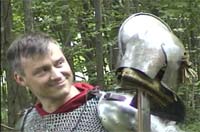
Fighting against the peasants.

For Historical European Fighting Arts, Weaponry, & Armor

Moderators: Webmaster, Stacy Clifford

User avatar
JeanryChandler
Posts: 978
Joined: Sat Dec 28, 2002 1:45 am
Location: New Orleans, aka northern Costa Rica
Contact:

Re: Fighting against the peasants.

Postby JeanryChandler » Wed Feb 22, 2006 1:00 am

Knights were well trained specialists who were often amazingly good at all of the Ars Martialis. However,

...the numbers of times that peasants and /or commoners from the towns and cities defeated knights through the Medieval and into the Renaissance period was actually significant. Why this seems to be ignored in more broadly available history is an interesting question, but specialists (and miniatures wargamers!) are well aware of the fact.

Just some examples.

The early and middle Viking raids, 8th - 10th century- the vast majority of the often militarily successful Vikings were commoners up until the very end of the Viking Age in the 11th century when you started to see more Viking kings and Jarls (Eorls) with their personal retinues. They had little trouble vanquishing Fraknish and Saxon Miles.

The Swiss Confederacy - The Reislauffer- Swiss peasants and burghers, didn't lose a major battle against the Aristocracy (and their knights) from their first major victory in 1315 until at least the 16th century. Their notable victims included both the Austrian Hapsburgs and Charles the Bold of Burgundy.

The Hussite Rebellion- Hussites from Bohemia withstood 6 Crusades in the 15th century and smashed several armies of knights, then went on to rampage unchecked through the Holy Roman Empire. They were only finally defeated by one faction being pitted against the other.

Willliam Wallace - Many if not all of the Scottish victories against the English from the 14th century on out were fought principly by commoners.

There were numerous famous Mercenary groups such as the Gallowglass, the Landsknechts etc. which were principally made up of commoners who did notably well at killing Knights ... and other major victories such as by the Flemish burghers and peasants at Courtrai (aka Golden Spurs) in 1302 IIRC.

Just some food for thought.

Jr

"We can't all be saints"
John Dillinger

User avatar
Andrew Adams
Posts: 6
Joined: Tue Feb 21, 2006 6:57 pm
Location: Springville, UT

Re: Fighting against the peasants.

Postby Andrew Adams » Wed Feb 22, 2006 5:31 pm

I think you may be confusing a “commoner” with a peasant. A commoner, as I will define it, is anyone not of a society’s aristocracy (military or otherwise). A peasant is a person slightly above slave status who is “tied” to the land. Lord’s may come and go but the peasants stay the same. If you are born a peasant you can’t just one day decide to up and leave or change profession. Peasants were not allowed to leave their village’s territory without their lord’s permission. Peasants also had to either ask permission of their lord to marry, pay a tax, or both. A freeman could move pretty much wherever he wanted to and his children could generally change jobs based on the parents purchasing an apprenticeship for them. Typically the only way out is death or extremely hard work (and luck) that one day you can purchase your way out of being a peasant.

Viking society was different than those of the people’s they raided. As in most societies there were three ranks of social class, only the Vikings had it different: slaves, freemen, and the military aristocracy. The town’s blacksmith or the lord’s carpenter were freemen and as in most barbaric societies all freemen were expected to be warriors. You might be a warrior first and a blacksmith second or vice versa but you were a warrior.

The Swiss fore the most part were a free society. Most farmers weren’t peasants but men who owned their own land or in commune within their canton. The Swiss had days set aside for drilling (much as the English did for archery) and these laws tended to be compulsory. You didn’t have to join the militia but if you didn’t you paid a tax or fee to exempt yourself (and pay for a mercenary replacement I suppose). The Swiss were more or less all freemen. As such they could possess weapons. Since many Swiss militias were formed right out of their local administrative units you knew your officers and the quality of man that stood beside you because you trained with them.

I think I mentioned that the Scots (like much of the British Isles) had large Yeomen populations. From a distance a Scotsmen might look and even live much like a peasant but being free they could and did possess weapons. And yet again as in most barbaric societies all freemen are warriors. The Scots loyalty lay to the clan or even power families in the clan not necessarily to a lord. The Scots, just like the Irish and Welsh, fought each other more often then they fought outsiders. Even if you wanted to just be a farmer, you couldn’t because your clan expected you to show up when they decided to raid another clan or to defend your lands when another clan decided to get back at you because you raided them. Often times clan vs. clan warfare was decided upon by clan chieftains and a set time and place (and even number of warriors) chosen so you knew where, when, and who you were fighting both with and against. The threat of constant warfare meant that freemen had to be ready for war. (Why do you think the tradition of the minuteman was so prevalent in Colonial America? Most of the men along the frontier were hardened clansmen from Ireland, Scotland, and Wales all of which had strong martial roots.) I will concede the armies of the Scottish rebellions were largely made up of commoners but not peasants. And they were commoners with a very martial background. And correct me if I’m wrong but England did end up “winning” the Scottish rebellions. (Although it could be contested that eventually the Scots won when James I became king of England. He was Scottish.) The Scottish martial tradition lived for a long time. Clear through the Napoleonic Wars and beyond most of the best British units were Scottish Regiments. During the Colonial Wars here in the Americas the best British units were the Scottish Regiments. Why do you think that was? It was the long held martial traditions the Scotts had (and possibly because the typical Scot is a rather large man). (Even clear back to Roman times, the than Picts, proved to be hard foes. Scotland has always been a very militant society.)

I will admit you have me on the Hussites. Even when you consider their phenomenal “War Wagons” tactic, charismatic leader Jan Zizka, and their individual fanaticism their army was almost entirely made up of Germanic peasants. And their track record speaks for itself.
"Greater love hath no man than this, that a man lay down his life for his friends." (John 15:13)

User avatar
JeanryChandler
Posts: 978
Joined: Sat Dec 28, 2002 1:45 am
Location: New Orleans, aka northern Costa Rica
Contact:

Re: Fighting against the peasants.

Postby JeanryChandler » Wed Feb 22, 2006 8:09 pm

Hi Andrew

I think you may be confusing a “commoner” with a peasant. A commoner, as I will define it, is anyone not of a society’s aristocracy (military or otherwise). A peasant is a person slightly above slave status who is “tied” to the land.


I think our disagreement here is one of semantics. I would call the position you are describing a serf, not a peasant, though the two terms have been used interchangably. My use of the word peasant is based on the way it is used today in Europe, which is generally meaning a small farmer, even a prosperous one with many farms, and other rural commoners involved in trades connected to farming (blacksmiths, even millers). I have relatives in France, Ireland and Switzerland and they all tend to refer to farmers or people from farming families as peasants (some of them in refernce to themselves).

I also think the more general term 'commoner' is more often applied to city and town dwellers by most military historians I have read.

In all these cases however it is important not to generalize too much, we must remember that things varied quite a bit from one corner of Europe to the next, and even from one decade to the next. Which was half of my original point, the other being that the empowered, free, and frankly tough commoner or peasant was somewhat more common than the general history books would have us believe.


Viking society was different than those of the people’s they raided. (snip) The town’s blacksmith or the lord’s carpenter were freemen and as in most barbaric societies all freemen were expected to be warriors. You might be a warrior first and a blacksmith second or vice versa but you were a warrior.


Yes and the same was true for the farmers, farm hands and fishermen who made up the bulk of Norse society at this time.

The Swiss fore the most part were a free society. Most farmers weren’t peasants but men who owned their own land or in commune within their canton. The Swiss had days set aside for drilling


What we are talking about here, with the Vikings, the Swiss, and even the Scots and Irish, are European societies in various degrees of transition from Northern European pagan tribal socities with built-in structures of "warrior democarcy" which you so aptly described, transforming into Romanized / Christianised feudal society which was much more hierarchical and much more polarized in terms of wealth and power.

My point is that the transition was not so neat or so complete or effective. True Feudalism with the peasants pushed down to the status of Serfs and the Lords elevated far above them arguably began to assert itself around the 10th - 11th century, but meanwhile the towns were becomming increasingly independent (and many were on their way to beccoming free cities) and many regions such as the Alpine cantons which became Switzerland managed to fight off traditional Feudalism and re-assert much of their original tribal traditions of free federation and military training for mutual protection.

their individual fanaticism their army was almost entirely made up of Germanic peasants. And their track record speaks for itself.


Excellent overview of the Hussites except, I think many Bohemians would object to being called Germanic <img src="/forum/images/icons/wink.gif" alt="" />

Jr


Edit: Oh and I believe the English married their way to victory over the Scots rather than decisvely defeating them on the battlfeild IIRC...
"We can't all be saints"

John Dillinger

User avatar
s_taillebois
Posts: 426
Joined: Fri Jul 01, 2005 11:29 pm
Location: Colorado

Re: Fighting against the peasants.

Postby s_taillebois » Wed Feb 22, 2006 11:10 pm

Another factor is social conditioning of the period. In the late middle ages, a religious and social convention developed which equated social stability to piety. As long as the nobility kept to its obligations (often fairly trivial stuff like ale rations, or funding festival days), often the resentments leading to open conflict, remained stifled. Additionally, despite the economic gap, the peasants (or yeomanry) had a literally closer personal acquitance with their nobility, than we do with our leaders. And simple events like when Elanor of Aquitaine or Henry 2nd, or Queen Blanche and various French Louis's walked amongst the people passing out bread, tended to reinforce those ties. Or when a noble passed through the square wearing penititent shifts, ie as Godifu once did. Essentially, as long as the climate stayed stable, and other conditions remained stable, the medieval mind was often quite willing to accomodate the status quo.
And actually, in their own right, the nobility (including the Church) feared the yoemanry/peasantry. When peasent revolts did arise, these could be unbelievably violent (and these often arose over fairly simple things-often over what was assumed to be a fuedal obligation, like prices fixed by tontine being raised, at some mill owned by the nobility/church). The local aristocrats, despite the armour and weapons weren't safe from being murdered. Some were...
So when a social movement started (like the Cathars, or such) which might have mobilized the peasants via an appealing and coherent message, the aristocrats often acted very violently and proactively.
But have to remember the lower orders were products of their time, and often as a revolt was building, it wasn't uncommon for them to appeal to the king, or respected churchmen, as a counterbalance to the local lord.
So in some ways, the lower orders, did have some powers the aristocrats did fear...otherwise they wouldn't have made the concessions they did make.
It was in the 1400's, due to plague and new technologies, that the whole system really began to break apart.
Steven Taillebois

User avatar
JeanryChandler
Posts: 978
Joined: Sat Dec 28, 2002 1:45 am
Location: New Orleans, aka northern Costa Rica
Contact:

Re: Fighting against the peasants.

Postby JeanryChandler » Thu Feb 23, 2006 10:07 pm

Mr Tallebois,

As usual your post is accurate and informative, but I think what you are speaking of in terms of the debts and obligations of nobility to peasantry and vice-versa, was really the ideal of how it was supposed to work, and may have in a given time period and in certain areas (parts of France and England for example)

My point however is that contrary to the popular conception, even though there is a great deal of truth to this system you describe, it was I think (and it's certainly arguable) kind of rare in practice that it worked so smoothly. Peasant uprisings were actually fairly common (think of some of the truly massive ones, Jacquerie, German Peasant Uprising, Wat Tyler Rebellion, etc. etc.), barbarian raids equally so (Saracens, Vikings, Magyars, Moors, etc.). Thanks to the random element always inherent in primogeniture, secular Lords and their equivalent in the Church (land holding Bishops etc.) were frequently very erratic in their behavior and willing to ignore any constraints on their behavior regardless of the consequences. Most of the cities and larger towns were either free (with their own governments) or were mroe or less constantly at war with both local would be landlords and foreign invaders. Heresies rose and fell constantly, some stamped out in huge bloodbaths like the Cathars, others apparently unconquerable like the Hussites. Finally, in many parts of Europe, the processes of Romanization, Feudalization, Christianization were in various stages of effective completion. For example think of the various times different parts of Europe were actualy converted to Christianity... this could range from the 2nd century to the 14th! And the tendency you mention of peasants or burghers using the King or Emperor against the local nobility is something which goes back to Julius Ceasar if not earlier, and was often a part of larger conflicts and civil wars which ruptured the land as petty kings tried to convert themsleves into autocratic power brokers.

In short, IMHO Europe was a much more chaotic place than we tend to assume!

Jr
"We can't all be saints"

John Dillinger

User avatar
s_taillebois
Posts: 426
Joined: Fri Jul 01, 2005 11:29 pm
Location: Colorado

Re: Fighting against the peasants.

Postby s_taillebois » Fri Feb 24, 2006 7:53 pm

M. Chandler, quite true about the practical variabilities. The strange thing about their system, is how long it did stay in place. Although as you note, there were substantial revolts, it's strange, given the repressions, that these did not occur more often.
Mayhaps, a few contributory factors beyond those discussed, might have mitigated the stresses (or at least our perceptions of these events). One would be the thousand small revolts which remained local, and accordingly obscure. For example, one clergyman once broke up a local millstone for paving, 'his' villiens pulled up the stones and beat him to death with them. And the malingering, theft and etc-was a type of class resistance which was widespread, albiet not as violent. And, the use of the Jewish populations as a 'target' upon which the lower orders could direct their frustrations. For example, Richard 1st was quite willing not to restore order during a Jewish pogram (which occured close to his coronation)-because it redirected hostility away from the costs of his ransom.
And true, as you note, the scions of the better leaders of the time, could certainly muck it all up. The sons of Henry 2nd and Elanor of Aquitaine being very good examples.
Perhaps that's why this culture was almost obsessive about its admired leaders, or why these leaders were used (even when dead) as symbols. Examples here would be the veneration of Thomas A' Becket's remains (something even Henry had to choke down), or when they hauled the corpse of El Cid, through the streets. And that's where their system was much weaker, than say, the Roman's. They were too closely linked to their perceptions of their leaders, rather than the state itself. So, they would hold to pointless wars, due to that loyalty, even when the leader(s) who formed the idea were long dead. The crusades, or that mess in the 100 years war would be a good example. Even Henry 5th, or Joan Pusselle, who would have been considered competant leaders (by many) were trapped by that tendancy...
Steven Taillebois

User avatar
Jake_Norwood
Posts: 913
Joined: Thu Sep 19, 2002 11:46 am
Location: Clarksville, TN

Re: Fighting against the peasants.

Postby Jake_Norwood » Fri Feb 24, 2006 10:44 pm

The prospect of being killed in war--a reality for me--scares the piss out of me. No lies.

I would fight 100 insurgents armed with RPGs and SK47s before I'd take on one squad of Rangers. Flat out.

Will professionals win everytime? No. But I also know that I've won sparring matches by making mean faces or yelling. I know that a Japanese manual from 1600 (in the appendix of the Thomas Cleary translation of Yagyu Munenori) cites acts of intimidation as the beginning of any fight or technique.

While defining "peasant" can be unecessarily difficult I think that the simple fact that 2-3 percent of the population managed to forcibly govern the other 97-98 percent of the population for centuries proves the point.

Jake
Sen. Free Scholar
ARMA Deputy Director

User avatar
Shane Smith
Posts: 1159
Joined: Thu Sep 19, 2002 2:15 pm
Location: Virginia Beach

Re: Fighting against the peasants.

Postby Shane Smith » Sat Feb 25, 2006 1:17 pm

SK-47...Is that the Iraqi Spelling for the "AK-47"? Just kidding you man.Keep your head down and come home safely! <img src="/forum/images/icons/cool.gif" alt="" />
Shane Smith~ARMA Forum Moderator
ARMA~VAB
Free Scholar

User avatar
TimSheetz
Posts: 412
Joined: Fri Sep 20, 2002 4:55 pm
Location: Madrid, Spain

Re: Fighting against the peasants.

Postby TimSheetz » Sat Feb 25, 2006 2:46 pm

HI Guys,


I am with Jake on his sentiment about insurgents vs Ranger Regiment guys. The level of training is HUGE and makes all the difference.

In fact, I used to use this to scare my logiticians out of their "I'm inthe rear" attitudes by telling them what I used to think when I was Infantry... would I rather fight folks that train to kill every day, or a truck driver? This helped my drivers take training a lot more seriously.

Now it is not difficult to make people interested in training.

Tim
Tim Sheetz
ARMA SFS

User avatar
JeanryChandler
Posts: 978
Joined: Sat Dec 28, 2002 1:45 am
Location: New Orleans, aka northern Costa Rica
Contact:

Re: Fighting against the peasants.

Postby JeanryChandler » Sat Feb 25, 2006 3:13 pm

Hi Jake <img src="/forum/images/icons/smile.gif" alt="" />

The prospect of being killed in war--a reality for me--scares the piss out of me. No lies.


I'm with you right there

I would fight 100 insurgents armed with RPGs and SK47s before I'd take on one squad of Rangers. Flat out.


I remember during Able Archer wargames in 1986, our whole battalion did a MILES (kind of like laser tag) warfare exercise against a company of rangers. They completely wiped us out, our entire battalion (500 people or so?) was casualties or captured vs IIRC 14 ranger casualties. I got killed twice and to my intense aggravation neither time saw the guy who "shot" me or even managed to get a single shot off, of course I was just a medic.

So I agree with you in terms of different levels of training.

On the other hand, would you rather face a squad of rangers right out of Ft Benning who have never been in combat, or 100 hardened Viet Cong militia who have been in the field for three years?

In combat, a lot of our elite forces have gotten slaughtered when faced with experienced enemies, (and sometimes inexperienced ones... just to cite two examples in the not too distant past, are you aware of the tragedies with the Rangers in Grenada or the SEALS in Panama?). It may have been different in the medieval period, but in modern times it certainly seems that training, at least to the degree we have been able to perfect it so far, can only get you so far. Combat experience is much more important... just enough to 'bloody' the troops, not so much to burn them out. Thats why countries like to send their armies to moderate hot spots to get a little experience. Gen. Kesselring said that the NCO's and officers who had combat experience from the Spanish Civil War were more valuable to the Wermacht than ten Panzer Divisions.

And considering the issue of training vs. experience, I can't even count how many times I've been in fights on Decatur St. with guys who obviously knew some kind of EMA, and beaten them hospital-ripe with no formal training at all.

Will professionals win everytime? No. But I also know that I've won sparring matches by making mean faces or yelling. I know that a Japanese manual from 1600 (in the appendix of the Thomas Cleary translation of Yagyu Munenori) cites acts of intimidation as the beginning of any fight or technique.


That is definately true and probably a good subject for a whole thread of it's own.

While defining "peasant" can be unecessarily difficult I think that the simple fact that 2-3 percent of the population managed to forcibly govern the other 97-98 percent of the population for centuries proves the point.

Jake


Yes, but, my point is that 'fact' which is popularly believed in the US is very exxagerated. Consider this question, if you were a bad -ass King or Duke in 14th -16th century Europe, who had the army that scared you the most? Who had the navy that could put fear in your heart?

The answer is hands-down the Swiss Confederacy, and the Venetian Republic, respectively. Neither of whom had a high percentage of knights in their armed forces.

Most people, even those with a fairly considerable knowlege of European history, don't have a clue about this. If you really look at a cross-section of European history throughout this period, while Feudalism was dominant, I would suggest to you that neigher 98% of the time or 98% of the territory is even remotely in the ball park.

Jeanry
"We can't all be saints"

John Dillinger

User avatar
Jake_Norwood
Posts: 913
Joined: Thu Sep 19, 2002 11:46 am
Location: Clarksville, TN

Re: Fighting against the peasants.

Postby Jake_Norwood » Sun Feb 26, 2006 8:51 am

Jeanry,

Good points. A few things, though--the Viet Cong and the Swiss you referred to shared one thing with knights--they were proffessional soldiers--men who spent the bulk of their time engaged in the activities of war. They may not have started as such, but after a few years that's what they were.

This also brings me back to an oft-quoted reference to SFC Larsen (Combatives Guru at Ft. Benning who came to the International event in 2003)--what makes a warrior is the willingness to close with the enemy.

Real fighters have it. "Peasants" (whatever that means) don't. There are men that IRL I would never cross--I know that it would take less will for them to do me harm than for me to return it. Of course this is not really attached to social class directly, but certain classes or castes (Spartans, Knights, Infantrymen, Marines, etc.) work hard to foster this willingness in the culture or sub-culture. What makes them dangerous isn't so much that they know how to hit, but that they will.

Thus your trained EMA (or WMA) fighter is beaten by a scrapper. The latter was a fighter, the former was pretending.

Jake
Sen. Free Scholar

ARMA Deputy Director

User avatar
s_taillebois
Posts: 426
Joined: Fri Jul 01, 2005 11:29 pm
Location: Colorado

Re: Fighting against the peasants.

Postby s_taillebois » Sun Feb 26, 2006 10:47 am

Part of the problem, is the ambiguety inherent in the word 'peasant'. Villiens maybe were somewhat less psychologically able to act effectively.
However, under the right conditions, levee's of commoners were effective in the medieval period. As mentioned the English yeomanry and the Swiss. And Harold Godwinson's army used a sizable levy which were peasants, they did beat Harold Hadrada. No easy task there, and if the discipline had held, they might have beaten back William. It was only when they broke lines, and moved to open ground where William's cavalry could be effective, when it all fell apart for them. Prior to that, they did keep beating back the Norman's.
In a modern sense, it wasn't uncommon for 'peasants', to raise hell with a modern army, provided they had professional soldiers to provide the tactics. They couldn't win in a direct fight, but could raise hell with the enemies logistics. A pre-eminant example would be the Soviet partisans in ww-2...they took appalling casualties, but the did tie up whole divisions. Similar events happened in China, Greece, Yugoslavia and etc.
Another factor, is that places such as rez's and barrios aside, the underclass's in this country do tend to be fairly complaint.
And as a group, not as pyschologically prone to violence as the lower orders in the Renn./Gothic. So we might be underestimating the potential for brutality or effective violence for that class in the Renn./Baroque-or in other countries in our own time. In case of the medieval villeins it was the church as the mitigating factor, now, perhaps it's a lingering belief in the American dream providing the restraint within this country. Outside the US difficult to comment, excepting am very familar with the Mexican situation. Would not want to try to interdict in that country...
M. Norwood, watch out for yourself, and hopefully whatever providence watches over you, will return you from your current travails without harm.
Steven Taillebois

User avatar
Attila DeWaal
Posts: 12
Joined: Thu Dec 15, 2005 11:26 am

Re: Fighting against the peasants.

Postby Attila DeWaal » Sun Feb 26, 2006 10:50 am

This reminds me of a little thing that impressed me greatly a while ago.

There was this computer game, I can't remember the name at the moment, based on real-world modern combat, mostly in reasonably large outdoor settings. The game was very realistic, and I think that's what made it possible.

See, games like thes when player over internet have a large community of generic players. Many just play for fun or are just bad at it. Some try to work themselves at the game and work with others. Often you'd have a single player who's very talented, and would cause a lot of damage going solo.

But then, I met this bunch whom suprised the hell outta me. These guys were a bunch of actual army rangers who were playing the game in their free time. These guys used their tactical combat training and familiarity with teamwork in the game with devastating effect. Every single game I saw them in, they wiped the floor with the opposition. Very impressive.

It shows that even in something as generic as a computergame, training counts for a Lot.

User avatar
JeanryChandler
Posts: 978
Joined: Sat Dec 28, 2002 1:45 am
Location: New Orleans, aka northern Costa Rica
Contact:

Re: Fighting against the peasants.

Postby JeanryChandler » Sun Feb 26, 2006 11:12 am

Good points all

And Harold Godwinson's army used a sizable levy which were peasants, they did beat Harold Hadrada. No easy task there, and if the discipline had held, they might have beaten back William. It was only when they broke lines, and moved to open ground where William's cavalry could be effective, when it all fell apart for them. Prior to that, they did keep beating back the Norman's.


This is an interesting situation. These Saxon / Danish peasants or "churls" (ironically this word a corruption of the old Norse term Karl which used to mean a free warrior) had gone through a wierd process which is exemplary of the whole situation in Europe....

Arriving in the British Isles as pagan Saxon warriors, the lower classes were gradually pushed down into kind of a serf status by the feudal system which the Saxons soon adopted. When the Viking raids started in the 8th cenutury, this proved problematic as the churls turned were incapable of defending themselves. The society in general was vulnerable due to the relatively low number of fighting men and the wide geographic separation of the groups of hardened professional miles (knights). Alfred the Great came upon the solution to try to revive tribal military traditions and retrain Saxon serfs as militia. He also had these Burhs or small castles built where they could rally for defense.

Though this seemed to work well and they were increasingly successful in defense, the Vikings did ultimately invade, but they soon settled into the local population and joined the militias themselves.

So by Hastings, you have a peasant population which has been systematically trained for generations and hardened by combat with Vikings, not to mention leavened with an admixture of Viking farmer-warriors.

In most cases where 'peasant's fight effectively, and there were alot of these cases, you will find that either they were either never really properly "enserfed" by the feudal system, (as with the Vikings or the Swiss), they retained strong tribal traditions which were stronger than feudalism (as with the Scots, Irish, and Welsh) they were trained as militia due to outside threats, (as with these British Saxons, and with peasants in Scandinavia and parts of Spain and Eastern Europe) they were in 'free' zones outside of the direct influence of feudalism (as with the urban dwellers of the free cities such as the Genoese crossbowmen) or they were as you say aided by professionals, as with the Hussites and the many peasant uprisings leading to the wars of the Reformation.

Another factor, is that places such as rez's and barrios aside, the underclass's in this country do tend to be fairly complaint.
And as a group, not as pyschologically prone to violence as the lower orders in the Renn./Gothic.


Ha! You should check out New Orleans! Though admittedly they seem to have been conditioned to mete out most of that violence upon each other...

Jr
"We can't all be saints"

John Dillinger

User avatar
JeanryChandler
Posts: 978
Joined: Sat Dec 28, 2002 1:45 am
Location: New Orleans, aka northern Costa Rica
Contact:

Re: Fighting against the peasants.

Postby JeanryChandler » Sun Feb 26, 2006 11:14 am

Jake, I think I agree with you... see my reply to mr. Tallebois, I think what you are talking about is a fighting spirit, which once lost, is very hard to recover. Peasants may or may not have it, but anyone who has meekly accepted a non fighters status will have a hard time regaining it.

Jr
"We can't all be saints"

John Dillinger


Return to “Research and Training Discussion”

Who is online

Users browsing this forum: No registered users and 7 guests


Note: ARMA - The Association for Renaissance Martial Arts and the ARMA logo are federally registered trademarks, copyright 2001. All rights reserved. No use of the ARMA name or emblem is permitted without authorization. Reproduction of material from this site without written permission of the authors is strictly prohibited. HACA and The Historical Armed Combat Association copyright 1999 by John Clements. All rights reserved. Contents of this site 1999 by ARMA.