Understanding G. Silver

For Historical European Fighting Arts, Weaponry, & Armor

Moderators: Webmaster, Stacy Clifford

User avatar
Lorraine Munoa
Posts: 61
Joined: Sun May 15, 2005 9:11 pm
Location: Solo in SoCal

Understanding G. Silver

Postby Lorraine Munoa » Tue May 29, 2007 10:02 pm

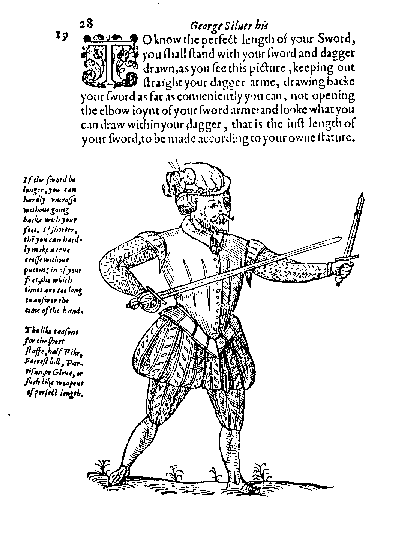
In his Paradoxes of Defence, Silver says, "To know the perfect length of your sword, you shall stand with your sword and dagger drawn, as you see this picture, keeping out straight your dagger arm, drawing back your sword as far as conveniently you can, not opening the elbow joint of your sword arm, and *look what you can draw within your dagger, that is the just length of your sword, to be made according to your own stature."

At about where I have placed an asterisk I suddenly lose any idea of what he means. In that position are we to measure from our sword hand to the point of the off-hand dagger?
:oops:
"In a fair fight, I would have beaten you!"
"Not much incentive for me to fight 'fair' is it?"

LafayetteCCurtis
Posts: 421
Joined: Sat Nov 04, 2006 7:00 pm

Postby LafayetteCCurtis » Tue May 29, 2007 10:52 pm

Well, I'd just go by the illustration placed immediately next to that passage. It shows the man holding his dagger vertically or at an upwards angle, so I guess we're supposed to measure from our sword hand to any point on the off-hand dagger's blade as long as the dagger is held in a roughly vertical position.

http://www.pbm.com/~lindahl/pics/paradox_stance.gif

User avatar
Randall Pleasant
Posts: 872
Joined: Mon Sep 23, 2002 3:35 pm
Location: Flower Mound, Texas, USA

Re: Understanding G. Silver

Postby Randall Pleasant » Wed May 30, 2007 12:13 am

Lorraine

My understanding of the perfect length is that your sword must be short enough so that when you can grab an adversary you can still easily thrust him. If your sword is too long then it will be harder for you to get your point on him. It is that lenght that Silver measures with his dagger.
Ran Pleasant

User avatar
Allen Johnson
Posts: 638
Joined: Fri Feb 20, 2004 1:43 am
Location: Columbia, SC

Postby Allen Johnson » Wed May 30, 2007 6:24 am

Yep! I think that pretty much one aspect of Silver that just about everyone in the WMA community agrees on. Btw... I'm about halfway through Wagner's book on Silver. I'll be posting reviews on both that one and Hands book soon after.
"Why is there a picture of a man with a sword in his head on your desk?" -friends inquiry

User avatar
Benjamin Smith
Posts: 184
Joined: Thu Jun 09, 2005 12:44 pm

Postby Benjamin Smith » Wed May 30, 2007 7:53 am

The idea is to be able to get you dagger in front of your sword when your off side is forward, if you can't your sword is too long. Also I should note that a lot of swords both medieval and renaissance are quite a bit shorter than this, and were perfectly serviceable to their time and place. However, very few specimens exceed the length that Silver advocates "a yard and an inch" or "a yard and 3 or 4 inches for a very large man."
Respectfully,

Ben Smith

LafayetteCCurtis
Posts: 421
Joined: Sat Nov 04, 2006 7:00 pm

Re: Understanding G. Silver

Postby LafayetteCCurtis » Wed May 30, 2007 10:23 pm

Randall Pleasant wrote:My understanding of the perfect length is that your sword must be short enough so that when you can grab an adversary you can still easily thrust him. If your sword is too long then it will be harder for you to get your point on him. It is that lenght that Silver measures with his dagger.


Well, I agree that this is the implicit meaning of the measure. And that's why its' measured with the sword's point touching or crossing a vertical dagger--because in this position the dagger wouldn't artificially increase the length of the off-weapon arm, with the result that it wouldn't give a deceptive measure of your reach.

Most of the time I just take the dagger out of the equation and measure to the crook between the thumb and index finger--with a good thick glove protecting the hand, of course.


Return to “Research and Training Discussion”

Who is online

Users browsing this forum: No registered users and 19 guests


Note: ARMA - The Association for Renaissance Martial Arts and the ARMA logo are federally registered trademarks, copyright 2001. All rights reserved. No use of the ARMA name or emblem is permitted without authorization. Reproduction of material from this site without written permission of the authors is strictly prohibited. HACA and The Historical Armed Combat Association copyright 1999 by John Clements. All rights reserved. Contents of this site 1999 by ARMA.