Could "hacking" swords completely sever limbs?

For Historical European Fighting Arts, Weaponry, & Armor

Moderators: Webmaster, Stacy Clifford

Michael Navas
Posts: 33
Joined: Mon Apr 30, 2007 8:50 pm

Could "hacking" swords completely sever limbs?

Postby Michael Navas » Sun Jul 08, 2007 6:52 pm

I have been asking myself this question lately, for I know this is often portrayed in media, especially in regards to the katana, but I am naturally loathe to take medias word, especially in regards to japanese blades, very seriously.

Seeing as the katana is a draw-cut weapon, it seems unlikely that it would be able to completely sever anything, unless used for that, but what about larger, straight swords? Would a longsword, or perhaps a Doppelschwert be capable of this feat?

I believe they do, based on two things:
1) I remeber a relatively recent video by John Clements where he used a blunted sword to cut through a bamboo pole in an attempt to show how easy it was, so as to convince people to not be so impressed with Asian stylists doing the same with katanas. Going by the assumption that the bamboo poles used for this sort of practice is supposed to realistically replicate the endurance of a human limb, if a blunt sword can cut through one fairly easily, a live sharp one should have no problems with complete dismemberment.
2) I have always been of the assumption that making a cut, but failing to penetrate the opponents body completely, would mean the risk of having your weapon get stuck without nessecarily killing him. And thus he, with his last effort, or his friends, if in a battlefield situation, would kill you before you had a chance to yank the blade free. Thus, making a good and powerful, completely penetrating cut would be the preferred objective, unless using a curved weapon.

Can anyone shed some scientific or historical light on the truth of this matter? And if one could use a "hacking" sword for complete dismemberment, where does the reasonable limit go? Is it possible to sever a hand or arm? A head? A entire torso horizontally? Vertically??!!

Anyone know?

david welch
Posts: 453
Joined: Wed Dec 18, 2002 5:04 am
Location: Knoxville TN

Postby david welch » Sun Jul 08, 2007 7:10 pm

Shoot, yeah they could.


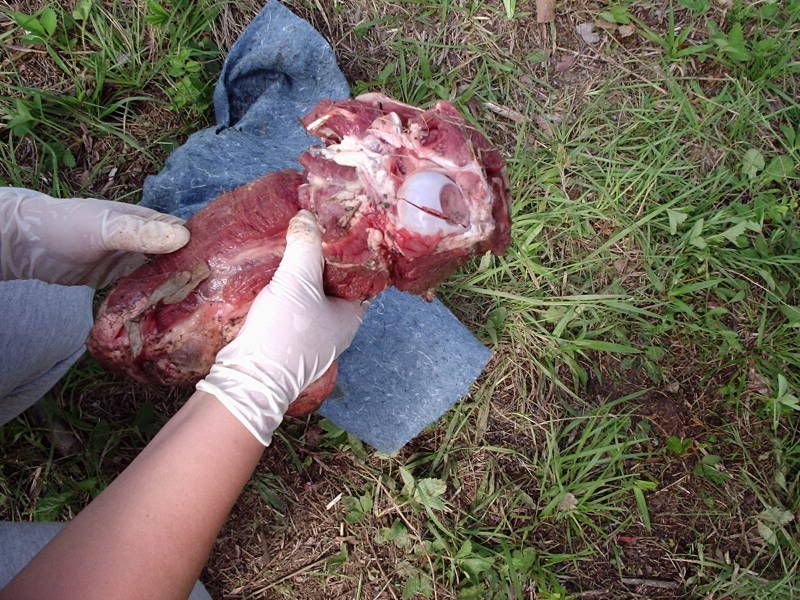
In this one we were doing test cutting on pigs we had cut up to human arm and leg dimensions. We cut this one completely through the ball joint under heavy felt padding and it felt like there was no resistance at all.. A good hit would have no trouble at all taking off an arm or leg. Or head.

Image
"A sword never kills anybody; it is a tool in the killer's hand." Lucius Annaeus Seneca 4BC-65AD.

david welch
Posts: 453
Joined: Wed Dec 18, 2002 5:04 am
Location: Knoxville TN

Postby david welch » Sun Jul 08, 2007 7:13 pm

I just wanted to add: As far as "hands" go, I can snip through wrist sized pig parts with just a bowie knife. you would have no chance against a sword.
"A sword never kills anybody; it is a tool in the killer's hand." Lucius Annaeus Seneca 4BC-65AD.

User avatar
Brian Hunt
Posts: 969
Joined: Thu Jan 23, 2003 2:03 am
Location: Price, Utah
Contact:

Postby Brian Hunt » Sun Jul 08, 2007 7:20 pm

Tuus matar hamsterius est, et tuus pater buca sabucorum fundor!

http://www.paulushectormair.com
http://www.emerytelcom.net/users/blhunt/sales.htm

Michael Navas
Posts: 33
Joined: Mon Apr 30, 2007 8:50 pm

Postby Michael Navas » Mon Jul 09, 2007 12:06 am

Ok, that was pretty convincing. But just to cover the specifics:

1) Could you cleave a man in two from top of the head to groin with a longsword cut reasonable to accomplish in actual combat?

2) Can a draw-cut penetrate completely? And if so, to what extent (arms, legs, torso)?

3) Are my assumptions regarding the risks when cutting a man without penetrating completely correct? Do the historical texts advise complete dismemberment, or is it all apples and oranges?

Thanks a lot.

User avatar
RayMcCullough
Posts: 160
Joined: Tue Sep 26, 2006 9:05 am
Location: Robertsdale, AL

Postby RayMcCullough » Mon Jul 09, 2007 3:01 am

Don't forget that you dont have to cut all the way through someone to kill them. Cutting a small piece of their skull of or cutting half way through their body does just as good as cutting it in half. They are not half dead , just dead. Cutting large limbs to the bone or off are fight enders as well. Their are no Hit point meters in real life.

I don't think the weapon would get stuck often enough or at all to matter. Someone who has experience test cutting could answer that question.

Ray
"The Lord is my strenght and my shield, my heart trusteth in Him and I am helped..." Psalms 28:7

"All fencing is done with the aid of God." Doebringer 1389 A.D.

User avatar
philippewillaume
Posts: 336
Joined: Wed Apr 21, 2004 6:51 am
Location: UK, windsor
Contact:

Postby philippewillaume » Mon Jul 09, 2007 4:32 am

I am not sure that we can talk about cut in absolute like that.

You need to take in account the practicality of such cut and the target given by the manual. (ie each given manual). But bearing in mind that each manual tell us the idea is to kill the opponents and not get killed.

For example Obata sensei (founder of schikenko) cut a big gash in a Japanese helmet (which is half as thick and half as hard as a European equivalent). But it was not a very practical cut (at least unless you are wearing armour yourself) in an actual fight.

So if we take Casper in the video do you need to hit that hard? Well I am not sure that there is a yes or no answer to that.
If your interpretation of the manual is that the movement of moving from guard to guard and the trajectory of the cut will protect you. And that the opponent may be wearing some form of hidden protection.
I would say that it is about the right amount of intensity.


That being said onbe way of seeing ringeck, is to say that we target the head the hands/wrist/forarm, neck shoulder and the belly/groin/ upper leg.
If that is you vision of things you cut will be geared to sever those targets.
So there is really no need to strike as hard as in the clip.

If he wear mail under is doublet that will stop the cut/schnitt and we can thrust (we are protected by the shape of the strike and because we are not so committed we can adapt more easily.
You will find both tendencies japans school personally I believe that both works and both were around.

My understanding on weapon being stuck in the target
Usually comes with heavy cut or heavy chop draw cut that did bot go well or with trust with a light or flat blade, in think as well that they need to not to be stiff blade.

So I would say that getting the blade stuck with a diamond section long sword is not that likely, especially if tend to cut by chopping as opposed a chop-draw

That being said I never go stuck test cutting, but I did not cut large piece of meat very often (in fact I only did it once)
Phil
One Ringeck to bring them all In the Land of Windsor where phlip phlop live.

david welch
Posts: 453
Joined: Wed Dec 18, 2002 5:04 am
Location: Knoxville TN

Postby david welch » Mon Jul 09, 2007 8:07 am

We test cut on meat almost exclusively. I have had swords "hang up" in shoulder blades before, but you would have been able to just jerk it out if it had been a person instead of a pig leg on a rope. I have never had it happen with an leg bone though. Usually the sword either cuts through, knocks a chunk of bone out, or breaks it. It doesn't really "cut into" the round bones in a way that seems likely to get stuck. You might in the pelvis or the head, but I would bet you could just yank those out also.

I'll see if we can get some pig pelvises and heads to cut on and try it out. I have been wanting to cut a pig head with my halberd anyway... it goes through deer heads like butter.
"A sword never kills anybody; it is a tool in the killer's hand." Lucius Annaeus Seneca 4BC-65AD.

LafayetteCCurtis
Posts: 421
Joined: Sat Nov 04, 2006 7:00 pm

Postby LafayetteCCurtis » Mon Jul 09, 2007 11:03 pm

Michael Navas wrote:1) Could you cleave a man in two from top of the head to groin with a longsword cut reasonable to accomplish in actual combat?


I don't think so, and I don't understand why it would ever be necessary. A longsword would probably be able to split an unarmored man's head from scalp to chin (or from temple to temple)--even with one-handed swords, there are some accounts of them splattering an opponent's brain all over the place. Anything more than that would have been overkill.

2) Can a draw-cut penetrate completely? And if so, to what extent (arms, legs, torso)?


A draw-cut alone? probably not. But we need to remember that most cutting actions are a combination of slicing and chopping (or of draw-cutting and push-cutting) actions; the katana can cleanly sever an unarmored limb or neck because it still has some chopping power, though certainly not as much as monster-cutters like the Oakeshott Type XIII.

3) Are my assumptions regarding the risks when cutting a man without penetrating completely correct? Do the historical texts advise complete dismemberment, or is it all apples and oranges?


I don't think so. It's pretty difficult to get your blade stuck in an opponent's body--you have to be cutting into a bone-rich environment like the head, the shoulders, the hips, or the ribcage. And even then modern test-cutters seem to rarely experience their blades getting sufficiently stuck to be a bother.

Just to take a tangential example, look at the thrust. Your blade will get stuck in an opponent's body if your thrust strikes true, right? But this rarely seems to bother the fighters we know of in history, since if it did then I'm sure we would have seen some special mention of such. Withdrawing a blade from a cut that penetrates only partway through is not inherently any more difficult than withdrawing it from a successful thrust.


philippewillaume wrote:For example Obata sensei (founder of schikenko) cut a big gash in a Japanese helmet (which is half as thick and half as hard as a European equivalent). But it was not a very practical cut (at least unless you are wearing armour yourself) in an actual fight.


And the Japanese kabuto-wari experts themselves would have been the first to point out that they couldn't have cut that deep if there had been hair, skin, bone, and brains under the helmet!

Michael Navas
Posts: 33
Joined: Mon Apr 30, 2007 8:50 pm

Postby Michael Navas » Mon Jul 09, 2007 11:14 pm

Thank you for all answers.

User avatar
Scott A. Richardson
Posts: 64
Joined: Tue Jul 10, 2007 11:19 am
Location: Danville, PA

Postby Scott A. Richardson » Wed Jul 11, 2007 4:02 pm

A well sharpened longsword can easily lop off an arm, leg, or head; as for complete dorsal bisection, I have no clue. One can't help but wonder, though, what would happen should an undefended Mittelhau at full speed catch your opponent right at mid-section. Would you have a greivously wounded opponent or two halves of an opponent?
Scott A. Richardson
Company of the Iron Gate
"Strike like Lightning, Fight like Thunder"

LafayetteCCurtis
Posts: 421
Joined: Sat Nov 04, 2006 7:00 pm

Postby LafayetteCCurtis » Wed Jul 11, 2007 10:06 pm

Scott A. Richardson wrote:Would you have a greivously wounded opponent or two halves of an opponent?


The first, almost certainly. The second, not unlikely--at least in my opinion.

User avatar
Stacy Clifford
Posts: 1126
Joined: Fri May 14, 2004 11:51 am
Location: Houston, TX
Contact:

Postby Stacy Clifford » Thu Jul 12, 2007 8:15 pm

Somewhere in John's book Medieval Swordsmanship, I forget where, he cites a 6th century text where a man cleaves his opponent from shoulder to hip and is so surprised by it that he exclaims "In truth, the wretch has no bones!"
0==[>>>>>>>>>>>>>>>>>
Stacy Clifford
Free-Scholar
ARMA Houston, TX

Jay Vail
Posts: 558
Joined: Thu Sep 26, 2002 2:35 am

Re: Could "hacking" swords completely sever limbs?

Postby Jay Vail » Fri Jul 13, 2007 4:13 am

Michael Navas wrote:I have been asking myself this question lately, for I know this is often portrayed in media, especially in regards to the katana, but I am naturally loathe to take medias word, especially in regards to japanese blades, very seriously.

Seeing as the katana is a draw-cut weapon, it seems unlikely that it would be able to completely sever anything, unless used for that, but what about larger, straight swords? Would a longsword, or perhaps a Doppelschwert be capable of this feat?

I believe they do, based on two things:
1) I remeber a relatively recent video by John Clements where he used a blunted sword to cut through a bamboo pole in an attempt to show how easy it was, so as to convince people to not be so impressed with Asian stylists doing the same with katanas. Going by the assumption that the bamboo poles used for this sort of practice is supposed to realistically replicate the endurance of a human limb, if a blunt sword can cut through one fairly easily, a live sharp one should have no problems with complete dismemberment.
2) I have always been of the assumption that making a cut, but failing to penetrate the opponents body completely, would mean the risk of having your weapon get stuck without nessecarily killing him. And thus he, with his last effort, or his friends, if in a battlefield situation, would kill you before you had a chance to yank the blade free. Thus, making a good and powerful, completely penetrating cut would be the preferred objective, unless using a curved weapon.

Can anyone shed some scientific or historical light on the truth of this matter? And if one could use a "hacking" sword for complete dismemberment, where does the reasonable limit go? Is it possible to sever a hand or arm? A head? A entire torso horizontally? Vertically??!!

Anyone know?


There is plenty of historical evidence that ancient swords severed limbs and did extensive damage. Vegetius comments on the need to condition recruits to the gruesomeness of the battlefield, which featured severed limbs all around and lots of blood. Excavations at Visby discovered the hastily buried corpses of battle dead many of whom had legs cut off, usually the left below the knee, the part of the body held most forward and unprotected by the shield.

LafayetteCCurtis
Posts: 421
Joined: Sat Nov 04, 2006 7:00 pm

Postby LafayetteCCurtis » Fri Jul 13, 2007 7:25 am

Ah. That reminds me of Livy's account of the Romans' Macedonian wars, where the Macedonians were horrified at the cutting wounds caused by the Roman swords, with instances of limbs being severed. So, things as short as the gladius already could do a great deal of cutting damage. How much more so with the longer (and, honestly, better balanced) medieval swords?


Return to “Research and Training Discussion”

Who is online

Users browsing this forum: No registered users and 21 guests


Note: ARMA - The Association for Renaissance Martial Arts and the ARMA logo are federally registered trademarks, copyright 2001. All rights reserved. No use of the ARMA name or emblem is permitted without authorization. Reproduction of material from this site without written permission of the authors is strictly prohibited. HACA and The Historical Armed Combat Association copyright 1999 by John Clements. All rights reserved. Contents of this site 1999 by ARMA.