Pell work, Pell videos, Pell talk

For Historical European Fighting Arts, Weaponry, & Armor

Moderators: Webmaster, Stacy Clifford

User avatar
Roy Robinson Stewart
Posts: 105
Joined: Sat Sep 22, 2007 11:48 pm
Contact:

Pell work, Pell videos, Pell talk

Postby Roy Robinson Stewart » Sun Sep 23, 2007 3:30 pm

Hi all,

I notice that very little is said anywhere on the subject of pell work ( yes I have seen the two excellent articles here) which is surprising considering how historically important it was as a training method. . .so i'm hoping for some discussion of pell work and possibly some videos.


:)

User avatar
Will Adamson
Posts: 378
Joined: Thu Dec 29, 2005 11:01 pm
Location: Abingdon, VA

Postby Will Adamson » Sun Sep 23, 2007 5:10 pm

I kind of thought the opposite. Pellwork is discussed in several capacities, not just as a training method in and of itself. You can do anything from cutting exercises to floryshes on it. You can even do tipogressions using the pell as a focal point. If you have a freestanding pell (like my wavemaster bag) you can even do takedowns to some extent.

The only real drawbacks to a pell are that it can't move on it's own and hit you back like a person can, although there are designs out there that come close. (My bag has come back from a pommel strike to hit me in the face! :oops: )
"Do you know how to use that thing?"
"Yes, pointy end goes in the man."
Diego de la Vega and Alejandro Murrieta from The Mask of Zorro.

User avatar
Roy Robinson Stewart
Posts: 105
Joined: Sat Sep 22, 2007 11:48 pm
Contact:

Postby Roy Robinson Stewart » Sun Sep 23, 2007 5:26 pm

Hi Will,

Not sure what you mean by "opposite" I'm just looking for suggestions on pell training possibilities in general as I have just made my first one.

So far I have noticed that my hands are very sore after pell work, something i haven't noticed with flourishes and other drills, I didn't even know I had hand muscles until today ! Presumably I'm having to grip harder during impact, either that or it's the repeated shocks but feels like well worked muscles.

Damage report is one inch and a quarter diameter 50 inch long white oak staff seriously cracked and with a huge chunk out of it, and a broken holly wood staff, which has been shortened and is still in use.

At first hitting seemed to interupt my flow, making me feel totally uncoordinated and limp wristed, but this improved. I notice that strikes can either stop dead or flow through by drawing slightly, have been trying to redouble the stop hit ones and drawing the second one through, is that a good idea?

One surprise was doing a cross strike with the short edge from the right Ochs, this feels really nice when flourishing but is shocking (literally) when hitting the pell. . . it snaps the elbow joint back and can be hard on the wrist too. .. . it feels like the arm geometry is wrong. I'm using a staff so possibly I wasn't turning the staff to present the edge correctly, doing so helped, as did doing a lighter strike and then redoubling witha harder one using the long edge.

Am also using a short stick (35 inches or so) with one hand.

Any comments will be appreciated, I have some video footage which I could post .

cheers
Roy

User avatar
Will Adamson
Posts: 378
Joined: Thu Dec 29, 2005 11:01 pm
Location: Abingdon, VA

Postby Will Adamson » Sun Sep 23, 2007 7:09 pm

Padding your pell (pool noodles, sleeping pads, etc.) will save your wasters a bit. You really need to be working with something that has discernable edges. Sticks are fine when you have nothing else, but there are particulars to how things work that you really need the edge there to see and feel what is going on. The wrong kind of padding can create a bouncy pell though. I have a portable one that is dangerous to put full power into because the waster is likely to fly back at your head! (I make my pells aggresive I guess. :roll: )

Are you stepping with each strike? Pellwork is one of the best ways to get your feet in time with your hands since you have that feedback into your hands that tells you when the strike landed.

If your hands are hurting, you're hitting hard. Congratulations, that shows effort. I'm guessing you are throwing a zwerch that is causing much of the wrist awkwardness. There is a particular way to hold the hands that should be shown in person, or explained by someone other than myself. If you have access to Meyer 1570, it is in there.

BTW, when I said "opposite" I was refering to your statement about there not being much content on the site in regards to pellwork. There is quite a bit about solo exercises, so I turn much of that in to pellwork, thus there turns out to be alot of pellwork content even outside of the articles specific to it. I hope that makes sense.

Caveat: I'm just a novice, but have made (and am still making) most all the rookie mistakes.

"Do you know how to use that thing?"

"Yes, pointy end goes in the man."

Diego de la Vega and Alejandro Murrieta from The Mask of Zorro.

User avatar
Roy Robinson Stewart
Posts: 105
Joined: Sat Sep 22, 2007 11:48 pm
Contact:

Postby Roy Robinson Stewart » Sun Sep 23, 2007 8:12 pm

Hi Will,

The pell is padded with carpet, but yes I'm hitting hard, even though it doesn't look like it. The only edged sword I have right now has a welded tang and i'm leery of it breaking, so sticks it is until I get a good beater or waster.

Regarding stepping, I'm having trouble stepping with each strike for two reasons:
One is that I can strike faster than I can step, so I don't feel like slowing sdown the strikes just to take a step ( I notice in the video of John C at the pell he is only stepping occasionally) not sure if that's ok.
The second is that if I keep stepping I'm going to run straight into the pell, presumably I have to circle it or something like that.

Yes it is the Zwerch i'm talking about, will investigate the grip futher, thanks for the tip.

Cheers
Roy

User avatar
Stacy Clifford
Posts: 1126
Joined: Fri May 14, 2004 11:51 am
Location: Houston, TX
Contact:

Postby Stacy Clifford » Sun Sep 23, 2007 10:07 pm

If your hand muscles are starting to hurt, it may also be that you are gripping the sword too tightly. You need a firm grip, but not a death grip. Solid enough to hang on to the sword when it hits the target hard, but light enough to still allow the hilt to rotate in your hands as needed. However, I do find my hands getting tired if I've been cutting a lot and sweating, making a smooth grip slippery. A sword grip that's too narrow for the size of your hand can make you work harder also.
0==[>>>>>>>>>>>>>>>>>
Stacy Clifford
Free-Scholar
ARMA Houston, TX

User avatar
Roy Robinson Stewart
Posts: 105
Joined: Sat Sep 22, 2007 11:48 pm
Contact:

Postby Roy Robinson Stewart » Sun Sep 23, 2007 10:58 pm

Hi Stacy,

Yes that's a possibility, however I have been swinging sticks ( escrima, jo staffs etc) for many years, at full speed and have had all kinds of aching muscles, but never the extremely aching hand muscles I got from the pell. I''m using an inch and a quarter diameter grip, which is not on the small side at all for my hands.

It must be a tightening upon impact that's happening, no doubt it will increase the grip strength.

It's good fun anyway

:D

User avatar
Jeremiah Backhaus
Posts: 162
Joined: Wed Dec 20, 2006 6:50 am
Location: West Bend, WI

Postby Jeremiah Backhaus » Mon Sep 24, 2007 7:08 am

Stepping is EXTREMELY important in this system. We all start off being able to swing a sword faster than stepping, but that is why we train. Stepping while swinging forces the hips to be used, and also when properly using the Segno you can void at the same time. If you are running into your pell as you step, make sure that you are stepping not in a straight line but a diagonal. What I mean is, if you throw a Zwerch, you should end up 90 degrees from your starting plane. You will find that with less effort on your part (meaning upper body strength) you are throwing just as strong as before, if not stronger. Stepping is not something that should be put to the wayside, it will make you a better fighter.

User avatar
Will Adamson
Posts: 378
Joined: Thu Dec 29, 2005 11:01 pm
Location: Abingdon, VA

Postby Will Adamson » Mon Sep 24, 2007 7:46 am

You can cut while stepping forward, backward, or to the side. Meyer (maybe from Lichtenauer) says that every cut needs a step. Yes, sometimes it might be necessary to cut without stepping, but the habit to get into is to step while cutting. It doesn't even need to be a passing step, even a simple step will get more into your strike than your arms alone can muster.

Pellwork should feel like as much of a leg workout as an arm and shoulder one. After all, you should be fighting with your whole body.
"Do you know how to use that thing?"

"Yes, pointy end goes in the man."

Diego de la Vega and Alejandro Murrieta from The Mask of Zorro.

User avatar
Jaron Bernstein
Posts: 1108
Joined: Sun Dec 07, 2003 12:58 am

Postby Jaron Bernstein » Mon Sep 24, 2007 8:58 am

Will Adamson wrote:You can cut while stepping forward, backward, or to the side. Meyer (maybe from Lichtenauer) says that every cut needs a step. Yes, sometimes it might be necessary to cut without stepping, but the habit to get into is to step while cutting. It doesn't even need to be a passing step, even a simple step will get more into your strike than your arms alone can muster.

Pellwork should feel like as much of a leg workout as an arm and shoulder one. After all, you should be fighting with your whole body.


Meyer says that every cut gets its own step. To which we add Dobringer who says you should always attack at an angle to your opponent (or pell). I would also add Jake's lesson from the IG and earlier Meyer seminar about cutting and the centerline just to add to the fun. :D

User avatar
Brent Lambell
Posts: 107
Joined: Thu Feb 15, 2007 3:02 pm
Location: Portland, OR

Postby Brent Lambell » Mon Sep 24, 2007 11:48 am

Roy Robinson Stewart wrote: Regarding stepping, I'm having trouble stepping with each strike for two reasons:
One is that I can strike faster than I can step, so I don't feel like slowing sdown the strikes just to take a step ( I notice in the video of John C at the pell he is only stepping occasionally) not sure if that's ok.
The second is that if I keep stepping I'm going to run straight into the pell, presumably I have to circle it or something like that.


Mr. Stewart,

First of all, I am glad we are talking about pell work again. To reiterate what others have said, its such a valuable training tool that I know many fencers overlook. Its not easy to make a durable pell all the time, and buying one is not always cost effective - but the money or work is worth it.

I think I have seen some of the videos that you have (of John Clements' pell striking), but I noticed a lot of simple steps in his routines. He's not passing or even traversing on some of them, its like he's stomping more than anything - that might be the simple step Mr. Adamson mentioned. Even that subtle change in footwork allows a much larger array of muscles to be used in a strike.

I do find that I have a hard time with the footwork, like you said, I run out of room with an immobile target. I tend to use a lot of traversing footwork myself (I think Mr. Clements does as well) so I am circling around the target slowly but surely. Between passing back and forth with traverse steps, you can get a good combination of strikes. Plus, keeping the appropriate distance should be difficult, that is one reason why I train with the pell.

User avatar
Roy Robinson Stewart
Posts: 105
Joined: Sat Sep 22, 2007 11:48 pm
Contact:

Postby Roy Robinson Stewart » Mon Sep 24, 2007 2:03 pm

This is the video of John's pell work that I'm watching:

http://www.thearma.org/Videos/AT_1stPellOutdoor_1727.mov

John is certinly using his whole body, and there are more steps in there than seen initially, because the assumption was that I was looking for 'wide passing steps'. . . . if it's ok to do some steps which are more or less rotations, or slight shuffles, hops etc. . . more or less as a consequence of hitting with the whole body then that's great, as they can be done more quickly.

I'm getting leg muscles worked too which is good, also back, abdomen, and of course shoulders and arms. .. . but the hands, they are definitely turning into claws !

Thanks for the feedback.

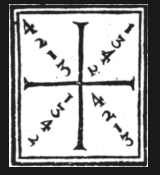
looking through Meyer's work, which is mind boggling, I came across something which seemed nice and simple, namely this:


Image

which is found here: http://www.schielhau.org/Meyer.p28.html

It looks like a nice simple but mixed up way to strike the pell in a pattern, it is easy enough using the long edge, but Meyer seems to talk about using the short edge, I can't seem to make it work using the short edge for the whole exercise, I suppose the idea is to mix it up? He's a little hard to understand, a bit like Chaucer.

:shock:

User avatar
Jaron Bernstein
Posts: 1108
Joined: Sun Dec 07, 2003 12:58 am

Postby Jaron Bernstein » Mon Sep 24, 2007 3:21 pm

It looks like a nice simple but mixed up way to strike the pell in a pattern, it is easy enough using the long edge, but Meyer seems to talk about using the short edge, I can't seem to make it work using the short edge for the whole exercise, I suppose the idea is to mix it up? He's a little hard to understand, a bit like Chaucer.

Ah, the twitching diagram. Try going from long edge to short edge with the diagram on your pell, taking a step each time. As for Meyer being hard to understand.....sometimes, sometimes not. Firstly, Shielhau only has part of one chapter. The entire book is now available and you will find that each chapter references things found in the others. Secondly, really learn the woodcuts in great detail. There is much useful and hidden in them.

User avatar
Will Adamson
Posts: 378
Joined: Thu Dec 29, 2005 11:01 pm
Location: Abingdon, VA

Postby Will Adamson » Mon Sep 24, 2007 6:19 pm

Jaron, I think we've turned him on to Meyer. [diabolical laughter] Jake will be proud. 8)

The one problem with working from the Forgeng translation (and I think this is pretty common when working from pure translations) is that certain terms are better understood in the original language because that is how we discuss them amongst ourselves. For example, the guard of the day being Vom Tag, or a wrath cut being a Zornhau. Krieg is the Onset, right? Personally I much prefer working from translations than interpretations, unless the language is so convoluted that it would take me forever to figure out. Even then, it would have to be someone I trust to know what they are doing.

The supple grip that Stacy mentioned is vital in being able to cut with the short edge. Once you get where you can cut with it, I'm sure you will try to use it as much as possible...even when it's completely uncalled for. It's just that cool!
"Do you know how to use that thing?"

"Yes, pointy end goes in the man."

Diego de la Vega and Alejandro Murrieta from The Mask of Zorro.

Kevin T. Crisalli
Posts: 18
Joined: Sun Aug 26, 2007 10:51 pm
Location: Bellevue, Wa

Postby Kevin T. Crisalli » Tue Sep 25, 2007 12:53 pm

Only moderately related, for the escrima equivalent of pell training, I've seen them use stacks of old car tires before... just a thought....


Return to “Research and Training Discussion”

Who is online

Users browsing this forum: No registered users and 20 guests


Note: ARMA - The Association for Renaissance Martial Arts and the ARMA logo are federally registered trademarks, copyright 2001. All rights reserved. No use of the ARMA name or emblem is permitted without authorization. Reproduction of material from this site without written permission of the authors is strictly prohibited. HACA and The Historical Armed Combat Association copyright 1999 by John Clements. All rights reserved. Contents of this site 1999 by ARMA.