why do you suppose...

For Historical European Fighting Arts, Weaponry, & Armor

Moderators: Webmaster, Stacy Clifford

Francisco Urbano García
Posts: 43
Joined: Sun Nov 30, 2008 9:37 pm

Postby Francisco Urbano García » Sun Jan 11, 2009 6:16 am

LafayetteCCurtis wrote:... the SengokuDaimyo.com website's assertion actually holds water if we remember the contextual fact that it discusses only samurai armor in the sense of the armors worn by the Japanese warrior elite between the 9th and the 17th centuries...


Well, I don't think so, the actual assertion is:

SengokuDaimyo.com wrote:One thing that needs to be addressed first is probably my biggest button: Japanese armour was never made of wood or bamboo. It was either leather, steel, or a combination of the two. Don’t even ask me.

Chris Ouellet
Posts: 83
Joined: Wed Aug 02, 2006 3:38 am

Postby Chris Ouellet » Thu Jan 15, 2009 12:09 am

I think you are correct Francisco. Some very early Japanese armour was indeed made of wood although I've failed to find a source text and no one claims to know of a complete suit, just fragments.
I agree with Max that the purpose of it may not be warfare, it could simply be art, sparring equipment or ceremonial.
However it's possible it was used in war at the time, thinking from a different angle this may not be entirely surprising either since Europeans clearly used wooden shields in war.
Interesting, I'de like to see an example someday out of curiosity.

Francisco Urbano García
Posts: 43
Joined: Sun Nov 30, 2008 9:37 pm

Postby Francisco Urbano García » Thu Jan 15, 2009 1:19 am

Chris Ouellet wrote:I think you are correct Francisco. Some very early Japanese armour was indeed made of wood although I've failed to find a source text and no one claims to know of a complete suit, just fragments...
Interesting, I'de like to see an example someday out of curiosity.


I think this will be difficult; wood, bamboo and similar stuff do not stand well the pass of time unless they had been taken care all that time. I mean, if you go to museums and you look devices 1000 years old or more, most of them are made out of stone, ceramic, metal... So when you deal with wood probably fragments is all you can ask for, and only if you're lucky, and specially in this case! because if they use pieces of wood in the armor for war, that wood had to endure a hard treatment.

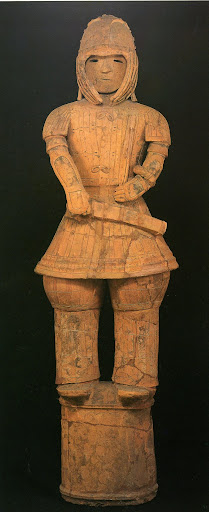
I think the closest thing to a complete suit we can see from that period are figures like the one below.

Image

http://lh6.ggpht.com/_ldFHRuuCIbE/RqTTpbk8NQI/AAAAAAAAAl8/Rtl8Y3uN51M/0009+haniwa+warrior+from+Iizuka+site,+Gunma.jpg
Last edited by Francisco Urbano García on Fri Jan 16, 2009 6:20 am, edited 1 time in total.

Maxime Chouinard
Posts: 72
Joined: Wed Sep 24, 2008 11:46 am

Postby Maxime Chouinard » Thu Jan 15, 2009 11:32 am

I can't see the picture but if they are Haniwa figures then its from the kofun period, only Iron and leather armors are found from this period: http://en.wikipedia.org/wiki/Kofun_period

The fact is there are no sources that show or mention wooden armor, and next to no artifacts found A.D. So we cannot reasonably suggest that they had any use for it once metal armor was introduced, even commoner armor is made of steel or more rarely leather.

Francisco Urbano García
Posts: 43
Joined: Sun Nov 30, 2008 9:37 pm

Postby Francisco Urbano García » Sat Jan 17, 2009 3:02 pm

Maxime Chouinard wrote:I can't see the picture but if they are Haniwa figures then its from the kofun period, only Iron and leather armors are found from this period: http://en.wikipedia.org/wiki/Kofun_period

The fact is there are no sources that show or mention wooden armor, and next to no artifacts found A.D. So we cannot reasonably suggest that they had any use for it once metal armor was introduced, even commoner armor is made of steel or more rarely leather.


Ok, if you consider this from the link you mention:

Much of the material culture of the Kofun period is barely distinguishable from that of the contemporaneous southern Korean peninsula, demonstrating that at this time Japan was in close political and economic contact with continental Asia (especially with the southern dynasties of China) through Korea.


Join to this from here http://www.emuseum.go.kr/cpomcont.do?currentPage=6&cpco_gubn=7&action=selectAll&

It is believed that it was around the era of the Three Kingdom when the production and use of armor started in its full scale in Korea. -It is believed that some armor in the era of the Three Kingdom may have made with hard wood or animal skins. However, nothing has been preserved up to now. -For armor made with bones, the relic in the Baekje period discovered in Mongchontoseong in Seoul is the only armor left to us.


I do not think it is difficult to accept that Japanese early armors had wood or perhaps even bones too. Specially I do not understand the "Do not even ask me" attitude that I read in some previous link as reference.

You have to consider that not everybody had the money to buy expensive armors, just like me for instance :wink:, and I assume that they had to use whatever was accessible, light and cheap like... wood? or perhaps even bones. Even if you had the luck to have a metal piece of armor, you still have to protect you arms and legs.

Think about it... you go to war and you have no protection in your legs, would you place some pieces of wood? You say that "we cannot reasonably suggest that they had any use for it once metal armor was introduced" but this is as much as to say as that everybody has no use for public transport when the car was introduced.

At least consider the bone armor from Korea in a period were metal was already being produced. I do believe that we can reasonably suggest the use of stuff like wood, and at least in Korea we can proved the used bones.... And now I will mention again the your link statement; "material culture of the Kofun period is barely distinguishable from that of the contemporaneous southern Korean peninsula"

Maxime Chouinard
Posts: 72
Joined: Wed Sep 24, 2008 11:46 am

Postby Maxime Chouinard » Sun Jan 18, 2009 12:05 pm

Same thing, they still fail to give out any proof of a wooden armor, only a fragment of bone armor (which I have less problem believing since neolithic groups were still alive and well in Asia). And then we don't know what is the purpose of such a garment, ceremonial, training, actual warfare? Your idea could be applicable to any place in the world actually, we could also say that butted maille was used in Europe for a long time since there are early examples, or even wooden armor. But finding one early curiosity doesn't make it a pattern.

Francisco Urbano García
Posts: 43
Joined: Sun Nov 30, 2008 9:37 pm

Postby Francisco Urbano García » Mon Jan 19, 2009 3:30 am

Maxime Chouinard wrote:...only a fragment of bone armor (which I have less problem believing since neolithic groups were still alive and well in Asia


Sorry, but the Neolithic era was 4 o 5 millennium prior to the time we're talking about.

finding one early curiosity doesn't make it a pattern.


Well, since you talk about the Neolithic... It is believed that at that time people would use spears made entirely with wood. Nonetheless only stones are preserved from that time. Following your logic, since no example, or only curiosities have been found we have to assume that wooden spears were not used widely, right?

Well, you know, sometimes you don't need to take a sample of the center of the Sun to assume it is hot.

User avatar
Stacy Clifford
Posts: 1126
Joined: Fri May 14, 2004 11:51 am
Location: Houston, TX
Contact:

Postby Stacy Clifford » Mon Jan 19, 2009 9:33 am

Guys, this has drifted way off subject from European martial arts, let's try and bring it back or wrap it up.
0==[>>>>>>>>>>>>>>>>>
Stacy Clifford
Free-Scholar
ARMA Houston, TX

Maxime Chouinard
Posts: 72
Joined: Wed Sep 24, 2008 11:46 am

Postby Maxime Chouinard » Mon Jan 19, 2009 11:27 am

Sorry, but the Neolithic era was 4 o 5 millennium prior to the time we're talking about.


There were a multitude of people in asia that were still at a neolithic state of technology, including the Ainu in Japan and the pinyin in China, just to name those two. Many neolithic societies still exist today around the globe.

Well, since you talk about the Neolithic... It is believed that at that time people would use spears made entirely with wood. Nonetheless only stones are preserved from that time. Following your logic, since no example, or only curiosities have been found we have to assume that wooden spears were not used widely, right?


No we have traces of wood and fixtures, we also have aboriginal art work, oral stories and sources from the first european contacts that confirm the theory. It is a completely different case.

Guys, this has drifted way off subject from European martial arts, let's try and bring it back or wrap it up.


I agree.

LafayetteCCurtis
Posts: 421
Joined: Sat Nov 04, 2006 7:00 pm

Postby LafayetteCCurtis » Sun Feb 01, 2009 1:03 am

I know it's past time to wrap this up, but I have to pass a message from Duncan Head that there's some doubts regarding the provenance of the Japanese wooden cuirasses; their features mimic contemporary metal cuirasses closely enough that there's plenty of reasonable ground for doubt that they were anything more than ceremonial imitations of the actual metal armor. Indeed, if this theory is right, we'd have a much easier time explaining why such wooden armors are not found in other East Asian cultures or in later Japanese periods--the problem vanishes instantly if we accept that the Japanese themselves never used the wooden cuirass in actual military actions.


Return to “Research and Training Discussion”

Who is online

Users browsing this forum: No registered users and 9 guests


Note: ARMA - The Association for Renaissance Martial Arts and the ARMA logo are federally registered trademarks, copyright 2001. All rights reserved. No use of the ARMA name or emblem is permitted without authorization. Reproduction of material from this site without written permission of the authors is strictly prohibited. HACA and The Historical Armed Combat Association copyright 1999 by John Clements. All rights reserved. Contents of this site 1999 by ARMA.