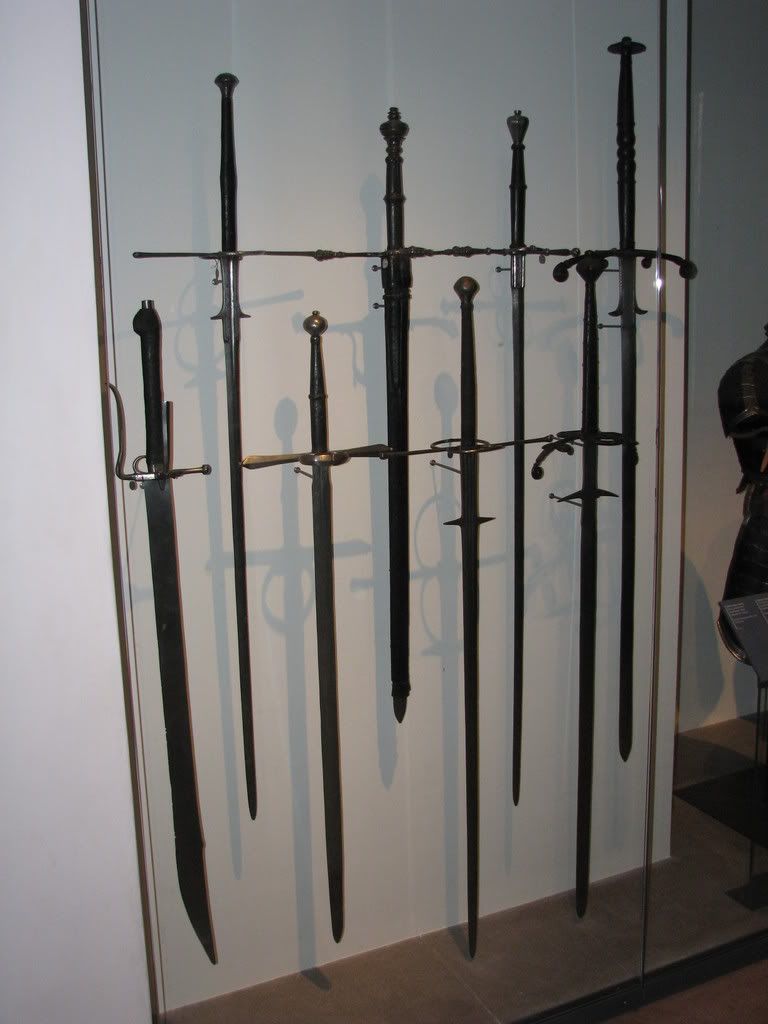
Case of two-handers
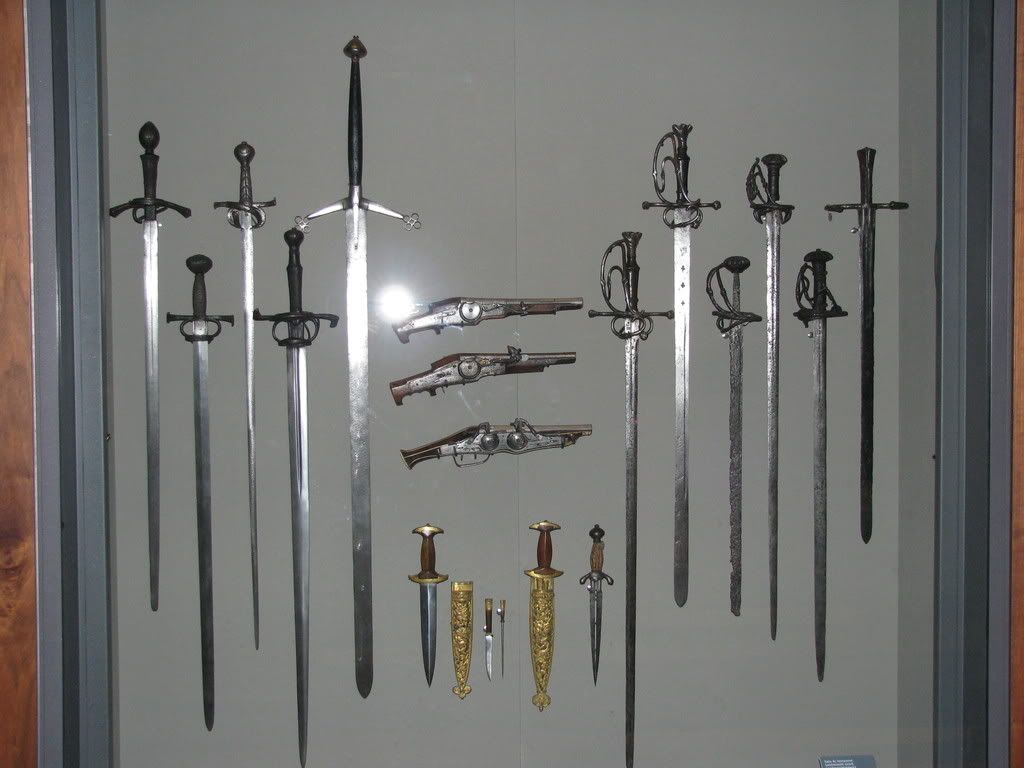
The kriegsmesser has larger proportions that Albion's kriegsmesser. Though its emphasis is definitely more on the cut than the rest of the swords in the case, it could hold its own against them. The left-most zweihander has a highly tapered blade and looks like it is right out of Morrozo's 1568 text minus the side rings. The next sword is proportionately similar to the swords in the Goliath manuscript. However, I thing of the germanic flared cross style as being later than the Goliath manuscript although the single side ring is also reminiscent of Goliath. I'm not sure if the narrowest blade would make any decent cuts. It might be just a large two handed tuck. The two swords on the right are typical of the later germanic flamboyant style of zweihander. Notice the rondel for the pommel.
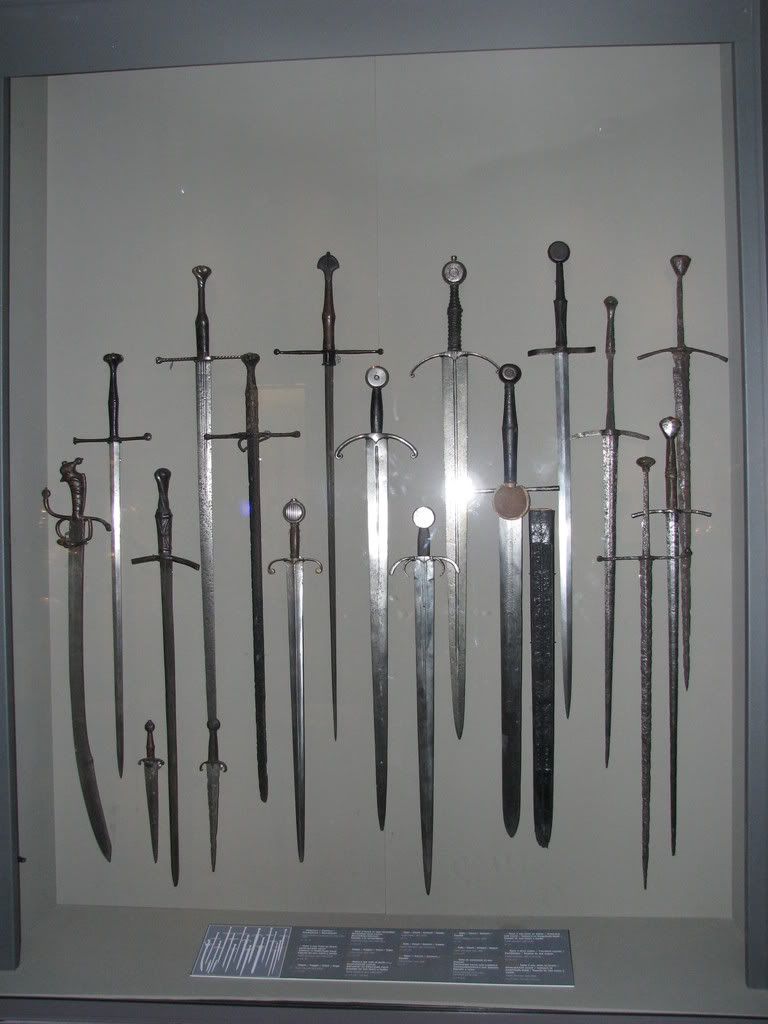
Next, late 15th/early 16th century
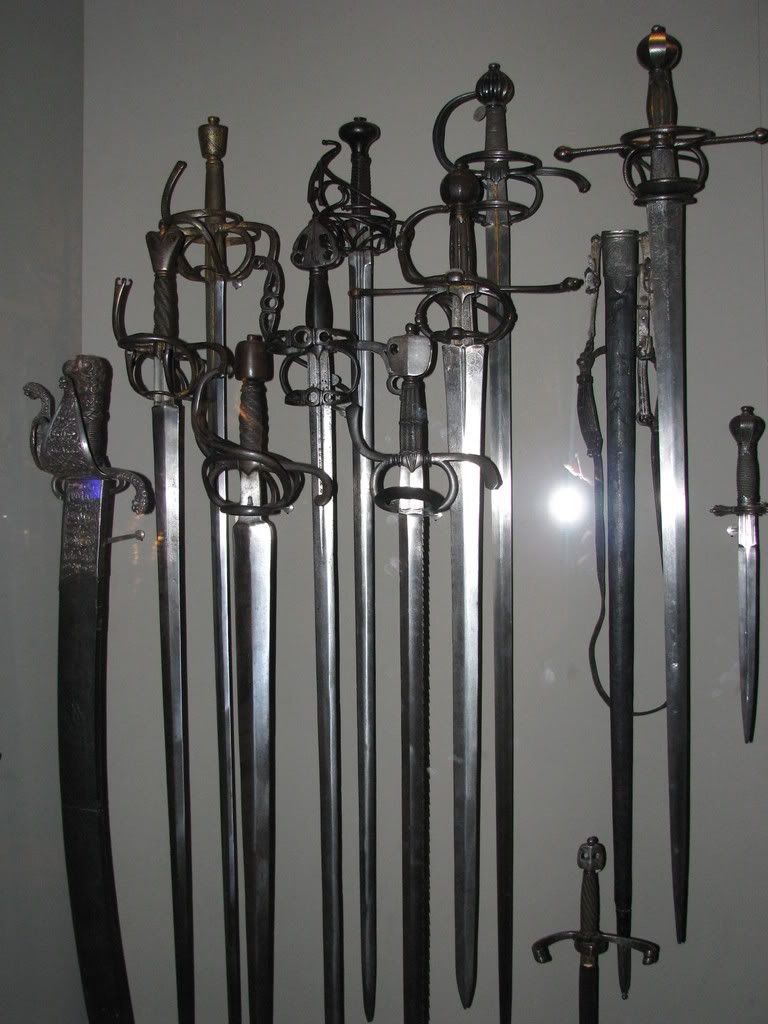
Lots to see here. There is a sword with the same design characteristics as the Albion Munich (not the only one of those I saw, either). The sword with the fishtail/half-moon pommel is a tuck with a triangular hollow-ground blade. Several of the longswords on the left resemble Lutel longswords and have both lenticular and diamond cross-sections. At least 3 swords on the right and one on the left have Oakeshott type XVII blades and fit into the Sempach family. Four swords in the middle share characteristics of down-turned cross, wheel pommel, and wide cutting blade but one of them has a longsword grip. The plaque said that the straight-wide blade sword with the long grip is ceremonial. Really, the only way to tell that would be by handling it. If it is functional, I think it would be interesting in a fight. We don't really talk much about the tuck. There isn't source material on it and it is primarily meant for armoured combat. But seeing one made me think, what would it be like to fight with that? Could I fight with it unarmoured if that's all I had at hand? It's like a two-handed rapier but earlier than the rapier came about.
Last one tonight
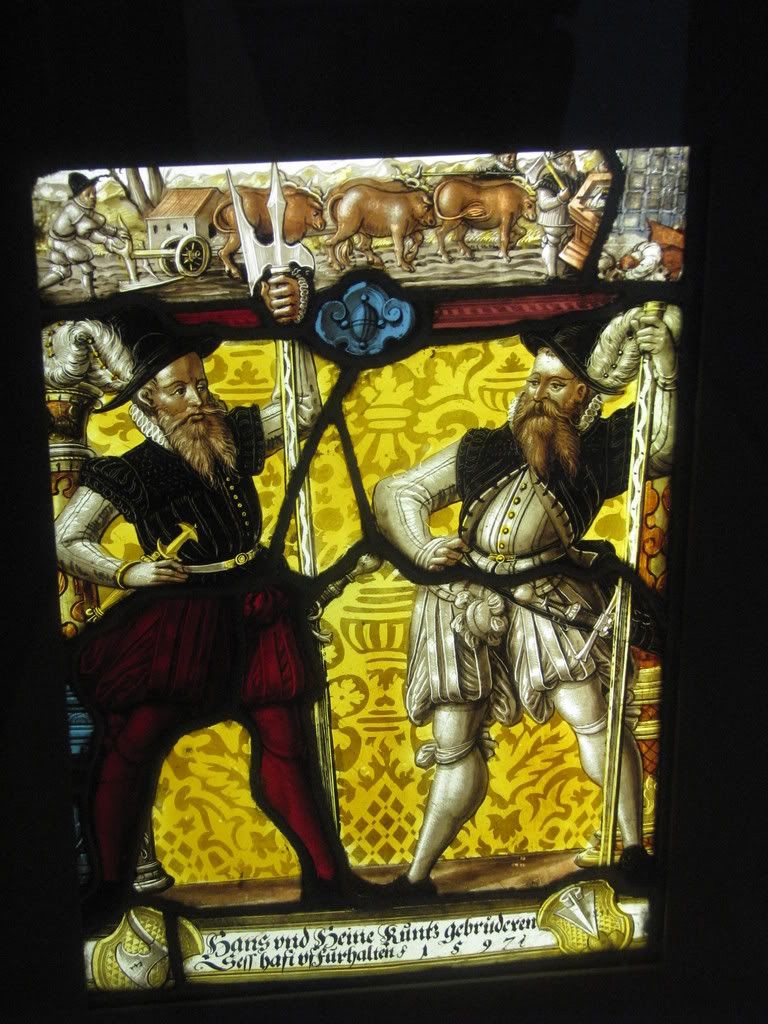
The baselards/Holbien/Swiss daggers at the bottom are just like the ones in the stained-glass of the halberdiers. On the left are some longswords and one-handers. Notice that the one-handers are longer than the longsword (bastard) on the far left. The lower longsword resembles the concept art for Albion's Markgraf. The plaque said that the swords on the right were all landsknecht swords. To me, I think of the landsknechts using katzbalgers primarily, and the katzbalger here is not typically what i see in artwork or what is depicted in modern reproductions. One of these on the right has a longsword lenght blade with a handle in hand-and-a-half (bastard) proportions. There is just so much variety in blade shapes, lengths, hilt configurations. All of my norms for specific categories of swords have just blurred. And yet patterns do emerge in how the swords would seem to function. And they are all impressed upon me their brutal effectiveness.