I.33 and Falling Under the Sword & Shield

For Historical European Fighting Arts, Weaponry, & Armor

Moderators: Webmaster, Stacy Clifford

User avatar
Randall Pleasant
Posts: 872
Joined: Mon Sep 23, 2002 3:35 pm
Location: Flower Mound, Texas, USA

I.33 and Falling Under the Sword & Shield

Postby Randall Pleasant » Sat Aug 08, 2009 4:22 pm

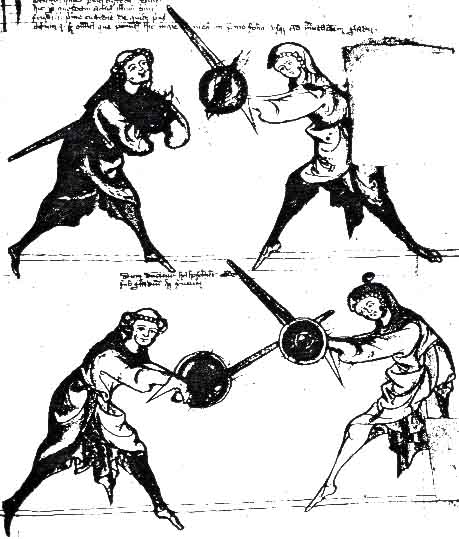
“Falling Under the Sword & Shield” is the first technique shown in the I.33 manual and starts with the priest in the Under-Arm (1st) guard and the student in the Half-Shield opposition. Although this technique is composed of very simple actions, basically a falling action and an under action, most scholars seem extremely confusion about how the technique is performed. To date, not a single interpretation of “Falling Under the Sword & Shield” put forth by scholars outside of the current ARMA membership have consisted of the priest's sword actually falling and then moving under the weapons of the student. For example, the interpretations by Guy Windsor, Paul Wagner, Roland Warzecha (http://www.swordschool.com/assets/files/pdf/133article080424.pdf), and Sean Hay (http://www.northwestacademyofarms.com) consisting of a raising cut by the priest that establishes a bind againt the blade of the student. I must view these interpretations as fundamentally wrong since a raising cut does not fall and the bind does in any way move under the student's weapons. I think the root of the problem for the above scholars is that they view “Falling Under the Sword & Shield” as just the action show in the bottom image on page 3 of I.33.

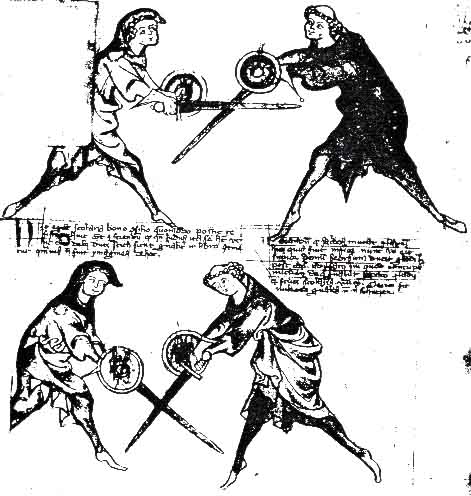
My interpretation of “Falling Under the Sword & Shield” consist of more than just the action shown in the bottom image on page 3. “Falling Under the Sword & Shield” is a play that starts with the cut shown on page 3 and concludes with the actions shown in both images of page 6 where the priest changes from an under-bind to an over-bind from which he will perform a shield-strike and a cut. When this play is executed at speed, with the student actively attempting to establish an over-bind and shield-strike as shown on pages 3 and 4, we see the priest making a cut that “falls” and then moves from an under-bind under the sword & shield of the student so as to establish an over-bind. Anywhere in I.33 where its author saids, "When Half-Shield is adopted, fall under the sword and shield" he is talking about the full play from page 3 to page 6. Please note that to the best of my knowledge all scholars working with I.33 do perform in one manner or another the change from an under-bind to an over-bind shown on page 6. However, none of them have associated that action with the “Falling Under the Sword & Shield” technique.

The whole reason behind performing “Falling Under the Sword & Shield” is that from the Under-Arm guard the priest cannot establish a strong safe bind against the student's blade. From such a bind the student has many options for counter attacking the priest. For this simple reason I consider the interpretations by Windsor, Wagner, Warzecha, and Hays as martially unsound. By performing the “Falling Under the Sword & Shield” technique the priest pulls the student into moving into a situation in which the priest can establish a strong safe bind from which he can perform a shield-strike.

Ran Pleasant

User avatar
Vincent Le Chevalier
Posts: 166
Joined: Mon Dec 31, 2007 5:18 am
Location: Paris, France

Re: I.33 and Falling Under the Sword & Shield

Postby Vincent Le Chevalier » Sat Aug 08, 2009 4:59 pm

Randall Pleasant wrote:To date, not a single interpretation of “Falling Under the Sword & Shield” put forth by scholars outside of the current ARMA membership have consisted of the priest's sword actually falling and then moving under the weapons of the student.
That makes the assumption that the "falling under" applies to the sword, which is not certain. One of the translation in French says "dive under the sword and shield", which I think carries well enough another possible meaning: while establishing the simple bind from the left you dive into the line of attack of the half-shield, under the weapons, protected by the bind.

Regards,

User avatar
Randall Pleasant
Posts: 872
Joined: Mon Sep 23, 2002 3:35 pm
Location: Flower Mound, Texas, USA

Re: I.33 and Falling Under the Sword & Shield

Postby Randall Pleasant » Sat Aug 08, 2009 9:42 pm

Vincent

Regardless of whether the priest's sword is diving or falling it is absolutely clear that the action has nothing to do with attempting to establish a bind. All of the actions of the "Falling Under the Sword & Shield" play are shown in the images on pages 5 and 6. There is just nothing there suggesting that the priest is attempting to bind. As I said earlier, binding against Half-Shield is not a good idea because if the bind is actually established the student is in Half-Shield and the priest is in Longpoint, ie. the student is in a strong position and the priest is in a weak position. I have seen this interpretation up close in two classes with Sean Hays and two classes with Robert Holland of Schola Saint George, both men are good guys and good instructors but I was totally un-impressive by their interpretations of this play. It is not something I would consider doing if my life was on the line. As I said in my first post, I think the whole point of the priest falling under the sword and shield is to entice the student into moving into a position where the priest can estable a good strong bind from which he can perform a shield-strike.
Ran Pleasant

User avatar
Jaron Bernstein
Posts: 1108
Joined: Sun Dec 07, 2003 12:58 am

Re: I.33 and Falling Under the Sword & Shield

Postby Jaron Bernstein » Sat Aug 08, 2009 10:04 pm

Randall Pleasant wrote:Vincent

Regardless of whether the priest's sword is diving or falling it is absolutely clear that the action has nothing to do with attempting to establish a bind. All of the actions of the "Falling Under the Sword & Shield" play are shown in the images on pages 5 and 6. There is just nothing there suggesting that the priest is attempting to bind. As I said earlier, binding against Half-Shield is not a good idea because if the bind is actually established the student is in Half-Shield and the priest is in Longpoint, ie. the student is in a strong position and the priest is in a weak position. I have seen this interpretation up close in two classes with Sean Hays and two classes with Robert Holland of Schola Saint George, both men are good guys and good instructors but I was totally un-impressive by their interpretations of this play. It is not something I would consider doing if my life was on the line. As I said in my first post, I think the whole point of the priest falling under the sword and shield is to entice the student into moving into a position where the priest can estable a good strong bind from which he can perform a shield-strike.


The Boars Tooth S&B DVD addresses this one IIRC. One thing they say, as well as Dobringer, is that you cut at the guy (in this particular technique, as well as in general), and not his sword. He either reacts to that or gets hit. If you hit him, great. If he reacts, you end up in a bind.

User avatar
Randall Pleasant
Posts: 872
Joined: Mon Sep 23, 2002 3:35 pm
Location: Flower Mound, Texas, USA

Re: I.33 and Falling Under the Sword & Shield

Postby Randall Pleasant » Sat Aug 08, 2009 10:54 pm

Jaron

I have not seen the Boars Tooth video but from your description it appears that David Rawlings interpretation is much more martial sound than the other interpretations discussed. However, it also sounds like David made the same mistaken as the other scholars in that he considered "Falling Under the Sword & Shield" to only include the actions shown on page 5, rather than including all of the actions shown on page 5 and 6. In other words, it appears that David Rawlings interpretation has the "Falling" part correct but is lacking the "Under the Sword & Shield" part. Without doubt David does perform the change from an under-bind to an over-bind shown on page 6, it just that he does not consider it part of the "Falling Under the Sword & Shield" play. Is my understanding of your description of David's interpretation correct (as you understand it from the video)?
Ran Pleasant

User avatar
Vincent Le Chevalier
Posts: 166
Joined: Mon Dec 31, 2007 5:18 am
Location: Paris, France

Re: I.33 and Falling Under the Sword & Shield

Postby Vincent Le Chevalier » Sat Aug 08, 2009 11:29 pm

Randall Pleasant wrote:Regardless of whether the priest's sword is diving or falling it is absolutely clear that the action has nothing to do with attempting to establish a bind. [...] As I said earlier, binding against Half-Shield is not a good idea because if the bind is actually established the student is in Half-Shield and the priest is in Longpoint, ie. the student is in a strong position and the priest is in a weak position.
You missed my point, Randall. I'm saying that 'dive' or 'fall under' does not apply to the sword but to the swordman...

If all goes well, you hit the hand. If the scholar is at least half awake, he will block and you bind weak against strong. I disagree that such a bind is useless; it is in fact exactly the method advocated by Thibault for the parry of a cut (including that of a great-sword, so not a weak cut), see Table XIV, circle 4.

I think this might be why the "general fighter" seeks to hit the head: like you, he thinks the bind will not protect you at all. Unfortunately for him it does. As he cuts you get stronger and he gets weaker, and it leads to the stichslach.

Well, that's how I understand it. I don't think you can count on the change of sword systematically right at the begining, it's too many actions with many branches in between. As you fall under you are not sure to even end up on page 6.

Regards,

User avatar
Randall Pleasant
Posts: 872
Joined: Mon Sep 23, 2002 3:35 pm
Location: Flower Mound, Texas, USA

Re: I.33 and Falling Under the Sword & Shield

Postby Randall Pleasant » Sat Aug 08, 2009 11:43 pm

Vincent Le Chevalier wrote:That makes the assumption that the "falling under" applies to the sword, which is not certain. One of the translation in French says "dive under the sword and shield", which I think carries well enough another possible meaning...


Vincent

I think you might also be making the same logic error that Guy Windor made on page 18 of his article on I.33 (http://www.swordschool.com/assets/files/pdf/133article080424.pdf). In the article Guy Windsor wrote:
Falling does not necessarily imply a descent; in later German manuals, it is used to denote a passing step; you can “fall into a high ward”.


In making the above statement Guy overlooks the simple fact that we are dealing with a translation from Latin to English. "Falling" is nothing more that the English translation of the Latin word "cade". The Latin verb "cado" means "to fall". You can't translate "cade" to English and then talk about what "fall" might mean in either English or German. You can only talk about "falling" in the context of what "cade" means in Latin. In no shape or form does "cado" mean to bind or to move into a position, it simply means to fall. Make sense?
Ran Pleasant

User avatar
Brian Hunt
Posts: 969
Joined: Thu Jan 23, 2003 2:03 am
Location: Price, Utah
Contact:

Postby Brian Hunt » Sun Aug 09, 2009 10:36 pm

Hi Randal,

sounds like you are discussing Stewart Feil's and my interpretation of falling under the sword and the shield. I completly agree that it is a descending cut, not a rising one. I find a descending cut at the right forearm of your opponent will create several actions. Either you will cut their forearm and you can dispatch them with a thrust to the chest or the face, they will rotate the buckler over to protect their arm and then you can still do the thrust, they will move back away from you to escape the cut, or they will cover with their sword and establish a bind. If you want you can also use the descending cut to just bind their sword when they are in halfshield, but I prefer to attack my opponent rather than his sword. I hold 1st ward with the buckler protecting my right elbow with the face pointed at my opponent. From there I actually find the descending cut into half shield to be quicker and stronger than a rising cut into half shield which by default must include a twist of my wrist to come into half shield with my true edge extended towards my opponent. I also find the descending cut to be stronger than the rising cut.While there is a lot to be said for establishing the bind and controlling your opponent out of the gate and I do think the I.33 is mostly about how to control the bind, but I don't think you should just go for the bind, I think you also have to also cut and thrust at the openings.

Interestingly enough, the same bind that is used against half shield or long point from the 1st ward is also used when you are in the third ward. From third ward why would you want to use a rising cut when a descending one is the obvious answer. I feel that both the 1st and the third ward use the same descending cut to arrive in an overbind on the right against half shield or long point.

all the best.

Brian Hunt

Co-author of "Polearms of Paulus Hector Mair."
http://www.paulushectormair.com

User avatar
I. Hartikainen
Posts: 81
Joined: Wed Jun 01, 2005 1:44 pm
Location: Finland
Contact:

Postby I. Hartikainen » Sun Aug 09, 2009 11:11 pm

Ran,

I am not sure I understand your interpretation correctly - what is shown on page 6 is the mutacio, which is listed as one of the three priest's options after the scholar has made the bind.

From the underarm ward a bind (as in binding the weapon down and entering) would indeed be a bit perilous, and a very large action; however simply covering yourself and entering either with a thrust or a cut can be done, as this is fairly common in all sword systems (such as Fiore, at least Talhoffer's messer, Bolognese and even Capoferro with a rapier. Viggiani's whole method is largely based upon this very action.).

'Falling under' as a term is quite cryptic, especially in this case where the initial position is a low guard. There is no reason to expect that the staring position would be anything different in this case, as the structure of the entire work is such that the beginning guards are first shown, and then the actions that follow. From a low position, 'falling under' seems contradictory how ever one looks at it.

The argument against the cut to the arm is that the text advices us not to execute a strike as that would leave the head open, and true enough, if the priest was to strike a simultaneous counterattack while covering with the buckler would be an option. If the priest goes against the blade, it may be more likely that the students then binds, giving the priest the options that he is looking for.

I think that the important thing here is, that whether the priests initial action is supposed to be a cut to the arm, a strike to the blade, a covering action, an angulated thrust or even a false edge rising strike to the blade, if the scholar feels himself insecure he will go for the bind, and that is what the priest is looking for.

- Ilkka

User avatar
Randall Pleasant
Posts: 872
Joined: Mon Sep 23, 2002 3:35 pm
Location: Flower Mound, Texas, USA

Postby Randall Pleasant » Sun Aug 09, 2009 11:35 pm

Brian Hunt wrote:Sounds like you are discussing Stewart Feil's and my interpretation of falling under the sword and the shield. I completly agree that it is a descending cut, not a rising one.


Brian

No, I am not discussing your and Stew's interpretation. The last time I heard you describe your interpretation of "Falling Under the Sword & Shield" you described it only as the action seen in the bottom image of page 3 or the bottom image of page 5. That is the same description you gave above. My interpretation of "Falling Under the Sword & Shield" is that it is a play that includes all of the actions seen in the image of page 5 and 6. I know that you and Stew do perform the change from an under-bind to an over-bind shown in the bottom image of page 6 but like all of the other scholars you have not consider it part of "Falling Under the Sword & Shield". That is a significant difference! The primary objective of the cut from Under-Arm guard is to get the adversary to move out of Half-Shield. It's nice if an adversary just sit there and let you cut their arm but it's not something one can count on. In my interpretation the sole objective of "Falling Under the Sword & Shield" is to get an over-bind.
Ran Pleasant

User avatar
Randall Pleasant
Posts: 872
Joined: Mon Sep 23, 2002 3:35 pm
Location: Flower Mound, Texas, USA

Postby Randall Pleasant » Mon Aug 10, 2009 12:15 am

I. Hartikainen wrote:I am not sure I understand your interpretation correctly - what is shown on page 6 is the mutacio, which is listed as one of the three priest's options after the scholar has made the bind.

From the underarm ward a bind (as in binding the weapon down and entering) would indeed be a bit perilous, and a very large action; however simply covering yourself and entering either with a thrust or a cut can be done, as this is fairly common in all sword systems (such as Fiore, at least Talhoffer's messer, Bolognese and even Capoferro with a rapier. Viggiani's whole method is largely based upon this very action.).
Ilkka

The instructions for the play are extremely simple! Nowhere in the first part of the description of "Falling Under the Sword & Shield" is the priest instructed to seek a bind or to thrust. The priest is instructed to seek a bind only after moving his sword under the weapons of the student.

'Falling under' as a term is quite cryptic, especially in this case where the initial position is a low guard. There is no reason to expect that the staring position would be anything different in this case, as the structure of the entire work is such that the beginning guards are first shown, and then the actions that follow. From a low position, 'falling under' seems contradictory how ever one looks at it.


There is nothing cryptic about "falling". There is just not way one should be confused into thinking "falling" means to raise, bind, or thrust. It is a simple clear word in both English and Latin.

Why do you consider the Under-Arm guard to be a low guard? There is only about a six inch difference in height from where the sword is held in Under-Arm and where it is held in Left-Shoulder. I can cut a powerful left Zorn from Under-Arm just as easily as I can from Left- Shoulder. And do note that a left Zorn does "fall".


The argument against the cut to the arm is that the text advices us not to execute a strike as that would leave the head open, and true enough, if the priest was to strike a simultaneous counterattack while covering with the buckler would be an option. If the priest goes against the blade, it may be more likely that the students then binds, giving the priest the options that he is looking for.


The author of I.33 says that the priest should not to cut to the student's head because it cannot be reached. The student's head cannot be reached becaused it is well protected by Half-Shield. The author of I.33 also says that the priest should not cut to a lower opening on the student because it will leave the priest's head open to an attack. But the author of I.33 does not say the priest should not cut to the student's arm.

I think that the important thing here is, that whether the priests initial action is supposed to be a cut to the arm, a strike to the blade, a covering action, an angulated thrust or even a false edge rising strike to the blade, if the scholar feels himself insecure he will go for the bind, and that is what the priest is looking for.


Why not just do what the master says? You are instructed to "fall under the sword and shield". That is exactly what is shown in the four images on page 5 and 6 of the I.33 manual.
Ran Pleasant

User avatar
Brian Hunt
Posts: 969
Joined: Thu Jan 23, 2003 2:03 am
Location: Price, Utah
Contact:

Postby Brian Hunt » Mon Aug 10, 2009 5:18 am

Hi Randal,

I agree that falling under the sword is the correct method for defending yourself against half shield when you are in first ward. The I.33 gives us the instruction to "fall under the sword and also the shield" when we are in first and the opponent is countering with "half shield." Where you lose me is when you say everything on page 5 and page 6 of the I.33 is "falling under the sword." Maybe I am misunderstanding you, but I see each of the four images found on page 5 and page 6 as seperate actions, each with it's own term. Further more, IMHO, this play is meant to teach us how to defend against the "rebind and step" by "changing the sword." For clarifcation I am going to go through the basic actions shown on pages 5 and 6 of the I.33 as I see them, then maybe you can be kind enough to share with me how you see them differently.

Image

At the top of page 5 we have the priest on the left in "1st ward" and the Scholar opposing him on the right in "half shield." This is the starting position from the first play and it is continued in the second play. Furthermore, we are informed that everything is the same up to the "change of the sword."

At the bottom of page 5 we have the priest "falling under the sword." To me, the action from the top of page 5 that brings you into the bind shown at the bottom of page 5 is the action of "falling under the sword." I see this position as the overbind established by the Priest. This is the action of "falling under the sword" as I see it. IMHO, what proceeds from here are other actions that are seperate techniques from the action of "falling under the sword."

Image

At the top of page 6 the scholar has done the rebind and step in order to defend himself from the attempted overbind of the priest by giving himself an overbind so he can move into the "shield strike" shown in the previous play at the bottom of page 4.

At the bottom of page 6 the priest "changes the sword" in order to protect himself from a "shield strike" by the scholar. This takes him from an underbind created by the scholar with the "rebind and step" and allows him to regain the overbind. From here the priest moves into the "nuken."

I don't know if we are speaking at cross purposes here or not, but I do not see all four sets of images as being the action of "falling under the sword." The only action of "falling under the sword" as I see it takes place from the top of page 5 and ends at the bottom of page 5.

Thanks for the interesting discussion. :)

all the best.

Brian Hunt

Co-author of "Polearms of Paulus Hector Mair."
http://www.paulushectormair.com

User avatar
I. Hartikainen
Posts: 81
Joined: Wed Jun 01, 2005 1:44 pm
Location: Finland
Contact:

Postby I. Hartikainen » Mon Aug 10, 2009 5:19 am

Ran,

please bear with me, I'm trying to follow your line of thought here but am still a bit unsure.

If we look at pages 5 and six, what we have is a new sequence (denoted by the cross), beginning just like the previous one. Priest is in underarm (which is depicted rather high, I agree), scholar adopts half-shield.

Then priest 'falls under' and we have this image where he is doing something (I honestly am not sure what this picture in the bottom of page 5 is supposed to represent). Clearly the priest is, from his viewpoint, on the left side of scholars weapons, the side where he started from.

Then the view is flipped, and priest's weapons are being bound by the scholar. Scholar is doing the bind to his right side.

Then the priest does the mutacio, an action to change from below to above, and from there he strikes with a 'nucken'.

What exactly is the falling under? Can you describe the action to me so that I would understand? From your previous posts I get the idea that it is either an action of 'cutting' under the weapons of the scholar, without seeking any contact, and then continuing after the scholar does something, or - as per your previous post - a cut to the arm in hopes that the scholar would bind.

I am not sure that I understood you correctly - in which case could you please clarify further. I totally understand your point in attempting to look for an actions that would be a falling action that ends under the sword and shield, which, in my opinion, a cut to the arm or any action against the blade is not.

- Ilkka

User avatar
Randall Pleasant
Posts: 872
Joined: Mon Sep 23, 2002 3:35 pm
Location: Flower Mound, Texas, USA

Postby Randall Pleasant » Mon Aug 10, 2009 8:00 am

Brian Hunt wrote:I agree that falling under the sword is the correct method for defending yourself against half shield when you are in first ward. The I.33 gives us the instruction to "fall under the sword and also the shield" when we are in first and the opponent is countering with "half shield." Where you lose me is when you say everything on page 5 and page 6 of the I.33 is "falling under the sword." Maybe I am misunderstanding you, but I see each of the four images found on page 5 and page 6 as seperate actions, each with it's own term. Further more, IMHO, this play is meant to teach us how to defend against the "rebind and step" by "changing the sword." For clarifcation I am going to go through the basic actions shown on pages 5 and 6 of the I.33 as I see them, then maybe you can be kind enough to share with me how you see them differently.


Brian

It is very easy to view of all of these actions shown on page 5 and 6 as separte actions because in the middle of describing the play the author of I.33 inserts what the student should be doing. But look at what the priest is actually doing on pages 5 and 6. In one smooth motion the priest cuts a left Zorn and then brings his sword back over to his left to bind so that his right arm is over his left arm behind his buckler. This one smooth motion results in the priest's blade "falling" and then moving "under the sword & shield" of the student. Of course, all of this depends upon the student doing what he should be doing, ie. attempting to bind. When performed at speed the student does not get to form his bind since the priest's blade is falling very fast. If the priest allowed the student to form the bind then the student might also get the shield-strike!
Ran Pleasant

User avatar
Randall Pleasant
Posts: 872
Joined: Mon Sep 23, 2002 3:35 pm
Location: Flower Mound, Texas, USA

Postby Randall Pleasant » Mon Aug 10, 2009 8:20 am

Ilkka

The "falling" is the priest cutting a left Zorn at the student's arm. When this happens the student attempts to bind. But the priest prevents the student from establishing a good bind by moving his blade under the sword and shield of the student and back over to his left so that he can get the over-bind. This is performed as one smooth motion.
Ran Pleasant


Return to “Research and Training Discussion”

Who is online

Users browsing this forum: No registered users and 9 guests


Note: ARMA - The Association for Renaissance Martial Arts and the ARMA logo are federally registered trademarks, copyright 2001. All rights reserved. No use of the ARMA name or emblem is permitted without authorization. Reproduction of material from this site without written permission of the authors is strictly prohibited. HACA and The Historical Armed Combat Association copyright 1999 by John Clements. All rights reserved. Contents of this site 1999 by ARMA.