New Jogo do Pau Study groups

For Historical European Fighting Arts, Weaponry, & Armor

Moderators: Webmaster, Stacy Clifford

Frederico Martins
Posts: 48
Joined: Sat Nov 21, 2009 7:01 am
Location: Lisbon
Contact:

New Jogo do Pau Study groups

Postby Frederico Martins » Tue Jan 05, 2010 2:22 pm

Good Day everyone,

I hope this is the right place to post this, please let me know if it isn't.

I want to announce the Jogo do Pau International Study Groups Program I'm developing with Luis Preto to help promote the practice of jogo do pau around the world.

This program was thought specially for international western martial arts groups that show interest in this art and to provide, possibly, the only way to learn Jogo do Pau with a qualified instructor outside of Portugal.

This program will work in the following way:

There will be a JdP instructor that will regularly provide exercises for the group to work with, in form of text, images, and video, to help them understand what is necessary. From that on, the group will have a very close following of it's development by the instructor, answering questions and most important, from time to time the group will be required to record videos of exercises executed the best they can for instructor's review. This level of interaction will help maintain the quality of the technical development of the group.

How will this work?

The group will be leaded by a Group Coordinator, that will be responsible for the development of the other members and for the communication with the instructor, this leader will have a very important role in the process.

This role is specially oriented to someone that has experience with martial arts and teaching, so he can organize and teach a group the information provided by the instructor, and manage that entire interaction.

The instructor and director of the program is Luis Preto, some of you must him, a respected jogo do pau instructor, with a degree in Sport Sciences and author of the book "Jogo do Pau: The Ancient Art and Modern Science of Portuguese Stick Fighting", so you know you are in good hands and learning Jogo do Pau from a valuable source.

You can know more about Luis Preto here: http://www.jogodopauportugues.com/progr ... uctor.html

This program requires a membership fee, that will be 30euros/month per group, no matter if you have 3, 10 or more members, so you can divide that amount as you like.

We will have a website that will have the groups under our program listed, so any individual that wants to join a official group will know where they are.

But keep in mind that this program is only directed at dedicated groups, that will have a place to practice and regular classes. The number of classes you can have is flexible but we are aiming at a quality work and to provide the best development possible with the distance difficulties this provides.

The fee is not to be listed on the website or to be part of the group only as a formality, but to have access to exercises and materials, and most importantly, direct, tight and regular communication with a high qualified instructor that will provide you the best learning tools and full accompaniment of the group's development.

Being part of this study groups don't require any kind of group or membership exclusivity, on the other side, it is aimed to work with existing groups and be a valuable addition to their current work.

You can find more detailed information on our website here:
http://www.jogodopauportugues.com/program/

This is an opportunity to practice a western martial art that has a continuous lineage of masters and reached us today in a fully combat oriented disposition. I really believe this is a unique and special opportunity for those outside of Portugal and am glad to be able to help Luis on this project. I also believe that when you get to a decent level in Jogo do pau that will affect any kind of combat with weapons that you do, and to the better. I really hope people participate and we can take this further( Ok... or else i wouldn't be posting, right...).

Well, we just started and I just made this public now and would really like to know what you think about it, so please, post what you think and feel free to ask any questions. If you are interested in Joining the program please contact us at: lusitanfencing@gmail.com

hope you like it,
Cheers.

Roger Norling
Posts: 140
Joined: Fri Nov 13, 2009 5:57 am
Location: Gothenburg, Sweden

Postby Roger Norling » Thu Jan 07, 2010 6:38 am

As you know, I hope and believe we will get this going with my little polearms study group.

I think there is a lot to learn from JdP when practicing other weapons, just compare the figure on the right in the attached images, taken from Joachim Meyer's 1600 manuscript in relation to the snapshot from Russo's and Preto's clip on YouTube.

Image

http://www.youtube.com/watch?v=OmcYaSHdL5s

Not forgetting that it will excellent fun to learn how to fight with a short staff in the JdP tradition! :)
Quarterstaff instructor
Gothenburg Free Fencers Guild
http://www.gffg.se

Member of MFFG
http://www.freifechter.com

Member of HEMAC
http://www.hemac.org

HROARR
http://www.hroarr.com

Frederico Martins
Posts: 48
Joined: Sat Nov 21, 2009 7:01 am
Location: Lisbon
Contact:

Postby Frederico Martins » Sun Jan 24, 2010 7:58 pm

Thank you Roger! Really nice comparative images, specially the leg stance.

Due to our member's feedback we decided to update the kind of services we provide to help the development of small groups.

There are now 3 services:

#1 - Will be a Pack of exercises, in form of text images and clips. - 10 euros a pack
This will help you start out at your pace, when you feel comfortable with this exercises you can get more advanced ones, or other pedagogical service.

This service will provide a great amount of learning material that some is already available and more in the works.

#2 - the second service is a more close in and interactive relation with the instructor. 20 euros and lasts a month.

The Instructor will review videos from the head of the group, helping allot in your technical development and give you specific exercises designer for your needs.

#3 - will be similar to #2 but will review and entire group of practitioners for 30 euros.

This way we hope new groups can have a good taste of what we offer with a 10 euro pack, and maybe a second, and when fell the need for a more direct instruction, can ask for a #2 or #3 service, for one time only, or for the time they feel necessary.

We feel this is a very cheap way to start since 10 euros for a group of 4 people isn't much, and even for 2 persons is fair enough to have a taste at it, so I hope more people join in!
This is just not fair for individuals since most exercises require a practice partner to do them correctly, so if you are alone in this interest, try to get a friend to practice with!

If you want to give it a try, email me here: lusitanfencing@gmail.com

For those that don't have a good Idea of what jogo do pau is about, I will leave you here a few videos from youtube, some with instructor Luis Preto on them:
http://www.youtube.com/watch?v=gSDSsereOdg
http://www.youtube.com/watch?v=4cr_12hdKJs
http://www.youtube.com/watch?v=CFucsRevxCw
http://www.youtube.com/watch?v=s-N4DkK-VFs

User avatar
RayMcCullough
Posts: 160
Joined: Tue Sep 26, 2006 9:05 am
Location: Robertsdale, AL

Postby RayMcCullough » Sun Jan 24, 2010 9:11 pm

"This is an opportunity to practice a western martial art that has a continuous lineage of masters and reached us today in a fully combat oriented disposition."

How far back does the continuous lineage go, what year?

Thanks
"The Lord is my strenght and my shield, my heart trusteth in Him and I am helped..." Psalms 28:7

"All fencing is done with the aid of God." Doebringer 1389 A.D.

Frederico Martins
Posts: 48
Joined: Sat Nov 21, 2009 7:01 am
Location: Lisbon
Contact:

Postby Frederico Martins » Mon Jan 25, 2010 6:55 am

Hi Ray,

We can't actually say that for sure.

Jogo do Pau wasn't developed or practiced by nobleman but by the hands of rural people, that is probably the reason it reach us today not in form of books but by practicing and teaching masters still alive.

It developed in an age that had firearms for long time but in poor areas of the country were people didn't have money for sword even less for guns and used the walking staff in their daily lives. This people couldn't read or write, so I don't think that there is much documents before the XX century, but I haven't done much research anyway.

the fact that even in an age of fire arms, people actually needed the staff for self defense as a weapon is what make it possible to jogo do pau to reach us today in a practical full combat oriented term and not as a cultural or traditional form, for ludic practice. And for me that is the most value of it. We, that don't use it for self defense anymore, still want to keep that aspect alive, as a martial art.

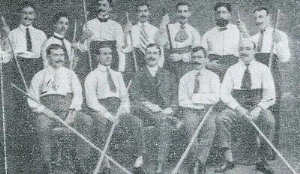
there is this photo from 1910
http://ejmas.com/jmanly/articles/2003/m ... adores.jpg

before that there is this document that i know of:
JOAQUIM ANTÓNIO FERREIRA «A Arte do Jogo do Pau», Porto 1886.
(The Art of Jogo do Pau by Joaquin António Ferreira, 1886)

I really wish there was a better research on that and im sure there are more stuff that i don't know about, but tracing it to older dates must be very hard since it might not be called jogo do pau before that time, even if people used staffs for self defense.

Since this people fought with similar weapons for centuries in wars we believe that there was influence from war weapons such as swords, from older periods, that is a little guess work but it makes allot of sense when you compare photos like Roger did and even strikes names from some older books. Even so the technique as is today is perfected and refined for the staff, but what I defend is that it has alot of stuff that has been transmitted with this art, in bio mechanical terms that is impossible or very hard to pass through books, and i believe that is of most value for the kind of studies that you guys in the WMA community do, that can't possible have any other way, or if you do, it is in a much more indirect way.

Roger Norling
Posts: 140
Joined: Fri Nov 13, 2009 5:57 am
Location: Gothenburg, Sweden

Postby Roger Norling » Mon Jan 25, 2010 7:44 am

Also, apparently the Montante manuscript has a lot of similarities with JdP, although I haven't read it through yet. I know that it contains large sections of circular strikes, however. There are numerous threads on interpretations of Montante on different forums.
Quarterstaff instructor
Gothenburg Free Fencers Guild
http://www.gffg.se

Member of MFFG
http://www.freifechter.com

Member of HEMAC
http://www.hemac.org

HROARR
http://www.hroarr.com

User avatar
Randall Pleasant
Posts: 872
Joined: Mon Sep 23, 2002 3:35 pm
Location: Flower Mound, Texas, USA

Postby Randall Pleasant » Mon Jan 25, 2010 1:49 pm

Roger

Our forum requires both the first and last legal name. Please edit your profile and spell out your last name.
Ran Pleasant

Frederico Martins
Posts: 48
Joined: Sat Nov 21, 2009 7:01 am
Location: Lisbon
Contact:

a

Postby Frederico Martins » Mon Jan 25, 2010 9:02 pm

Yes Roger, the montante rules seem to work very fine with jogo do pau tecnique, the turning of the body with the strike and the foot work make alot of sense to me. Some sequences of strikes seem to to able to flow well with jogo do pau strikes too. There are some basic differences, like the right hand being in front, that is something I don't understand, but in general, most rules description would be pretty much doable and make sense with jogo do pau technique too.

I don't think any Portuguese staff fighter from old times actually read that book or any other, but I'm sure there is some influence at early stages from that kind of exercises/practices, it only makes allot of sense.

Roger Norling
Posts: 140
Joined: Fri Nov 13, 2009 5:57 am
Location: Gothenburg, Sweden

Postby Roger Norling » Mon Jan 25, 2010 11:43 pm

I have heard a theory that Jogo Do Pau would stem from sword exercises, either directly or possibly from people mimicking what they saw swordsmen do. I don't know if there is any proper validity to such a theory.

That the right hand is leading with a hand-and-a-half longsword comes natural, for several reasons including that it could be wielded with one hand only. But a thought that occured to me is that in armour, you often switched to a principle called half-swording, where the left hand grips the middle of the blade. This gives you more precision and strength in thrusting against armour. That means you are actually leading with your left, like in JdP.

So perhaps, this is how the left hand lead developed in JdP? Then you can parry in between your hands, as is done in a lot of other staff traditions as well. This also transfers to spearwork btw, and relates to how you manipulate rotational points. From what I understand, some styles of JdP, like in the Azores works even more with wide grips.

Of course, making simple grip changes and striking with a left hand lead could naturally evolve from there.

Just a thought... :)

Oh, and regarding the age of JdP, I could very well imagine it being well defined by the mid 1600, in other words around the time of Mairs short staff sections and the zweihänders. I remember that Luis Preto mentioned some JdP reference in a manuscript that I think was from about that time. Was it King Dom Duarte's book on jousting? From what I recall sword techniques that were similar to JdP were described there.

Oh, and this comes from Wikipedia:

"Some believe that it was influenced by an Indian dance or Indian martial art, which would have been imported and adapted in the period of the Discoveries, while there are others who say that its origins are medieval techniques of combat much similar to what is taught in the medieval book A ensinança de bem cavalgar em toda a sela ("The art of being a good horseman on any saddle") by Edward of Portugal (1391–1438). "

EDIT: I did a little research on Duarte and there is actually a few references here at ARMA to Portuguese wooden swords for training in Duarte.

"One of the clearest examples of the use of wooden swords in Medieval fencing comes to us from the 1434 writings of the Portuguese King Dom Duarte. In his Regimento, Duarte described: “And there he had weapons made of fine iron for other men, and he had lances and axes and wooden swords, and whenever he wanted to practice he armed himself with heavier weapons...made for learning different methods of defence and offence in which others are well versed.”[1] Duarte further advised: “Have spare weapons and armor at your house for anyone who comes over. Have wooden weapons to play with. When you spar use heavier weapons. Sparring helps you to learn new techniques from suitable partners. If no one comes over, train with anyone you can.”

http://www.thearma.org/essays/wasters.htm

It is even possible that the Portuguese knights taught lesser ranked and possibly poorly equipped infantry to use weapons like the goedendag with rotational strikes, but this is a very loose idea and I have no ground for such a claim... :) It would seem logical though, that more skilled fighters would teach the less skilled, since it bettered the odds for everyone.

In relation to this, the above mentioned article mentions:

"From at least the tenth century in many Italian communities rival bands of youth battled in open fields with wooden swords and shields. (Davis. p. 14). In Medieval Pisa, there were also so-called giucco del mazzeascudo, or fighting “with wooden weapons sometimes altogether, sometimes two at a time; [with] a wooden helmet on the head and a padded breastplate of iron.” (R. Davis, p. 175, note 8). Pretend wars between fighters wielding sticks and protected by shields, helmets, and body armour were a regular occurrence in Italian cities during the era. (R. Davis, p. 49).

John Stow’s 1598, Survey of London, recounted the following: “Ye may have read in mine annals how that in the year 1222 the citizens kept games of defence, and wrestlings, near unto the hospital of St. Giles in the field, where they challenged and had the mastery of the men in the suburbs and other commoners…The youths of this city also have used on holy days after Evening prayer, at their masters’ doors, to exercise their wasters and bucklers.” (Stow, p. 36). Starting in the late 12th century in Bergamo, Italy, an infantry training exercise using wooden weapons was called “battle with small shields”. In these pugne or “fights” all classes took part in the activity and Judges imposed heavy fines on anyone caught using iron weapons. By the 14th century it became a form of public entertainment often degenerating into brawls among the youth. (Nicolle, Italian Miltiaman, p. 31)."

This could also be a possible root for JdP...
Last edited by Roger Norling on Tue Jan 26, 2010 3:55 am, edited 1 time in total.
Quarterstaff instructor
Gothenburg Free Fencers Guild
http://www.gffg.se

Member of MFFG
http://www.freifechter.com

Member of HEMAC
http://www.hemac.org

HROARR
http://www.hroarr.com

User avatar
Stacy Clifford
Posts: 1126
Joined: Fri May 14, 2004 11:51 am
Location: Houston, TX
Contact:

Postby Stacy Clifford » Tue Jan 26, 2010 2:05 am

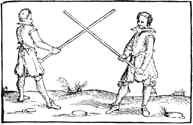
I find it interesting that JdP would restrict the grip to having the left hand in front. Joseph Swetnam in 1617 had this to say:

Keepe the point of your Staffe right in your enemies face, holding one hand at the verie butt end of the Staffe, and the other a foote and a halfe distant, looking over your Staffe with both your eies and your feet a foot and a half distance, or there-abouts, according to this picture, always standing crosse with your enemie, I meane, if his right hand and foote be foremost, let yours be so likewise, and if his left-hand and foote be formost, then make you your change and crosse with him also.
Image


This is directly related to a principle Swetnam calls the Forehand Defence, which basically says that your strongest position is to have his staff always where you can push it forward, not backward, and that you should be prepared to switch hands if your opponent does and fight equally well on both sides with either hand forward. Learning to switch the hands smoothly and quickly is tricky at first, but works well once you get used to it.

...so that you always have a care to keepe your staffe in his right place, that is to say, if your right hand and foote be formost, then leave all your bodie open, so that your enemie can not endanger you on the out-side of your staffe, but if hee will hit you, he must needes strike or thrust on the in-side of your staffe, and then you must defend all blowes or thrusts, by bearing your staffe over your bodie towards the left side, for this we call the Fore hand Defence, and this defence consumeth no time: but if in holding your staffe in the right hand, as before is said, and yet for your guarde doe beare your Staffe over towards the left hand, then you leave your right shoulder arme or face, open or unguarded, the which must bee defended backeward, but you may defend twentie thrusts or blowes before hand, better then one backeward; for the backe defence is nothing so readie, nor so certaine, as the fore-hand defence is, and therefore keepe and continue your guard, according unto the Picture, for then if hee proffer a thrust on the out-side of your Staffe: you neede not to feare nor offer to defend it, for there is no place in anie danger, but all is guarded, especiallie from the gerdle-stead upward.
0==[>>>>>>>>>>>>>>>>>
Stacy Clifford
Free-Scholar
ARMA Houston, TX

Roger Norling
Posts: 140
Joined: Fri Nov 13, 2009 5:57 am
Location: Gothenburg, Sweden

Postby Roger Norling » Tue Jan 26, 2010 3:52 am

Actually, not all JdP restricts itself to left hand lead. The Azores switches continually, from what I understand, depending on what type of strike they use.

http://www.youtube.com/watch?v=mFElG8r_d4o

I don't know what the variations in lengths of the staffs have been, but this would seem more useful with longer staffs, rather than short ones.
Quarterstaff instructor
Gothenburg Free Fencers Guild
http://www.gffg.se

Member of MFFG
http://www.freifechter.com

Member of HEMAC
http://www.hemac.org

HROARR
http://www.hroarr.com

Frederico Martins
Posts: 48
Joined: Sat Nov 21, 2009 7:01 am
Location: Lisbon
Contact:

..

Postby Frederico Martins » Tue Jan 26, 2010 6:48 am

hi!

the use of the right hand on the back in jdp is because the extremity of the staff should be the rotation pivot, and that should be the place were you have your strongest hand grip(the front hand slides to adapt to distance). I don't know about sword, that might work different but for staff that is the best way to use it. Gives you more range and more power.

never had a look at the Dom Duarte book, but ive always been told that he uses similar names of the strikes that we do. The knights and kings were professional warriors, but the people still fought too, and as you say, there should have been some exchange that influenced jdp.

Stacy, what you say about changing hands is something I, and my masters at jogo do pau dont agree due to combat reasons. In combat you don't have time to change hands like that, the azores guys do it, but they practice a more demonstrative style that is actually impressive but not the most effective. Also, practicing for both sides means you will have to practice twice to get perfect for both sides, or what will happen is that you will be half as good in both sides, and if your opponent practices the same time you do but on one side, and perfects it, he will be a better fighter than you.

Also, jdp derives and has in its core, combat against multiple opponents, and changing hands in that situation, slows you down, and weakens your strike.

We actually have forms that preserve some movements with that situations, but don't practice them much for combat situations since they don't work very well when we try it at the fastest speed. Of course you can do them, one of my masters likes to have fun with us, and does that kind of stuff because we are much weaker, but when facing other master he only uses the most effective technique and doesen't dare to use that against a equal fighter.

what you quoted stacy, about moving the foot the same as you opponent is what we do also, in same time, so you are not catch with your feet in the air, that when the 2 opponents are circulating. We just don't do the hand change, but adapt the waiting guard depending on the side we are moving to compensate that situation.

Roger Norling
Posts: 140
Joined: Fri Nov 13, 2009 5:57 am
Location: Gothenburg, Sweden

Postby Roger Norling » Tue Jan 26, 2010 7:00 am

Yep, that is what I meant with rotational points. For speed and power with circular strikes it is best to move the main hand as far to the end as possible and rotate it there. It wouldn't surprise me if you sometimes do it similarly. Since you also uses some one handed techniques you also get better reach.

With longswords we place that point inbetween the hands and push with the leading hand while we pull with the rear, a bit simplified of course, but this increases the point spead compared to if one hand is held still.

With longer staffs movements are quicker if you set the rotational point closer to the leading hand rather than the rear, although at the cost of power.

Changing hands and sides is slow with shorter weapons but is reasonable with close distance or longer and slower weapons held in half-staff, or a pollax, for that matter. Perhaps the staffs used to be longer in the Azores?
Quarterstaff instructor
Gothenburg Free Fencers Guild
http://www.gffg.se

Member of MFFG
http://www.freifechter.com

Member of HEMAC
http://www.hemac.org

HROARR
http://www.hroarr.com

Frederico Martins
Posts: 48
Joined: Sat Nov 21, 2009 7:01 am
Location: Lisbon
Contact:

Postby Frederico Martins » Tue Jan 26, 2010 9:55 am

I don't think the Azores has much different staffs, the size of the staffs was never standard until very recently, but it shouldn't be much higher than a man, or else strikes like the ascending ones start to be complicated and even rotation is slower.

Remember the origins of jogo do pau is in combat against multiple opponents, that hand change ive seen in other parts too, but they don't do that when practicing against multiple opponents.

I think that is bad practice for staffs that size, possible, but not the best way to fight, I don't know about larger ones, but probably when you get to a point in which they are so big you can barely rotate them, hand change can start to be useful, but that is not what we do at jogo do pau then. Do you have much hand changing in longsword techniques?

User avatar
Stacy Clifford
Posts: 1126
Joined: Fri May 14, 2004 11:51 am
Location: Houston, TX
Contact:

Postby Stacy Clifford » Tue Jan 26, 2010 11:41 am

The English in the time of Silver and Swetnam tended to prefer staffs that were around 7-8 feet long, longer and thicker than the ones I see in your videos, and didn't do a lot of slinging blows with one hand, using it more like a spear, so switching hands was a little more practical, and from my own practice I haven't found it that difficult to use their techniques equally well with either hand forward. I trust that the method they advocated worked well for the equipment they used, and Swetnam's principles are very sound.

So far, JdP looks more like what I've seen in Joachim Meyer, who does use large one handed slinging blows like the ones in your videos and whose method I think is optimized for a shorter staff than the English. He only describes the techniques using the left hand forward, but makes no mention whether you should learn it with either hand or not.
0==[>>>>>>>>>>>>>>>>>

Stacy Clifford
Free-Scholar
ARMA Houston, TX


Return to “Research and Training Discussion”

Who is online

Users browsing this forum: No registered users and 30 guests


Note: ARMA - The Association for Renaissance Martial Arts and the ARMA logo are federally registered trademarks, copyright 2001. All rights reserved. No use of the ARMA name or emblem is permitted without authorization. Reproduction of material from this site without written permission of the authors is strictly prohibited. HACA and The Historical Armed Combat Association copyright 1999 by John Clements. All rights reserved. Contents of this site 1999 by ARMA.