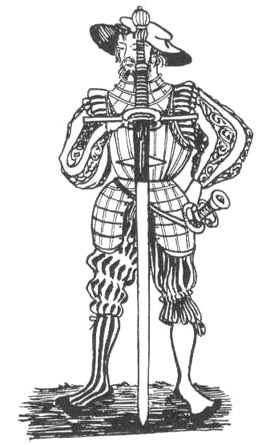
Stacy, so you mean that the two handed great sword (like here) waster should come up to my armpit, just like longsword, right? And after some good time of training I can make/get a longer waster, with length like on this pic ?
The swords in the article and the sword in the woodcut illustration are all zweihanders. The historical name for those swords would be biddenhander (both-hands) or doppelhander (double hands). Since the term 'greatsword' is ill defined, it is not wrong to refer to those swords as 'greatswords.' But I usually use the term 'greatsword' to mean either the earlier war swords like the Oakeshott XIIa and XIIIb or the 15th and 16th century swords which bridge the spectrum between longsword and true zweihander.
The zweihander is really a different weapon than longswords or the larger intermediate greatswords. It handles differently, it fights differently. It is comparable to a pike or halberd and would be used alongside those weapons while a longsword or one-hander was worn on the hip. It's not so much that you start out with a longsword, and gradually move up to bigger and bigger swords. In ARMA, we start with the longsword because that is the central weapon of the fighting arts of the Renaissance until the rapier took over. As we progress, we continue to study the longsword but branch out and study other weapons as well such as dagger, staff, sword and buckler, etc. Several of us study zweihanders as well.
But if you are interested in larger swords, intermediate greatswords work fine with the longsword material. The fechtbuch, Goliath, takes traditional longsword text and pairs it with very large greatswords. So we know that people practiced the longsword teachings with larger swords too.