fighting against shields

For Historical European Fighting Arts, Weaponry, & Armor

Moderators: Webmaster, Stacy Clifford

david a goodman
Posts: 22
Joined: Thu Nov 29, 2007 2:44 pm
Location: lubbock texas

fighting against shields

Postby david a goodman » Sat Nov 10, 2012 5:52 am

greetings all
anyone got any good info or a place to go for technique against a shielded opponent? the size in question is the "kite" style or something similar
"You live for the touch, for the feel of the steel; one man and his honor."

User avatar
John Farthing
Posts: 179
Joined: Fri Aug 12, 2005 4:09 pm
Location: ARMA Middle Tennessee
Contact:

Postby John Farthing » Sat Nov 10, 2012 10:04 am

If you are looking for historically accurate shield techniques, the sad truth is we just don't know with certainty. This is due to the fact that unlike other forms of Mediæval combat, we have no written record of how shields were used in training and/or combat. Using iconographic sources from the period coupled with a sound understanding of combat kineseology can provide a framework for some pretty educated theories though! Some of the better speculative research in this area is presented in the book 'Medieval Swordsmanship' by ARMA director John Clements. While much of the material covering the sword alone is outdated, given our current understanding of the subject, the shield content remains amongst the best speculative research/practical analysis currently in print. Another worthwhile source for gaining some insight into how shields might have been used is presented by the late Hank Reinhardt in his video: 'Viking Sword'. It is important to remember however, that the Vikings (so far as we currently know) did not write down any information about how they trained and/or fought (with a shield or otherwise), and both the work of Mr. Clements and Mr. Reinhardt is speculative and based upon practical analysis gained in earnest sparring, drilling, etcetera coupled with study of the iconographic evidence of shields in use during the Mediæval period.
-John Farthing, Free Scholar
ARMA Deputy Director

david a goodman
Posts: 22
Joined: Thu Nov 29, 2007 2:44 pm
Location: lubbock texas

Postby david a goodman » Sat Nov 10, 2012 2:57 pm

thanx john
not a lot to go on, but good info anyway. i suppose 'winging it' would be my best option going against a fully shielded opponent?
"You live for the touch, for the feel of the steel; one man and his honor."

User avatar
John Farthing
Posts: 179
Joined: Fri Aug 12, 2005 4:09 pm
Location: ARMA Middle Tennessee
Contact:

Postby John Farthing » Sat Nov 10, 2012 3:06 pm

No problem, I'm happy to help! I just noticed that you are located in or near Lubbock, Texas. I am not sure how close this is to the Dallas/Fort Worth area, but longtime ARMA member Ernie Perez is a member of the Study Group there and has had some experience working with a shield.
-John Farthing, Free Scholar

ARMA Deputy Director

david a goodman
Posts: 22
Joined: Thu Nov 29, 2007 2:44 pm
Location: lubbock texas

Postby david a goodman » Sun Nov 11, 2012 7:40 pm

lubbock's bout 8hrs from the dfw area, there are a few ARMA memebers in the west tx area but we have a hard time getting schedules together
"You live for the touch, for the feel of the steel; one man and his honor."

Roger Norling
Posts: 140
Joined: Fri Nov 13, 2009 5:57 am
Location: Gothenburg, Sweden

Postby Roger Norling » Mon Nov 12, 2012 2:38 am

The typical cavalry "heater" shield is not described in any treatise as far as I know. It is not ideal for fighting on foot as it mostly protects your side and thus makes you more undynamic. So if you are interested in the kite shield and want to experiment with it, you really should get on a horse as that is how it was used primarily.

As described, the problem is a low number of literary sources. There are some though, for instance Talhoffer on the German duelling shield, the I.33 and the Bolognese on Sword & Buckler, several sources on the Italian Rotella and a few on the Scottish Targe and some other odd shields.

Might also want to have a talk to Hammaborg regarding the use of shields. They are probably the ones who have worked the most with round shields and they are great guys and scholars. Their work is experimental, as there are no detailed sources on how to use the round shield. Much of their thoughts appear to be based on the German duelling shield for which there is quite a bit of material. Both these shield types are centre grip and therefore offer similar use.

http://www.youtube.com/results?search_query=hammaborg+viking&oq=hammaborg+viking&gs_l=youtube.3..0.1910.10399.0.10555.30.18.7.5.5.0.106.992.17j1.18.0...0.0...1ac.1.7ndZXaZhHo8

Another group that explores the round shield is Hurstwic, so you might find it interesting to contact them too:

http://www.hurstwic.org/
Quarterstaff instructor
Gothenburg Free Fencers Guild
http://www.gffg.se

Member of MFFG
http://www.freifechter.com

Member of HEMAC
http://www.hemac.org

HROARR
http://www.hroarr.com

david a goodman
Posts: 22
Joined: Thu Nov 29, 2007 2:44 pm
Location: lubbock texas

Postby david a goodman » Mon Nov 12, 2012 5:06 am

good stuff Roger
what im really looking for is how to attack against someone using that type of shield. myself, ive no use for a shield, dont like em; im also looking for good attack technique against polearms.

dave
"You live for the touch, for the feel of the steel; one man and his honor."

Roger Norling
Posts: 140
Joined: Fri Nov 13, 2009 5:57 am
Location: Gothenburg, Sweden

Postby Roger Norling » Mon Nov 12, 2012 5:48 am

Well considering that his kite shield is strapped to his left side, then I would think flanking towards his right side would be the best. Then you don't have to worry as much about his shield. This is how I handle sword & buckler fencers.

Also the shield will block his vision quite a bit and that can be exploited. Moving to his left side and causing him to raise it will blind him, so you can attack his legs.
Quarterstaff instructor
Gothenburg Free Fencers Guild
http://www.gffg.se

Member of MFFG
http://www.freifechter.com

Member of HEMAC
http://www.hemac.org

HROARR
http://www.hroarr.com

Roger Norling
Posts: 140
Joined: Fri Nov 13, 2009 5:57 am
Location: Gothenburg, Sweden

Postby Roger Norling » Mon Nov 12, 2012 5:51 am

Attacking polearms is extremely difficult if you are using a short weapon, which I assume you are. The problem is that polearms can quickly go both high and low, covering all of your body in a fraction of a second. This will put pressure on you and it is extremely difficult to protect your whole body. Instead you have to rely on handling distance well and timing. As soon as you get past the opponent's point then he is vulnerable. So, wait for him to thrust, "bind" his weapon and rush in on him.
Quarterstaff instructor
Gothenburg Free Fencers Guild
http://www.gffg.se

Member of MFFG
http://www.freifechter.com

Member of HEMAC
http://www.hemac.org

HROARR
http://www.hroarr.com

User avatar
John Farthing
Posts: 179
Joined: Fri Aug 12, 2005 4:09 pm
Location: ARMA Middle Tennessee
Contact:

Postby John Farthing » Mon Nov 12, 2012 7:09 am

Mr. Goodman,

You might also wish to check out the episode on shields from Mike Loades series 'Weapons that made Britain'. You can view it online for free at: http://www.veoh.com/watch/v6260704ENM2s ... n+-+Shield
-John Farthing, Free Scholar

ARMA Deputy Director

User avatar
James Brazas
Posts: 229
Joined: Mon Jul 25, 2011 2:29 pm
Location: Virginia Beach, VA

Postby James Brazas » Mon Nov 12, 2012 11:28 am

Another idea is to try studying those materials surviving for Sword-and-Buckler as well as Sidesword-and-Rotella.

Even if you aren't interested in shields, learning how to use them is often the best way to learn how to fight against them. It's the same reason why George Silver, who hated rapiers, learned to use one and even taught its use. To defeat the enemy, you must know him.

Sword-and-Buckler is different from Crusader-era Sword and Kite shield in that the Buckler is small, much faster in use, held in a fist grip, and made of steel. Bucklers range in size, with most being approx. 1 foot in diameter. British Royal Manuscript I.33 is a good introduction.

Sidesword-and-Rotella is different from Crusader-era Sword and Kite Shield in many ways. The Sidesword is a longer sword, has better hand protection, and favors the thrust over the cut. The Rotella is a round steel shield about 2 feet in diameter. The shield is somewhat closer to the Kite Shield, but it is still smaller, made of steel, and more mobile. It is also held in a stance that does not block the swordsman's view as much. Manciolino, Marozzo, and Di Grassi all teach Sidesword and Rotella (aka Sword and Target or Sword and Shield).

4 tactics that might be useful to you:
1. If you are using a longsword, you usually have a reach advantage over an opponent using sword-and-buckler, sword-and-shield, etc. Try to stay out of his range and thrust and cut from afar. So long as you keep the opponent at a distance, you will eventually win. This tactic works any time you have a longer weapon than your opponent.

2. Try to move to his shield-side (as before mentioned) since he can't see you as well there. You have a free hand, so you can grab his shield or buckler, wrench it to the side (or even out of his hand) and stab or cut him.

3. A good sword-and-buckler or sword-and-shield user knows that he has the advantage if he can trap your sword between his sword and shield. That would allow him to disarm you or perform various advanced counterattacks. Sword-and-buckler/sword-and-shield often has the advantage in the bind. Don't let him trap your sword. Keep it moving.

4. If your opponent has a shield or buckler, another useful tactic is feinting. If you convince your opponent that you are attacking in one direction, he will usually raise his shield/buckler to defend there. This will create an opening in another area. Immediately strike that area. Larger shields have the ability to protect a larger area at a time, but they are also slower to move. You can use that to your advantage. It can be especially difficult for him to defend against a cut to the legs when he has moved his shield to protect his head.

Hopefully this helps.

User avatar
Jon Pellett
Posts: 125
Joined: Mon Apr 04, 2005 12:15 pm
Location: Calgary, AB

Postby Jon Pellett » Mon Nov 12, 2012 7:20 pm

Thibault has a whole section on countering sword and round shield with single sword (rapier).

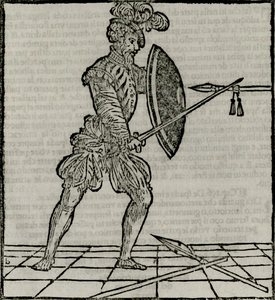
Marozzo has some short sections on sword and imbracciatura, a kite-like shield, both sword and shield against sword and shield, and sword and shield against polearms.

Image

david a goodman
Posts: 22
Joined: Thu Nov 29, 2007 2:44 pm
Location: lubbock texas

Postby david a goodman » Mon Nov 12, 2012 10:52 pm

many thanx to all those who've given input, looking forward to putting these suggestions to use
dave
"You live for the touch, for the feel of the steel; one man and his honor."

david a goodman
Posts: 22
Joined: Thu Nov 29, 2007 2:44 pm
Location: lubbock texas

Postby david a goodman » Tue Nov 13, 2012 8:30 am

John,
great video. would be interesting to see how a shield wall would hold up to a flamberge (sp) armed shock-squad.

dave
"You live for the touch, for the feel of the steel; one man and his honor."

steve hick
Posts: 104
Joined: Mon Sep 23, 2002 4:04 pm

Postby steve hick » Thu Nov 15, 2012 10:53 am

Jon Pellett wrote:Thibault has a whole section on countering sword and round shield with single sword (rapier).

Marozzo has some short sections on sword and imbracciatura, a kite-like shield, both sword and shield against sword and shield, and sword and shield against polearms.

Image


Pietro Monte has a section (short like all his sections) on the use of the shield, including the adarga which is a heart shaped or interlocking ellipses shaped shield grasped by the hand - in very erudite humanist Latin. Hopefully someone's translation will eventually see print. This is also in the pseudo Monte from Spain, which is in absolutely horrible Spanish.

The use of the adarga and lance for a light horseman is recorded in many of the mounted combat text - Gavalo for one. But I suspect this is not what you're seeking.

Steve

PS and a note the imbracciatura is also a very narrow shield.


Return to “Research and Training Discussion”

Who is online

Users browsing this forum: No registered users and 19 guests


Note: ARMA - The Association for Renaissance Martial Arts and the ARMA logo are federally registered trademarks, copyright 2001. All rights reserved. No use of the ARMA name or emblem is permitted without authorization. Reproduction of material from this site without written permission of the authors is strictly prohibited. HACA and The Historical Armed Combat Association copyright 1999 by John Clements. All rights reserved. Contents of this site 1999 by ARMA.