schielhau v. pflug

For Historical European Fighting Arts, Weaponry, & Armor

Moderators: Webmaster, Stacy Clifford

User avatar
Jeff Hansen
Posts: 122
Joined: Thu Jun 03, 2004 3:48 pm
Location: Pelham, AL

schielhau v. pflug

Postby Jeff Hansen » Sun Jun 13, 2004 6:03 pm

Just something that occured to me... It's accepted that schielhau "breaks" pflug, however, if you are aware of that, it's fairly easy to counter. What occured to me was that the nature of schielhau makes it a simple matter to throw it left a little early, and cut more or less vertically from the left shoulder, in order to come down on the left side of your opponent's blade(his right). If it can be thrown down either side of the blade, that makes it that much harder to defend. Right?
Like I said, just something that occured to me. wuddaya think? Or did everyone but me already figure this one out? <img src="/forum/images/icons/smile.gif" alt="" />
Jeff Hansen
ARMA FS
Birmingham, AL study group leader

"A coward believes he will ever live
if he keep him safe from strife:
but old age leaves him not long in peace
though spears may spare his life." - from The Havamal

User avatar
leam hall
Posts: 126
Joined: Sat Jan 24, 2004 10:49 am
Location: Texas
Contact:

Re: schielhau v. pflug

Postby leam hall » Sun Jun 13, 2004 6:59 pm

Thus the admonition to "void and counter". If you see the blow coming then footwork to your side and that answers the question of where your sword should defend.

If I'm defending against a downward blow my opponent has a wide range of options because I'm a big guy. <img src="/forum/images/icons/smile.gif" alt="" /> So i slip to my left-forward making him choose my right side as a target. That way I only have to defend that part, not my whole body.
ciao!

Leam
--"the moving pell"

User avatar
philippewillaume
Posts: 336
Joined: Wed Apr 21, 2004 6:51 am
Location: UK, windsor
Contact:

Re: schielhau v. pflug

Postby philippewillaume » Mon Jun 14, 2004 4:01 am

Jeff

I think we are on the same line here (Not that it makes it right though <img src="/forum/images/icons/laugh.gif" alt="" /> ). I think the schiel is an oberhaw that collapse the incoming blow/guard (ie plough or long point) Uncle Sigmund tells us do it to hit him in his right shoulder:

Der schilhaw mitt sinen stucken.
Schiller ein bricht, waß bufler schlecht oder stycht. Wer wechsel trawet, schiller jn dar vß beraubet.
Glosa.
Hie merck: der schiller ist ain haw, der den buffeln, die sich maysterschafft an nemmen mit gwalt, in brich in hawen vnd stechen. Vnd den haw tryb also: wan er dir eben ein hawet (31 v ) von siner rechten sytten, so haw och von dener rechten sytten mit der kurtzen schnyden mit vff gerechten armen gen sinen hawe jn die schwech sines schwerts vnd schlag jn vff sinen rechten achsel. Wechselt er durch, so schyß jn mit dem hawe, lang jn zu° der brust. Vnd also haw a°ch, wan er gen dir stat jn der hutte des pflugs oder wen er dir vnden zu° wyll stechen.

The schielhaw with its pieces
The shill breaks what the buffalo strike or thrust. Who trusts changing/ who relies on changing, the schill will despoil him.
Here mark: the sheil is a strike that breaks the strike and thrust of the buffaloes who imbue (annemmen=annehmen) the craft of master with strength (gwalt=gewalt). And the strike goes like so: when he strikes you accordingly, so strike as well from your right side towards his blow, with extended arms. With the short edge in the weak of his sword and strike him over/onto the right shoulder. Should he change through, then shoot him long (i.e. trust) with the strike in the chest? And strike him so as well when he stands in the guard of the plough against you or when he when he wants to thrust from under.

The bit that is tricky with schiel is the short edge bit. From the only text that I know of on what the short edge is, and from the drawings that comes with it,(IE Meyer) I think it as much a hands position as the side of the sword facing you. To be fair it really a matter of turning the sword or turning your hands


philippe
One Ringeck to bring them all In the Land of Windsor where phlip phlop live.

User avatar
Jeff Hansen
Posts: 122
Joined: Thu Jun 03, 2004 3:48 pm
Location: Pelham, AL

Re: schielhau v. pflug

Postby Jeff Hansen » Mon Jun 14, 2004 8:50 am

What I'm talking about is that last line of the quote from "Uncle Sigmund", "And strike him so as well when he stands in the gaurd of the plough against you". Unfortunately, I haven't obtained a copy of Ringeck yet. However, I am fortunate enough to live in Provo, UT so I can work with a study group every week, so my knowledge of Sigmund's admonitions is second hand. My idea was, that in the limited instance of use against someone who stands statically in pflug, you could throw the schielhau to hit the right hand of your opponent as I described in my initial post. This is in addition to the way I've been shown, which was basically a low schielhau which beats on the right side of the opponent's blade before continuing on to strike his left hand/wrist/forearm, probably to be followed by a thrust to the important stuff. To my mind, more options for attack lead to greater odds of success (or at least opponent failure). Unless, of course, it just doesn't work, which to the best of my knowledge has yet to be determined.

Clear as mud?
Jeff Hansen

ARMA FS

Birmingham, AL study group leader


"A coward believes he will ever live

if he keep him safe from strife:

but old age leaves him not long in peace

though spears may spare his life." - from The Havamal

User avatar
JeffGentry
Posts: 1089
Joined: Tue Apr 20, 2004 8:35 am
Location: Columbus Ohio

Re: schielhau v. pflug

Postby JeffGentry » Mon Jun 14, 2004 9:48 am

Well IMHO i think your looking at this as static, but normaly you move into and through your gaurd's as the fight develope's. If you look at this By Ringeck you see the dynamic of "and if he does this".

The Squinter (schielhau) is a strike which primarily "breaks" the strikes and thrusts of those fencers, who rely only on their strength. Do it like this: If he attacks you from his right side, strike from your right side with the short edge and extended arms against the weak of his sword and hit him on the right shoulder. If he changes through, thrust him into his breast with your arms extended. You should strike like this, too, if he faces you in the guard of the plough or if wants to thrust you from below.

Notice he say's this is good to use against those who rely on there strength, it would be good to try it and see you have sound reasoning behind you.
Semper Fidelis

Usque ad Finem

Grace, Focus, Fluidity

User avatar
Jeff Hansen
Posts: 122
Joined: Thu Jun 03, 2004 3:48 pm
Location: Pelham, AL

Re: schielhau v. pflug

Postby Jeff Hansen » Mon Jun 14, 2004 11:14 am

When I say "static pflug", consider that to a truly skilled practitioner that may be merely pausing in your guard for a matter of seconds while considering your next move. If anyone has conquered that particular habit completely, I salute you. I know I'm certainly guilty of "hanging out" in one gaurd or another for far too long between exchanges. (a habit I'm trying to break)

I'm not addressing schielhau vs. (for instance) zornhau because it doesn't need to be addressed. who can argue with a technique that, in my experience, is so effective that it's actually difficult to restrain from braining your opponent in friendly practice. <img src="/forum/images/icons/grin.gif" alt="" />


p.s. - I'm old enough that I didn't grow up with a computer, and I'm new to this forum stuff.-- so what the heck does IMHO mean anyway? <img src="/forum/images/icons/confused.gif" alt="" />
Jeff Hansen

ARMA FS

Birmingham, AL study group leader


"A coward believes he will ever live

if he keep him safe from strife:

but old age leaves him not long in peace

though spears may spare his life." - from The Havamal

User avatar
Brian Hunt
Posts: 969
Joined: Thu Jan 23, 2003 2:03 am
Location: Price, Utah
Contact:

Re: schielhau v. pflug

Postby Brian Hunt » Mon Jun 14, 2004 12:16 pm

Hey Jeff,

IMHO means "in my humble opinion"

hope that helps. <img src="/forum/images/icons/smile.gif" alt="" />

Brian Hunt
GFS
Tuus matar hamsterius est, et tuus pater buca sabucorum fundor!

http://www.paulushectormair.com
http://www.emerytelcom.net/users/blhunt/sales.htm

User avatar
Shane Smith
Posts: 1159
Joined: Thu Sep 19, 2002 2:15 pm
Location: Virginia Beach

Re: schielhau v. pflug

Postby Shane Smith » Mon Jun 14, 2004 2:32 pm

Another thing to be concerned with is whether your opponent is a "runner" or not. Many will seek a void and counter as their most common option against an attack on many occasions. This makes life a bit trickier for the meisterhau in my opinion as even though you close with the pass,your opponent is passing away while seeking your hands with his own strike. It seems to me that the master cuts work great against another that does not know them,much less so when your opponent does as he is mindful of the developing situation(Unless of course you chase the runner down with a probing flurry of zwerchaus while defending his counter) <img src="/forum/images/icons/wink.gif" alt="" /> That is my experience anyhow.Others may disagree.
Shane Smith~ARMA Forum Moderator
ARMA~VAB
Free Scholar

User avatar
philippewillaume
Posts: 336
Joined: Wed Apr 21, 2004 6:51 am
Location: UK, windsor
Contact:

Re: schielhau v. pflug

Postby philippewillaume » Tue Jun 15, 2004 6:13 am

hello all
Jeff, I think I understand what you mean (famous last words). <img src="/forum/images/icons/wink.gif" alt="" />

There is a feint with the sheil where you actually hit the hands
IE
Aber ain stuck vß dem schillhaw.
Schill zu° dem oberen haupt, hende wilt dü bedebren.
Glosa.
Merck, wen er dir oben will jn hawen, so schill mit dem gesicht, alß dü jn vff das haupt wylt schlagen. Vnd haw mit der kurtzen schnyden gen sinen haw, vnd schlag jn an siner schwertz klingen mit dem ort vff die hend.

Yet another piece of the Shiel
Shiel to the top of the head, the hands you will inherit (bedebren=bederbenen=to benefit of the usufruct)
Glose
Mark; when he wants to strike you high, then Shiel with the glance as if you were to strike his head. And strike with the short edge towards his strike, and strikes at his blade with the point at/to the hand,

But to break the guard you are targeting the right shoulder.
Good old Joachim gives us a nice idea of what I mean by the position of the hands. http://schielhau.org/Meyer.p11.html
Please not that it is not the scheil as described in ringeck it is just to illustrate the position of the front hands. (I think the arms are lower in ringeck but it is against a big whallop so)

So to go back at hitting the hand with the schiel whilst the other is in plough,
yes it can work however it will work because you are quicker than your opponent so it can work but you are not taking advantage of Ringeck system.
In my opinion Ringeck system give you mechanical advantage so you do not have to be quicker of you opponent If you attack the hands to break the plough, you are going toward the strong of you opponent so he can potentially counter you. A changing through an abzetsen, a schnit or a wrestling. I think the whole idea to keep the point up is to control the shoulder. So that you prevent any movement forward and you deprive him of all counter options save doing a versetzen, and if he is not on the ball it is likely that it is going to be a bad versetzen or something you can wind from
Does that make sense ?

Shane
I agree with you thought I think all the master haw can be obtain by transforming the zornh (or any uberhaw) so it adds a certain dynamic components. And the fact that you need to get close enough to strike so that the blow can be delivered as quickly as possible.
That being said it is not magic and the braking of the initial distance is a tad dodgy in any style. (This where pooh-pooh can happen even more than any other times) beside long ort (or sprechfenster) is you friend.

philippe
One Ringeck to bring them all In the Land of Windsor where phlip phlop live.

david welch
Posts: 453
Joined: Wed Dec 18, 2002 5:04 am
Location: Knoxville TN

Re: schielhau v. pflug

Postby david welch » Thu Jun 17, 2004 9:20 pm

This is something we are just starting to explore in Knoxville with Meyer, so please bear with me.

I am starting to believe that the strikes to break a guard is not to break that guard, but the natural defense to a strike you will go into from that guard.

If you are in pflug, and I get a good strike down on your head, if you are making sure you are guarding yourself, you will probably go to hengen, since it would be hard to meisterhaw schielhau from pflug.

So if I know you will go to hengen from pflug, I will make my cut a schielhau, since the short edge cut wraps around hengen and lets me cut your head. If you do stop my cut, you will want to cross your arms and make a long edge cut to my opposite hip, but from schielhau if I do the same ( cross arms and make a long edge cut to the opposite hip ) my cut comes under yours and protects me in a barrier guard. from there I would continue cutting to the rest of the four divisions.

So I guess what I am trying to say is that it is thinking ahead a move like you would in chess. It doesn't break pflug, it breaks where you go from pflug.

Is anyone else working on this line of strategy, or have any thoughts about it?
"A sword never kills anybody; it is a tool in the killer's hand." Lucius Annaeus Seneca 4BC-65AD.

User avatar
Randall Pleasant
Posts: 872
Joined: Mon Sep 23, 2002 3:35 pm
Location: Flower Mound, Texas, USA

Re: schielhau v. pflug

Postby Randall Pleasant » Thu Jun 17, 2004 9:48 pm

David wrote:
It doesn't break pflug, it breaks where you go *from* pflug.
David

I must disagree with you. In order for your statement to be true then you have to show that <u>all</u> translations of Ringeck, Goliath, and Meyer's contain major errors. All of the translations of these works are very clear about Schielhau breaking Pflug. What you are describing may work but it is different than what the masters appeared to have said.
Ran Pleasant

User avatar
James_Knowles
Posts: 143
Joined: Tue Sep 23, 2003 7:15 pm
Location: Utah, USA

Re: schielhau v. pflug

Postby James_Knowles » Fri Jun 18, 2004 2:01 am

If you are in pflug, and I get a good strike down on your head, if you are making sure you are guarding yourself, you will probably go to hengen, since it would be hard to meisterhaw schielhau from pflug.
(emphasis mine)

Where you go is dependent upon the situation, but I'd have to disagree with the general idea expressed here. If I can deflect and strike (schielhau) in one technique, rather than two (via hengen as the intermediate technique), I'll choose economy of motion.

I've played with this a little bit from Ringeck, but have started to cross-reference to the other books. I'm having to alter my original thinking from being first taught and applying it against static pflug.

I'm fairly comfortable with using scheilhau against a static pflug. I find it's fairly effective to step in/right (twisting hands) and continue the motion to cut/thrust.

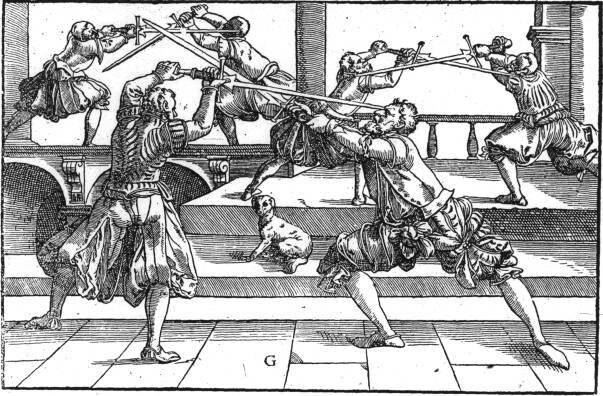
I'm still playing with using scheilhau to break an oberhau (mostly from Ringeck), but I'm starting to see that yes, it can be done as described. (It doesn't appear to be tremendously powerful, but I'm still a beginner.) The Meyer image gave me an "AHA!" moment for scheilhau vs. oberhau.

Image

Instead of going to a "left pflug"-ish position, this shows a "left ochs"-ish positon. It appears that he also may have voided the oberhau with the side step. If so, then it's a straightforward motion to go from pflug to this high sheilhau.

I still suck at it, but it adheres to the general concept of moving from one guard position to another. I've found that as a general principle it's not a problem to deal with the oberhau. Learning timing &amp;c. is the challenge.

I want to go play with this some more.
James Knowles
ARMA Provo, UT

User avatar
Joachim Nilsson
Posts: 331
Joined: Wed Oct 02, 2002 2:08 pm
Location: Gimo, Sweden

Re: schielhau v. pflug

Postby Joachim Nilsson » Fri Jun 18, 2004 9:16 am

James Knowles wrote:
Instead of going to a "left pflug"-ish position, this shows a "left ochs"-ish positon. It appears that he also may have voided the oberhau with the side step. If so, then it's a straightforward motion to go from pflug to this high sheilhau.


But Meyer -whom you refers to with the above picture- states that Schielhau should be executed from the High Guard/Roof/Vom Dach. Not Pflug.

Schielhauw ist auch ein Oberhauw, aber darumb also genant das er gleich mit einer kleinen Schiele gehawen, wirt also gemacht, stell dich in die Hut des Tags oder Zorns (davon im dritten Capitel) mit dem Lincken fuß vor, wirt auff dich gehauwen, so Hauwe hingegen, doch im streich verwende dein kurtze schneid gegen seinem streich, unnd Schlag mit ebichter hand zuglich mit ihme hinein, trit mit deinem Rechten Fuß wol auff seine Lincke seiten, und nimm den Kopf geschwindt mit, so hastu ihm recht gethan, und stehest wie das grosser Bild in nechst gedachter Figur mit dem G gegen der lincken anzeiget.

The Glancing Strike is also a High strike, but has been so named in that one closes with a small glancing blow, which is done thus: put yourself in the Guard of the Roof or Wrath (as shown in the third chapter) with your left foot forward, from which you will be striking, and while striking be sure to wind your short edge against his strike, and hit with inverting hands at the same time as closing with him, step fully with your Right Foot toward his left side, and so quickly take his head, thus have you done it rightly, and will stand as shown by the figures fighting on the left side of illustration G.


Going from Pflug to Ochs in order to defend against an Oberhau is more reminiscent of an Absetzen action. It's referred to -albeit begining in a left side Pflug- in David Lindholm's book on page 132.

In my mind, there are two versions of Shielhau; one low to break Pflug and one high [as the one in Meyer for instance] to defend against an Oberhau.
-----------------------------------
ARMA Gimo, Sweden

Semper Fidelis Uplandia

david welch
Posts: 453
Joined: Wed Dec 18, 2002 5:04 am
Location: Knoxville TN

Re: schielhau v. pflug

Postby david welch » Fri Jun 18, 2004 10:23 am

Where you go is dependent upon the situation, but I'd have to disagree with the general idea expressed here. If I can deflect and strike (schielhau) in one technique, rather than two (via hengen as the intermediate technique), I'll choose economy of motion.


I think I have to apologize for making my explanation extra complicated. I should have written:

"since it would be hard to meisterhaw against a schielhau from pflug.


But Meyer -whom you refers to with the above picture- states that Schielhau should be executed from the High Guard/Roof/Vom Dach. Not Pflug.


Also, in plate G Meyer states "as shown by the figures fighting on the left side of illustration G."

If you look at the two figures in the background left on plate G, you see a schielhau striking around hengen. This is really what got us thinking around these lines. Reading about "schielhau breaking pflug", and hengen being a transitional guard coming from somewhere else, it went with what we have been doing.
"A sword never kills anybody; it is a tool in the killer's hand." Lucius Annaeus Seneca 4BC-65AD.

User avatar
JeffGentry
Posts: 1089
Joined: Tue Apr 20, 2004 8:35 am
Location: Columbus Ohio

Re: schielhau v. pflug

Postby JeffGentry » Fri Jun 18, 2004 10:58 am

like what was stated earlier it seem's best to void and counter, These are the technique's i think some of this is tactical to. Depending on your proficiency and predisposition as far as what is quickest for you to do, i can see scheilhau would force you to move out of pflug to something else and i wonder if it would not be decide to a limited extent by personal experience, and your feel of the opponent.You reasonably could void and do around over your head in the after and strike to the opponent's right side from pflug and it would be quick and unpredictable. is Just MHO. I just wonder what they mean by "breaking pflug" do they mean defeat it or make the opponent do something to throw off the timing while you are still attacking and a threat.
Semper Fidelis


Usque ad Finem


Grace, Focus, Fluidity


Return to “Research and Training Discussion”

Who is online

Users browsing this forum: No registered users and 16 guests

cron


Note: ARMA - The Association for Renaissance Martial Arts and the ARMA logo are federally registered trademarks, copyright 2001. All rights reserved. No use of the ARMA name or emblem is permitted without authorization. Reproduction of material from this site without written permission of the authors is strictly prohibited. HACA and The Historical Armed Combat Association copyright 1999 by John Clements. All rights reserved. Contents of this site 1999 by ARMA.