Kimura equivalent in Ringen

European historical unarmed fighting techniques & methods

Moderators: Webmaster, Stacy Clifford

User avatar
Corey Roberts
Posts: 223
Joined: Sat May 07, 2005 6:11 pm
Location: Pyeongtaek, South Korea

Kimura equivalent in Ringen

Postby Corey Roberts » Wed Jun 11, 2008 11:11 pm

Question: is there an equivalent/similiar technique in Kampringen to the Kimura? Is it perhaps in CW? I have a vague notion it's in one of the manuals somewhere but maybe I'm out to lunch.
--Scholar-Adept
Pyeongtaek
Republic of Korea

User avatar
Jeff Hansen
Posts: 122
Joined: Thu Jun 03, 2004 3:48 pm
Location: Pelham, AL

Re: Kimura equivalent in Ringen

Postby Jeff Hansen » Thu Jun 12, 2008 8:01 am

Corey Roberts wrote:Question: is there an equivalent/similiar technique in Kampringen to the Kimura? Is it perhaps in CW? I have a vague notion it's in one of the manuals somewhere but maybe I'm out to lunch.


What is the Kimura? Even though I trained mma for over a year and know the word, I always paid more attention to techniques than terminology.
Jeff Hansen
ARMA FS
Birmingham, AL study group leader

"A coward believes he will ever live
if he keep him safe from strife:
but old age leaves him not long in peace
though spears may spare his life." - from The Havamal

User avatar
Brent Lambell
Posts: 107
Joined: Thu Feb 15, 2007 3:02 pm
Location: Portland, OR

Postby Brent Lambell » Thu Jun 12, 2008 9:27 am

I can think of a dagger technique that uses an arm lock similar to the kimura - Codex Wallerstein if memory serves. But a true ringen technique does not come to mind, I would guess that its in there somewhere and the dagger technique transfers well to unarmed for what it's worth. However, with so little ground fighting in WMA I think we don't have anything identical to the kimura. The technique is a pretty basic arm lock in essence, I think a major difference for ARMA versus BJJ or Judo is that we do the technique standing up.

User avatar
Mike Cartier
Posts: 594
Joined: Mon Sep 23, 2002 12:21 pm
Location: USA Florida

Postby Mike Cartier » Thu Jun 12, 2008 1:39 pm

Kimura is a Brazilian Jiujitsu technique, and has a standing and ground version. However thestanding version is hard to use as a submission without strikes. Its earlier names are the Hammer lock from catch as catch can wrestling and shoot fighting and possibly even back into Antiquity with the anceient greek pankration. there are depictions of it although not with any name of course.


i love Kimura BTW its a great sub attempt that can mask a slick sweep on the ground , essentially allowing a double attack.

Just the hand position itself has alot of leverage and can be used to control the opponents body well , standing on on the ground.
Mike Cartier
Meyer Frei Fechter
www.freifechter.com

User avatar
David_Knight
Posts: 171
Joined: Sat Sep 27, 2003 4:56 am
Location: Brooklyn, NY

Postby David_Knight » Thu Jun 12, 2008 5:29 pm

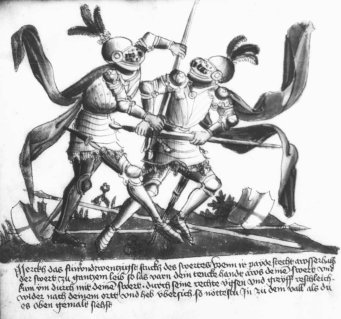
There are many variations of this (from Gladiatoria):
Image

And several from Mair:
Image Image

But I'd have to search for an unarmed version. Not sure if I have seen one.

User avatar
Ken Dietiker
Posts: 98
Joined: Wed Jul 19, 2006 1:01 pm
Location: Tacoma, WA, USA

Postby Ken Dietiker » Thu Jun 12, 2008 8:30 pm

Fiore die Liberi, "Flos Deullatorum" (Getty);

It's one of the bind of the "Lower Keys". Fiore uses it primarily against an armed opponent to control the other's weapon (and presumably, as illustrated in the dagger techniques, to take it away and use it against him.)

Dagger - Folio 10 Verso, bottom right play
http://www.getty.edu/art/gettyguide/artObjectDetails?artobj=143469&handle=li

Dagger - Folio 14 Recto, bottom left play
http://www.getty.edu/art/gettyguide/artObjectDetails?artobj=143481&handle=li

Longsword - Folio 29 Verso, bottom left play
http://www.getty.edu/art/gettyguide/artObjectDetails?artobj=143512&handle=li

Halfsword - Folio 33 Verso, both bottom left and right plays (continuous technique).
http://www.getty.edu/art/gettyguide/artObjectDetails?artobj=143521&handle=li


But I agree with David; not sure I've ever seen one unarmed that I can remember.
Last edited by Ken Dietiker on Sat Jun 14, 2008 8:28 am, edited 1 time in total.
Ken

-----
"They are ill discoverers that think there is no land,
when they can see nothing but the sea". ~Francis Bacon

Jay Vail
Posts: 558
Joined: Thu Sep 26, 2002 2:35 am

Postby Jay Vail » Fri Jun 13, 2008 4:12 am

Ken Dietiker wrote:
But I agree with David; not sure I've ever seen one unarmed that I can remember.


Yes, actually there are a few. See Codex Wallerstein, plates 86, 137 and 142. (142 is the famous one where the defender also is striking the back of the attacker's neck with the edge of his hand).

Stewart Sackett
Posts: 116
Joined: Mon Dec 11, 2006 5:46 am
Location: Portland, OR

Postby Stewart Sackett » Sun Aug 24, 2008 12:38 pm

I find the tequnique in Plate 86 of the codex to be very effective & commonly available if you know how to pummel for underhooks. As a matter of fact I'll ofen use this from the guard in jiu-jitsu rather then the typical "figure-four" kimura. I simply turn my hip under my opponent instead of using the lunge that powers the technique when standing.
Last edited by Stewart Sackett on Sun Aug 24, 2008 6:13 pm, edited 1 time in total.
All fighting comes from wrestling.

User avatar
David_Knight
Posts: 171
Joined: Sat Sep 27, 2003 4:56 am
Location: Brooklyn, NY

Postby David_Knight » Sun Aug 24, 2008 3:26 pm

Since the original question specifically asked about a "kimura", let's be precise with the terminology.

Plate 86 isn't a kimura. It isn't even a submission. It's a throw that works by cranking the upper arm and shoulder to drive the opponent off-balance while turning him over your leg. If he resists, yes, you will dislocate his shoulder, but generally it will drive a standing opponent forwards and downwards and is thus more of a setup for the throw. No leverage is exerted against the opponent's wrist or forearm, as you'd see in a kimura. This technique is very easily and effectively adapted as a takedown for MMA purposes; it's my signature move from an underhook and one that nobody expects. You end up right in side control, and as the text says, it "is good with strong men."

Plate 137 isn't a kimura either; it's a "paintbrush" (or "americana") standing. Granted, both techniques are similar, and the way the attacker positions his hands is the same , but it isn't a kimura proper.

Plate 142 is a kimura if you use that term to describe any arm crank that leverages the opponent's forearm upwards from behind, but the Codex shows a different hand/arm position than you'd see in any art that uses the specific term "kimura".

Stewart Sackett
Posts: 116
Joined: Mon Dec 11, 2006 5:46 am
Location: Portland, OR

Postby Stewart Sackett » Sun Aug 24, 2008 6:11 pm

You are absolutely right that plate 86 is not a kimura however, when used as a break, it does use the same shoulder pressure as a kimura & as I've said: the arm position can be used (on the ground) to apply a submission that has the same mechanical effect as the kimura.

When classifying submissions I tend to categorize any shoulder lock that places the palm back (in contrast with the americana which places the palm forward) as a kimura variation because the mechanical effect on an opponent is the same. Having said that, each major variation has it's own routes & posture even if the essential pressure remains the same.

I've seen nothing that matches a traditional kimura in the unarmed portions of the fightbooks but there are weapon techniques that lever the arm in a kimura "style" & a good deal of unarmed techniques that attack the shoulder through rotation like either the kimura or americana.
All fighting comes from wrestling.

Jay Vail
Posts: 558
Joined: Thu Sep 26, 2002 2:35 am

Postby Jay Vail » Sat Aug 30, 2008 4:14 pm

David_Knight wrote:Since the original question specifically asked about a "kimura", let's be precise with the terminology.

Plate 86 isn't a kimura. It isn't even a submission. It's a throw that works by cranking the upper arm and shoulder to drive the opponent off-balance while turning him over your leg. If he resists, yes, you will dislocate his shoulder, but generally it will drive a standing opponent forwards and downwards and is thus more of a setup for the throw. No leverage is exerted against the opponent's wrist or forearm, as you'd see in a kimura. This technique is very easily and effectively adapted as a takedown for MMA purposes; it's my signature move from an underhook and one that nobody expects. You end up right in side control, and as the text says, it "is good with strong men."

Plate 137 isn't a kimura either; it's a "paintbrush" (or "americana") standing. Granted, both techniques are similar, and the way the attacker positions his hands is the same , but it isn't a kimura proper.

Plate 142 is a kimura if you use that term to describe any arm crank that leverages the opponent's forearm upwards from behind, but the Codex shows a different hand/arm position than you'd see in any art that uses the specific term "kimura".


I've always found there is little agreement on what a kimura is in the modern mma community. Generally, however, I've heard the word used to refer to a technique that is also called a "figure 4." Figure 4s come in two flavors: those that work the upper key and those that work the lower key. David thinks the kimura means only the figure 4 in the lower key. I have not yet seen a manual showing the figure 4 in the lower key. There are 2 versions in the upper key, which I have already cited above.

Jay Vail
Posts: 558
Joined: Thu Sep 26, 2002 2:35 am

Postby Jay Vail » Sun Aug 31, 2008 2:58 pm


Stewart Sackett
Posts: 116
Joined: Mon Dec 11, 2006 5:46 am
Location: Portland, OR

Postby Stewart Sackett » Sun Aug 31, 2008 3:27 pm

& here's an instructional video on how to apply a kimura (low key) from standing & finish on the ground:

http://www.youtube.com/watch?v=U2FajIE2gHI
All fighting comes from wrestling.


Return to “Unarmed Skills Discussion”

Who is online

Users browsing this forum: No registered users and 9 guests


Note: ARMA - The Association for Renaissance Martial Arts and the ARMA logo are federally registered trademarks, copyright 2001. All rights reserved. No use of the ARMA name or emblem is permitted without authorization. Reproduction of material from this site without written permission of the authors is strictly prohibited. HACA and The Historical Armed Combat Association copyright 1999 by John Clements. All rights reserved. Contents of this site 1999 by ARMA.