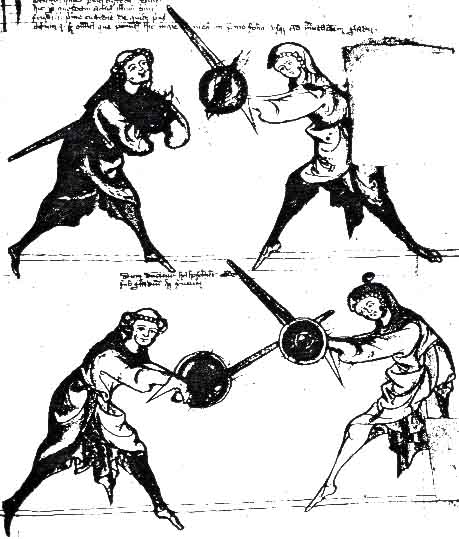
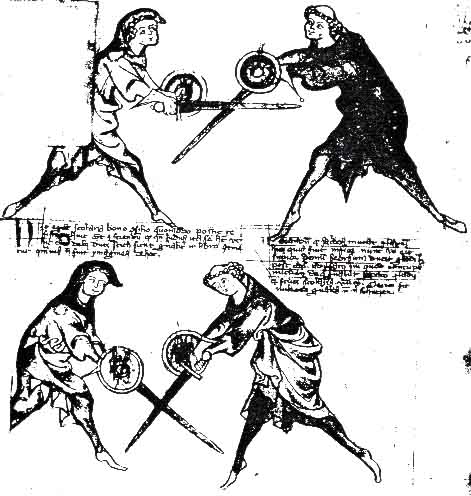
“Falling Under the Sword & Shield” is the first technique shown in the I.33 manual and starts with the priest in the Under-Arm (1st) guard and the student in the Half-Shield opposition. Although this technique is composed of very simple actions, basically a falling action and an under action, most scholars seem extremely confusion about how the technique is performed. To date, not a single interpretation of “Falling Under the Sword & Shield” put forth by scholars outside of the current ARMA membership have consisted of the priest's sword actually falling and then moving under the weapons of the student. For example, the interpretations by Guy Windsor, Paul Wagner, Roland Warzecha (http://www.swordschool.com/assets/files/pdf/133article080424.pdf), and Sean Hay (http://www.northwestacademyofarms.com) consisting of a raising cut by the priest that establishes a bind againt the blade of the student. I must view these interpretations as fundamentally wrong since a raising cut does not fall and the bind does in any way move under the student's weapons. I think the root of the problem for the above scholars is that they view “Falling Under the Sword & Shield” as just the action show in the bottom image on page 3 of I.33.
My interpretation of “Falling Under the Sword & Shield” consist of more than just the action shown in the bottom image on page 3. “Falling Under the Sword & Shield” is a play that starts with the cut shown on page 3 and concludes with the actions shown in both images of page 6 where the priest changes from an under-bind to an over-bind from which he will perform a shield-strike and a cut. When this play is executed at speed, with the student actively attempting to establish an over-bind and shield-strike as shown on pages 3 and 4, we see the priest making a cut that “falls” and then moves from an under-bind under the sword & shield of the student so as to establish an over-bind. Anywhere in I.33 where its author saids, "When Half-Shield is adopted, fall under the sword and shield" he is talking about the full play from page 3 to page 6. Please note that to the best of my knowledge all scholars working with I.33 do perform in one manner or another the change from an under-bind to an over-bind shown on page 6. However, none of them have associated that action with the “Falling Under the Sword & Shield” technique.
The whole reason behind performing “Falling Under the Sword & Shield” is that from the Under-Arm guard the priest cannot establish a strong safe bind against the student's blade. From such a bind the student has many options for counter attacking the priest. For this simple reason I consider the interpretations by Windsor, Wagner, Warzecha, and Hays as martially unsound. By performing the “Falling Under the Sword & Shield” technique the priest pulls the student into moving into a situation in which the priest can establish a strong safe bind from which he can perform a shield-strike.
 |
||||||||
|
|
||||||||