Hi Randall.
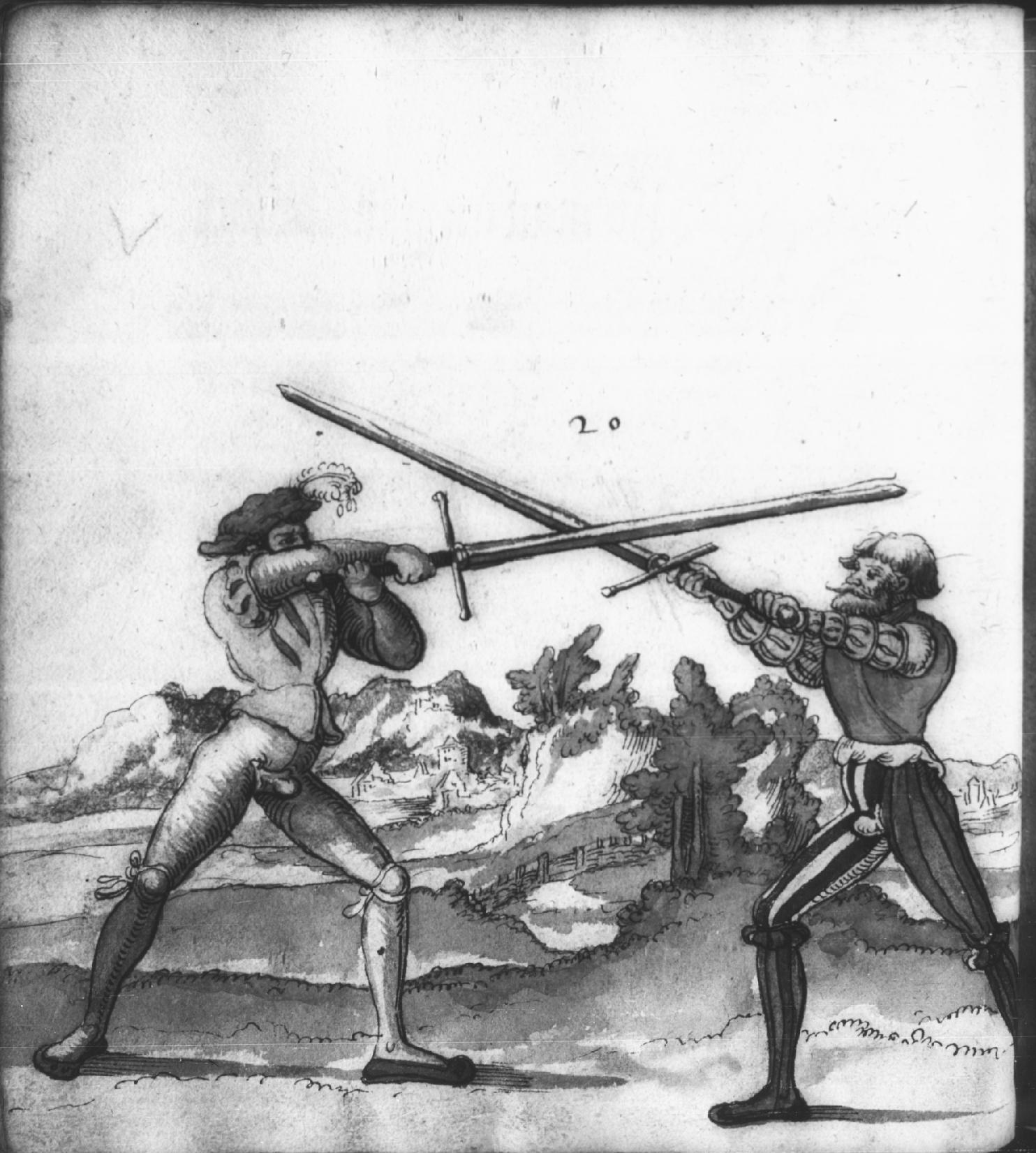
I've been working with that drawing for a while. It's vexing. Notice that he appears to be striking with the long edge. Yeah. Vexing.
As for the thrust from pflug not ending in long point...
WHAT?
Of course it ends in long point. That's where thrusts go. Why would anyone chose not to fully extend their thrust except as an issue of close range? I have found no thrusts that are not fully extended when range permits it. Thus a thrust from pflug will "end" in long point, with the knuckles down, long edge down.
If we look at the guy on the left, though, he isn't fully extended into long point, and if he did, not only would the attack be a thrust (not a cut), but the range gained would not be enough to save him from anything without an accompanying deflection. The hypotenuse issue is exactly my problem with the schiller "overrunning" the thrust from the plough--it's on the wrong angle, while the plough-thrust isn't.
I'll tell you what I *do* see in this image, though. Meyer's and Talhoffer's "Sturzhauw." Going off of this we could postulate (reasonably), that the earlier masters didn't differentiate (I'm sure they didn't). The Schiller that Meyer shows is with uncrossed hands. If we cross arms (as depicted here), then we can hit the right shoulder and create a krump-like deflection of the incoming strike. After all, Goliath (and Doebringer?) say to strike the Schiller "with a twist of the blade." This is generally understood to mean rotating the blade to strike with the short edge--but perhaps it's referring to a quick crossing of the arms, "twisting" the whole weapon as the strike is thrown.
However, even then, we're in a little bit of trouble, as this image shows the schiller against an oberhau, not an attack from pflug.
In fact, since we're on the subject, let's talk about Goliath and this image some more.
Goliath says:
"The Schiller breaks what the "puffel" strikes or thrusts. Who breaks with changing (wechsel), the Schiller robs him of it.
"Glossa
"The Schielhau breaks the guard which is called the pflug and it is a particular good and honest stroke, as it breaks with force the strokes and thrusts. And it goes with the turned (twisted?) sword, therefore there are many masters of the sword that cannot say anything about this stroke.
"How one should strike the Schiller.
"Mark, if you come to him in the zufechten, stand with the left foot forwards and hold your sword on your right shoulder. If he strikes to you from above to the head, turn your sword and strike against his stroke with the short edge far from straightened arms from above over his sword to his head. If he is prudent and wants to change through (durch wechseln) from below, let the point shoot long forwards with the stroke so that he is not able to change through from below."
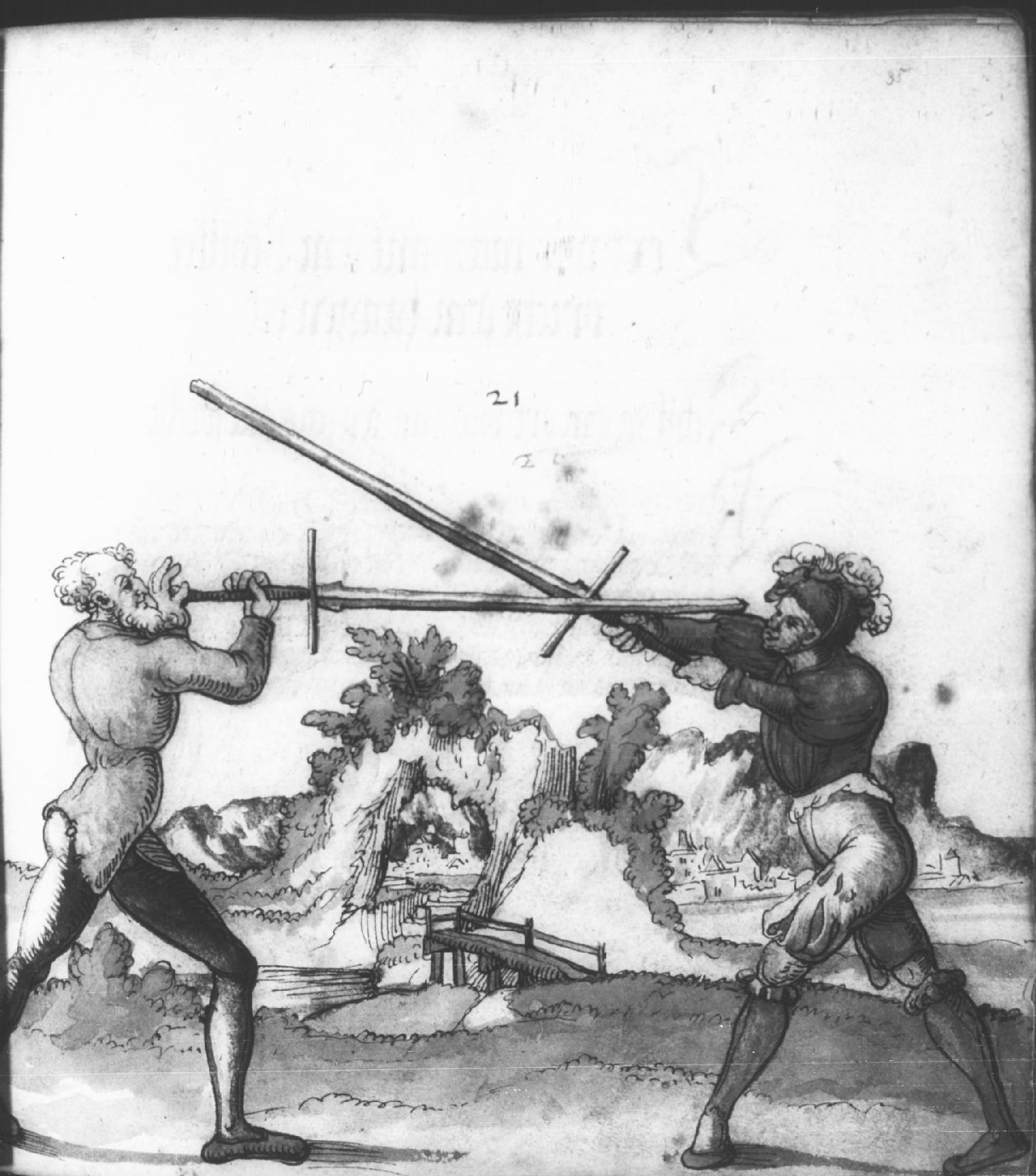
The image follows this. Should the guy on the right raise his left hand in order to wechselhau to the lower opening of the guy on the left, then the right-triangle principle works fine--the new attack is on a longer line than the schiller is. So we agree there, at least. It's also worth noting (in response to an earlier discussion with Shane Smith) that the guy on the left, performing the schiller, appears not to have stepped with the strike, except maybe to widen his stance a little with a simple step forward. But that's from another discussion.
Goliath continues:
"Another one.
"If you stand against him and hold your sword on your right shoulder and he stands against you in the guard of pflug and wants to thrust at you downwards, strike to him with the schiller from above and move the point long to him to the breast, so that he is not able to reach you below with the thrust."
Here, again, we're looking at the right triangle principle--doing exactly what you said. But in both instances the schiller seems to hinge on the bad guy attacking the *lower* openings with tha thrust or strike. In which case yes, the schiller will successfully overreach. But *any* oberhau will overreach in those circumstances.
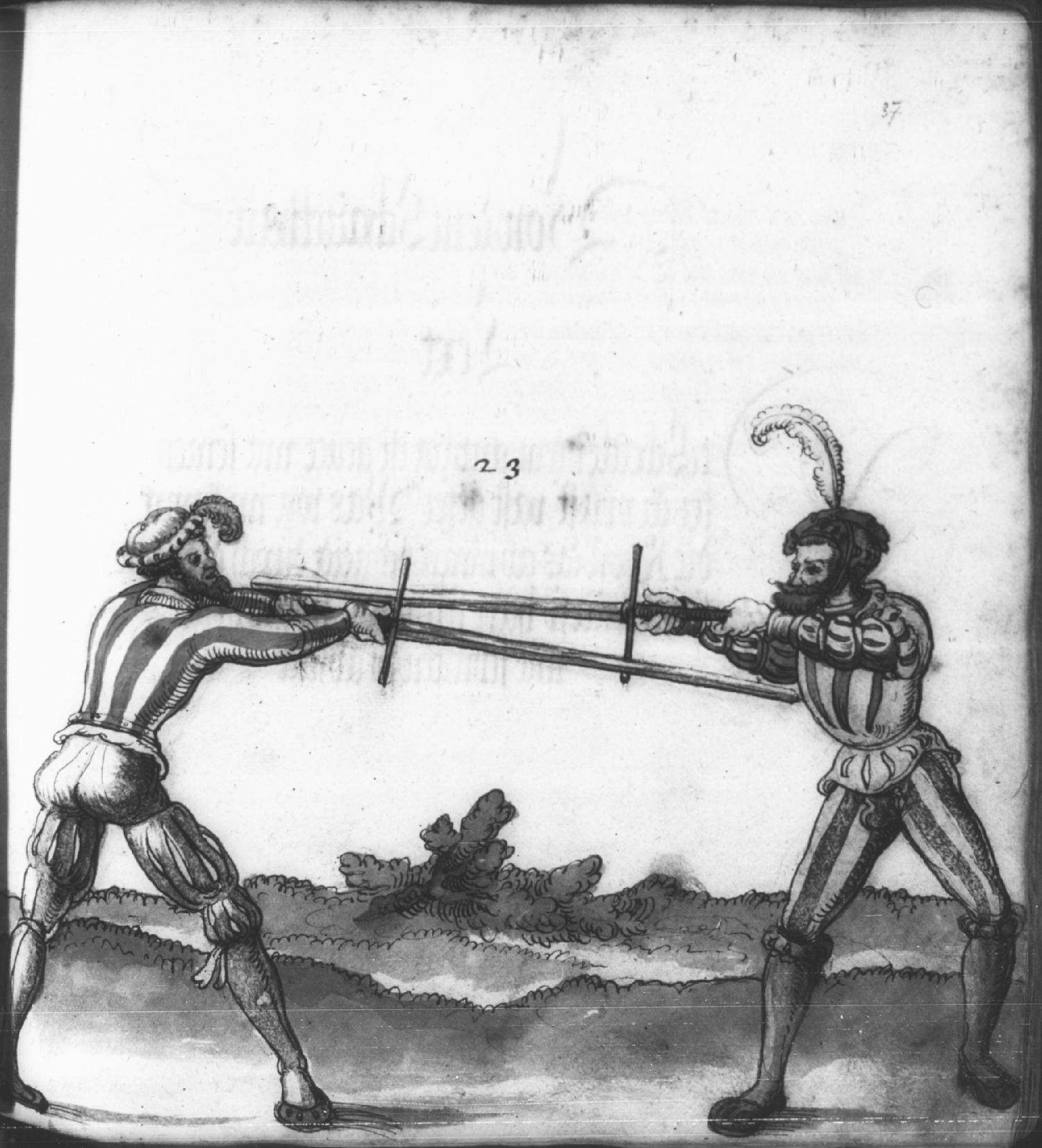
Other items worth noting are that (1) in the second example the schiller seemingly ends in a thrust (2) the introduction says "it breaks with force the strokes and thrusts," implying to me that it is certainly intended to make contact with the opponent's weapon, although those situations of uberlauffen are immediately addressed in case the attacker doesn't hit within the schiller area of dominance (3) in the next image of the Schiller from Goliath the agent strikes with open arms and a distinctly short edge, but still without stepping forward with the right foot (for whatever reason...speed, perhaps?).
As we move further into Goliath, though, a few insights are offered. If both strikes from above and thrusts to the upper openings all reach "long point" sooner or later, Goliath's comments on how the Schiller breaks long point probably make a big difference here.
Goliath says:
"The text how one breaks the long point with the Schiller.
"Strike the schiller to the point, and take the throat with no fear.
"Glossa:
"If you come to him in zufechten, and he stands against you and holds the long point to your face or breast [note: this denotes someone in a static long point, don't you think...still...], hold your sword on your right shoulder and squint (schil) with your face to the point. And do as if you wanted to strike to him to it [the point of the adversary's sword?] and strike firmly with the schiller with the short edge to his sword and move the point with it long to his throat, with a step in of the right foot."
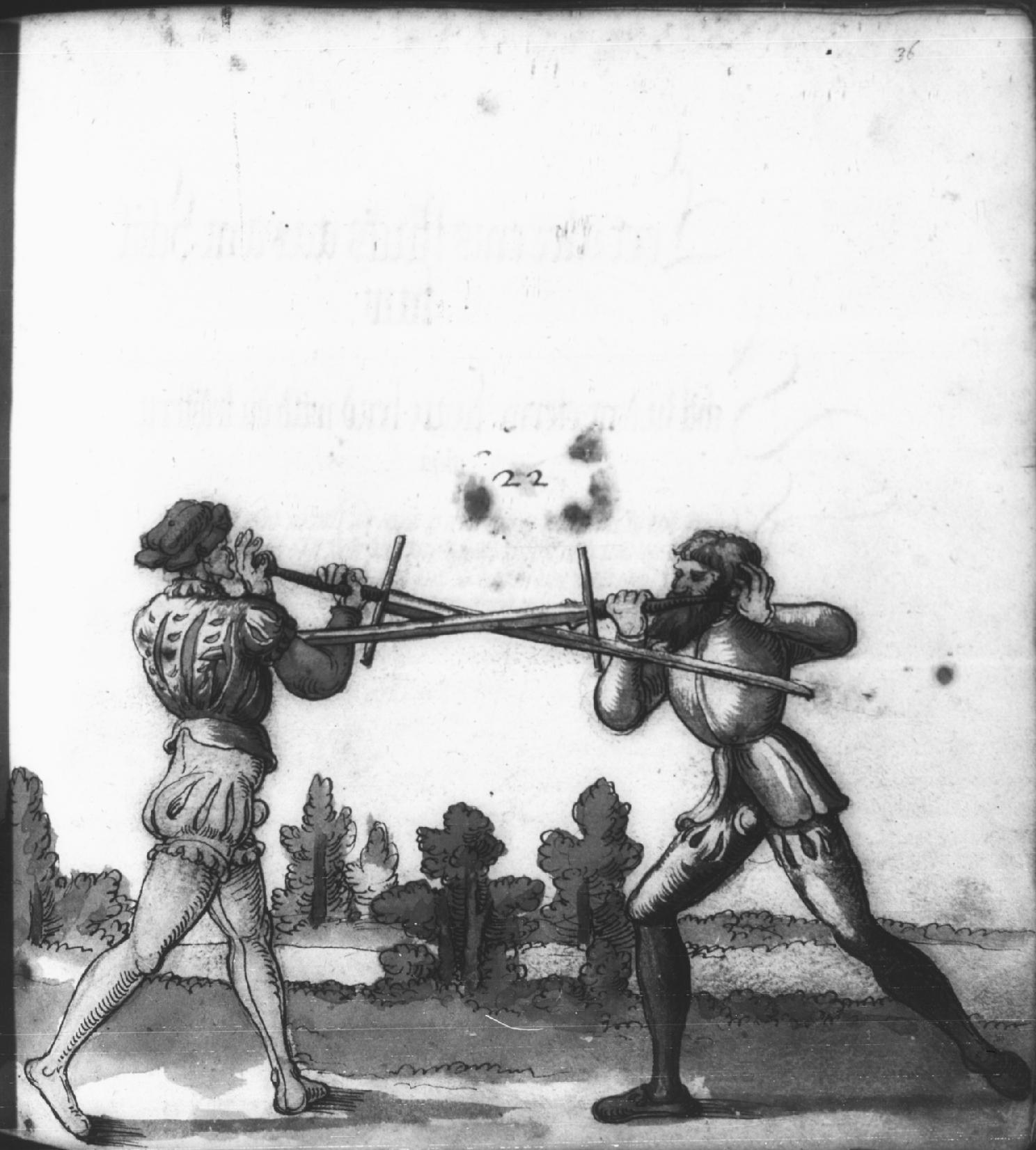
This is illustrated in plate 22 of Goliath, executed by the swordsman on the left. The image takes place after the initial beat and a response by the guy in langort of trying to wind into a thrust by raising his hilt. The Schiller out-times it. Here, also, although the text says "to the throat," the image shows a thrust to the breast, with the point appearing to exit through the shoulderblade of the guy on the left. Unlike the previous 2 images, this one shows the shiller-guy taking a step with the right foot.
Based on that image alone I would actually suggest that the initial strike was something more along the lines of a zornhau or krump, which wound into a schiller immediately upon achieving the bind.
Goliath has 4 images of the Schiller (#20-23). The first two show no step with the right foot. The other two do. The first one shows an attack with crossed arms and the long edge (apparently). The other three show uncrossed arms and a clear short edge.
All this does, to be honest, though, is confuse me more. I feel that I'm closer, but I haven't had that "eureka" yet. Maybe I'm looking for something that isn't there...trying to make this fit misconceptionf based on incomplete information about what the schiller does...
Jake
ps. The aforementioned images #20-23 can be found at:
Plate 20
Plate 21
Plate 22
Plate 23
 |
||||||||
|
|
||||||||