Schielhau of Doebringer

For Historical European Fighting Arts, Weaponry, & Armor

Moderators: Webmaster, Stacy Clifford

User avatar
Jake_Norwood
Posts: 913
Joined: Thu Sep 19, 2002 11:46 am
Location: Clarksville, TN

Re: Schielhau of Doebringer

Postby Jake_Norwood » Sat Jun 11, 2005 9:45 pm

Hi Randall.

I've been working with that drawing for a while. It's vexing. Notice that he appears to be striking with the long edge. Yeah. Vexing.

As for the thrust from pflug not ending in long point...

WHAT?

Of course it ends in long point. That's where thrusts go. Why would anyone chose not to fully extend their thrust except as an issue of close range? I have found no thrusts that are not fully extended when range permits it. Thus a thrust from pflug will "end" in long point, with the knuckles down, long edge down.

If we look at the guy on the left, though, he isn't fully extended into long point, and if he did, not only would the attack be a thrust (not a cut), but the range gained would not be enough to save him from anything without an accompanying deflection. The hypotenuse issue is exactly my problem with the schiller "overrunning" the thrust from the plough--it's on the wrong angle, while the plough-thrust isn't.

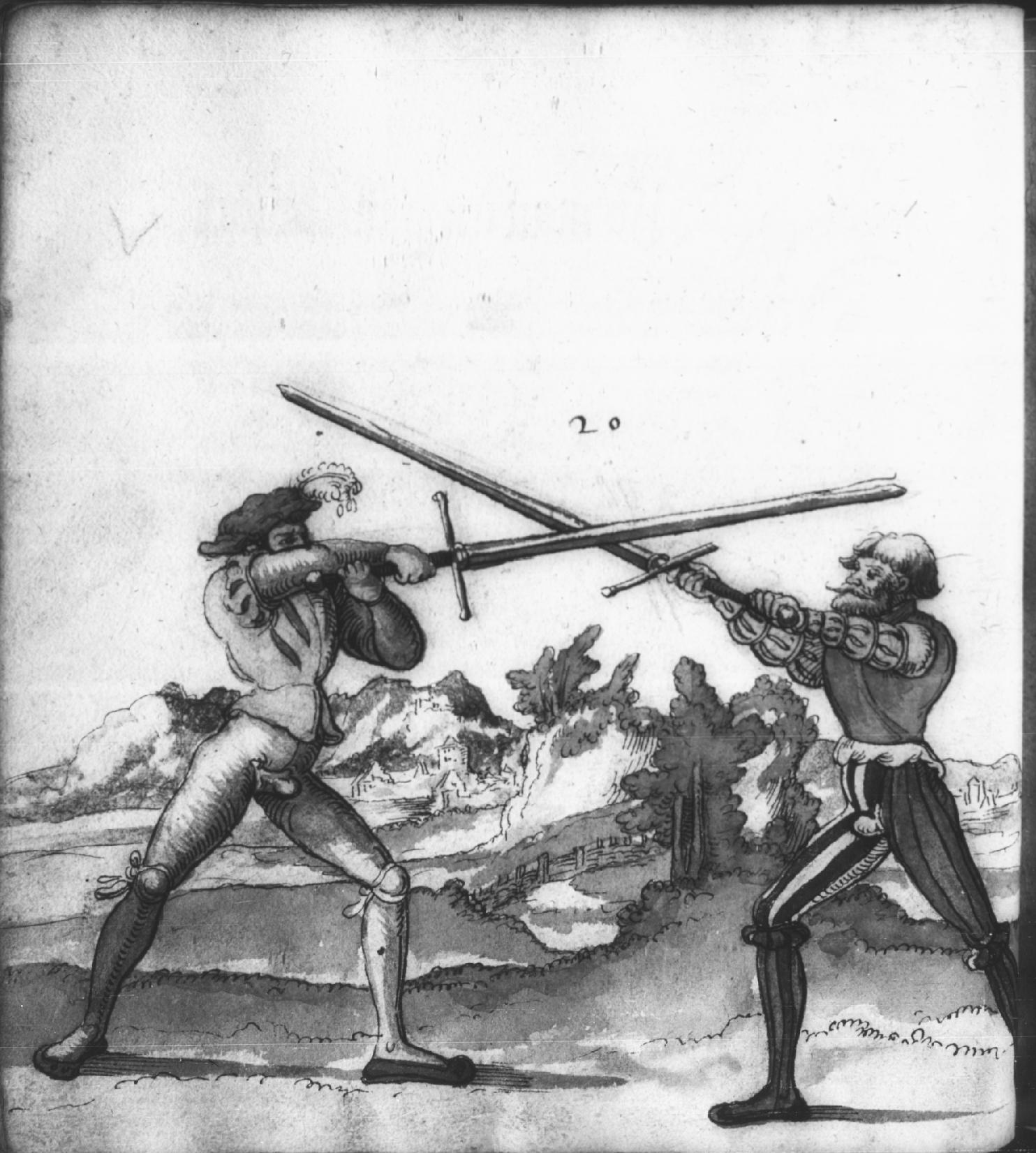
I'll tell you what I *do* see in this image, though. Meyer's and Talhoffer's "Sturzhauw." Going off of this we could postulate (reasonably), that the earlier masters didn't differentiate (I'm sure they didn't). The Schiller that Meyer shows is with uncrossed hands. If we cross arms (as depicted here), then we can hit the right shoulder and create a krump-like deflection of the incoming strike. After all, Goliath (and Doebringer?) say to strike the Schiller "with a twist of the blade." This is generally understood to mean rotating the blade to strike with the short edge--but perhaps it's referring to a quick crossing of the arms, "twisting" the whole weapon as the strike is thrown.

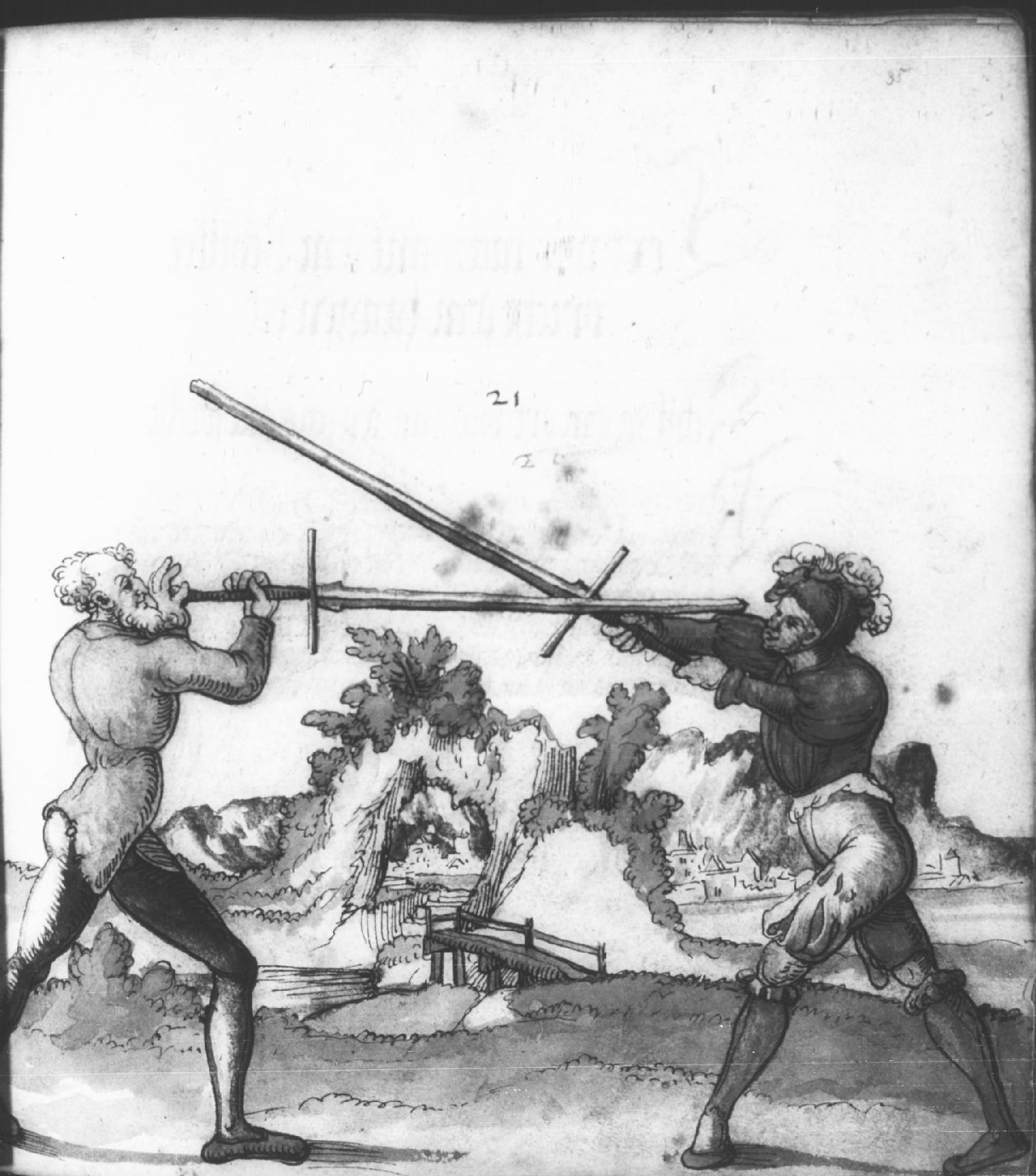
However, even then, we're in a little bit of trouble, as this image shows the schiller against an oberhau, not an attack from pflug.

In fact, since we're on the subject, let's talk about Goliath and this image some more.

Goliath says:

"The Schiller breaks what the "puffel" strikes or thrusts. Who breaks with changing (wechsel), the Schiller robs him of it.

"Glossa

"The Schielhau breaks the guard which is called the pflug and it is a particular good and honest stroke, as it breaks with force the strokes and thrusts. And it goes with the turned (twisted?) sword, therefore there are many masters of the sword that cannot say anything about this stroke.

"How one should strike the Schiller.

"Mark, if you come to him in the zufechten, stand with the left foot forwards and hold your sword on your right shoulder. If he strikes to you from above to the head, turn your sword and strike against his stroke with the short edge far from straightened arms from above over his sword to his head. If he is prudent and wants to change through (durch wechseln) from below, let the point shoot long forwards with the stroke so that he is not able to change through from below."

The image follows this. Should the guy on the right raise his left hand in order to wechselhau to the lower opening of the guy on the left, then the right-triangle principle works fine--the new attack is on a longer line than the schiller is. So we agree there, at least. It's also worth noting (in response to an earlier discussion with Shane Smith) that the guy on the left, performing the schiller, appears not to have stepped with the strike, except maybe to widen his stance a little with a simple step forward. But that's from another discussion.

Goliath continues:

"Another one.

"If you stand against him and hold your sword on your right shoulder and he stands against you in the guard of pflug and wants to thrust at you downwards, strike to him with the schiller from above and move the point long to him to the breast, so that he is not able to reach you below with the thrust."

Here, again, we're looking at the right triangle principle--doing exactly what you said. But in both instances the schiller seems to hinge on the bad guy attacking the *lower* openings with tha thrust or strike. In which case yes, the schiller will successfully overreach. But *any* oberhau will overreach in those circumstances.

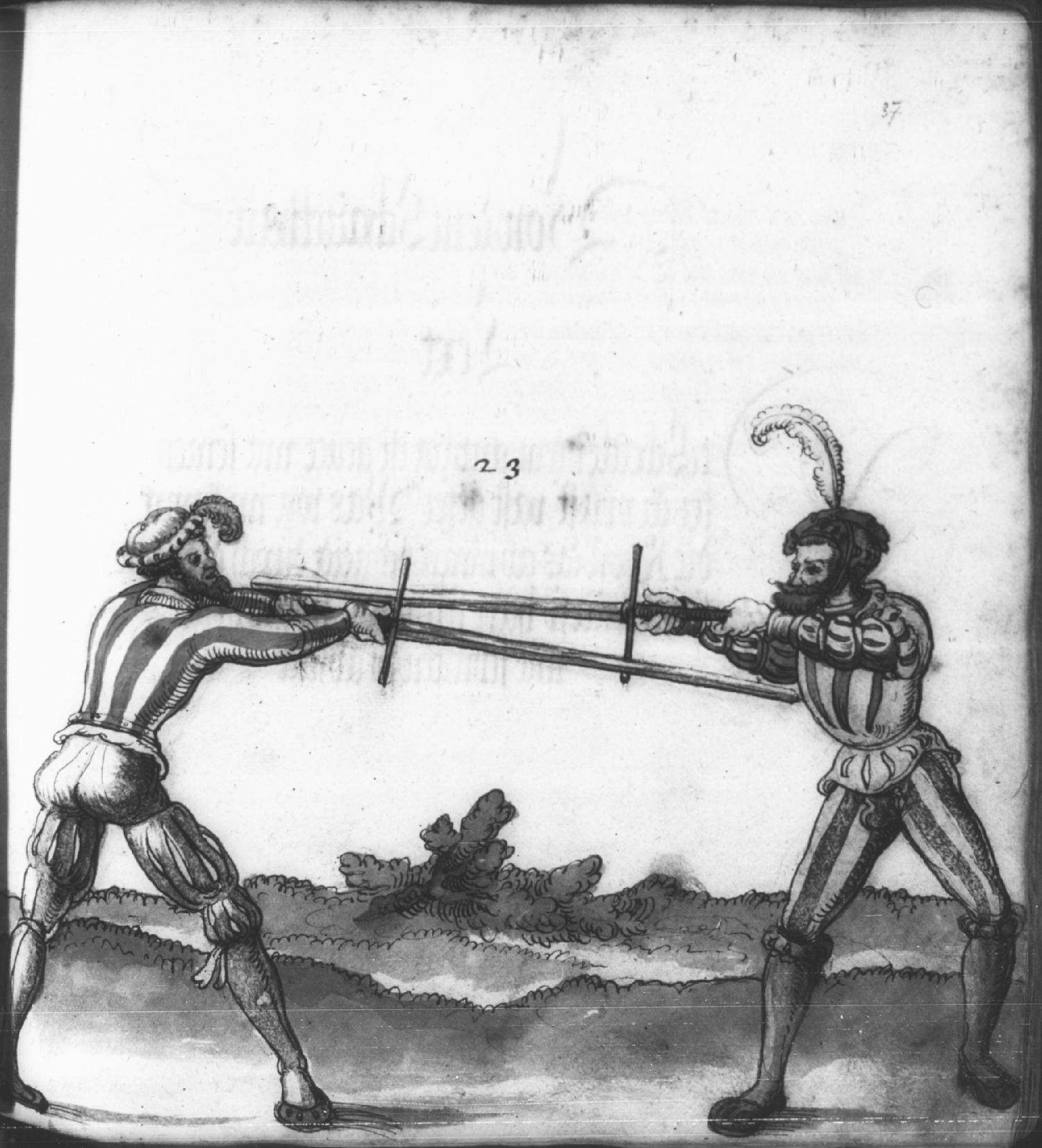
Other items worth noting are that (1) in the second example the schiller seemingly ends in a thrust (2) the introduction says "it breaks with force the strokes and thrusts," implying to me that it is certainly intended to make contact with the opponent's weapon, although those situations of uberlauffen are immediately addressed in case the attacker doesn't hit within the schiller area of dominance (3) in the next image of the Schiller from Goliath the agent strikes with open arms and a distinctly short edge, but still without stepping forward with the right foot (for whatever reason...speed, perhaps?).

As we move further into Goliath, though, a few insights are offered. If both strikes from above and thrusts to the upper openings all reach "long point" sooner or later, Goliath's comments on how the Schiller breaks long point probably make a big difference here.

Goliath says:

"The text how one breaks the long point with the Schiller.

"Strike the schiller to the point, and take the throat with no fear.

"Glossa:

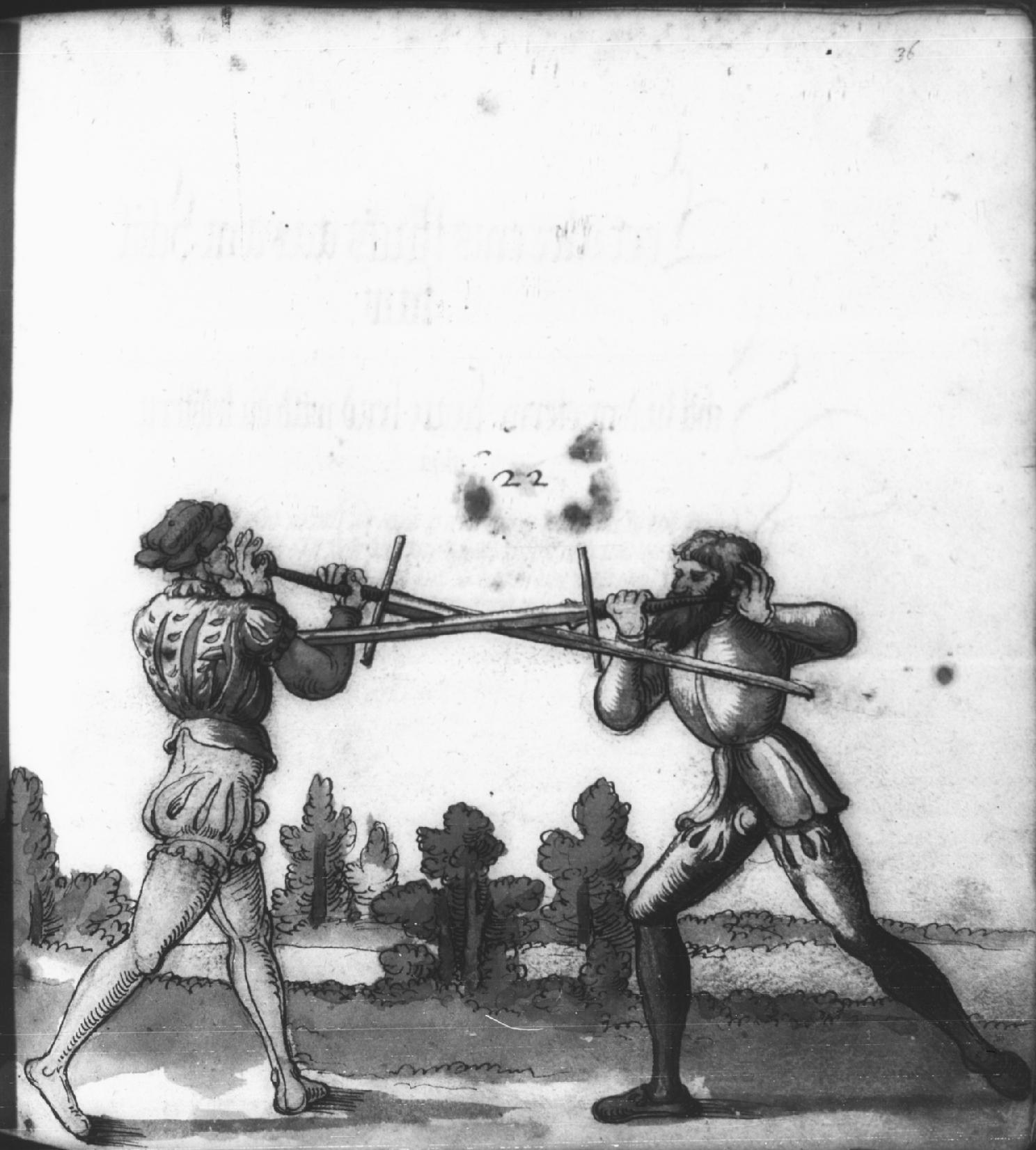
"If you come to him in zufechten, and he stands against you and holds the long point to your face or breast [note: this denotes someone in a static long point, don't you think...still...], hold your sword on your right shoulder and squint (schil) with your face to the point. And do as if you wanted to strike to him to it [the point of the adversary's sword?] and strike firmly with the schiller with the short edge to his sword and move the point with it long to his throat, with a step in of the right foot."

This is illustrated in plate 22 of Goliath, executed by the swordsman on the left. The image takes place after the initial beat and a response by the guy in langort of trying to wind into a thrust by raising his hilt. The Schiller out-times it. Here, also, although the text says "to the throat," the image shows a thrust to the breast, with the point appearing to exit through the shoulderblade of the guy on the left. Unlike the previous 2 images, this one shows the shiller-guy taking a step with the right foot.

Based on that image alone I would actually suggest that the initial strike was something more along the lines of a zornhau or krump, which wound into a schiller immediately upon achieving the bind.

Goliath has 4 images of the Schiller (#20-23). The first two show no step with the right foot. The other two do. The first one shows an attack with crossed arms and the long edge (apparently). The other three show uncrossed arms and a clear short edge.


All this does, to be honest, though, is confuse me more. I feel that I'm closer, but I haven't had that "eureka" yet. Maybe I'm looking for something that isn't there...trying to make this fit misconceptionf based on incomplete information about what the schiller does...

Jake

ps. The aforementioned images #20-23 can be found at:

Plate 20

Plate 21

Plate 22

Plate 23

Sen. Free Scholar
ARMA Deputy Director

User avatar
David Craig
Posts: 81
Joined: Wed May 12, 2004 10:19 am
Location: New Jersey, U.S.

Re: Schielhau of Doebringer

Postby David Craig » Sun Jun 12, 2005 7:10 am

Back to Doebringer:

<<Und wer
mit durchwechsel drewt /der wirt mit dem
schilhaw beschemet /und eyner sal wol
schilhawen und lank genuk /und den ort
vaste schiessen /anders her wirt gehindert
/mit /durchwechsel /und /eyner sal /wol
schilen mit dem orte /czu dem halse kun-
lich ane vorchte

And he who tries with a changing
through [Durchwechsel ]will be shamed by
the squinting strike [Schiler ].And you shall
squint well and long enough and shoot the
point well,or else the changing through
[Durchwechsel ]will stop you.And one
shall squint well with the point to the neck,
courageously and without fear.>>

Although this isn't about the versetzen, it seems to support the geometry argument. But what does "squint well" actually mean? Does it mean twist your body far enough sideways? Or is it just a general admonition to perform the strike correctly? The phrase is repeated twice in this section, so it appears to have some importance.

As for the thrust from pflug not ending in long point...

WHAT?

Of course it ends in long point. That's where thrusts go.


I agree. A thrust from pflug does end in longpoint (at least that's how I do it)and thus has considerable range. To me it is unclear how the versetzen grants enough geometric advantage for the attacker performing a schielhau to have a reasonable expectation of not taking a thrust -- unless he makes blade contact and forces his opponent's point offline. But if your opponent's thrust is aimed low, making blade contact requires that you either drop your hands or drop your point.

David

User avatar
Randall Pleasant
Posts: 872
Joined: Mon Sep 23, 2002 3:35 pm
Location: Flower Mound, Texas, USA

Re: Schielhau of Doebringer

Postby Randall Pleasant » Sun Jun 12, 2005 6:34 pm

Jake wrote:
As for the thrust from pflug not ending in long point...

WHAT?

Of course it ends in long point. That's where thrusts go. Why would anyone chose not to fully extend their thrust except as an issue of close range? I have found no thrusts that are not fully extended when range permits it. Thus a thrust from pflug will "end" in long point, with the knuckles down, long edge down.

Yes, I fully agree with you that thrust from Pflug will in a fully extended long point. A poor choice of words on my part in my previous message. <img src="/forum/images/icons/blush.gif" alt="" /> What I was trying to say is that the long point at the end of a Schielhau might out reach and/or out time the thrust from Pflug. Keep in my this is just something I was *thinking* about (a hypothesis) yesterday, not something I have tested (didn't get to play with it at practice today due to a sick child).

I've been working with that drawing for a while. It's vexing. Notice that he appears to be striking with the long edge. Yeah. Vexing.

I am very glade to hear of your interest in this image. I have been trying to tell other ARMA members for two years that this image is right on the money and wrothy of much consideration. I am completely sure that the man is making the cut with the short edge and that his hands are not crossed. The man's thumb if it had been place on the side of the handle/blade (or if it had been drawn) would have been facing the viewer. Standing in front of a mirror you can easily reproduce the same body and hand positions seen in the image. The key to reproducing the same positions seen in the image is to cut to long point, not to Ochs, with "a twist of the blade". I agree with you that this cut was probably involves a deflection and is probably made with a simple step.
Ran Pleasant

User avatar
Jake_Norwood
Posts: 913
Joined: Thu Sep 19, 2002 11:46 am
Location: Clarksville, TN

Re: Schielhau of Doebringer

Postby Jake_Norwood » Sun Jun 12, 2005 9:02 pm

Hi Randall.

A few things on that image.

First, I'm pretty sure it is the long edge. Here's why:

I'm not sure how you would figure the thumb would be facing the viewer, but the long edge is traditionally aligned with the kuckles, the short with the wrist--that's what we're looking at in the image.

The arms are crossed. Not literally, no, but they are in the opposite position of "open." Arms always appear in one of two positions--"open" and "crossed." If a cut or stance is "open" on one side it's "crossed" on the other, even if it doesn't seem literally so. When the manuals say that one should cross or uncross the arms, it's always from one position to the other--there is no "official" middle ground. Thus what we're looking at is a "crossed arms" position, even if the arms aren't fully crossed.

This is further bolstered by the fact that all german cuts but the schaytler (which is a center-line cut) and the zornhau (which is "supposed" to be performed only from the right...sort of...) alternate edges when you alternate sides and crossed/uncrossed relationships.

The krump, zwerch, and unterhau are all prime examples of this. They're short edge from the right and long edge from the left. Could the schiller be the same? I don't think it's without precedent.

Jake
Sen. Free Scholar

ARMA Deputy Director

User avatar
JeffGentry
Posts: 1089
Joined: Tue Apr 20, 2004 8:35 am
Location: Columbus Ohio

Re: Schielhau of Doebringer

Postby JeffGentry » Sun Jun 12, 2005 9:18 pm

hey guy's

Image 20 in Goliath is the very start of the "upper" schielhau.

Here is the same position as we see in the Goliath image notice the hand position's, I have just dropped my point forward from right vom Tag.

Image

Goliath image 20 look's to be the start of the schielhau, the figure in Goliath still need's to step with the right foot and twist the sword around to the left for the deflection and to hit his opponenet in the head.

Remember these are either pose's or drawn from memory of the artist where as we have photograph' so it is easy to do multiple image's quickly.


Jeff
Semper Fidelis

Usque ad Finem

Grace, Focus, Fluidity

User avatar
Jake_Norwood
Posts: 913
Joined: Thu Sep 19, 2002 11:46 am
Location: Clarksville, TN

Re: Schielhau of Doebringer

Postby Jake_Norwood » Mon Jun 13, 2005 8:18 am

Hey Jeff-

What you're suggesting is that Plate 20 is the beginning of the strike, and that the other 3 plates show a moment after, as the blade twists (about at the time of impact) and the arms "open"? That's pretty close to what I suggested a few posts back, but better thought out.

Interesting...it reminds me of my early (faulty) interpretation of the kurtzhauw...which I really liked, and found effective, but it didn't fit the proper criteria.

Fantastic! I feel like we're getting somewhere.

Jake

Jake
Sen. Free Scholar

ARMA Deputy Director

User avatar
JeffGentry
Posts: 1089
Joined: Tue Apr 20, 2004 8:35 am
Location: Columbus Ohio

Re: Schielhau of Doebringer

Postby JeffGentry » Mon Jun 13, 2005 11:27 am

Hey Jake

well yes and no.

Image 21 the guy on the left is in the end position aginst an oberhau, like in the Meyer's schiller, something is wrong with his footwork though, it apear's that he is standing left foot forward, he should be right footward i do not know if it is just me or the artist drawing.

The guy on the right in Image 22 is actualy useing schiller against another attack and is also in the end position, I do not remember what the Glose say's though.

In Image 23 the guy on the right is about mid point, just before the displacement, in his transition to finish schiller against long point.

So I guess they are all showing it in some point in mid technique there is just not much order to it.

Jeff
Semper Fidelis


Usque ad Finem


Grace, Focus, Fluidity

User avatar
Jake_Norwood
Posts: 913
Joined: Thu Sep 19, 2002 11:46 am
Location: Clarksville, TN

Re: Schielhau of Doebringer

Postby Jake_Norwood » Mon Jun 13, 2005 12:30 pm

Hi Jeff.

Yes and no.

See my post analysing all 4 of those images. Plate 20 is different from the others in a few significant ways. While the footwork issue is important, I also think that as we synthesize the info that these plates and their accompanying text gives us, we can *triangulate* the real schiller--not that the plates show us the whole thing step-by-step, but they let on to some very, very important details that I've never "seen" before.

Jake
Sen. Free Scholar

ARMA Deputy Director

User avatar
Jeffrey Hull
Posts: 678
Joined: Wed Sep 25, 2002 3:40 pm
Location: USA

Re: Schielhau of Doebringer

Postby Jeffrey Hull » Mon Jun 13, 2005 12:36 pm

Yes, it does seem like Krump, I realised that 15 minutes after I left the computer. <img src="/forum/images/icons/crazy.gif" alt="" />

However, I was trying to describe the strike in a way that would actually distinguish it from Krump. At least as much as Meyer's Schiel is distinguished from Zwerch. <img src="/forum/images/icons/wink.gif" alt="" />

I wish I could show what I meant but unfortunately such is the limit of any forum and my audio-visual recording resources, such that I cannot.

I still encourage its consideration, but admittedly, I am still toying with the possibility.

JH
JLH

*Wehrlos ist ehrlos*

User avatar
Jeffrey Hull
Posts: 678
Joined: Wed Sep 25, 2002 3:40 pm
Location: USA

Re: Schielhau of Doebringer

Postby Jeffrey Hull » Mon Jun 13, 2005 12:50 pm

How about this Talhoffer (1467) image as anlogous to what Randall posted about Goliath:

http://thearma.org/talhoffer/t5.htm

I got to thinking about this tafel 5 because of an unrelated chat I was having with Mike Rasumsson. This tafel 5 is, I think probably a *throat-slash* (*Hals fahen*) versus overhew, which is the generally accepted interpretation. Our comrade MR interprets it as a sort of *block*, it seems. But a third interpretation occured to me, that it may be showing Schielhau. This would not surprise me, as the geometry and short-edge use seems right, and Talhoffer likes to use similar techniques to rest of German school, but just by unique names.

It would depend upon if fighter had come out of roof (thus probably the strike is squinter, though perhaps slash could still be done) or out of plough or ox (thus strike is probably slash). In tafel 5 the foe is definitely attacking by overhew.

In any case, Schielhau is one of those strikes that can flow from a *hew* into a *thrust/slash*, so I think it lends itself to a number of possibilities for our interpretation.

Just an idea.

JH
JLH


*Wehrlos ist ehrlos*

User avatar
Jeffrey Hull
Posts: 678
Joined: Wed Sep 25, 2002 3:40 pm
Location: USA

Re: Schielhau of Doebringer

Postby Jeffrey Hull » Mon Jun 13, 2005 1:32 pm

Armateers:

Those who are ARMA members can access Armaria and look at 7r of longsword stuff from Codex Guelf (late 15th Cent) and see one of the things I advocate vis-a-vis this discussion.

Armateers could PM reaction or comments to me if they like.

That is all to say here, as it is members only. <img src="/forum/images/icons/wink.gif" alt="" />

JH
JLH


*Wehrlos ist ehrlos*

User avatar
Jake_Norwood
Posts: 913
Joined: Thu Sep 19, 2002 11:46 am
Location: Clarksville, TN

Re: Schielhau of Doebringer

Postby Jake_Norwood » Mon Jun 13, 2005 2:15 pm

That Talhoffer Plate is perfect. I think that we're moving on the right track, and I agree with Talhoffer just using slightly different naming conventions. This shows what could be a schiller landing in just the right place, in response to what could be a thrust (even though we know it's an oberhau), we see the "long point" directed off line, and the inside line closed as the halsfahen--a downward short-edge stroke--is applied.

Here's what I think has been my issue with the schiller, which is solved by this running theory. When I moved from tag to strike down with the short edge I always ended up doing something like a downward-diagonal zwerch. The angle was wrong and it lacked "distinctness" from the zwerch in application. The advice to "look to the point" or hit the right shoulder was all absent.

But, if we bring the blade down, as in plate 20 and Jeff's photo first, *then* we "twist" or turn the blade upon contact, we close the center line (preventing thrusts and cuts from above), we control the opponent's blade with a forceful wind in the twist, and we threaten not only the breast and head with the point, but by moving in tighter we can strike the opponent's right shoulder/neck. It fits the images, the text, and the intent of the technique.

I have yet to see better, in truth.

Jake
Sen. Free Scholar

ARMA Deputy Director

User avatar
Shane Smith
Posts: 1159
Joined: Thu Sep 19, 2002 2:15 pm
Location: Virginia Beach

Re: Schielhau of Doebringer

Postby Shane Smith » Mon Jun 13, 2005 3:37 pm

Hi Jeff,
I was just looking at your photo above.Are you left-handed?
Shane Smith~ARMA Forum Moderator
ARMA~VAB
Free Scholar

User avatar
JeffGentry
Posts: 1089
Joined: Tue Apr 20, 2004 8:35 am
Location: Columbus Ohio

Re: Schielhau of Doebringer

Postby JeffGentry » Mon Jun 13, 2005 10:26 pm

Hey Jake
But, if we bring the blade down, as in plate 20 and Jeff's photo first, *then* we "twist" or turn the blade upon contact, we close the center line (preventing thrusts and cuts from above), we control the opponent's blade with a forceful wind in the twist, and we threaten not only the breast and head with the point, but by moving in tighter we can strike the opponent's right shoulder/neck. It fits the images, the text, and the intent of the technique.


You got it brother dead on, on all count's that is exactly what you are doing with the schiller, now if you do it lower against plough it work's also for the same reason.

Jeff
Semper Fidelis


Usque ad Finem


Grace, Focus, Fluidity

User avatar
JeffGentry
Posts: 1089
Joined: Tue Apr 20, 2004 8:35 am
Location: Columbus Ohio

Re: Schielhau of Doebringer

Postby JeffGentry » Mon Jun 13, 2005 10:30 pm

Hey Shane

I'm right handed, It is my web cam so i was limited as to which way to face, my right hand is up at the gaurd you can see my watch on the lower hand(left wrist).

Jeff
Semper Fidelis


Usque ad Finem


Grace, Focus, Fluidity


Return to “Research and Training Discussion”

Who is online

Users browsing this forum: No registered users and 17 guests


Note: ARMA - The Association for Renaissance Martial Arts and the ARMA logo are federally registered trademarks, copyright 2001. All rights reserved. No use of the ARMA name or emblem is permitted without authorization. Reproduction of material from this site without written permission of the authors is strictly prohibited. HACA and The Historical Armed Combat Association copyright 1999 by John Clements. All rights reserved. Contents of this site 1999 by ARMA.