Quarterstaff Sources & Construction

For Historical European Fighting Arts, Weaponry, & Armor

Moderators: Webmaster, Stacy Clifford

User avatar
John Peloquin
Posts: 3
Joined: Sat Aug 21, 2004 11:24 am
Location: Rhode Island, USA

Quarterstaff Sources & Construction

Postby John Peloquin » Wed Nov 30, 2005 4:36 pm

I recently changed my focus from longsword to staff, primarily due to cost factors. I'm still very much a neophyte at both weapons.

Searching these forums, I found the following sources mentioned for staff: Mair, Meyer, Silver, Swetnam, and "English Martial Arts" by Terry Brown. Are there others that I should be looking at?

From what I've been able to find through google, a staff should be about 1 1/4 inches in diameter and, for my height, about 8 1/2 feet long (I'm 5'10"). Are these numbers accurate?

For a padded staff, should the diameter of the pole be lessened? How thick should the foam be, and should the entire staff be padded or should gaps be left for the hands? I've built padded wasters before according to Jeanry's method, so I have those materials on hand already.

Thanks for the help.

User avatar
David_Knight
Posts: 171
Joined: Sat Sep 27, 2003 4:56 am
Location: Brooklyn, NY

Re: Quarterstaff Sources & Construction

Postby David_Knight » Thu Dec 01, 2005 12:50 pm

1 1/4" or 1 3/8" is a good diameter.

The "correct" length of a staff varies from source to source and depends largely on what style you are trying to learn.

Mair's quarterstaves, for example, are in the 6' range. This is partly because Mair's grip is not the "one hand in the middle, the other a quarter-length from the end" seen in traditional English quarterstaff. This absence of 2+ feet at the butt end allows for tighter manuevering when closing with the enemy, one of the central concepts behind Mair's system.

In contrast, Silver, for instance, advocates an 8+ foot staff and says that its length should be used to keep opponents at bay. I may be mistaken, but I do not believe there is any emphasis on closing.

You are only slightly taller than me, so I would recommend starting with a 6' weapon and graduating up to something longer. You will probably find it is much easier to start using a 6' staff with a Mair-style grip (one hand near the middle, the other at the butt end) than a longstaff with the equivalent of a 2' pommel at the butt end.

As for padded weapons, I use a fully-covered 6' design (1 1/4" pine core covered with standard 1/2" thick pipe insulation and spiral-wrapped in contractor-grade duct tape, with 2" of foam padding at each tip). We have subjected this design to a lot of abuse in ARMA SoFL and never had a problem. It is also lighter than the PVC-core type on the ARMA site, easier to make, and much cheaper (~$10/staff).

The only drawback is that the diameter is 2 1/4", but since 1" of that is foam, it is still relatively easy to maintain a good grip.

I have seen others in ARMA only pad 12" or so at the end of a regular quarterstaff (essentially a padded spear), but I would not recommend full-contact sparring with a mostly unpadded quarterstaff unless you are restricting yourself exclusively to thrusts.

And definitely do not pad everything except where your hands should go (as in military pugil sticks), because your grip should remain fluid. Your hands should be able to slide from a regular grip to a half-staff grip (both hands equal distance from the middle) and back without snagging on padding.

Also, be sure to use a proper hardwood such as hickory (best for striking) or ash (best for thrusting).

User avatar
David_Knight
Posts: 171
Joined: Sat Sep 27, 2003 4:56 am
Location: Brooklyn, NY

Re: Quarterstaff Sources & Construction

Postby David_Knight » Fri Dec 02, 2005 11:36 am

To clarify, get a proper hardwood staff (hickory, oak, etc.) for drilling technique, but use pine (or something equally inexpensive) for the core of your sparring staff.

User avatar
Stacy Clifford
Posts: 1126
Joined: Fri May 14, 2004 11:51 am
Location: Houston, TX
Contact:

Re: Quarterstaff Sources & Construction

Postby Stacy Clifford » Fri Dec 02, 2005 1:05 pm

This is partly because Mair's grip is not the "one hand in the middle, the other a quarter-length from the end" seen in traditional English quarterstaff. This absence of 2+ feet at the butt end allows for tighter manuevering when closing with the enemy, one of the central concepts behind Mair's system.


Your description of the English grip is not correct. Swetnam describes and illustrates it thus:

Keep the point of your Staffe right in your enemies face, holding one hand at the verie buttt end of the Staffe, and the other a foote and a halfe distant, looking over your Staffe with both your eies and your feet and and a half distance, or thereabouts, according to this picture...
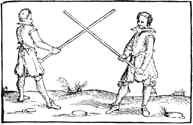
Image

I'm pretty sure the term "quarterstaff" refers to holding the rear quarter of the staff, not the second quarter.

In contrast, Silver, for instance, advocates an 8+ foot staff and says that its length should be used to keep opponents at bay. I may be mistaken, but I do not believe there is any emphasis on closing.


Silver has this to say about holding the staff and using its length:

And this note, that these lengths will commonly fall out to be eight or nine foot long, and will fit, although not just, the statures of all men without any hindrance at all unto them in their fight, because in any weapon wherein the hands may be removed, and at liberty, to make the weapon longer or shorter in fight at his pleasure, a foot of the staff being behind the back most hand does no harm.

Silver describes this closing maneuver (which is quite cool and fun to do):

9. If you play with your staff with your left hand before and your right hand back behind, as many men find themselves most apt when that hand is before, & if your adversary upon his blow comes in to take the close of you, when you find his staff crossed with yours near his hand, then suddenly slip up you right hand close to the hind side of your foremost hand, & presently loosing the hind side of your foremost hand & put in under your own staff, & then cross or put by his staff therewith your hand take hold of his staff in such sort that your little finger be towards the point of his staff, & your thumb & forefinger towards his hands, & presently with your right hand mount the point of your own staff casting the point thereof over your right shoulder, with your knuckles downwards, & so stab him in the body or face with the hind end of your staff, but be sure to stab him at his coming in, whether you catch his staff or not, for sometimes his staff will lie to far out hat upon his coming in you cannot reach it, then catch that arm in his coming in which he shall first put forth within your reach, but be sure to stab, for his staff can do you no hurt, and having so done, if you find yourself too strong for him, strike up his heels, if too weak fly out.

10. The like must you do if you play with your right hand & your left hand back behind, but if you need not to slide forth your left hand, because your right hand is in the right place on your staff already to use in that action, but then you must displace your left hand to take hold of his staff, or the grip as is aforesaid, & to use the stab as is above said.


In describing the fight of long staff vs. short staff, Silver does talk about drawing back the long staff and shortening it to counter a closing move by the short staff man, but he has this to say about the drawbacks of that idea:

5. Again it is to be remembered in that time that you keep him at bay, upon the drawing in of his staff, the hind end thereof lying so far back behind will be so troublesome for him, that he can make no perfect fight against you & commonly in his drawing in of his staff it will be too short to make a true fight against you, neither to offend you or make himself safe.

Swetnam also describes two different closing techniques, one for fighting at night and the other employing a fake thrust to initiate it.

If you're making a padded staff, Swetnam is very adamant about being able to quickly shift your grip from the left side to the right, and his technique involves sliding the rear hand forward before shifting the forward hand back (all on that rear quarter of the staff), so take that into consideration as well.

0==[>>>>>>>>>>>>>>>>>
Stacy Clifford
Free-Scholar
ARMA Houston, TX

User avatar
Jon Pellett
Posts: 125
Joined: Mon Apr 04, 2005 12:15 pm
Location: Calgary, AB

Re: Quarterstaff Sources & Construction

Postby Jon Pellett » Fri Dec 02, 2005 7:49 pm

Great post, Stacy. I totally agree.
I'm pretty sure the term "quarterstaff" refers to holding the rear quarter of the staff, not the second quarter.
I frankly doubt this is anything more than a Victorian folk etymology; the only source I know for it is speculation by Allanson-Winn, who writes: "...I imagine it originally derived its name from being grasped by one hand at a quarter of its length from the middle, and with the other hand at the middle." The grip is wrong, and he says he is just guessing.

Cheers

PS To the OP - for other staff sources, you can look in Zach Wylde (no, the other Zach Wylde <img src="/forum/images/icons/wink.gif" alt="" />). There are also little snippets in McBane and elsewhere. If you want to practice the later Victorian style, look in the Journal of Manly Arts at EJMAS, which has McCarthy, Allanson-Winn, and Boy Scout Quarterstaff in the archives.

Edited - A-W, not McCarthy

User avatar
John Peloquin
Posts: 3
Joined: Sat Aug 21, 2004 11:24 am
Location: Rhode Island, USA

Re: Quarterstaff Sources & Construction

Postby John Peloquin » Fri Dec 02, 2005 10:50 pm

I've managed to track down a copy of Wylde's text and the articles in the Journal of Manly Arts, but the only source I can find that's connected to McBane is "Lannaireachd: Gaelic Swordsmanship" by Christopher Thompson. Is there another source that discusses McBane or a place where I can find his writings?

Thanks again to everyone who's helped me out.

User avatar
David_Knight
Posts: 171
Joined: Sat Sep 27, 2003 4:56 am
Location: Brooklyn, NY

Re: Quarterstaff Sources & Construction

Postby David_Knight » Sat Dec 03, 2005 10:25 am

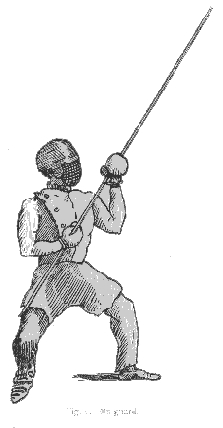
Stacy - I should have been clearer. I was speaking in very general terms and referring to the grip popularized by English quarterstaff tournaments of the 19th century (noted by Jon)...

Image

... but I know I have seen this grip in one of the more obscure fechtbucher, though I believe it was Swiss or German... Someone emailed it to me after the Provo '05 event because the author used a double-overhand grip like Mair, but I can't find it anywhere on my hard drive or on the ARMA site. Anyone?

It's also in DiGrassi's Di Adoprar..., p. 112, and possibly others.

Is closing the exception or the rule in Silver/Swetnam? I know Silver says that a staff-fighter should "behave himself to keep that distance", whereas Mair is constantly advancing and comes to butt-strikes, throws, etc. in almost every plate.

User avatar
Brian Hunt
Posts: 969
Joined: Thu Jan 23, 2003 2:03 am
Location: Price, Utah
Contact:

Re: Quarterstaff Sources & Construction

Postby Brian Hunt » Sat Dec 03, 2005 2:53 pm

Hey David,

are you talking about Christian Egenolph?

A translation of his quarter staff can be found here

staff

Laters.

Brian Hunt
GFS
Tuus matar hamsterius est, et tuus pater buca sabucorum fundor!

http://www.paulushectormair.com
http://www.emerytelcom.net/users/blhunt/sales.htm

User avatar
Stacy Clifford
Posts: 1126
Joined: Fri May 14, 2004 11:51 am
Location: Houston, TX
Contact:

Re: Quarterstaff Sources & Construction

Postby Stacy Clifford » Sat Dec 03, 2005 6:07 pm

OK, I'm not familiar with the later English sources, but Silver and Swetnam are pretty consistent in their approach. Both definitely prefer to keep the opponent at the point of the staff and give sound advice for how to maintain that. Since they advocate using longer weapons than Mair, I think that's pretty sensible. Why use a longer weapon in the first place if you're not going to use that natural advantage? Neither seems opposed to closing "if you are cunning in wrestling" as Swetnam says, but it's clear that it's not their first choice. It's been a while since I looked at Meyer, but as I recall he also seemed more focused on blows and thrusts utilizing the length rather than closing. Mair seems a bit unorthodox compared to the other staff material I've seen. We'll have to trade classes one of these days and compare notes.

As for Egenolph, I've seen that translation, and it's still almost incomprehensible. I think Milan told me one time it was some obscure dialect of French with a lot of unrecognizable words. Silver reads like Mr. Rogers by comparison.
0==[>>>>>>>>>>>>>>>>>

Stacy Clifford
Free-Scholar
ARMA Houston, TX


Return to “Research and Training Discussion”

Who is online

Users browsing this forum: No registered users and 21 guests


Note: ARMA - The Association for Renaissance Martial Arts and the ARMA logo are federally registered trademarks, copyright 2001. All rights reserved. No use of the ARMA name or emblem is permitted without authorization. Reproduction of material from this site without written permission of the authors is strictly prohibited. HACA and The Historical Armed Combat Association copyright 1999 by John Clements. All rights reserved. Contents of this site 1999 by ARMA.