|
||||||||
|
|
||||||||
|
||||||||
|
|
||||||||
Moderators: Webmaster, Stacy Clifford

I wouldn't say so. I find it interesting to make these comparisons, at the least.Well to compare individual merits is a rather endless and inconclusive discussion.
Are you quite certain that's always true? In mountainous terrain, for example?Mongolia is the horse capital of the world. Whether dismounting in battle or not, Cavalry is always at an advantage against infantry.
On the other hand, this put a significant strain on their logistics, as they had to be able to provide the requisite fodder for all of these animals, and as far as I know, the only places that would have been able to support them would have been in the most densely populated and heavily defended areas of Europe.Mongol armies could not only field a 100% cavalry army but afford multiple horses per soldier, compounding this advantage. While the horses themselves were relatively small they're quite hardy, able to live on very little food and perform well in just about any envirornment they came across the the exception of dense jungle.
I'm not really certain what you're defining "successful" as, beyond raiding, as it seems to me that groups such as the Turks, or maybe the Magyars, only became really successful after they became more settled and less nomadic, historical examples seeming to show that the city-dwellers always prevail over the nomads sooner or later.From Mamluke to Cataphract, mounted archers have always been the elite of an army, the mongols didn't just train as cavalry archers, the lived that way (not to say this isn't true of several other highly successful nomad civilizations.
As did their European counterparts, I'm sure.Due to great size of the mongol empire their armies had exposure to an immense diversity of fighting styles and military technologies.
Increases more friction between different religious groups and their adherents.Religious diversity - No state religion and a policy respecting and learning from all religions translates to significant diplomatic advantages.
I should think though, that the European armies would have had an edge in terms of attrition, which, it seems, eventually proved to be the case.Clearly Mongol armies hold a significant advantage over a European army on the scale of entire campaigns in the 13th century!
You seem to be contradicting most of your previous statements here.When talking of such things I think it's extremely important to avoid turning this into an ethnic/cultural superiority discussion. If Mongol armies seem martially superior (in the 13th century!) it certainly does not mean this is true in other time periods or that Mongolians are inherently superior to Europeans. The defining factor in this situation is GEOGRAPHY! Nothing more. Speaking of things in terms of eastern vs western inevitably leads to people defending the cultures they identify with which is rather irrelavent to the discussion.
Are you quite certain that's always true? In mountainous terrain, for example?
On the other hand, this put a significant strain on their logistics, as they had to be able to provide the requisite fodder for all of these animals, and as far as I know, the only places that would have been able to support them would have been in the most densely populated and heavily defended areas of Europe.
I'm not really certain what you're defining "successful" as, beyond raiding, as it seems to me that groups such as the Turks, or maybe the Magyars, only became really successful after they became more settled and less nomadic, historical examples seeming to show that the city-dwellers always prevail over the nomads sooner or later.
As did their European counterparts, I'm sure.
Increases more friction between different religious groups and their adherents.
I should think though, that the European armies would have had an edge in terms of attrition, which, it seems, eventually proved to be the case.
Fair enoughIf you think they're contradictory then you misunderstand my point...or I've made a mistake. But let's not talk about that right
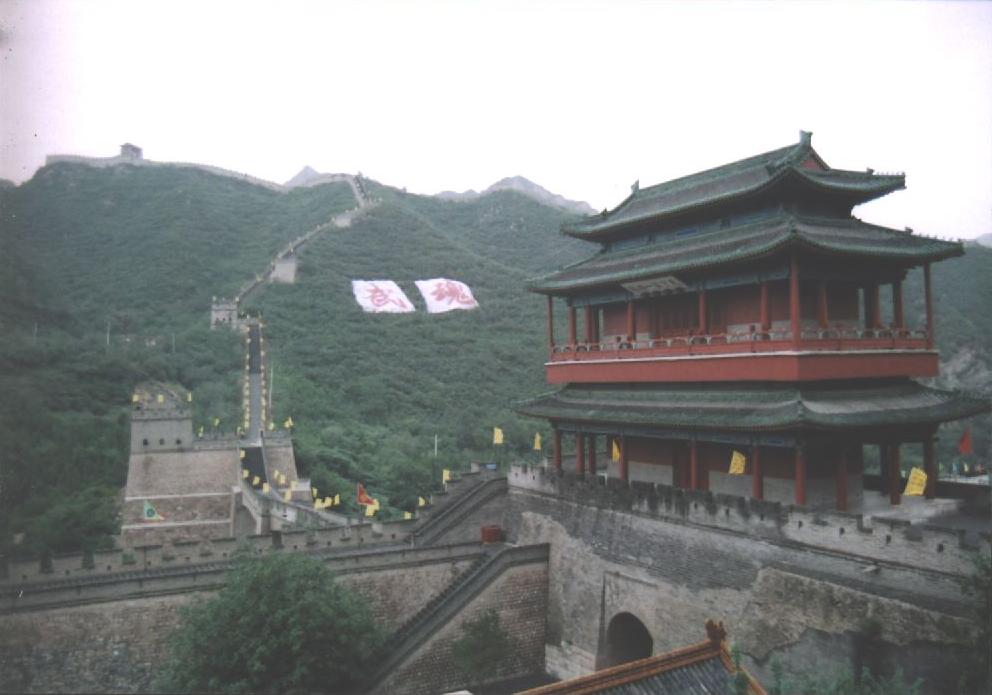
Well, the second one failed to load, and the first is, the Great Wall? Not an especially successful fortification, if I recall correctly. I hope that doesn’t sound glib, but I can’t think of many castles (in Europe, I mean) that were actually taken by the Mongols, in fact, they seemed to have quite a bit of trouble with the Hungarian ones.I'd say Chinese fortifications were pretty comparable to their European counterparts. They consisted of tall, thick stone walls topped by battlements and supported by towers and gatehouses. A few stylistic differences but essentially the same function. A few examples:
http://www.lomo-expedition.de/out01661.jpg
http://www.travelblog.org/Photos/51025.html
Keep in mind the Mongols held a large portion of the middle east as well.
Well, I can’t back this up with documentation, yet, but I’ve heard that medieval Europe had considerably fewer access routes from one region to another, and many of which could probably be turned into choke-points against invaders.Or at sea...I concede there are certain regions in which horses would not be useful. Luckily people generally don't leave there either. My point was that even if you're just going to dismount to engage in infantry tactics the horses still give you an edge in mobility. Mongol access to horses gave them an advantage and that access was due to geography.
I think your own reference to supply points probably answers your question regarding deserts.Then how did they achieve such success in the deserts? How did any primarily cavalry army? I don't see any evidance of this being a logistical problem, only an advantage due to increase mobility between supply points.
In which case they would no longer be nomads, I’m thinking.Or perhaps that successful nomads eventaully become city dwellers.
Maybe, but you did define them as nomads previously.In any case I'm more concerned with the cavalry archers of city dwellers, which the Mongols largely were by that point.
Not necessarily, I should think.On the other hand, isn't any conquering army by definition nomadic?
Conceded. However, geographic area doesn’t necessarily indicate the variety of means of waging war to be encountered.Not to the same extent. This area is significantly larger and more diverse in addition to being held by one empire as opposed to a collection of competing countries.
It depends, doesn’t it? The Mongol empire at the time no doubt was religiously diverse, but what of their military? Wouldn’t they be composed primarily of Mongols, and possess shared religious beliefs (for the most part)?This doesn't seem to have been the case.
Because, it seems that logistics played the greatest part in their decision to pull back. For one example, their losses couldn’t be replaced, far away from home as they were. For another, they would have to find enough fodder to maintain all of their mounts (possibly 150,000-400,000, assuming every one of Batu’s riders had two to three horses).Why?

Cavalry is always at an advantage against infantry.

One also has to understand, that no footsoldier unit can withstand the full force of a knightly horse charge. .

Return to “Research and Training Discussion”
Users browsing this forum: No registered users and 102 guests
|
|
|||
|
|
|||
|
|||