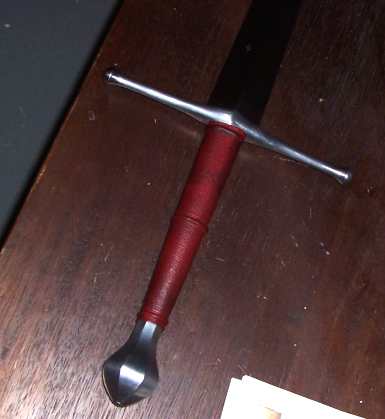
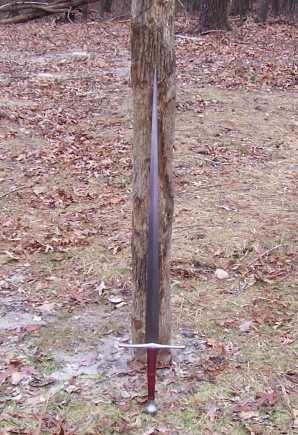
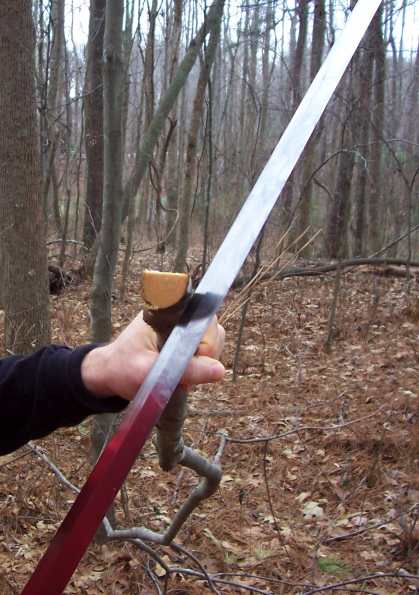
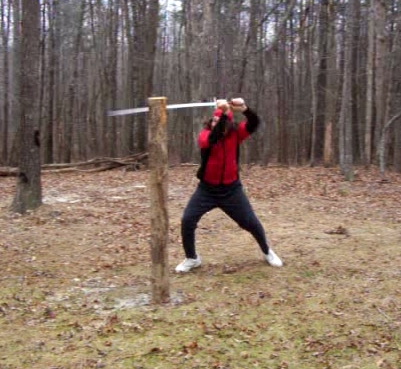
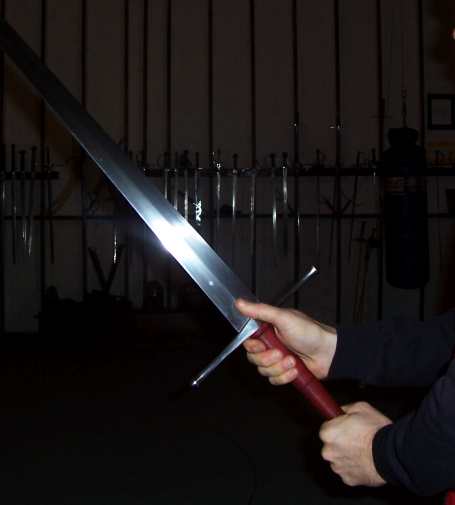
I've been working out the last two days with a new Albion Swords piece I acquired, the “Talhoffer” (honoring the early 15th century Fechtmeister Hans Talhoffer) from their “Next Generation line” of weapons. It’s offered as one of their limited edition makes intended as accurate replica blades for serious practitioners.
I’ve handled several Albion pieces the last 3 years and played with a few. I’ve yet to be anything other than greatly impressed. Getting to finally put one through an extended strenuous workout was a pleasure.
It’s rare that immediately upon handling a reproduction piece you feel good about it and, like an antique specimen, instantly want to wield it with enthusiasm. As I often say: accurate historical weapons encourage accurate historical technique, and accurate historical techniques call for a historically accurate weapon. So far with this piece I feel confident it meets the test.
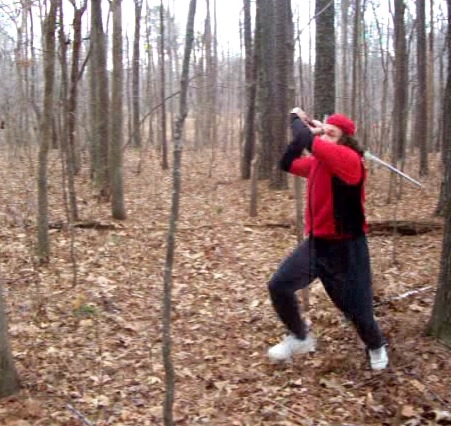
When I get a new sword, I suppose like many people, I heft it, swing it, go through postures to get a feel for it, slowly florysh with it, make strikes and displacements, and then do high energy practice routines with it. I’ll use it with increasing force on a pell, as well as test targets if it’s sharp. If blunt, I’ll try out moves with increasing energy against a partner using another suitable blade. But I first want to see how it “speaks”, that is, what intuitively the weapon seems to suggest about how it should best be used given what actions it evidently was designed for.
Essentially, I want to see how it handles from what I know to do and what I have come to expect from real swords. I also smack it around a bit first, not to determine how well it’s made but just if it feels like it will hold up to basic moves (I've had all sorts of swords fail on me while using them solo at empty air—blades have snapped at the tang or flown out of the hilt, blades have bent at the ricasso or handle, hilts have fallen apart, pommels twisted off, grips cracked, etc., so I’ve learned to be skeptical). I also want to know how generally stiff or flexible it is, but I don’t need to know how much it will flex. From all this I evaluate how a sword performs. With this Albion piece my process was no exception.
So, saying that a blade “held up” is a minimum expectation uncommonly met in my experience. Saying that it actually encouraged and inspired my workout surpasses expectation. Such was the case with this Talhoffer style, I am happy to write.
This tapered Albion model is not especially long at 46” but such a length was ideal for piercing thick cloth armor, or facing reinforced maile and plate in close combat, and would be vicious in thrusting against unarmored opponents. Against plate armor one would not be cutting heavy blows so much as engaging the other weapon or half-swording it to get that deadly point or the hilt into play while preventing the opponent from doing much the same. The length and weight of this weapon is perfectly suited for such 14th & 15th century fighting techniques. Yet, I have no doubts it could take off an arm or cut to the bone of an unprotected limb with an appropriate edge blow.
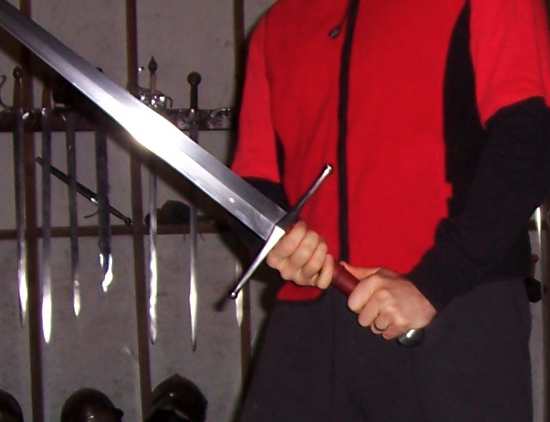
The piece feels particularly light yet is robust and acutely pointed, the blade is comfortably stiff but not rigid, and happily, like all the Albion pieces I have so far handled, its hilt is wondrously solid. A fighting sword is really only as good as its hilt, after all, and here the grip and fittings are tight and quite well matched to the blade, not crammed on as an aesthetic after thought. Swedish swordsmith Peter Johnsson’s astute influences as Albion’s master designer are perhaps self-evident in the weapon, I feel.
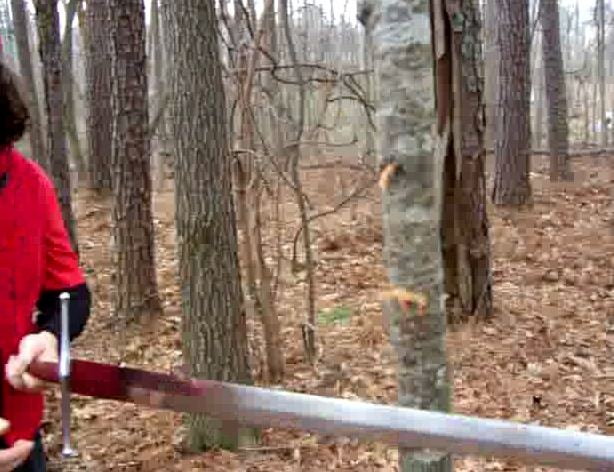
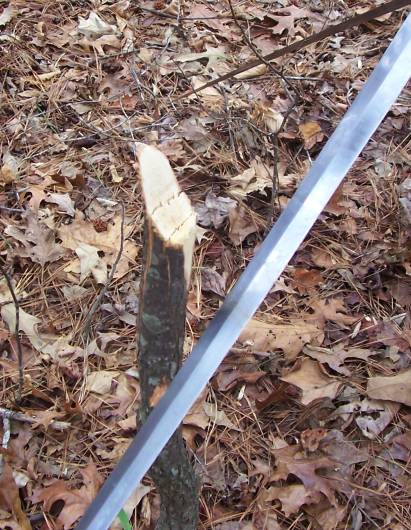
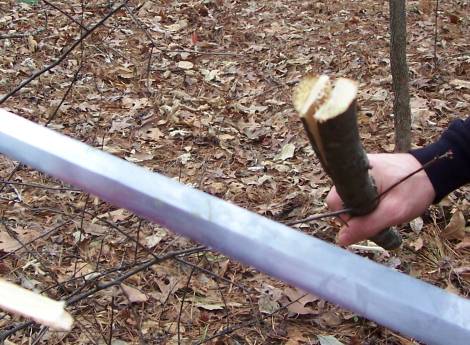
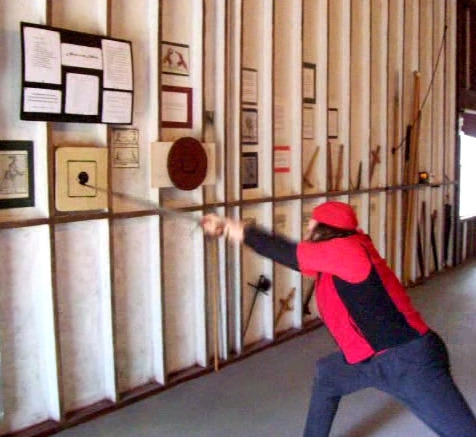
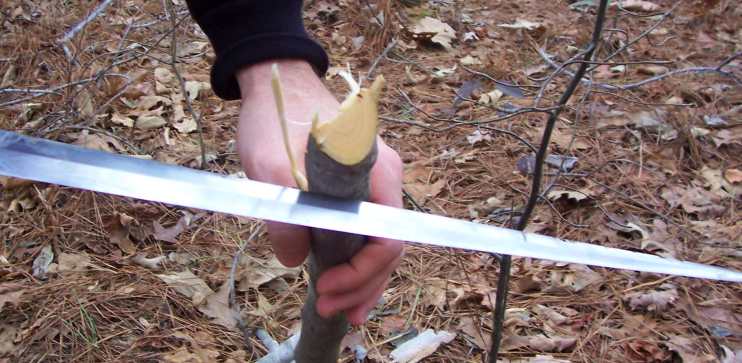
The center of gravity of the piece is just right and along with the hilt and edge would be its finest attribute. It’s a sweet stabber, but to a degree it’s also a fairly decent cutter too. The edge on this piece was especially nice. For not being fully sharpened it was rightly hard and very well honed, and not excessively thick. My strikes easily shaved wood off from a pell post, cleaved 3” pine saplings, and its point repeatedly pierced a solid rubber wall target with no effort. (The feel of it was so solid and well balanced. I even was tempted to hurl it like a spear and give a good throw at an outdoor test target. This style of sword is certainly capable of just such a historical technique).
This style sword is not my ideal of a perfect length or heft for a longsword, but it’s certainly one well suited to its martial role and a good complement to my arsenal of training weapons. The one aspect of the model I am uncertain of, is that while the blade is nicely resilient, it seemed a bit too flexible, more in the last fifth of its length at the point (I was able to flex it by just pressure of my thumb and index finger). Although I imagine there may certainly have very well been historical specimens designed like this, I have seen others of this style that where stiffer.
Ironically, the biggest complement I think you can pay a good replica like this is that it makes you want to have it in a fully sharpened version for test cutting, in the same way when you have it sharp it makes you really long for a completely blunted version for partnered practice.
I personally “use” my swords; I need them for my research and my practice so I need to have them sturdy and well-made and as historically accurate as production limitations and economics will permit. I test them out to a standard I believe is above the average sword aficionado and that of many other serious practitioners. When you purchase a sword that is ostensibly accurate or real, and one that is a substantial investment, you not only expect good value---though you will never employ it as a tool for dealing death or injury---but as a serious student of the Art, you want to know: “How will this piece help me?”, “What might I learn through practice with it?”, “How will it aid my training?” With a fine model like this one I can say the answers will come easily.
Evaluating a sword is a subjective matter, as you have to have some basis by which to decide if you like it or not and whether it’s something that you should in fact like or not. There is a feedback that occurs between producers and users, and both makers and consumers of replica swords today need to communicate and educate one another. Fortunately, in Albion Swords I think we have a company that sincerely seems to understand and appreciate this historic dynamic. Weapons like this one are clearly intended for serious students of historical fencing.
The biggest question I feel one can ever really ask with any sword is, “Would I trust to defend my life with it in real combat?” The answer in this case for me is a firm “Yes.”
Gotta run,
JC
p.s.
I’ll be posting for fun a few vids here soon of putting the Talhoffer through its paces in my fencing studio.
Do NOT send me private messages via Forum messenger. I NEVER read them. To contact me please use direct email instead.