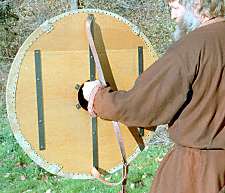
Anglo Saxon Shield Material and Testing

For Historical European Fighting Arts, Weaponry, & Armor

Moderators: Webmaster, Stacy Clifford

User avatar
Jeffrey Hull
Posts: 678
Joined: Wed Sep 25, 2002 3:40 pm
Location: USA

Anglo Saxon Shield Material and Testing

Postby Jeffrey Hull » Tue Oct 17, 2006 7:56 am

This is interesting. Apparently a show on BBC had some round-shields built and tested, made of "lime-wood"
(not citrus at all -- rather the same as linden / basswood):

http://www.channel4.com/history/microsi ... ield1.html

8)
JLH

*Wehrlos ist ehrlos*

Nigel Plum
Posts: 27
Joined: Thu Jan 26, 2006 10:52 am
Location: London

Re: Anglo Saxon Shield Material and Testing

Postby Nigel Plum » Tue Oct 17, 2006 11:16 pm

Jeffrey Hull wrote:This is interesting. Apparently a show on BBC had some round-shields built and tested, made of "lime-wood"
(not citrus at all -- rather the same as linden / basswood):

http://www.channel4.com/history/microsi ... ield1.html

8)


Not the BBC, Channel 4. Mike Loades is the UKs resident TV "expert" on all things about medieval warfare. His background is stage fighting. Most WMAers & re-enactors take anything he says with a fair pinch of salt.
Schola Gladiatoria

User avatar
Jeffrey Hull
Posts: 678
Joined: Wed Sep 25, 2002 3:40 pm
Location: USA

Postby Jeffrey Hull » Wed Oct 18, 2006 5:06 pm

Oh yeah, that notorious Channel 4 that Mrs Bucket (aka "Bouquet") so despises :wink:

Anyway, the basswood / linden struck me as at least one authentic thing about the whole deal, as there seems ample evidence for its use in round-shields.

It was funny, because just that same day in a hobby shop, where I was getting a little back-saw blade to help craft a sword-grip, I saw this array of basswood blocks. But unfortunately no shield-sized sheets thereof. :cry:

And incidentally: No, I am not using any of that basswood for the sword-grip, nor do I know if it would be suitable for such. :?:
JLH


*Wehrlos ist ehrlos*

User avatar
Brian Hunt
Posts: 969
Joined: Thu Jan 23, 2003 2:03 am
Location: Price, Utah
Contact:

Postby Brian Hunt » Thu Oct 19, 2006 7:44 am

Anther good wood for simulating historic shields is poplar and is usually found in most hardware stores for a reasonble price.

Brian Hunt
GFS
Tuus matar hamsterius est, et tuus pater buca sabucorum fundor!

http://www.paulushectormair.com
http://www.emerytelcom.net/users/blhunt/sales.htm

Michael Douglas
Posts: 9
Joined: Sat Sep 09, 2006 10:12 am

Postby Michael Douglas » Thu Oct 19, 2006 10:37 am

I make such shields as part of my living.
I trust you are talking about early English shields from 5th to 10th century?
Lime/linden wood is good,
willow or poplar is good too.
Both have a tendency NOT to split, and to become damaged and cut thereby absorbing impact not brittlely resisting.
Suitable pine (rare, lucky to find) does a great job too for those norse shields.
Most early English shields were fairly thin, not more than 12mm at the centre around the boss tapering to about 6mm at the bound enge. This makes them very quick to handle.

I think Heinrich Harke made a small book or article about his reconstructions in the 80s, I might be wrong about the date. He's a bit dodgy on the workmanship and other parts but it is a good beginning for a clutzy archaeologist.

We have some test results and photos gathered over the years.
A good program was the TIME TEAM LINCOLNSHIRE Dig for which I and Richard Darrah made a replica shield & boss and tested it to destruction with spears and an axe.

Michael Douglas
Posts: 9
Joined: Sat Sep 09, 2006 10:12 am

Postby Michael Douglas » Thu Oct 19, 2006 10:42 am

Aha! I see you are referring to the C4
'Weapons that made Britain' series.

As I recall the SHIELD episode was very poor, getting distracted with the wierd duelling-shields with spikes on the top and bottom.

The section on making and testing smaller round shields should be ignored. The maker obviously hadn't made one properly in his life, did it all wrong, they fell to bits. Incompetence and lies will still get his fee from the telly people.

User avatar
Martin_Wilkinson
Posts: 76
Joined: Fri Feb 10, 2006 5:30 pm
Location: London, England

Postby Martin_Wilkinson » Thu Oct 19, 2006 11:09 am

Michael Douglas wrote:Aha! I see you are referring to the C4
'Weapons that made Britain' series.

As I recall the SHIELD episode was very poor, getting distracted with the wierd duelling-shields with spikes on the top and bottom.

The section on making and testing smaller round shields should be ignored. The maker obviously hadn't made one properly in his life, did it all wrong, they fell to bits. Incompetence and lies will still get his fee from the telly people.


Duelling shields like those featured in Talhoffer?
"A bullet, you see, may go anywhere, but steel's almost bound to go somewhere."

User avatar
Jeffrey Hull
Posts: 678
Joined: Wed Sep 25, 2002 3:40 pm
Location: USA

Poplar Popular

Postby Jeffrey Hull » Thu Oct 19, 2006 11:37 am

Thanks to both you guys for suggesting poplar. We see that often in the lumber yards and hardware stores of USA.

Usually I do not see plywood sheets of poplar -- but of course then one may build a plank-construction shield, with the needed gluing and iron-strapping to achieve that.

Now sometimes we see a high-quality plywood made of birch. I should like to know if anyone has made a round shield of that stuff, as it seems promising.
JLH


*Wehrlos ist ehrlos*

User avatar
Brian Hunt
Posts: 969
Joined: Thu Jan 23, 2003 2:03 am
Location: Price, Utah
Contact:

Postby Brian Hunt » Fri Oct 20, 2006 7:16 am

Birch plywood makes a nice strong shield. However, I do not consider modern plywood to be a historically accurate material with the caveat that they did layer some shields in a similar cross glued pattern similar to plywood.

Brian Hunt
GFS
Tuus matar hamsterius est, et tuus pater buca sabucorum fundor!


http://www.paulushectormair.com

http://www.emerytelcom.net/users/blhunt/sales.htm

Michael Douglas
Posts: 9
Joined: Sat Sep 09, 2006 10:12 am

Re: Poplar Popular

Postby Michael Douglas » Fri Oct 20, 2006 11:22 pm

Jeffrey Hull wrote:Usually I do not see plywood sheets of poplar -- but of course then one may build a plank-construction shield, with the needed gluing and iron-strapping to achieve that.


The 'plywood' idea is somewhat of a red-herring.
The only ply-construction shields I know of are from 1st to 3rd century and are tall curved 'scutum' type roman shields. The material for these 'plywood' shields is normally oak. Those shields are damn heavy too.

Anglo-saxon Poplar shields are always planked, requiring glueing edge-to-edge (use casein, fish or sinew glues) and some substantial RIM for the shields. Rawhide is best, bronze was common, iron was extremely rare and only in rows of clips.

It seems there is a lot of misinformation in t'internet.

User avatar
Jeffrey Hull
Posts: 678
Joined: Wed Sep 25, 2002 3:40 pm
Location: USA

Re: Poplar Popular

Postby Jeffrey Hull » Sat Oct 21, 2006 6:32 am

Michael Douglas wrote:The 'plywood' idea is somewhat of a red-herring.
The only ply-construction shields I know of are from 1st to 3rd century and are tall curved 'scutum' type roman shields. The material for these 'plywood' shields is normally oak. Those shields are damn heavy too.

Anglo-saxon Poplar shields are always planked, requiring glueing edge-to-edge (use casein, fish or sinew glues) and some substantial RIM for the shields. Rawhide is best, bronze was common, iron was extremely rare and only in rows of clips.

It seems there is a lot of misinformation in t'internet.


Firstly, to use a term like "red-herring" implies someone is being deceptive or illogical. This is not the case, this is not appreciated, we are here exchanging ideas. And mention of the Roman scutum is practically irrelevant.

Secondly, the absolutist stance about planking may not be the case for each and every Teutonic round-shield ever made (if I may be allowed to expand the round-shield topic beyond just the Anglo-Saxon, as I should have clarified previously).

Thirdly, if I had meant "rim" I should have written "rim". I wrote "strapping" to indicate the flat-iron, sometimes plain and on the back, sometimes decorative and on the front, which is reasonably construed to have been used in construction of some plank-builts.

Lastly yes, many of us do read substantial literature in book-form, not just accept everything in the hit-and-miss Internet and regard it as the sole source of reading.

However, to quote one of the more legitimate source amid the Internet, then here is what Hurstwic says of round-shields, which is a mixed bag of evidence, supportive of differing assertions:

Hurstwic wrote:In the Viking age, shields typically were round, and were always made of wood. A reproduction shield is shown to the left. A typical shield was 80-90cm (32-36 inches) in diameter. While all the surviving examples are made from solid butted planks (right), there is slight evidence that shields were made of laminated wood (plywood).

Both before and after the Viking era, laminated shields were used. Literary evidence from the Viking age (the 10th century Frankish poem Waltharius, and the Norwegian Gulaþing laws) suggests that shields were made of laminated wood. A late 11th century kite shield found in Trondheim is made of two layers.

However, no archaeological evidence supports this style of construction during the Viking era in Norse lands.

Surviving shields are made from spruce, fir, or pine. Again, literary evidence contradicts and suggests that shields were made with linden wood (commonly known as basswood in North America)...

...Although archaeological evidence is slight, iron reinforcing bars on the rear of the shield may have added strength to the shield and also served to hold the plywood or planking together.


So anyway, an URL to that which has much more about round-shields and other things:

http://www.hurstwic.org/history/article ... tm#shields

Cheers,
JLH


*Wehrlos ist ehrlos*

Michael Douglas
Posts: 9
Joined: Sat Sep 09, 2006 10:12 am

Postby Michael Douglas » Sun Oct 22, 2006 10:42 am

It looks like this "80-90cm" viking shield diameter comment is quite prevalent, DESPITE the Gokstad shields all being 94cm or larger. Wierd misinformation there, a 90cm top limit is just WRONG.

Jeffrey worte ; " I wrote "strapping" to indicate the flat-iron, sometimes plain and on the back, sometimes decorative and on the front, which is reasonably construed to have been used in construction of some plank-builts."
The Hurstwic webpage linked also says ; "Although
archaeological evidence is slight, iron reinforcing bars on the rear of the shield may have added strength to the shield and also served to hold the plywood or planking together."

More misinformation, especially the totally fictitious reconstruction in their picture of the back of their shield ; http://www.hurstwic.org/history/article ... d_grip.jpg

The only iron 'strapping' I know of from anglo-saxon finds are extended iron grip-bars in the centre. No additional strapping has been found.


Return to “Research and Training Discussion”

Who is online

Users browsing this forum: No registered users and 34 guests


Note: ARMA - The Association for Renaissance Martial Arts and the ARMA logo are federally registered trademarks, copyright 2001. All rights reserved. No use of the ARMA name or emblem is permitted without authorization. Reproduction of material from this site without written permission of the authors is strictly prohibited. HACA and The Historical Armed Combat Association copyright 1999 by John Clements. All rights reserved. Contents of this site 1999 by ARMA.