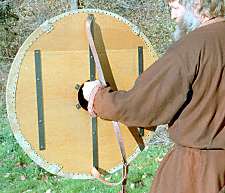
(not citrus at all -- rather the same as linden / basswood):
http://www.channel4.com/history/microsi ... ield1.html

 |
||||||||
|
|
||||||||
Moderators: Webmaster, Stacy Clifford

Jeffrey Hull wrote:This is interesting. Apparently a show on BBC had some round-shields built and tested, made of "lime-wood"
(not citrus at all -- rather the same as linden / basswood):
http://www.channel4.com/history/microsi ... ield1.html


Michael Douglas wrote:Aha! I see you are referring to the C4
'Weapons that made Britain' series.
As I recall the SHIELD episode was very poor, getting distracted with the wierd duelling-shields with spikes on the top and bottom.
The section on making and testing smaller round shields should be ignored. The maker obviously hadn't made one properly in his life, did it all wrong, they fell to bits. Incompetence and lies will still get his fee from the telly people.
Jeffrey Hull wrote:Usually I do not see plywood sheets of poplar -- but of course then one may build a plank-construction shield, with the needed gluing and iron-strapping to achieve that.
Michael Douglas wrote:The 'plywood' idea is somewhat of a red-herring.
The only ply-construction shields I know of are from 1st to 3rd century and are tall curved 'scutum' type roman shields. The material for these 'plywood' shields is normally oak. Those shields are damn heavy too.
Anglo-saxon Poplar shields are always planked, requiring glueing edge-to-edge (use casein, fish or sinew glues) and some substantial RIM for the shields. Rawhide is best, bronze was common, iron was extremely rare and only in rows of clips.
It seems there is a lot of misinformation in t'internet.
Hurstwic wrote:In the Viking age, shields typically were round, and were always made of wood. A reproduction shield is shown to the left. A typical shield was 80-90cm (32-36 inches) in diameter. While all the surviving examples are made from solid butted planks (right), there is slight evidence that shields were made of laminated wood (plywood).
Both before and after the Viking era, laminated shields were used. Literary evidence from the Viking age (the 10th century Frankish poem Waltharius, and the Norwegian Gulaþing laws) suggests that shields were made of laminated wood. A late 11th century kite shield found in Trondheim is made of two layers.
However, no archaeological evidence supports this style of construction during the Viking era in Norse lands.
Surviving shields are made from spruce, fir, or pine. Again, literary evidence contradicts and suggests that shields were made with linden wood (commonly known as basswood in North America)...
...Although archaeological evidence is slight, iron reinforcing bars on the rear of the shield may have added strength to the shield and also served to hold the plywood or planking together.
Return to “Research and Training Discussion�
Users browsing this forum: No registered users and 160 guests
|
|
|||
|
|
|||
|
|||