Hey guys,
I've been messing around with wooden practice swords I've made for a good few years, and sometime soon I'd like to move on up and buy a sword. Before I do though, I have a few questions and considerations I thought I'd put to you guys with more experience, to aid my decision and help me get something that best suits my strengths.
I'm looking for something fairly agile and maneuverable. I'm about 6ft tall and around 145lbs, and I'd suppose a little stronger than the average person of my size, so while I can cope with a heavier blade, I'd prefer something relatively light, well-balanced and quick but still substantial enough to do some damage and stand up to heavy action.
I'm thinking of getting a Darksword Armory single-handed sword of some sort, which while relatively inexpensive, I understand are quite good blades. In case you're not as familiar with them, here's their site:
http://www.darksword-armory.com/
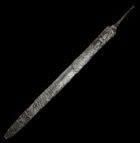
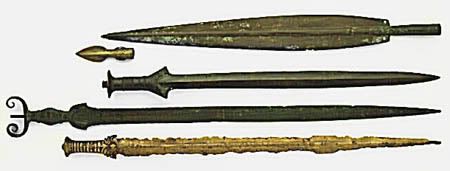
What I'm curious about is the effects on handling of the shape of the blade. I'm most interested in Oakeshott Types XII, XVI and XVIII as compared to a leaf-shaped blade.
Assuming you had one of each of those to compare with equally lengthed blades, I think the XII, XVI and XVIII's would all handle very similarly.
The XII looks like it would be the heaviest of the Oakeshotts as it has the least taper and typically the broadest blade along the whole length. Accordingly, I figure it would have the strongest cut of the three, yet would suffer comparatively in thrusting and agility. A leaf-shaped blade I'd imagine lends a very powerful cut as well, but would its agility suffer from the extra mass near the tip, or does the narrower waist section mitigate that? I'm curious about how a leaf-shaped blade would handle compared to the general design of the three Oakeshott types. Leaf-shaped blades intrigue me, and I'm basically just wondering if the shape lends anything particularly noteworthy to the handling.
The XVI and XVIII seem to me to be fundamentally the same sword, with the primary distinguishing characteristic being the XVI's fuller and the XVIII's lack of one. Does the fuller have any notable function or effect on handling? I notice it typically widens the blade, but other than that I can only deduce that they would be similar in balance and handling, with the XVIII being moderately stiffer to the thrust. Is that about right, or is my guesswork off?
Anyway, hopefully that's not too obnoxiously large or complicated a set of questions. I really appreciate any info, advice or insight at all. Thanks guys!
 |
||||||||
|
|
||||||||