Effects of blade shape?

For Historical European Fighting Arts, Weaponry, & Armor

Moderators: Webmaster, Stacy Clifford

User avatar
Carey Vaughn
Posts: 10
Joined: Fri Mar 14, 2008 3:04 pm
Location: VA

Effects of blade shape?

Postby Carey Vaughn » Sun Mar 30, 2008 4:41 pm

Hey guys,

I've been messing around with wooden practice swords I've made for a good few years, and sometime soon I'd like to move on up and buy a sword. Before I do though, I have a few questions and considerations I thought I'd put to you guys with more experience, to aid my decision and help me get something that best suits my strengths.
I'm looking for something fairly agile and maneuverable. I'm about 6ft tall and around 145lbs, and I'd suppose a little stronger than the average person of my size, so while I can cope with a heavier blade, I'd prefer something relatively light, well-balanced and quick but still substantial enough to do some damage and stand up to heavy action.

I'm thinking of getting a Darksword Armory single-handed sword of some sort, which while relatively inexpensive, I understand are quite good blades. In case you're not as familiar with them, here's their site:
http://www.darksword-armory.com/

What I'm curious about is the effects on handling of the shape of the blade. I'm most interested in Oakeshott Types XII, XVI and XVIII as compared to a leaf-shaped blade.

Assuming you had one of each of those to compare with equally lengthed blades, I think the XII, XVI and XVIII's would all handle very similarly.
The XII looks like it would be the heaviest of the Oakeshotts as it has the least taper and typically the broadest blade along the whole length. Accordingly, I figure it would have the strongest cut of the three, yet would suffer comparatively in thrusting and agility. A leaf-shaped blade I'd imagine lends a very powerful cut as well, but would its agility suffer from the extra mass near the tip, or does the narrower waist section mitigate that? I'm curious about how a leaf-shaped blade would handle compared to the general design of the three Oakeshott types. Leaf-shaped blades intrigue me, and I'm basically just wondering if the shape lends anything particularly noteworthy to the handling.

The XVI and XVIII seem to me to be fundamentally the same sword, with the primary distinguishing characteristic being the XVI's fuller and the XVIII's lack of one. Does the fuller have any notable function or effect on handling? I notice it typically widens the blade, but other than that I can only deduce that they would be similar in balance and handling, with the XVIII being moderately stiffer to the thrust. Is that about right, or is my guesswork off?

Anyway, hopefully that's not too obnoxiously large or complicated a set of questions. I really appreciate any info, advice or insight at all. Thanks guys!

A man can only be beaten in two ways: If he gives up, or if he dies.

User avatar
Patrick Hardin
Posts: 99
Joined: Wed Sep 25, 2002 5:25 pm
Location: Memphis, TN

Postby Patrick Hardin » Sun Mar 30, 2008 6:24 pm

Hey Carey.

Okay, first of all, the weight of the sword isn't that much of an issue, or at least it isn't if the sword is well made. All swords that are accurately-made enough to claim the name of a sword will weigh around 2-3 lbs. Also, again if they're accurately-made, they will be properly balanced so that the width of the blade is not much of an issue. There will be a slight difference in balance between a type XII and the other two, but more on that in a moment. The main issue, if you're considering types XII, XVI and XVIII, is what these blade-types are meant to do.

A sword with a type XII blade comes from a period when knights were well-armored with mail, and this blade shape is designed to combat this. The blade has enough width and flex to be an excellent cutting blade, but the point is more acute than the knightly sword had been previously, to assist in thrusting. The idea is to drive the point through the rings of the mail.

Type XVI comes from a period when plate armor was on the rise, and type XVIII comes from when the use of plate armor was in full swing. A sword cannot cut through plate armor, so more emphasis was placed on the thrust in the blade shape. Here the idea is to drive the point in between the openings that have to be in armor to allow for movement. Hence the more acute points on each of these types. A type XVI will have a bit more flex in the blade than a type XVIII, but might be slightly stiffer than a type XII. The fuller is not really meant to widen the blade, but more to lighten it. Type XVIII will be a little stiffer than both the others, because it is meant to thrust more. Another difference between XVIII and XVI is that a type XVIII will often have a hollow-ground blade. This enables it to have a thicker spine that gives it greater rigidity for a thrust, yet still enables it to be light and fast, as well as retain a good edge for cutting.

Now, about the handling. As I just mentioned, any sword that's well-made will be balanced properly so that it's not hard to handle. There will be some difference, though, between a type XII and the other two. Types XVI and XVIII will be balanced a bit more toward the hilt, as they are meant to thrust more than type XII. Type XII will be balanced more toward the blade. But any of these blade types will serve well as a cutting sword.

As for these types vs. a more leaf-shaped blade, we're getting more into the realm of speculation. As I mentioned before, these blade types were developed in response to developments in armor. If armor had not developed as it had, maybe we would have seen leaf blades of that length in the Middle Ages. But as far as I know, you don't see leaf-shaped blades much past the Roman Republic, and all of these were short swords. For shearing cuts with longer blades, most seem to have preferred a sword with straight edges. The leaf shape is, I think, meant to increase cutting power in a shorter sword by putting more width and mass at the point where the blade makes contact with its target. But in a longer sword, this is made up for by the length of the blade, so the extra width is unnecessary.

Well, I hope that helps you in choosing. Basically, it boils down to what you want the sword to be able to do. I would recommend Albion, if you can afford them: (http://www.albion-swords.com) Their swords are well-made and handle really well.

User avatar
Carey Vaughn
Posts: 10
Joined: Fri Mar 14, 2008 3:04 pm
Location: VA

Postby Carey Vaughn » Tue Apr 01, 2008 8:26 pm

Thanks very much, Patrick, that helped a lot. Ultimately I'm looking for a good balance between cutting and thrusting, which any of those three types are. They're similar enough that either of the three would serve a fairly flexible role, especially since I guess I probably won't actually be trying to kill anyone wearing armor, either chain or plate.

The leaf-shaped blades I've been looking around at are replicas of a Roman Spatha, a Dark Ages Germanic sword of Roman influence, and an early Medieval Saxon type sword. Darksword Armory reportedly does models of existing historical blades, so I assume all these are legitimate and not fanciful. All the same, you definitely put it into perspective for me that the length of a Medieval sword is plenty for cutting power, and a straight edge would be preferable. All the same, I still find the leaf-shaped blades interesting. (Here's a link to each one respectively if you wanted to take a look:
http://www.darksword-armory.com/1335.html
http://www.darksword-armory.com/1302.html
http://www.darksword-armory.com/1303.html )

I've been looking around extensively at Albion, and I'd absolutely love to go with one of those. However, they're a little more expensive than my student budget can handle at the moment! For sure I'll be saving up for one of those within the next few years, preferably after I have more experience. For the time being I'll try out a Darksword Armory blade, probably taking them up on their offer to do custom work.

Again, thanks Patrick for all your help, much appreciated and very informative!
A man can only be beaten in two ways: If he gives up, or if he dies.

LafayetteCCurtis
Posts: 421
Joined: Sat Nov 04, 2006 7:00 pm

Postby LafayetteCCurtis » Sat Apr 05, 2008 8:48 am

Carey Vaughn wrote:The leaf-shaped blades I've been looking around at are replicas of a Roman Spatha, a Dark Ages Germanic sword of Roman influence, and an early Medieval Saxon type sword. Darksword Armory reportedly does models of existing historical blades, so I assume all these are legitimate and not fanciful. All the same, you definitely put it into perspective for me that the length of a Medieval sword is plenty for cutting power, and a straight edge would be preferable. All the same, I still find the leaf-shaped blades interesting. (Here's a link to each one respectively if you wanted to take a look:
http://www.darksword-armory.com/1335.html
http://www.darksword-armory.com/1302.html
http://www.darksword-armory.com/1303.html )


Unfortunately, none of those three models seems to be historically accurate. I'm not aware of any leaf-shaped medieval European blade forms; the Roman gladius and the ancient Greek xiphos did have leaf-shaped baldes, but both of them were shorter than most medieval swords and might have needed the leaf-bladed shape to compensate for their short length (that is, to give the sword more percussive power without lengthening the blade). Also, as far as I remember the leaf-shaped blades of the early Iron Age from Northern Europe had already been replaced by straight-bladed forms when the Romans started meeting the Germanic peoples in earnest; I've never heard or seen of any leaf-bladed spatha in the historical or archaeological record.

User avatar
Carey Vaughn
Posts: 10
Joined: Fri Mar 14, 2008 3:04 pm
Location: VA

Postby Carey Vaughn » Sun Apr 06, 2008 10:16 am

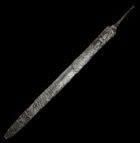
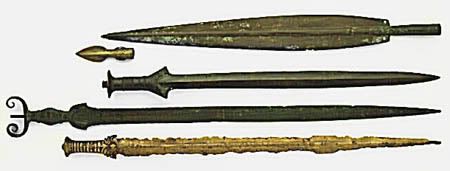
Ok, yeah I wondered about that. The one thing I had in mind was as you mentioned the leaf-shaped blades of the Celtic cultures during the Bronze and early Iron age. These swords were actually comparable in length to medieval swords as they were often used from horseback.

Image

Since that style pretty much disappeared after that time period, I presume it was for good reason, namely that the extra mass at the tip of a sword that long wasn't necessary to provide an effective cut?

But I guess the same principle must apply to longer swords as with shorter ones, that the extra mass would lend much more percussive power to an already long sword.. so provided you had a well-made, well-balanced sword with a leaf-shaped blade, you'd have significantly more power to the cut than you would with a sword of typical medieval style. But, point taken, it's not necessary, especially since it would add a great deal of weight. Thanks for all your help, guys.
A man can only be beaten in two ways: If he gives up, or if he dies.

User avatar
Stacy Clifford
Posts: 1126
Joined: Fri May 14, 2004 11:51 am
Location: Houston, TX
Contact:

Postby Stacy Clifford » Sun Apr 06, 2008 11:51 am

Could it also be that the extra width and mass in the leaf-shaped blades was structural compensation for the relatively weaker bronze to keep the blade from getting bent quite as easily? This wouldn't have been necessary in later iron and steel blades, and they could have been made narrower and more agile with the advent of tougher blade materials. I'm not discounting the extra cutting ability of the broader blade as an incentive to build it that way, but it could have served multiple purposes. I'm sure they just liked the way it looked too.
0==[>>>>>>>>>>>>>>>>>
Stacy Clifford
Free-Scholar
ARMA Houston, TX

User avatar
Carey Vaughn
Posts: 10
Joined: Fri Mar 14, 2008 3:04 pm
Location: VA

Postby Carey Vaughn » Sun Apr 06, 2008 4:49 pm

Yeah, good call. Honestly that hadn't occurred to me, though it ought to have as the metallurgy aspect of blades is something I'm also interested in. And yeah, the shape is very likely also a cultural reflection, though straight-edged swords were also prominent at that time.

Image
Image

However I would tend to think those were secondary to the fact that they just wanted strong slashing swords, since at that time armor was minimal.
A man can only be beaten in two ways: If he gives up, or if he dies.

User avatar
Stacy Clifford
Posts: 1126
Joined: Fri May 14, 2004 11:51 am
Location: Houston, TX
Contact:

Postby Stacy Clifford » Mon Apr 07, 2008 3:06 pm

Perhaps straight-edged blades had a thicker spine to compensate as opposed to leaf-shaped blades. That would be interesting to know if you could find or take measurements. There's more than one way to achieve greater structural integrity, and I'm sure enterprising smiths tried them all.
0==[>>>>>>>>>>>>>>>>>

Stacy Clifford
Free-Scholar
ARMA Houston, TX

LafayetteCCurtis
Posts: 421
Joined: Sat Nov 04, 2006 7:00 pm

Postby LafayetteCCurtis » Fri Apr 11, 2008 2:39 am

BTW, if you'd still like alternative recommendations for sword manufacturers, Valiant Armoury has a new, affordable line of swords that breaks it previously mediocre reputation, since it's designed by Gus Trim and is manufactured to a somewhat higher standard than their older models:

http://www.valiant-armoury.com/practical.html

While Clyde Hollis from Generation 2 is planning to release a similar model based on the Henry V sword, at least if the information in this myArmoury discussion thread is accurate:

http://www.myarmoury.com/talk/viewtopic ... highlight=

Of course, even Albion has the Squire Line, and you might want to check that one out too.

User avatar
Ken Dietiker
Posts: 98
Joined: Wed Jul 19, 2006 1:01 pm
Location: Tacoma, WA, USA

Postby Ken Dietiker » Fri Apr 11, 2008 7:55 am

Don't know about Gen 2, but if you're looking at Angus Trim swords, best bet is to order directly from the source, Gus himself, as this way you can select the blade type and the furniture you prefer. Otherwise, you could find you may not be as satisfied with what you get. The price goes up a little, but I think being able to select even the furniture is important to some folk. At the same time, Gus normally makes his sharp swords oriented more towards cutting, for the mass market that is. If you want something more durable, you really have to order from him and specify that you want something that will stand up to some abuse. His "cutters" don't really do that. One nice thing about Gus' swords is that you can disassemble the hardware. Maybe not historical in that sense, but worth considering.

http://www.angustrimdirect.com/
Ken

-----
"They are ill discoverers that think there is no land,
when they can see nothing but the sea". ~Francis Bacon

User avatar
Carey Vaughn
Posts: 10
Joined: Fri Mar 14, 2008 3:04 pm
Location: VA

Postby Carey Vaughn » Mon Apr 14, 2008 8:01 pm

Ok great, thanks very much guys. I'll definitely look into both of those further; I've read a little about them, but nothing in much detail. I appreciate the recommendations!
A man can only be beaten in two ways: If he gives up, or if he dies.


Return to “Research and Training Discussion”

Who is online

Users browsing this forum: No registered users and 32 guests


Note: ARMA - The Association for Renaissance Martial Arts and the ARMA logo are federally registered trademarks, copyright 2001. All rights reserved. No use of the ARMA name or emblem is permitted without authorization. Reproduction of material from this site without written permission of the authors is strictly prohibited. HACA and The Historical Armed Combat Association copyright 1999 by John Clements. All rights reserved. Contents of this site 1999 by ARMA.