There really isn't a lot out there on this. The fechtbuks out there which include the pike, like PH Mair or J Meyer, deal with fighting with the pike in general. So just like with all the other weapons in the fechtbuks, they are not specific to group of battle fighting. Instead, you learn how to fight with the weapon, all the techniques possible and how to use the weapon in general, and then you apply that ability based upon the circumstance you find yourself in. I believe that the coverage of pike combat in the fechtbuks is intended to be fully applicable to battlefield tactics. There just wasn't a circumstance where the pike was regularly employed besides the battlefield. So yeah, what's in the manuals can and should be used for group and battlefield fighting.
That's not the same as saying that most soldiers knew how to fight or "fence" with the pike as taught in the manuals. This is normal for soldiers in the time period. Most people would not have had the opportunity to receive formal instruction in the handling of their arms of the same caliber as what we see in the fechtbuks. Most landsnkechts and reisslaufer were regular people, farmers, bakers, butchers, etc. They went off to war because they thought the money might be better than they were making at their trade or because jobs were scarce where they were. We can expect that new recruits were given some level of instruction in handling pikes, but this was probably more in the direction of drill--moving and working together as a unit--instead of fighting well. But then you would have veteran soldiers and fighters within a unit too and some of these would have attempted to pass on whatever they knew, whether formal instruction or just tried and true experience. So you have a mix of ability level in any particular company. This mix would still be on the low side in comparison to the ability distribution of a company of U.S. marines just out of boot camp.
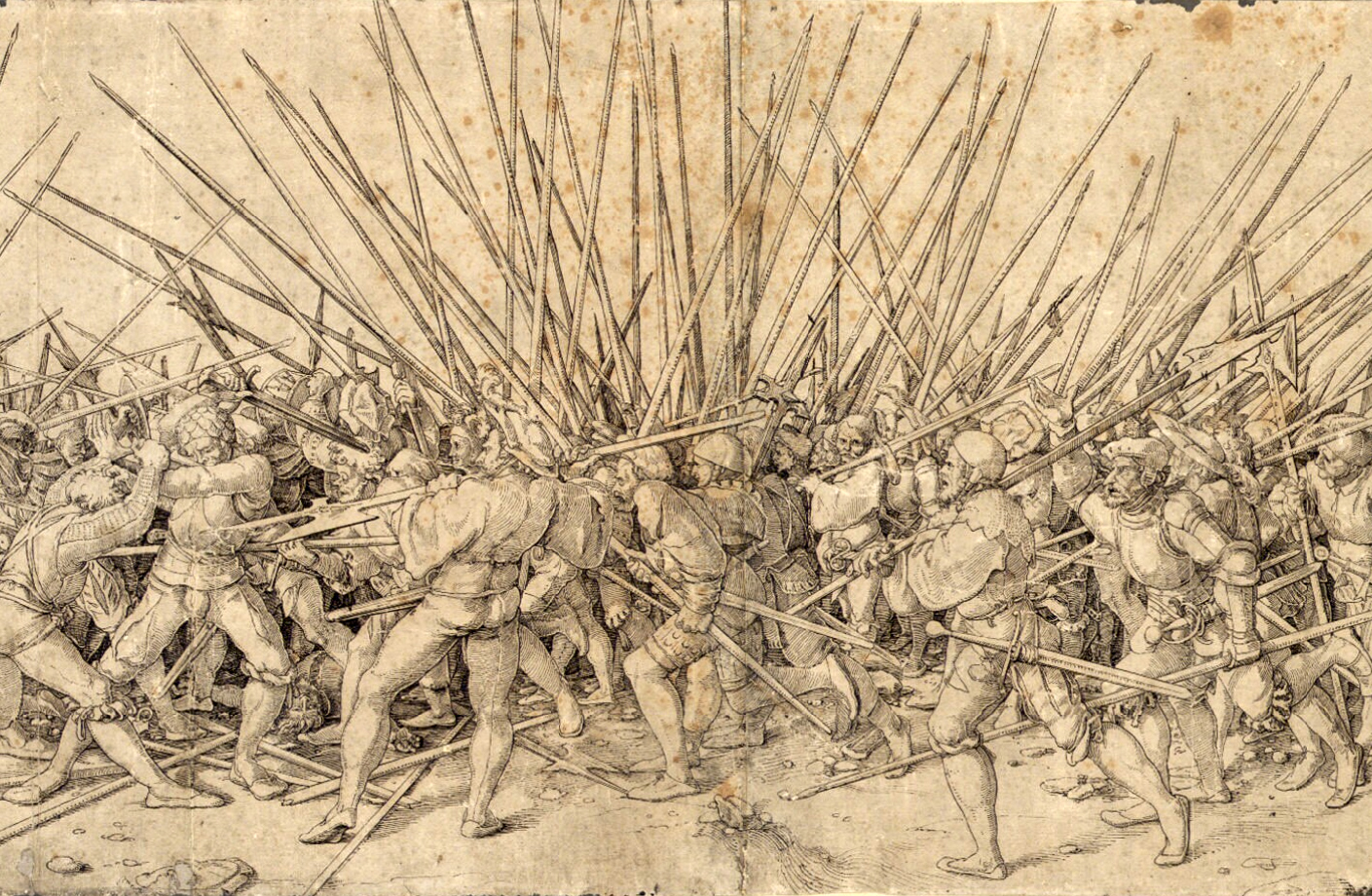
The image posted above is from Hans Holbien. I don't think the drawing shows what a pike battle would look like exactly. Rather, it captures the reality of the chaos, mess, confusion, and brutality of the struggle. When I see it, it makes me think of the "push of pikes" quite like the Sealed Knot group does it, which is quite ahistorical. They have two pike formations come together and lock up with their pikes up in the air and then start a shoving match. Pikes were used with their points at the opponent's head and chest, not up in the air. Sealed Knot just found a way to combine reenacting with fun and physical competition. Good for them. But it is not pike fighting. Nor does any one piece of period art capture it all.
In a pike engagement, pikes would be pushing by each other, knocking opposing pikes aside and down, thrusting at opponents, and then there would be the other pole weapons, bills, halberds, dopplehanders, etc. in there chopping at pike and at each other. It would look like a mess, but the integrity of the formation would be key, just like it is in any group fighting. The formation is designed to protect each other. You protect the guys beside you and in front of you while the guys beside and behind protect you in turn. All the while the guns or crossbows would be along the flanks firing volley after volley into the opposing formations. More halberds, bills, guisarms, partizans, and maybe a few dopplehanders would protect the flanks of the formation and stop any gaps that opened up. Maintaining order, going with the flow, adapting and overcoming, and flexibility with strength, these would be the virtues of victory.