In reply to:
--------------------------------------------------------------------------------
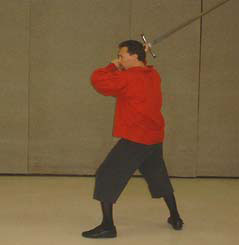
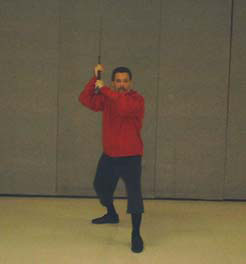
John wrote: We were playing with these Miesterhau from the on shoulder position some this weekend using a sharp Del Tin warsword against a fresh killed deer. There was little question it resulted in weaker cuts than when held higher aloft over the shoulder
--------------------------------------------------------------------------------
John, this result was not in question.
I think the key to solve the how-to-cut-a-zorn-efficiently-question is:
Danzig quotation, page 11r:
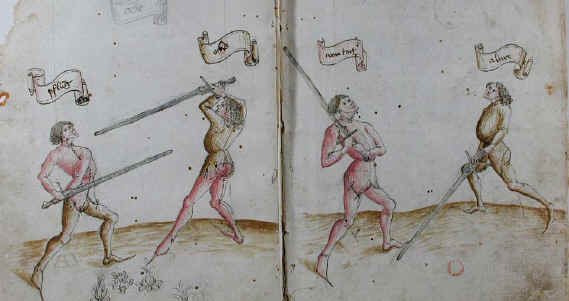
„Glosa / Merck daß ist / wenn du mit dem zu vechten zu im kumpst / waß du den vechten wild daß treib mit gantzer sterck deß leibs / und haew im do mit nahent ein zu kopf / und zu leib /“
Danzig and others say (sorry for repeating that phrase every now and then), that you should use the strength of your whole body to cut, emphasize on “whole body”.
But it says not: use the maximum power and strength with every cut. Everything overdone, wastes energy and might be exploited by my opponent.
A slight distinction. Important are arms, legs, feet and hands, not just the arms and shoulders.
I am well aware that ARMA has a different opinion about the use of strength, thus it is up to you to use the following things or not. Just my two cents.
Starting Zorn at the shoulder is perhaps not the strongest version thinkable, but it is not necessary to cut as strong as my arms can, see the quotation above.
You IMO really do not need to cut an opponent in two parts to harm him efficiently (see Deer example). We talk of Blosfechten, where no armour is worn and thus a cut 2 cm deep at the throat is more than needed to kill.
And remember the insulting wording in manuscripts for fencers who rely only on strength: “Büffelschlag” (lit. Buffalo-Blow) or “Bauernschlag” (lit. Peasant-Blow).
Honestly, I do not want to be compared with a pitchfork swinging peasant when it comes to fencing abilities. Do you?
On the other hand, Ringeck states:
"Item, du solst mercken alles das du fechten wilt das trüb mit ganzer störk deines lybs Vnnd haw im do mitt nahent ein zu kopf vnd zu lyb so mag er vor dinem ort nicht durch wechseln...
"Note: Always fence with all your strength! Strike against his head and against the body so that he can't change through (durchwechseln) in front of your (sword) point.
-David Lindholm's translation, p 19; Sigmund Ringeck's Knightly Art of the Longsword
A too weakly thrown initial cut would simply be too easily displaced/parried/blown aside. Now, on behalf of all my fellow ARMA colleagues, I would like to clarify our standpoint when it comes to the use of strength.
Yes: we do advocate the use of strength when cutting. But this doesn't neccesarily mean that we base our fencing purely on strength. Just as the fechtmeistern of old adviced, we use our entire bodies in the cut; feet, legs, hands, arms and shoulders. But we do it with strength -strength used in concert with the body as a whole. Strength and technique in combination. Strength with control. Strength based on the coordinated assembly of proper footwork, good technique, and powerful cuts. ARMA as a whole have never argued otherwise.
Now who would be more dangerous as an opponant in a swordfight: a pshysically weak, not very hard cutting, but very technically skilled fencer -or a stronger, but equally technically skilled fencer who uses stronger cuts?
My vote goes out to the stronger fencer. During a fight, battle or any similar condition, the human body becomes literaly high on adrenaline. One purpose of that adrenaline is to numb the pain and make sure the individual survives the fight. Even if he/she in the process sustains what would ordinarily be considered quite horrendous wounds. Blossfechten or not. There are plenty of examples from real life of people sustaining heavy injuries, but still being able to carry on fighting. Even if I gave my opponant a 2cm gash in his neck, if he's pumped up on adrenaline and stress, can I be entirely sure that my cut will be effecient enough? Or will he, despite his wounds, still have the energy to retaliate? Even if it is with only one blow? Not wanting to take any unneccesary risks during a fight, I would go out of my way to make sure he didn't even have the slightest, tiny shred of a possibility to harm me with a schtoss, schnitt or hau. There might be more opponants around that I need to deal with after disposing of him, and I'd very much like to deal with them with all my fighting abilities intact. Therefore I would use my strength when I cut him. My controlled strength mind you. As advocated by both the meisters as well as ARMA.
If you haven't done so already I suggest you read: http://www.thearma.org/essays/strength.htm -JC's article on fencing with strength.
As for your reference to the "buffeln und die bauern" mentioned in the source texts -well you said it yourself. <img src="/forum/images/icons/smile.gif" alt="" /> They relied on strength only. We do not.
More important: Cutting with too much strength is the reason for not achieving a binding proper.
What you miss with overdoing IE the use of strength are all the tiny and quick moves you need in the binding/in Krieg. You simply cannot “Fühlen”, which is essential to react or act against an opponent when the blades are crossed.
Well, Ringeck stated:
"Aber du solt dir mit dem an hurten nicht zu gauch lassen syn dem krieg wenn der krieg ist nicht anders dann die winden am schwert."
"But do not hasten into close combat ([i]Krieg) since close combat is nothing other than winding at the sword.[/i]"
-D. Lindholm, p 44; Sigmund Ringeck's Knightly Art of the Longsword.
Perhaps one shouldn't be in such a hurry to end up in Krieg. Perhaps I don't even want to? While there's a lot of techniques (in Ringeck) concerned with binden und winden, there's also quite a lot of techniques that deal with something else that winding at the sword. Even though they might start out from the bind. Ringen am swert for instance. What if I choose to engage him with (for instance) Drei Hau and when achieving or ending up in a bind choose to strike/swipe his sword aside with my crossguard and go into ringen instead? If binden und winden was the sole purpose and goal of the art, then Ringeck wouldn't have included all the other techniques.
Even though I acknowledge a proficiency in all manner of techniques -especially the usefullness of winden und binden I also acknowledge the option, with it's inherent pro's and con's, of perhaps not going into binden und winden each and every time. There's a multitude of possible events that might occur during combat, and one must be prepared for all of them.
And while cutting softer with the intention of achieving a bind so that one might execute a duplieren or wind and thrust or whatever is fine -is that really something to aim for all the time? And just because we advocate cutting with strenght it doesn't mean that we overdo it. Strength with control. Neither does it mean that one, once the bind has happened, cannot switch from strength to quick and nimble motions in the winden. In my mind, despite cutting with strength, once in the bind I should still be able to utilize Fühlen and instinctively decide what to do. Otherwise I'm doing something wrong.
And besides, just because we advocate cutting and fencing with strength it doesn't mean that we do it all the time. <img src="/forum/images/icons/wink.gif" alt="" /> I make a distinction between forcefull cuts and lighter, more harassing cuts.
Just some food for thought.
Regards,