Vom Tag;"on" the shoulder or "over"

For Historical European Fighting Arts, Weaponry, & Armor

Moderators: Webmaster, Stacy Clifford

User avatar
Joachim Nilsson
Posts: 331
Joined: Wed Oct 02, 2002 2:08 pm
Location: Gimo, Sweden

Re: Vom Tag;"on" the shoulder or "over"

Postby Joachim Nilsson » Fri Feb 13, 2004 6:55 am

Hi Claus,

In reply to:
--------------------------------------------------------------------------------

John wrote: We were playing with these Miesterhau from the on shoulder position some this weekend using a sharp Del Tin warsword against a fresh killed deer. There was little question it resulted in weaker cuts than when held higher aloft over the shoulder


--------------------------------------------------------------------------------


John, this result was not in question.

I think the key to solve the how-to-cut-a-zorn-efficiently-question is:

Danzig quotation, page 11r:

„Glosa / Merck daß ist / wenn du mit dem zu vechten zu im kumpst / waß du den vechten wild daß treib mit gantzer sterck deß leibs / und haew im do mit nahent ein zu kopf / und zu leib /“

Danzig and others say (sorry for repeating that phrase every now and then), that you should use the strength of your whole body to cut, emphasize on “whole body”.
But it says not: use the maximum power and strength with every cut. Everything overdone, wastes energy and might be exploited by my opponent.
A slight distinction. Important are arms, legs, feet and hands, not just the arms and shoulders.

I am well aware that ARMA has a different opinion about the use of strength, thus it is up to you to use the following things or not. Just my two cents.

Starting Zorn at the shoulder is perhaps not the strongest version thinkable, but it is not necessary to cut as strong as my arms can, see the quotation above.
You IMO really do not need to cut an opponent in two parts to harm him efficiently (see Deer example). We talk of Blosfechten, where no armour is worn and thus a cut 2 cm deep at the throat is more than needed to kill.

And remember the insulting wording in manuscripts for fencers who rely only on strength: “Büffelschlag” (lit. Buffalo-Blow) or “Bauernschlag” (lit. Peasant-Blow).
Honestly, I do not want to be compared with a pitchfork swinging peasant when it comes to fencing abilities. Do you?


On the other hand, Ringeck states:

"Item, du solst mercken alles das du fechten wilt das trüb mit ganzer störk deines lybs Vnnd haw im do mitt nahent ein zu kopf vnd zu lyb so mag er vor dinem ort nicht durch wechseln...

"Note: Always fence with all your strength! Strike against his head and against the body so that he can't change through (durchwechseln) in front of your (sword) point.

-David Lindholm's translation, p 19; Sigmund Ringeck's Knightly Art of the Longsword

A too weakly thrown initial cut would simply be too easily displaced/parried/blown aside. Now, on behalf of all my fellow ARMA colleagues, I would like to clarify our standpoint when it comes to the use of strength.

Yes: we do advocate the use of strength when cutting. But this doesn't neccesarily mean that we base our fencing purely on strength. Just as the fechtmeistern of old adviced, we use our entire bodies in the cut; feet, legs, hands, arms and shoulders. But we do it with strength -strength used in concert with the body as a whole. Strength and technique in combination. Strength with control. Strength based on the coordinated assembly of proper footwork, good technique, and powerful cuts. ARMA as a whole have never argued otherwise.

Now who would be more dangerous as an opponant in a swordfight: a pshysically weak, not very hard cutting, but very technically skilled fencer -or a stronger, but equally technically skilled fencer who uses stronger cuts?

My vote goes out to the stronger fencer. During a fight, battle or any similar condition, the human body becomes literaly high on adrenaline. One purpose of that adrenaline is to numb the pain and make sure the individual survives the fight. Even if he/she in the process sustains what would ordinarily be considered quite horrendous wounds. Blossfechten or not. There are plenty of examples from real life of people sustaining heavy injuries, but still being able to carry on fighting. Even if I gave my opponant a 2cm gash in his neck, if he's pumped up on adrenaline and stress, can I be entirely sure that my cut will be effecient enough? Or will he, despite his wounds, still have the energy to retaliate? Even if it is with only one blow? Not wanting to take any unneccesary risks during a fight, I would go out of my way to make sure he didn't even have the slightest, tiny shred of a possibility to harm me with a schtoss, schnitt or hau. There might be more opponants around that I need to deal with after disposing of him, and I'd very much like to deal with them with all my fighting abilities intact. Therefore I would use my strength when I cut him. My controlled strength mind you. As advocated by both the meisters as well as ARMA.

If you haven't done so already I suggest you read: http://www.thearma.org/essays/strength.htm -JC's article on fencing with strength.

As for your reference to the "buffeln und die bauern" mentioned in the source texts -well you said it yourself. <img src="/forum/images/icons/smile.gif" alt="" /> They relied on strength only. We do not.

More important: Cutting with too much strength is the reason for not achieving a binding proper.
What you miss with overdoing IE the use of strength are all the tiny and quick moves you need in the binding/in Krieg. You simply cannot “Fühlen”, which is essential to react or act against an opponent when the blades are crossed.


Well, Ringeck stated:

"Aber du solt dir mit dem an hurten nicht zu gauch lassen syn dem krieg wenn der krieg ist nicht anders dann die winden am schwert."

"But do not hasten into close combat ([i]Krieg) since close combat is nothing other than winding at the sword.[/i]"

-D. Lindholm, p 44; Sigmund Ringeck's Knightly Art of the Longsword.

Perhaps one shouldn't be in such a hurry to end up in Krieg. Perhaps I don't even want to? While there's a lot of techniques (in Ringeck) concerned with binden und winden, there's also quite a lot of techniques that deal with something else that winding at the sword. Even though they might start out from the bind. Ringen am swert for instance. What if I choose to engage him with (for instance) Drei Hau and when achieving or ending up in a bind choose to strike/swipe his sword aside with my crossguard and go into ringen instead? If binden und winden was the sole purpose and goal of the art, then Ringeck wouldn't have included all the other techniques.

Even though I acknowledge a proficiency in all manner of techniques -especially the usefullness of winden und binden I also acknowledge the option, with it's inherent pro's and con's, of perhaps not going into binden und winden each and every time. There's a multitude of possible events that might occur during combat, and one must be prepared for all of them.

And while cutting softer with the intention of achieving a bind so that one might execute a duplieren or wind and thrust or whatever is fine -is that really something to aim for all the time? And just because we advocate cutting with strenght it doesn't mean that we overdo it. Strength with control. Neither does it mean that one, once the bind has happened, cannot switch from strength to quick and nimble motions in the winden. In my mind, despite cutting with strength, once in the bind I should still be able to utilize Fühlen and instinctively decide what to do. Otherwise I'm doing something wrong.

And besides, just because we advocate cutting and fencing with strength it doesn't mean that we do it all the time. <img src="/forum/images/icons/wink.gif" alt="" /> I make a distinction between forcefull cuts and lighter, more harassing cuts.

Just some food for thought.

Regards,
-----------------------------------
ARMA Gimo, Sweden

Semper Fidelis Uplandia

User avatar
Joachim Nilsson
Posts: 331
Joined: Wed Oct 02, 2002 2:08 pm
Location: Gimo, Sweden

Re: Vom Tag;"on" the shoulder or "over"

Postby Joachim Nilsson » Fri Feb 13, 2004 7:32 am

I'd also like to add that the definition of "fencing with all your strength" doesn't just pertain to muscular power only. It also means to use all your strenghts, i.e: muscular power, as well as agility, speed, balance and so forth.

Regards,
-----------------------------------

ARMA Gimo, Sweden


Semper Fidelis Uplandia

User avatar
claus drexler
Posts: 16
Joined: Thu Sep 26, 2002 1:03 am
Location: Bavaria

Re: Vom Tag;"on" the shoulder or "over"

Postby claus drexler » Fri Feb 13, 2004 10:09 am

Hi Joachim!

Thank you very much for your very long, partially off-topic posting (see headline of the thread).
Profound arguments and critique on the other hand will be always appreciated.

Am really afraid, that David Lindholms published translation of the Ringeck quote
“Item, du solst mercken alles das du fechten wilt das trüb mit ganzer störk deines lybs“ is not precise.

As I said before, I offered just my 2 cents – initially I intended nothing but to help IE Robert Hyatt with my very first posting.

Never intended to question any Arma dogmas and thus I won´t comment on that further.
I am indeed starting to get bored to repeat again and again what I said and what I said not.

Reading your posting I see, that at least your approach is not that different to mine, what means that further discussion is not necessary.

Please allow me a personal note: I am little disappointed that you and not John (which I addressed one of my previous posts to), did write such a general statement in IMO official behalf of ARMA.

Again just my 2 cents.

Best,
Claus
________________________________
Ochs - historische Kampfkünste
HEMAC-Member

User avatar
Joachim Nilsson
Posts: 331
Joined: Wed Oct 02, 2002 2:08 pm
Location: Gimo, Sweden

Re: Vom Tag;"on" the shoulder or "over"

Postby Joachim Nilsson » Fri Feb 13, 2004 10:39 am

Hi Claus!

Being slightly off topic was more or less intentional. Especially since I find that endlessly debating this issue is a moot point. And I didn't feel like I had too much to add to what had already been said. Discussions are fine and even neccesary, but there is also the reasoning of "less talk, more action." (Me sometimes choosing that path could be because I'm Swedish, and we're not so talkative all the time <img src="/forum/images/icons/grin.gif" alt="" /> ) But one interpretation's supremacy over the other will eventually be proven by dilligent sparringsessions. But at the end of the day I still side with JC's:

Bottom line, try whatever you think works. But if you keep losing hits and being struck by opponents doing it differently, after while it’s time to change what you are doing.


And I not saying that you're wrong here, Claus! I'm just stating that what may work for you, may not work for me. And Danzig aside, I confess to being of the opinion that the sword should be held above the shoulder or over the head (as shown in the majority of available manuals.) Now I know that Danzig must have had a pretty good reason to show it in front of the shoulder, but I'm very sceptical as to how useful that is when compared to holding it over the shoulder. And, furtermore, should those pictures (in Danzig) really be taken literaly? Even if they intend to show the Vier Leger [referring to the banners above the fencer(s)] and nothing else?

You also wrote:
Am really afraid, that David Lindholms published translation of the Ringeck quote
“Item, du solst mercken alles das du fechten wilt das trüb mit ganzer störk deines lybs“ is not precise.


Hm, yes. I've been a bit sceptical about that part too, but unfortunately my German is a wee bit rusty these days cinsidering the confusion of a few words here and there, could you be so kind as to offer your translation of that phrase? -Seeing how you seem to be well versed in the English language.

As for me making a general statement on behalf of ARMA and not John, probably simply comes down to me beating him to the punch. <img src="/forum/images/icons/wink.gif" alt="" />

Regards,
-----------------------------------

ARMA Gimo, Sweden


Semper Fidelis Uplandia

User avatar
Webmaster
Posts: 289
Joined: Wed Sep 18, 2002 9:19 pm
Location: Houston, Texas

Re: Vom Tag;"on" the shoulder or "over"

Postby Webmaster » Fri Feb 13, 2004 12:57 pm

Claus,

Looks like you and Stew found a couple of things I wasn't clear on, so I'll correct myself here. First, I'm a he, not a she, just for the record. Second, Stew is correct in pointing out that our definition of zuefechten does include everything outside of the range I described. I was focusing on the one-pass range because that is the distance within zuefechten where the things we are discussing are most critical with respect to speed and reaction time. Certainly from two or three steps further away from your opponent, you are at less risk in resting the blade on your shoulder while you decide on your action.

Something else Stew noted which makes a difference is the way you describe your body position in the stance. As you describe it with your shoulders tilted away from the opponent with the left leading, what you say about cutting from underneath without first sliding off the shoulder would seem more likely to work. Our stance is slightly different, as Stew says, in holding the shoulders squared forward. You can see what I mean in this article from our essays section:

http://www.thearma.org/essays/StancesIntro.htm

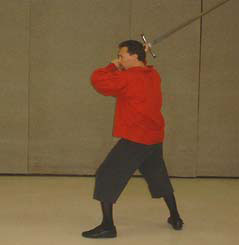
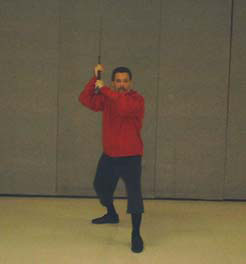
Here are pictures of John demonstrating the stance as we teach it (and as I practice it, to answer your question):

Image Image Image

John's shoulders do appear slightly turned here, but we both agree that from this shoulder position an unterhau from on the shoulder does not proceed completely smoothly without first removing it from the shoulder. Keeping it above the shoulder as shown allows us to cut in all directions more smoothly and quickly in our own experience.

I have not had a chance to look at Von Danzig yet, but I can tell you that what John teaches is based on commonalities among many manuals combined with common sense and vigorous experimentation (frequently on me), rather than the work of a single or a few masters. This approach is bound to produce somewhat different results than someone with a tighter focus such as yourself. It is quite clear here that small differences in the way we start off or define terms or situations can make significant differences in our expected and observed results. As you said, Von Danzig says "at the shoulder," which to me could mean either of our interpretations without being wrong. His diagrams, assuming they accurately depict the action, would serve to clarify his intended meaning in such a case. Ultimately I think this is one of those cases where the only way to completely understand each other's point of view and reference is by demonstrating in person and comparing.

For the record though, even if our methods of study are different, your insistence on referring to source materials in your posts is more consistent than just about anybody else here, and your input is highly valued on any topic and always thought-provoking. You have my statement now, so please dissect.
0==[>>>>>>>>>>>>>>>>>>>>>>>>>>>>
Stacy Clifford
ARMA Webmaster

User avatar
claus drexler
Posts: 16
Joined: Thu Sep 26, 2002 1:03 am
Location: Bavaria

Re: Vom Tag;"on" the shoulder or "over"

Postby claus drexler » Fri Feb 13, 2004 1:19 pm

Hi Joachim,

there is also the reasoning of "less talk, more action." (Me sometimes choosing that path could be because I'm Swedish, and we're not so talkative all the time)

Hah! I like that, cause I am Bavarian and Bavarians are not so talkative all the time... <img src="/forum/images/icons/grin.gif" alt="" />

I'm just stating that what may work for you, may not work for me

Funny, because I am saying just the same all the time this thread - in regard to vom Tag!

Now I know that Danzig must have had a pretty good reason to show it in front of the shoulder

Well, yes. And IMO the "why" has to be researched, if there is only a tiny doubt...

cheers,
Claus
_____________________________________
Ochs - historische Kampfkünste e.V.
HEMAC-Member

User avatar
claus drexler
Posts: 16
Joined: Thu Sep 26, 2002 1:03 am
Location: Bavaria

Re: Vom Tag;"on" the shoulder or "over"

Postby claus drexler » Fri Feb 13, 2004 1:27 pm

Stacy,

just a short note now, I am in a little hurry:

Just for the record, I thought Stacy is a girls name. Sorry for that.

A dissection perhaps following on monday <img src="/forum/images/icons/wink.gif" alt="" />

Best,
Claus
_______________________________
Ochs - historische Kampfkünste e.V.
HEMAC-Member

Stuart McDermid
Posts: 218
Joined: Tue Feb 18, 2003 8:48 pm

Re: Vom Tag;"on" the shoulder or "over"

Postby Stuart McDermid » Fri Feb 13, 2004 4:41 pm

Hi Stacy,

Those pics of John are interesting, thanks for posting them.

When doing German, we stand with the blade a little more upright and the elbows relaxed against the body. In my IMVHO John is exposing his elbows to attack by standing like this.
Cheers,
Stu.

User avatar
Jake_Norwood
Posts: 913
Joined: Thu Sep 19, 2002 11:46 am
Location: Clarksville, TN

Re: Vom Tag;"on" the shoulder or "over"

Postby Jake_Norwood » Fri Feb 13, 2004 4:55 pm

Re: Zufechten

I'm going off of Meyer's use of the term, meaning everything leading up to committed striking and other work in-range. Thus even when not in the bind, as when twitching, one is in krieg, not zufechten, according to Meyer. Meyer's three stages are (1) zufechten, moving into the fight, including those strikes intended to create an opportunity to really commit, (2) krieg und handarbeit, being winding, binding, twitching, and other striking in-range, and (3) abzug, the withdrawal, which is essentially zufechten in reverse, where strikes are thrown to make a safe retreat.

Hope that clarifies my comments.

Jake
Sen. Free Scholar
ARMA Deputy Director

User avatar
John_Clements
Posts: 1167
Joined: Wed Sep 18, 2002 10:43 pm
Location: Atlanta area

Re: Vom Tag;"on" the shoulder or "over"

Postby John_Clements » Fri Feb 13, 2004 8:23 pm

Well, that's as funny an opinion as I ever heard. My elbows look just like ones in countless historical images and I don't get hit on them---they are certainly farther back and freer to move than if the hilt were pulled forward so the blade rests on the shoulder. So, I guess this is one of those things in martial arts where people will just have to disgaree. In my time I've learn that even when you beat the heck out of some people in sparring they still refuse to drop erroneous stances or give up futile pet ideas that they clinged to. I can't help them. Best to move on.

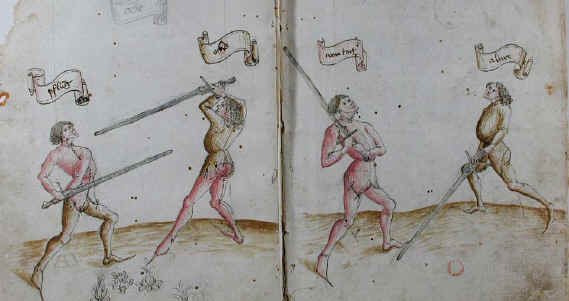
As to von Danzig's image of stances seen below
Image

If taken "literally”, then we must also stand with our Ochs over our head, our face angle to look up at it and our leg pointing straight out; our Alber with a 6 foot long sword touching the ground and our feet daintily pointed with the rear leg bent and raised; and our Pflug with the hilt pulled back behind the waist and our hips twisted forward. That is...if we take the images literally as our guide. Heck, both the Solothurner Fechtbuch and Paulus Kal's roof guard are depicted with the sword held almost vertical pointed straight upward.

So, if images of the roof stance as held "over the head" were often drawn strangely (so that they appear to not be above it), isn't it reasonable that ones drawn "over the shouder" were as well?


From a reliable translation of Doebringer’s verses of Liechtenauer (4r) “from the roof” (Vom Tag), is defined as where “the sword is held over one’s head or the right shoulder.” No mention on being "on" it that I find so far.

From von Danzig’s Glossa on the four guards or defenses: (26r):
“Merck die h&amp;#367;tt haist vom tag / do schick dich also mit / Stee mit dem lincken füeß vor / und halt dein swert an deiner rechten achsel oder mit auff gerackten armen hoch über dein haubt / und stee also in der h&amp;#367;t”

“Notice, the fourth guard is called ‘from the roof’, and assume it this way: stand with the left foot forwards and hold your sword on your right shoulder or with straightened arms high above your head, and stand in the guard this way.” He here does not mention it being "on."

Later he adds: “The fourth guard, “from the roof”, is the “long point”: who leads it well with straightened arms, cannot be hit well with neither strokes nor thrusts, but he himself may hit well, and it [the guard] hangs above the head.” This hanging above the head by the blade certainly occurs when the weapon is held over the head or over the shoulder, but arguably not really when held lower and resting on the shoulder.

After all, we certainly don’t want our stances resting statically or immobile. As Liechtenauer taught (courtesy of G. Zabinski): “Before all the things one should not remain in them for too long.” And von Danzig wrote: “That is why Liechtenauer has a proverb: ‘Who rests, that is dead, who moves, is still alive’. And this concerns the guards, that one should rather move with techniques than such a man who waits in the guard…” Further, since Liechtenauer’s teaching place great emphasis on overreaching the opponent by stretching out the arms, I fail to grasp then why any fighter would purposely limit himself to a stance that is both mechanically slower and tactically shorter.
Do NOT send me private messages via Forum messenger. I NEVER read them. To contact me please use direct email instead.

Stuart McDermid
Posts: 218
Joined: Tue Feb 18, 2003 8:48 pm

Re: Vom Tag;"on" the shoulder or "over"

Postby Stuart McDermid » Sat Feb 14, 2004 3:29 am

Hi John,

Look again at the picture of you in Vom Tach and the picture you just posted from Von Danzig.

Your elbow is being held pretty much level with your chin and the the chap in the von Danzig manual has his pretty much resting against his side. I think this is an important difference especially if fighting against someone in alber.

With the elbow in, you are a little bit further out of distance and what's more can actually see what is going on in the low line.

Now I don't think the pics from Von Danzig are supposed to be representative of fighting stances taken against each other at a realistic distance, but it is pretty easy to see the additional exposure of having your elbows up over having them down to my eye.

“Notice, the fourth guard is called ‘from the roof’, and assume it this way: stand with the left foot forwards and hold your sword on your right shoulder or with straightened arms high above your head, and stand in the guard this way.” He here does not mention it being "on."


I am quite confused. It plainly says in the text you just quoted to hold the sword "on" your shoulder.

If taken "literally”, then we must also stand with our Ochs over our head, our face angle to look up at it and our leg pointing straight out;


Do you not think that the artist is trying to tell us something here? Looking up has got me stumped unless the fighters are supposed to be looking at the signs drawn above them or something but the straight front leg I believe to be indicative of the weight of the body being carried on the back leg. This could be to create distance or it could be so that a large spring into distance is possible from here, I don't know. You might be right, it might mean nothing but I don't think that assumption should be made withou at least considering other interpretations do you? When I can't make something work according to my interpretation of a manual, I am very, very reluctant not to assume that my understanding is at fault rather than the manual.

Alber with a 6 foot long sword touching the ground and our feet daintily pointed with the rear leg bent and raised; and our Pflug with the hilt pulled back behind the waist and our hips twisted forward.


I don't see anything wrong with the sword touching the ground. Wards almost identical to this one are found in other fencing systems as an invitation. The 6 ft long sword is a mystery but I do think that the swords used in judicial duelling are different from those used on the battlefield. In no picture I have seen from any German manual are the combatants wielding weapons with blades as short as most people are using. I consider the swords that most people are using to be bastard swords which are not the same as the weapons shown in any German fechtbuch in my opinion.

Having played at the Lichtenauer system with claymores (we don't actually have any other two handers) I found it to work much better than with smaller hand and a halfers especially in getting meisterhauen to work in something close to single time.

Why not keep the hilt well back in Pflug to stop it being crossed? If you intend to respond to an attack with a thrust (Pflug is nothing more than a thrust from below- Ringeck) then there is good reason to refuse engagement to invite attack. As for the hips being twisted forward, this does allow one to pull back the sword a little further IMHO adding creedence to my theory about the pflug guard being held so as to refuse engagement.

Further, since Liechtenauer’s teaching place great emphasis on overreaching the opponent by stretching out the arms, I fail to grasp then why any fighter would purposely limit himself to a stance that is both mechanically slower and tactically shorter.


Being short in a stance is not a great disadvantage in my opinion. All postures are a compromise between attack and defence, speed and power, invitation and the closing of lines, exposure and cover (ie the elbow issue from above).

A postures that satisfies any one of the above factors cannot IMHO satisfy it's partner, you have to make a choice.

Looking forward to further interesting debate.
Cheers,
Stu.

Jay Vail
Posts: 558
Joined: Thu Sep 26, 2002 2:35 am

Re: Vom Tag;"on" the shoulder or "over"

Postby Jay Vail » Sat Feb 14, 2004 6:09 am

John’s interpretation of von tag over the shoulder is consistent with the expression of this posture in other sword arts, notably yagu shinkage ryu kenjutsu and other kenjutsu ryu. I have not seen any kenjutsu posture that involves placing the blade actually on the right shoulder. There is one posture that comes close, a variation of hisso-no-kamae (which is the Japanese over the shoulder von tag). In this variation, the left hand is about waist level and the right hand is at the armpit. The blade is vertical rather than angled.

In view of the fact that kenjutsu, which has many many points of similarity with western medieval fencing, does not appear to have an on the shoulder von tag, I think the stronger argument lies against placing the sword on the right shoulder in von tag. Thus, John’s interpretation of von tag over the shoulder is correct.

User avatar
Mike Cartier
Posts: 594
Joined: Mon Sep 23, 2002 12:21 pm
Location: USA Florida

Re: Vom Tag;"on" the shoulder or "over"

Postby Mike Cartier » Sat Feb 14, 2004 6:50 am

I'm a little confused by this thread, we seem to have 2 camps one advocating on the shoulder and one advocating over the shoulder. And here i am stuck in the middle, i like them both.
Meyer mentions using the Glancer (Schielhauw), Thwarter (Zwerchauw), Wrathful (Zornhauw) all from either Vom Dach or Zornhut resting on the shoulder.

Both over the shoulder Vom Dach and on the shoulder Zornhut seem to have different uses to me. Discovering Zornhut simply added another dimension to the over the shoulder guard. Not worse, not better, just different.
Its utility determined solely by its application. I use vom dach over shoulder and Zornhut on the shoulder.

Unless we are simply discussing Vom tach and not Zornhut which I am adding to this discussion in my impish Meyerism. if so pardon me and forget i mentioned it <img src="/forum/images/icons/smile.gif" alt="" />
Mike Cartier
Meyer Frei Fechter
www.freifechter.com

User avatar
Matthew_Anderson
Posts: 335
Joined: Wed Sep 24, 2003 5:57 pm
Location: Virginia Beach, VA

Re: Vom Tag;"on" the shoulder or "over"

Postby Matthew_Anderson » Sat Feb 14, 2004 10:54 am

Wow, this turned into quite a thread. Although it did stray a little off topic, I'm finding the diversity of opinion displayed on this one little aspect fascinating.

I guess I'm in the same boat as you Mike, I have found both to be useful in different ways and different situations, although "over" the shoulder feels more versatile to me.

I totally agree with John however, that we must be very careful when interpreting manuscript images and text. I think if the medieval masters could be here now and see some of the interpretations of their work by modern practioners, they would get a good laugh! They would probably think we were all whimps too! "Ow, you hit my thumb, I'm gonna have to go put some ice on this". <img src="/forum/images/icons/grin.gif" alt="" />
Matt Anderson
SFS
ARMA Virginia Beach


Return to “Research and Training Discussion”

Who is online

Users browsing this forum: No registered users and 28 guests


Note: ARMA - The Association for Renaissance Martial Arts and the ARMA logo are federally registered trademarks, copyright 2001. All rights reserved. No use of the ARMA name or emblem is permitted without authorization. Reproduction of material from this site without written permission of the authors is strictly prohibited. HACA and The Historical Armed Combat Association copyright 1999 by John Clements. All rights reserved. Contents of this site 1999 by ARMA.