New Article Online - Damaged Edges

For Historical European Fighting Arts, Weaponry, & Armor

Moderators: Webmaster, Stacy Clifford

User avatar
John_Clements
Posts: 1167
Joined: Wed Sep 18, 2002 10:43 pm
Location: Atlanta area

Re: New Article Online - Damaged Edges

Postby John_Clements » Mon Sep 27, 2004 3:04 pm

Hi
If you interpret that statement absolutely literally, then yes. But, the thumb can be entirely under the baled and the short edge aimed at you both as instructed while the blade remains at 45 degrees. These things are not mutually exclusive. They do not call for the blade to be held with the flat parallel to the ground. I can’t fathom why people think that must be the case? There is certainly no instruction to specifically hold the sword in Ochs (or in Finestra) with the flat aimed down nor a single image depicting such a stance. There is no problem turning the sword to strike Zwerch from the more diagonal stance we use. It’s certainly a natural position that occurs when cutting upward diagonally or when turning the sword around to Ochs from Vom Tag. It not only permist receiving with the flat of the strong, it also keep the cross and edge from hitting you in the head should your weapon be struck. And on the left side, it fits in perfectly with transitioning to the short edge Pflug. Make sense?

JC
Do NOT send me private messages via Forum messenger. I NEVER read them. To contact me please use direct email instead.

User avatar
Matt Bailey
Posts: 30
Joined: Tue Sep 24, 2002 7:00 am
Location: Carthage, Texas

Re: New Article Online - Damaged Edges

Postby Matt Bailey » Mon Sep 27, 2004 5:14 pm

Some points:

Thumb-under your blade-When the German manuals mention the thumb, it's a thumb placed on the flat of the blade. "Strike with the short edge and the thumb under the blade" or some such is the same language that's used in most ever fencing manual to describe Zwerchau, which I'm sure we all agree involves the edges being horizontal. If a zwerch's alignment is biomechanically and martially sound, then why is the same alignment not sound when counter-thrusting in the ox? Especially in light of the instructions to wind against your opponent's sword with your long/short edges while doing this technique?

I don't know what to say about being hit in the head with the cross of the sword-The German manuals tell you to hold the cross defensively in front of your head in numerous places, as opposed to beside your head. It would seem that if your opponent is trying to strike your sword in such a way to knock the hilt into your head in ox, he's commited suicide, since you've already formed the nessecary ward to simply thrust to his face with opposition.

There is certainly no instruction to specifically hold the sword in Ochs (or in Finestra) with the flat aimed down nor a single image depicting such a stance.

From the Jud Lew fechtbuch,
Item, In the Ochs you should stand with the left foot forward and hold your sword to your right side with the hilt beside your head so that the short edge stands against you and hold your point thus against the face.

Item In den ochßen schick dich also Stee mit dem lincken fuß für und halt dein swert zu deiner rechten seitten mit dem gehültz für dass haubt daß die kurtz sneide gegen dir stee und halt Im den ort also gegen dem gesichte etc.

I'd call that fairly specific.

Who are these people telling us to bang swords together like stage combatants anyway? I haven't encountered them.
"Beat the plowshares back into swords. The other was a maiden aunt's dream"-Robert Heinlein.

User avatar
Brian Hunt
Posts: 969
Joined: Thu Jan 23, 2003 2:03 am
Location: Price, Utah
Contact:

Re: New Article Online - Damaged Edges

Postby Brian Hunt » Mon Sep 27, 2004 8:08 pm

Hi Matt,

since the German word "gegen" can also mean "towards" as well as "against", I would translate that as "with the short edge towards you." rather than "against you."

As such an ochs held with a 45 degree inclination of the blade, with the short edge angled down towards your right shoulder and your true edge angled up away from your right shoulder, would also fit just fine with Jud Lew's instructions. Just because it says towards you, it doesn't mean that the short edge must sit at a horizontal 90 degree angle to your head.This position also allows me to easily protect my head with my cross, and from this type of a 45 degree Ochs, it is very easy to do a Zwerch with your short edge and your thumb under the flat of the blade, just by uncrossing your wrists, thus rotating you blade in a counter clockwise direction and doing a passing step with your right foot.

This is of course my "interpretation" and my opinion of Jud Lew's written words. Yours may very well be different than mine. <img src="/forum/images/icons/smile.gif" alt="" />

Just my 2 cents worth.

Brian Hunt
GFS
Tuus matar hamsterius est, et tuus pater buca sabucorum fundor!

http://www.paulushectormair.com
http://www.emerytelcom.net/users/blhunt/sales.htm

User avatar
JeffGentry
Posts: 1089
Joined: Tue Apr 20, 2004 8:35 am
Location: Columbus Ohio

Re: New Article Online - Damaged Edges

Postby JeffGentry » Mon Sep 27, 2004 11:04 pm

Hey Rabbe

Exactly why will the edges get dull if they are used in parrying? Admittedly, I'm not much of an expert in German longsword, but parries are rarely made with the foible, at least in the systems I've studied.


I don't know how to explain it in text i am not a real technical type guy, if you go to the kitchen and take two large sharp kitchen knive's and hold the edge's 90 degree's to each other, then hit one on the other hard and see what it does to the edge, then think of a four foot sword at full power from an adult doing the same thing, i'll warn you if you do this to them hard it will ruin the knive's, that is why people don't beat the edge's of there good kitchen knive's against marble cutting board's or other hard surface's, most good kitchen knife maker's even say to put cover's on the blade's of there kitchen knive's not just throw them in a draw full of knive's.

I am serious about this, i am a simple type person i need to show you not try to tell you, because i could probably not get the right word's to explain what would happen.

Jeff
Semper Fidelis

Usque ad Finem

Grace, Focus, Fluidity

User avatar
Rabbe J.O. Laine
Posts: 49
Joined: Fri Aug 06, 2004 3:33 am
Location: Hämeenlinna, Finland

Re: New Article Online - Damaged Edges

Postby Rabbe J.O. Laine » Mon Sep 27, 2004 11:20 pm

Casper,

Actually, that is the forceful forte-on-foible edge-on-edge parry I mentioned earlier.

Rabbe

In the Ochs guard my thumb is always on the underside of my blade/sword. I would have to rotate my hand on top of my sword in order for my thumb to not be on the underside. You might ask youself what "thumb under the blade" actually means. Does it mean just on the underside or out on the flat? Likewise, does it mean the blade must be completely hortizontal or can it be a a 45 degree angle? All of us have to watch that we don't read too much meaning into what the masters wrote.


Quite so; however, if you'd read my post and the post I responded to again, you'd propably notice that I never said the manuals instruct to that the edges must be absolutely horisontal, but that they must face outwards, at whatever angle - although, I do think the egde-out horisontal Ochs is more effective in most cases, and likely what the historical masters meant. I guess I wasn't too clear about it, though. Sorry.

Rabbe

User avatar
Rabbe J.O. Laine
Posts: 49
Joined: Fri Aug 06, 2004 3:33 am
Location: Hämeenlinna, Finland

Re: New Article Online - Damaged Edges

Postby Rabbe J.O. Laine » Tue Sep 28, 2004 3:02 am

Hey Rabbe


In reply to:
--------------------------------------------------------------------------------

Exactly why will the edges get dull if they are used in parrying? Admittedly, I'm not much of an expert in German longsword, but parries are rarely made with the foible, at least in the systems I've studied.


--------------------------------------------------------------------------------


I don't know how to explain it in text i am not a real technical type guy, if you go to the kitchen and take two large sharp kitchen knive's and hold the edge's 90 degree's to each other, then hit one on the other hard and see what it does to the edge, then think of a four foot sword at full power from an adult doing the same thing, i'll warn you if you do this to them hard it will ruin the knive's, that is why people don't beat the edge's of there good kitchen knive's against marble cutting board's or other hard surface's, most good kitchen knife maker's even say to put cover's on the blade's of there kitchen knive's not just throw them in a draw full of knive's.

I am serious about this, i am a simple type person i need to show you not try to tell you, because i could probably not get the right word's to explain what would happen.

Jeff


Jeff,

I understand what you're saying; however, parries are rarely made with the foible (ie. the half, or especially the third of the blade nearest to the point, which is the only part where edge damage really matters since you are using it to strike the opponent), so damage to the cutting edge is quite unlikely.

Rabbe

User avatar
JeffGentry
Posts: 1089
Joined: Tue Apr 20, 2004 8:35 am
Location: Columbus Ohio

Re: New Article Online - Damaged Edges

Postby JeffGentry » Tue Sep 28, 2004 8:04 am

Hey Rabbe

That may be why you see the edge contact as being the right way to block and gaurd, you never intentionaly block with your edge, you dull the edge you might as well fence with a piece of flat bar stock it is the same thing, it will not cut, it is then a club.


i think this is what you refered, i am not so worried about the of strong of the blade i.e gaurd to about half way to the point on a longsword like you said i don't use it to cut , i would be concerned about repeatedly taking straight 90 degree hard cut's to this, if it is a hard enough to nick it may cause an internal crack in the steel and next time you use it it may break, in essence you are wedging across the flat, steel does have kind of grain for flexibility and it doesn't flex well across the flat, it could break with repeadted hard hit's this way.


I am no metalurgist, this is MO so just take it for what it is worth.

Jeff
Semper Fidelis


Usque ad Finem


Grace, Focus, Fluidity

User avatar
Stacy Clifford
Posts: 1126
Joined: Fri May 14, 2004 11:51 am
Location: Houston, TX
Contact:

Re: New Article Online - Damaged Edges

Postby Stacy Clifford » Tue Sep 28, 2004 12:17 pm

If a zwerch's alignment is biomechanically and martially sound, then why is the same alignment not sound when counter-thrusting in the ox? Especially in light of the instructions to wind against your opponent's sword with your long/short edges while doing this technique?


The zwerch's alignment is biomechanically and martially sound because the blade is in motion and the edge is being aimed at something. Also, in order to perform a zwerch from ochs, you have to reverse the position of your arms (crossed/uncrossed, depending whether you're in right or left ochs) as you transition through vom tag, which changes the biomechanics of how you hold the weapon. From that perspective I would not argue that optimal edge alignment is necessarily comparable between ochs and zwerchau.

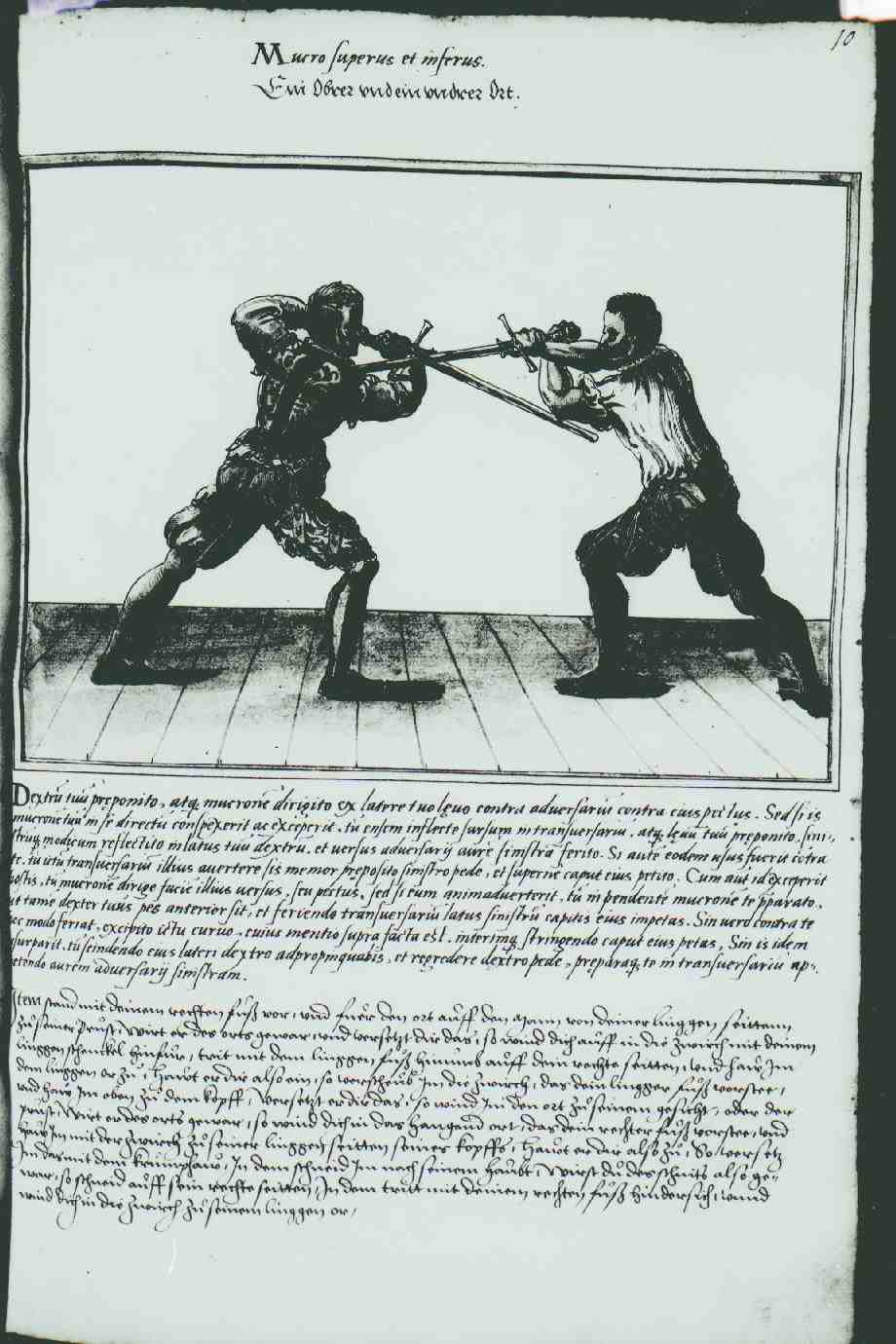
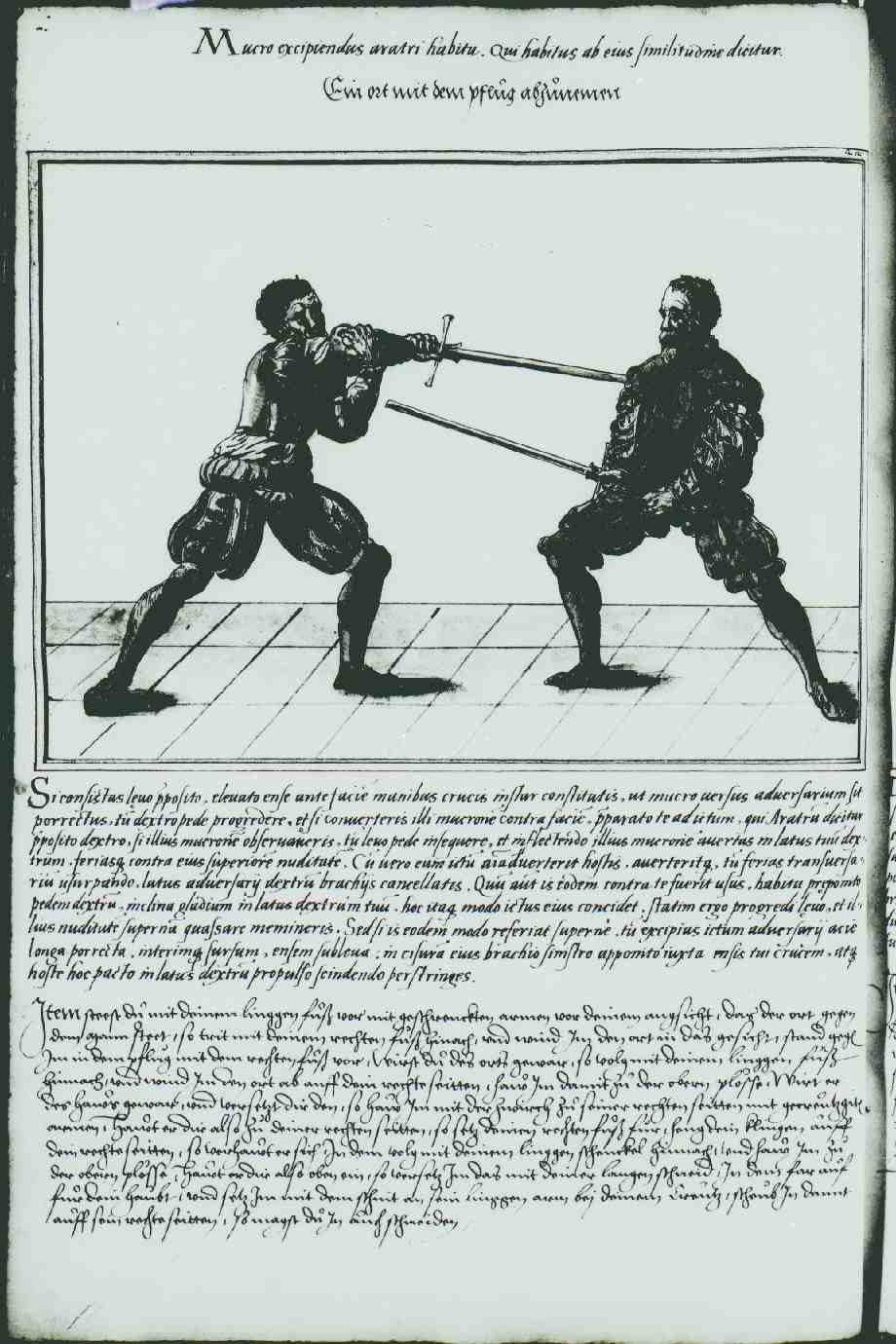
As for the actual orientation of the blade in ochs, I am in agreement that the 45 degree alignment satisfies all the requirements of the text and feels more natural to finish a cut in and hold. Once you decide to thrust from here, you can easily twist your blade either horizontally or vertically as needed with little extra movement. As the images below from Paulus Hector Mair pretty clearly show, there's nothing wrong with a vertically oriented thrust from ochs, and I tend to prefer it that way myself.

I don't know what to say about being hit in the head with the cross of the sword-The German manuals tell you to hold the cross defensively in front of your head in numerous places, as opposed to beside your head. It would seem that if your opponent is trying to strike your sword in such a way to knock the hilt into your head in ox, he's commited suicide, since you've already formed the nessecary ward to simply thrust to his face with opposition.


When you're comfortably in ochs (assuming you're right-handed), the cross tends to fall more forward of your face on the left side and back closer to the eyes or temples on the right just due to the natural mechanics of your arms. You don't block a blow just by standing in the position though, you press out to meet it, which is going to move your sword forward a bit. As for your opponent committing suicide by attempting to knock your blade inward, I would say never assume that your opponent can't beat you to the punch. Keeping your cross oriented away from your face is a prudent safety precaution, even if it's forward of your face, because that cross moving inward in an arc could then jam into your eye instead of your temple. If you hold your cross at an angle, even a slight one, then it will more likely deflect off the curves of your head and land flat than jam straight into you.

Image
Image
0==[>>>>>>>>>>>>>>>>>
Stacy Clifford
Free-Scholar
ARMA Houston, TX

User avatar
robrobertson
Posts: 61
Joined: Mon Jul 19, 2004 12:17 pm
Location: Gallatin, Mo

Re: New Article Online - Damaged Edges

Postby robrobertson » Tue Sep 28, 2004 1:12 pm

-----------------------------------------------------------------------------------------
Exactly why will the edges get dull if they are used in parrying? Admittedly, I'm not much of an expert in German longsword, but parries are rarely made with the foible, at least in the systems I've studied.
------------------------------------------------------------------------------------------

The quick answer is that steel has limits on what it can and can not handle. Given that you don't strike me as the type of person who settles for quick answers I'll try to go a little more in depth.

Perhaps it will help you to understand the inherit dangers of edge on edge payying if you were to be aware of the heat treating process of sword making.

Swords are potentially subjected to much abuse during combat. We want them to be hard enough to cut well and hold an edge, yet to be tough enough to not shatter under the impact that is required during the course of combat. The consequence of a failed blade can be very serious! If a tip snaps during a live blade demonstration then you have in principal a thrown blade. Remember the saying, A KNIFE IN MOTION IS A KNIFE ON A MISSION!

Broken tangs aren't funny either!

It will help if you understand that when I say HARD think BRITTLE, like a file. When I say TOUGH it is the OPPOSITE OF BRITTLE, pure lead is very tough.

NORMALIZING:

After forging the blade and rough grind complete, you will want to normalize the steel. To do this you will heat the sword to a cherry red and let it sit in the air and cool. This will releave some of the stress from your hammer work.

ANNEALING:

Next you will heat it again as before but you now will put it in a substance that will help to hold the heat. Some use lime others have different mediums, this is to let the stress be released completley, If not they may sometimes come out bent or corkscrewed or whatever, but it IS a good idea to do this!

Let it sit overnight. It needs to be cool to the touch. Be patient!

HARDENING:

Next you'll heat it all up untill the steel is no longer magnetic. Now without hestitation quench it in oil tip first, the whole length of the blade. Get it all.

What you've done here is you got the molecules moving very fast, then locked them into place and fractured the crystaline structure of the steel. There is now an intense amount of stress within your sword blade! If you drop it it should shatter!

TEMPERING:

The steel will now look black. shine up at least one side so that it looks shiney, you will need to be able to read the colors. they will tell you the temperature of the steel.

Now slowley heat the sword up until it is the desired color of the temperature that you want. I prefer what I call a pigeaon blue, but you will honestly need to actually see this live or experiment till you have experience as the color charts don't match what mine (or any other bladesmith I've ever spoken with's) eyes see. You may repeat this last step twice.

Test it:

For this you may DROP TEST it. simply hold it at shoulders height at arms legth. Now drop it on the concrete. It takes a lot of courage the first time, but you get used to it. Did it shatter? If so then it was too brittle. If not then you can use various test cuts to determine further if it wa a complete sucess. I'm the type of guy that will chop on oak roots, decapitate various animals that we're slaughtering for dinner anyway etc. obviously not an option if you live in an apartment, or have no livestock. <img src="/forum/images/icons/wink.gif" alt="" /> <img src="/forum/images/icons/shocked.gif" alt="" /> <img src="/forum/images/icons/tongue.gif" alt="" /> <img src="/forum/images/icons/grin.gif" alt="" />

Tempering is so important because it releaves the stress from hardening, yet it must retain the hardness to be able to cut. It's a very delicate balance. Much like the archers bow, It's half broke, mind you a very controlled half broke, but if it wasn't the bow would either be a club or all of the way broken.

If the smith for what ever reason didn't have the balance perfect, then the weapon is either more inclined to brake, or it won't cut so well. What if there's a flaw in the steel? Well you, the swordsman, will reap the repercussions of those flaws.

A microscopic hairline fracture, that passed the drop test, can be further aggravated by edge on edge. The energy is all concentrated on that one area, not spread out over the flat. If the sword is properly heat treated it will distribute the vibrations of the impact across the flat. But you can not realistically expect ANY sword to be subjected to edge on edge abuse and not have it break!!!

There are many factors that come into play, different cross sections will effect this too, but that's an entirely different thread!

Rob
Dean deas thu fhein! / Make yourself ready!

User avatar
Rabbe J.O. Laine
Posts: 49
Joined: Fri Aug 06, 2004 3:33 am
Location: Hämeenlinna, Finland

Re: New Article Online - Damaged Edges

Postby Rabbe J.O. Laine » Tue Sep 28, 2004 1:35 pm

Dear Rob,

I'm quite aware of the heat-treating process and the various properties of hard vs. soft steel.

A microscopic hairline fracture, that passed the drop test, can be further aggravated by edge on edge. The energy is all concentrated on that one area, not spread out over the flat. If the sword is properly heat treated it will distribute the vibrations of the impact across the flat. But you can not realistically expect ANY sword to be subjected to edge on edge abuse and not have it break!!!


Waitwaitwait. Nobody here is advocating Hollywood-style foible-on-foible bashing; a proper edge-on-edge parry performed with the forte will cause hardly any stress on the steel. If my opponent cuts zornhau, and I counter with the same, catching his blade on my forte, the edges will likely meet, the angle depending on our relative positions, but neither sword will be damaged to any noticeable degree.

There are many factors that come into play, different cross sections will effect this too, but that's an entirely different thread!


Yep.

Rabbe

User avatar
robrobertson
Posts: 61
Joined: Mon Jul 19, 2004 12:17 pm
Location: Gallatin, Mo

Re: New Article Online - Damaged Edges

Postby robrobertson » Tue Sep 28, 2004 1:45 pm

Dear Rabbe

By all means, train hard, and have fun swinging steel. Choose your options wisely.

Rob
Dean deas thu fhein! / Make yourself ready!

User avatar
Jeffrey Hull
Posts: 678
Joined: Wed Sep 25, 2002 3:40 pm
Location: USA

Re: New Article Online - Damaged Edges

Postby Jeffrey Hull » Tue Sep 28, 2004 5:34 pm

Hey Everybody:

Goliath (from Schielhau.org) says:
Wen du gegenn im stest inn der hut vom tag so hau im hinlich oben / ein zu dem kopf springt er denn aus dem hau unnd meint er wol vor / kumen mit dem Zwerhau unnd schlecht dir domit zu deiner linckn / seitenn zu dem kopf so val im mit der langen schneiden auf das schwert...

Wenn er dir schlecht mit der Zwer vonn seiner rechtenn seiten zu deiner linckn / oben zu dem kopff so versetz mit der langn schneid und pleib im mit dem ort / vor der prust...

My translation:
When you stand against him in the ward of From-Roof and hew him likewise above to the head, but then he springs out of the way and would mean to come forth with the Thwart-hew and strike you therewith to your left-side to the head, then down it with the long-edge upon the sword...

When he strikes with the Thwart from his right side to your left, above to the head, so forset with the long-edge and stay with the point in front of the breast...

RP wrote:
Actually both of these techniques end in a Zwerchau countering a Zwerchau which never results in an edge-on-edge impacts of the blades. Note that since the counter Zwerchau is cut very low the edge of the other blade impacts upon the upper flat of your blade. Also note that in the first technique the adversary’s first Zwerchau comes at you on horizontally (zero degrees) on your left side. Your counter the Zwerchau with a long edge verticle (90 degrees) cut. This results in your long edge hitting the adversary's upper flat and his false edge hitting your lower guard. Again, althought you are using you long edge there is no edge-on-edge impact.

MB wrote:
Randall, describe to me in clear simple words, or better yet post a picture, of how this technique can be done without blades meeting edge-to-edge.

It seems really clear what RP wrote. This is how it works against Zwerch, by fighter's long-edge upon foe's flat, when one displaces versus a short-edge Zwerch. Lindholm’s Ringeck book shows such a short-edge Zwerch. The planes of fighter’s blade and foe’s blade are perpendicular to each other. It is that simple.

MB wrote:
But in the techniques I've discussed, the simplest possible interpretations are martially valid, IF we give up "the swords' edges must never meet" as a criteria for martial validity.

The martially valid interpretation is to utilise the flat of either one’s own or the foe’s blade as much as possible. Why have might of each blow focused into the less than ½ mm when meeting edge-to-edge which shall likely gouge or shatter one’s sword? To claim "simplest possible interpretation" as most valid really amounts to unimaginative literalism, to a sort of fundamentalism. What such an argument really says is that there is no context – definition is more important than meaning – that others interpret by interpolation (except for oneself, of course), no matter how simple another’s interpretation actually is. Indeed, interpolation can be by either commission or omission, so the literalist is just as culpable. It amounts to mere gainsay.

Why would a fighter limit himself to only one-quarter (edge-to-edge) of the four basic planer possibilities in parrying? Why should he not make primary praxis of the other three-quarters (edge-to-flat, flat-to-edge, and flat-to-flat), which are not assured to ruin one’s sword by gouging or shattering, which set one up to counter-strike efficiently, and which let at least one of the blades flex with the carbo-ferrous grain? Can anyone give me a sensible answer based upon physics, fight-books, and basic respect for one’s own weapon which countermands this, daresay, self-evident truth? So far no one has, because there is no sensible answer to be found in such an utterly useless approach.

JH
JLH

*Wehrlos ist ehrlos*

User avatar
Rabbe J.O. Laine
Posts: 49
Joined: Fri Aug 06, 2004 3:33 am
Location: Hämeenlinna, Finland

Re: New Article Online - Damaged Edges

Postby Rabbe J.O. Laine » Tue Sep 28, 2004 11:34 pm

Rob,

Dear Rabbe

By all means, train hard, and have fun swinging steel. Choose your options wisely.

Rob


You too.

Jeffrey wrote:
The martially valid interpretation is to utilise the flat of either one’s own or the foe’s blade as much as possible. Why have might of each blow focused into the less than ½ mm when meeting edge-to-edge which shall likely gouge or shatter one’s sword? To claim "simplest possible interpretation" as most valid really amounts to unimaginative literalism, to a sort of fundamentalism. What such an argument really says is that there is no context – definition is more important than meaning – that others interpret by interpolation (except for oneself, of course), no matter how simple another’s interpretation actually is. Indeed, interpolation can be by either commission or omission, so the literalist is just as culpable. It amounts to mere gainsay.


I don't think *anyone* is saying that *only* edge-on-edge can happen.

Why would a fighter limit himself to only one-quarter (edge-to-edge) of the four basic planer possibilities in parrying?


Nobody is saying that you should *only* parry edge-on-edge, just that the edges occasionally *will* meet. Why should a fighter limit himself to only three-quarters of the four basic planar possiblities in parrying?

... which are not assured to ruin one’s sword by gouging or shattering...


Edge-on-edge isn't, either, unless your definition of it is a full-power foible-on-foible bash.

...which set one up to counter-strike efficiently


And that can not happen if the edges meet?

... and which let at least one of the blades flex with the carbo-ferrous grain?


Why on Earth should *that* be a requirement for a good parry?

Can anyone give me a sensible answer based upon physics, fight-books, and basic respect for one’s own weapon which countermands this, daresay, self-evident truth?


Fine. Your opponent cuts Zornhau at your head, you counter with the same. Tell me, please, how you can avoid edge-on-edge in this scenario (which certainly can be found in the fechtbucher)?

Neither blade will be damaged here. His blade will be caught on your forte, propably at some angle other than 90 degrees depending on your positions relative to each other, and you will set his attack aside as effectively as you would if you had struck his flat.

So far no one has, because there is no sensible answer to be found in such an utterly useless approach.


Could you, then, please give me *one* reason to avoid edge-on-edge contact?

Rabbe

User avatar
Rabbe J.O. Laine
Posts: 49
Joined: Fri Aug 06, 2004 3:33 am
Location: Hämeenlinna, Finland

Re: New Article Online - Damaged Edges

Postby Rabbe J.O. Laine » Wed Sep 29, 2004 7:20 am

Stewart,

I never said it has to be a 90 degree angle - just that the edges will (likely) make contact, the angle determined by the direction of the first cut and the starting position of the fencers.

Rabbe


Return to “Research and Training Discussion”

Who is online

Users browsing this forum: No registered users and 29 guests


Note: ARMA - The Association for Renaissance Martial Arts and the ARMA logo are federally registered trademarks, copyright 2001. All rights reserved. No use of the ARMA name or emblem is permitted without authorization. Reproduction of material from this site without written permission of the authors is strictly prohibited. HACA and The Historical Armed Combat Association copyright 1999 by John Clements. All rights reserved. Contents of this site 1999 by ARMA.