Moderators: Webmaster, Stacy Clifford
Exactly why will the edges get dull if they are used in parrying? Admittedly, I'm not much of an expert in German longsword, but parries are rarely made with the foible, at least in the systems I've studied.
Rabbe
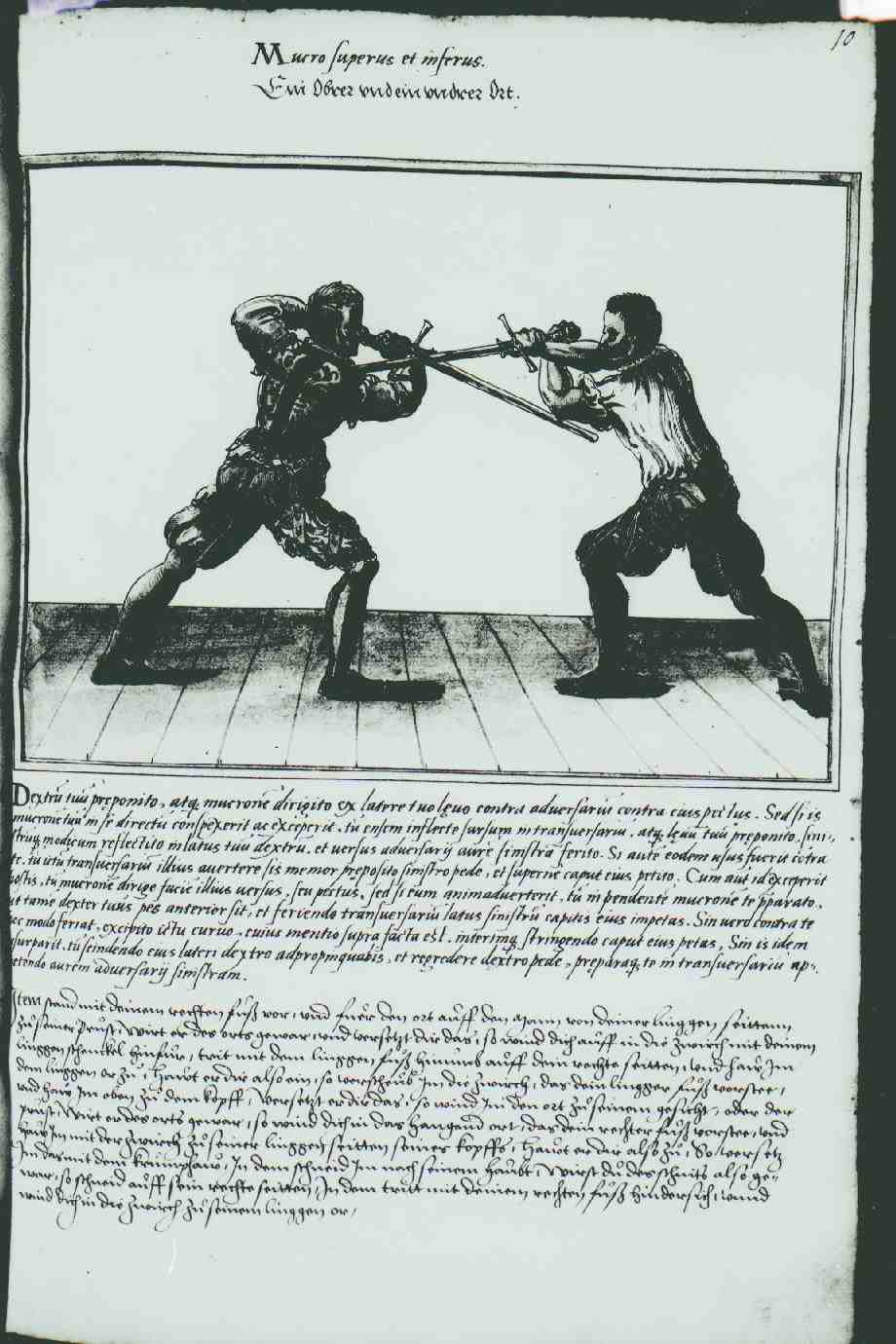
In the Ochs guard my thumb is always on the underside of my blade/sword. I would have to rotate my hand on top of my sword in order for my thumb to not be on the underside. You might ask youself what "thumb under the blade" actually means. Does it mean just on the underside or out on the flat? Likewise, does it mean the blade must be completely hortizontal or can it be a a 45 degree angle? All of us have to watch that we don't read too much meaning into what the masters wrote.
Hey Rabbe
In reply to:
--------------------------------------------------------------------------------
Exactly why will the edges get dull if they are used in parrying? Admittedly, I'm not much of an expert in German longsword, but parries are rarely made with the foible, at least in the systems I've studied.
--------------------------------------------------------------------------------
I don't know how to explain it in text i am not a real technical type guy, if you go to the kitchen and take two large sharp kitchen knive's and hold the edge's 90 degree's to each other, then hit one on the other hard and see what it does to the edge, then think of a four foot sword at full power from an adult doing the same thing, i'll warn you if you do this to them hard it will ruin the knive's, that is why people don't beat the edge's of there good kitchen knive's against marble cutting board's or other hard surface's, most good kitchen knife maker's even say to put cover's on the blade's of there kitchen knive's not just throw them in a draw full of knive's.
I am serious about this, i am a simple type person i need to show you not try to tell you, because i could probably not get the right word's to explain what would happen.
Jeff
That may be why you see the edge contact as being the right way to block and gaurd, you never intentionaly block with your edge, you dull the edge you might as well fence with a piece of flat bar stock it is the same thing, it will not cut, it is then a club.
If a zwerch's alignment is biomechanically and martially sound, then why is the same alignment not sound when counter-thrusting in the ox? Especially in light of the instructions to wind against your opponent's sword with your long/short edges while doing this technique?
I don't know what to say about being hit in the head with the cross of the sword-The German manuals tell you to hold the cross defensively in front of your head in numerous places, as opposed to beside your head. It would seem that if your opponent is trying to strike your sword in such a way to knock the hilt into your head in ox, he's commited suicide, since you've already formed the nessecary ward to simply thrust to his face with opposition.

A microscopic hairline fracture, that passed the drop test, can be further aggravated by edge on edge. The energy is all concentrated on that one area, not spread out over the flat. If the sword is properly heat treated it will distribute the vibrations of the impact across the flat. But you can not realistically expect ANY sword to be subjected to edge on edge abuse and not have it break!!!
There are many factors that come into play, different cross sections will effect this too, but that's an entirely different thread!
Dear Rabbe
By all means, train hard, and have fun swinging steel. Choose your options wisely.
Rob
Jeffrey wrote:
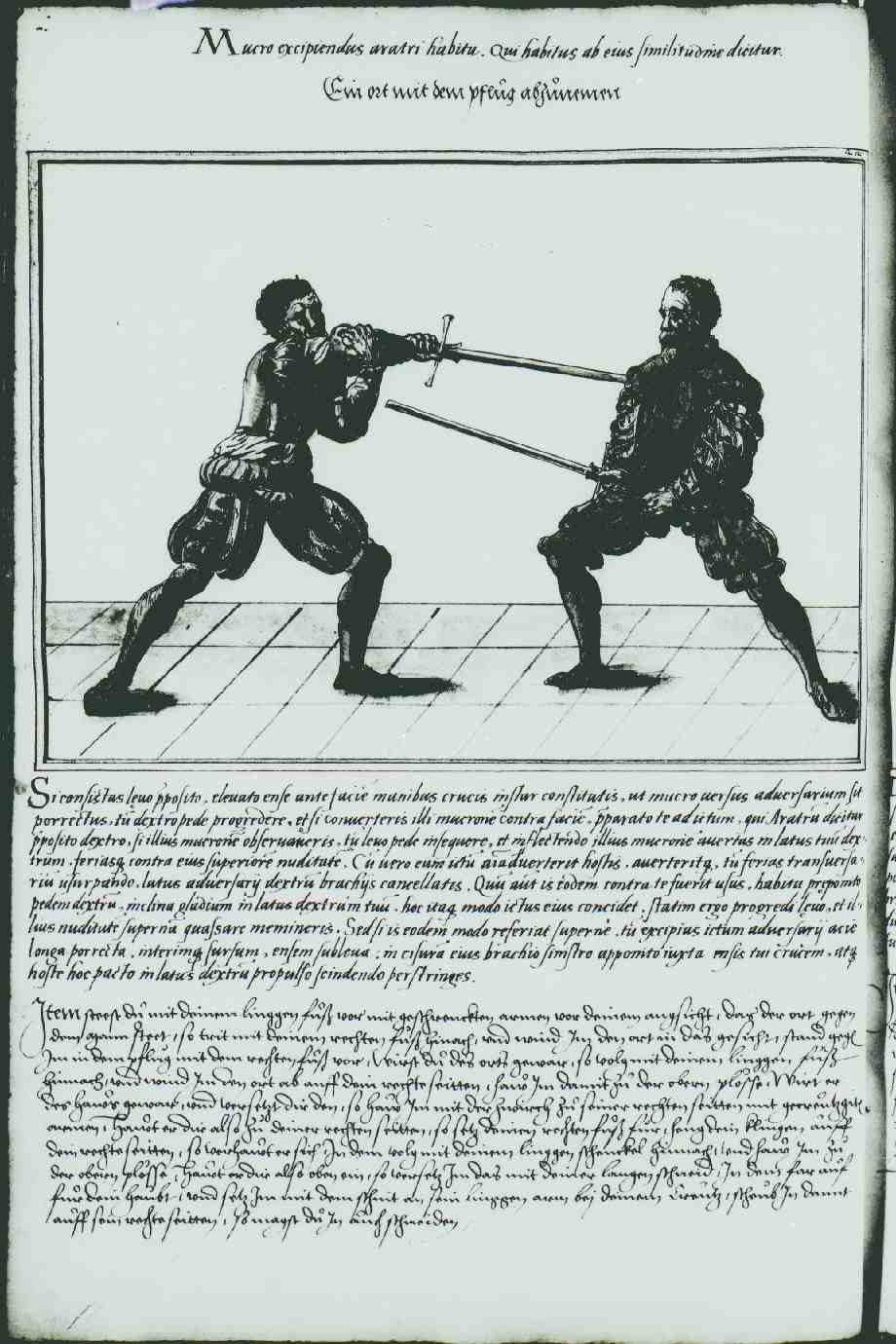
The martially valid interpretation is to utilise the flat of either one’s own or the foe’s blade as much as possible. Why have might of each blow focused into the less than ½ mm when meeting edge-to-edge which shall likely gouge or shatter one’s sword? To claim "simplest possible interpretation" as most valid really amounts to unimaginative literalism, to a sort of fundamentalism. What such an argument really says is that there is no context – definition is more important than meaning – that others interpret by interpolation (except for oneself, of course), no matter how simple another’s interpretation actually is. Indeed, interpolation can be by either commission or omission, so the literalist is just as culpable. It amounts to mere gainsay.
Why would a fighter limit himself to only one-quarter (edge-to-edge) of the four basic planer possibilities in parrying?
... which are not assured to ruin one’s sword by gouging or shattering...
...which set one up to counter-strike efficiently
... and which let at least one of the blades flex with the carbo-ferrous grain?
Can anyone give me a sensible answer based upon physics, fight-books, and basic respect for one’s own weapon which countermands this, daresay, self-evident truth?
So far no one has, because there is no sensible answer to be found in such an utterly useless approach.
Return to “Research and Training Discussion”
Users browsing this forum: No registered users and 20 guests
|
|
|||
|
|
|||
|
|||