After discussing in one of the threads about what geometry for blades was better for thrusting (I was sustaining straight double edged was the best) I decided to put some quick maths to back my arguments on this so that to prove, not only that is better but how much better it is.
The thing is that math would serve me just the same to prove how much better are curved blades at cutting compared to straight ones, so shoulders to the wheel!
The math experiment I carried out assumes all blades are equally sharp and that they thrust and cut homogeneous matter (just imaging an enemy made entirely of wood)
Here are the results and, afterwards, I will give the details of how I achieved them and why they are such. (Note that I do not consider fighting strategies to choose the best geometry for a particular situation):
Thrusting
Straight Thrust: The best geometry for blades is the one closest to a needle; the narrower the blade the better and the point must be centered and sharp (and straight, of course, the curvier the really worse). Must be said that if the point is not centered the thrusting power is exactly the same but the point of such blades are geometrically weaker that those with the point centered. The reason for this is that the centered point maximizes the angle of the point, being that angle less in any other position, and thus, weaker. So this is a good design for thrusting:
http://www.tritonworks.com/content/images/albion_talhoffer2.jpg
circular Thrust: Just exactly the same as with the Straight Thrust just that the blade should be curved in exactly the same circular thrust movement... Though I guess that circular thrusting makes more sense for stabbing with a dagger; a circular thrust with a long sword would be kinda weird. So good for stabbing in very close quarters would be this (I just remind I am not considering any fighting strategies or any other disadvantes that the curved blade might have):
http://webprojects.prm.ox.ac.uk/arms-and-armour/600/1884.24.267.jpg
Cutting
The fact is that, regardless the shape of the blade and the volume hit, the whole matter in the volume will oppose resistance to that blade. Therefore, applying the same energy to the blow we would get the same area cut (remember, homogeneous target). But how this applies to different cuts?
Chopping an enemy's head/arm/leg: which blade is better? the straight or the curved? Both the same!!!! Interesting, uh? The curved blade will go deeper at the beginning since its shape allows part of the blade to “wait outside” to start cutting, we could say that the curved blade has a “thrusting” power at the beginning of the cut that the straight blades has not. But the straight blade will cut wider, and all the advantage the curved blade had to “thrust in”, when the cut reaches the middle point, becomes disadvantage to keep cutting, the straight blade has done most of the job and past the middle point will cut easier than the curved blade.
Deep cuts: Since both blades will cut the same area, although the straight blade will do wider cuts, due to the shape of the curved blade the curved will go deeper, since in humans the deeper a wound the deadlier it becomes, a narrow deep cut is more life-threating that a wide shallow one. Therefore, for deep cuts the curvier the better. In fact if we try to cut a cylinder deep to its center, it will takes around 28% more energy to do so with a straight blade that with a blade as curved as the cylinder (very curved).
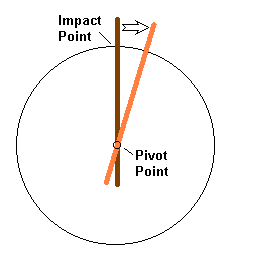
Cuts with the point: In this case the curved blade will follow easily the circular movement of the hands and will not try much to go deeper in the body making the cut really easy. With a straight blade, the point will try to go deep inside the body which might cause the blade to stop at the middle of the cut... But again, the deeper the deadlier, and besides, if the blade stops it would be a great opportunity to start a thrusting attack.
Nonetheless I assume that, when hitting with the blade, no one's expects to cut the enemy in two but to create a damaging deep cut, therefore curved blades are better for this. So a good example would be:
http://upload.wikimedia.org/wikipedia/commons/0/0b/MuseeMarine-sabreOfficer-p1000451.jpg
beware MATHS ahead!
Now comes the proves:
The plan is to calculate the resistance of a body to be penetrated by a particular geometry, and then compare which geometry offers less resistance.
Thrust
Now let's imagine we have a triangle tip and we want to know where should the point be placed (center, one side...) so that to have the less possible resistance from the target:
This formula expresses the resistance of the target given a t thrusting distance for a triangle with a base b, a height h and a point place at a distance d from one of the sides of the edge.
Resistance = t*cos(%pi/2-atan((b-d)/h))*sqrt(h^2+(b-d)^2) + t*cos(%pi/2-atan(d/h))*sqrt(h^2+d^2);
simplifying we have:
(d*sqrt(h^2+d^2)*t)/(sqrt(d^2/h^2+1)*h)-((d/h-b/h)*sqrt(h^2+(b-d)^2)*t)/sqrt((d/h-b/h)^2+1)
and simplifying further:
(b*abs(h)*t)/h
and since h is always positive we have that:
Resistance = b*t
meaning that the only important thing when trusting is how wide “b” the blade is and how deep “t” we want to thrust! The geometry of tip does not matter!
But if we accept that the wider the tip the stronger and durable it is, within all those possible geometries with the same penetration power, we would like to know which one offers the wider angle in the tip.
The angle for every possible triangle geometry in a blade is expressed by:
Angle = atan(d/h)+atan((b-d)/h)
Since we want to maximize it we solve the derivative which is:
1/((d^2/h^2+1)*h)-1/(((b-d)^2/h^2+1)*h)=0
And if we calculate what value “d” should be to get the expression right we have:
d=b/2
Which means that the distance of the point “d” must be just in the middle of the blade “b/2” to have the maxim angle, and thus, maxim strength and durability.
Cut
First I calculate how much resistance will a cylinder will offer to a curved blade against a straight blade, for the calculation I will consider that both blades go as deep as to the center of the cylinder. If we think about the previous proof we realize that I only have to pay attention on the area cut by the blade to calculate the resistance that I will get from the target.
The curved bladed will be as curved as the cylinder (very curved). If both blades go to the center of the cylinder with a radius of a unity we will have these amounts of area removed:
Straight = pi/2
Curved =pi/2-2*(integrate(-sqrt(1-x^2)+1, x, 0, sqrt(3)/2)+integrate(sqrt(1-x^2), x,sqrt(3)/2,1)))
Which means
Straight = 1.570796326794897
Curved = 1.228369698608757
And therefore we will have to place 27.876% more energy to go as deep as the curved blade. But, important, if we want to cut completely the cylinder, from the middle point on the straight blade has an easier life that the curved one and the values even out resulting in having to use the exact amount of energy to in both blades to completely cut the cylinder.
 |
||||||||
|
|
||||||||


 anyway, given this situation we need to compare again two scenarios to decide what is the best geometry for thrusting.

 (Well, not quite, everything still stands if you consider all blades with the same mass distribution)