The best geometry for blades

For Historical European Fighting Arts, Weaponry, & Armor

Moderators: Webmaster, Stacy Clifford

Francisco Urbano García
Posts: 43
Joined: Sun Nov 30, 2008 9:37 pm

The best geometry for blades

Postby Francisco Urbano García » Thu Dec 25, 2008 3:21 pm

After discussing in one of the threads about what geometry for blades was better for thrusting (I was sustaining straight double edged was the best) I decided to put some quick maths to back my arguments on this so that to prove, not only that is better but how much better it is.

The thing is that math would serve me just the same to prove how much better are curved blades at cutting compared to straight ones, so shoulders to the wheel!

The math experiment I carried out assumes all blades are equally sharp and that they thrust and cut homogeneous matter (just imaging an enemy made entirely of wood)

Here are the results and, afterwards, I will give the details of how I achieved them and why they are such. (Note that I do not consider fighting strategies to choose the best geometry for a particular situation):

Thrusting

Straight Thrust: The best geometry for blades is the one closest to a needle; the narrower the blade the better and the point must be centered and sharp (and straight, of course, the curvier the really worse). Must be said that if the point is not centered the thrusting power is exactly the same but the point of such blades are geometrically weaker that those with the point centered. The reason for this is that the centered point maximizes the angle of the point, being that angle less in any other position, and thus, weaker. So this is a good design for thrusting:

http://www.tritonworks.com/content/images/albion_talhoffer2.jpg

circular Thrust: Just exactly the same as with the Straight Thrust just that the blade should be curved in exactly the same circular thrust movement... Though I guess that circular thrusting makes more sense for stabbing with a dagger; a circular thrust with a long sword would be kinda weird. So good for stabbing in very close quarters would be this (I just remind I am not considering any fighting strategies or any other disadvantes that the curved blade might have):

http://webprojects.prm.ox.ac.uk/arms-and-armour/600/1884.24.267.jpg

Cutting

The fact is that, regardless the shape of the blade and the volume hit, the whole matter in the volume will oppose resistance to that blade. Therefore, applying the same energy to the blow we would get the same area cut (remember, homogeneous target). But how this applies to different cuts?

Chopping an enemy's head/arm/leg: which blade is better? the straight or the curved? Both the same!!!! Interesting, uh? The curved blade will go deeper at the beginning since its shape allows part of the blade to “wait outside” to start cutting, we could say that the curved blade has a “thrusting” power at the beginning of the cut that the straight blades has not. But the straight blade will cut wider, and all the advantage the curved blade had to “thrust in”, when the cut reaches the middle point, becomes disadvantage to keep cutting, the straight blade has done most of the job and past the middle point will cut easier than the curved blade.

Deep cuts: Since both blades will cut the same area, although the straight blade will do wider cuts, due to the shape of the curved blade the curved will go deeper, since in humans the deeper a wound the deadlier it becomes, a narrow deep cut is more life-threating that a wide shallow one. Therefore, for deep cuts the curvier the better. In fact if we try to cut a cylinder deep to its center, it will takes around 28% more energy to do so with a straight blade that with a blade as curved as the cylinder (very curved).

Cuts with the point
: In this case the curved blade will follow easily the circular movement of the hands and will not try much to go deeper in the body making the cut really easy. With a straight blade, the point will try to go deep inside the body which might cause the blade to stop at the middle of the cut... But again, the deeper the deadlier, and besides, if the blade stops it would be a great opportunity to start a thrusting attack.

Nonetheless I assume that, when hitting with the blade, no one's expects to cut the enemy in two but to create a damaging deep cut, therefore curved blades are better for this. So a good example would be:

http://upload.wikimedia.org/wikipedia/commons/0/0b/MuseeMarine-sabreOfficer-p1000451.jpg

beware MATHS ahead!

Now comes the proves:

The plan is to calculate the resistance of a body to be penetrated by a particular geometry, and then compare which geometry offers less resistance.

Thrust

Now let's imagine we have a triangle tip and we want to know where should the point be placed (center, one side...) so that to have the less possible resistance from the target:

This formula expresses the resistance of the target given a t thrusting distance for a triangle with a base b, a height h and a point place at a distance d from one of the sides of the edge.

Resistance = t*cos(%pi/2-atan((b-d)/h))*sqrt(h^2+(b-d)^2) + t*cos(%pi/2-atan(d/h))*sqrt(h^2+d^2);

simplifying we have:

(d*sqrt(h^2+d^2)*t)/(sqrt(d^2/h^2+1)*h)-((d/h-b/h)*sqrt(h^2+(b-d)^2)*t)/sqrt((d/h-b/h)^2+1)

and simplifying further:

(b*abs(h)*t)/h

and since h is always positive we have that:

Resistance = b*t

meaning that the only important thing when trusting is how wide “b” the blade is and how deep “t” we want to thrust! The geometry of tip does not matter!

But if we accept that the wider the tip the stronger and durable it is, within all those possible geometries with the same penetration power, we would like to know which one offers the wider angle in the tip.

The angle for every possible triangle geometry in a blade is expressed by:

Angle = atan(d/h)+atan((b-d)/h)

Since we want to maximize it we solve the derivative which is:

1/((d^2/h^2+1)*h)-1/(((b-d)^2/h^2+1)*h)=0

And if we calculate what value “d” should be to get the expression right we have:
d=b/2

Which means that the distance of the point “d” must be just in the middle of the blade “b/2” to have the maxim angle, and thus, maxim strength and durability.

Cut

First I calculate how much resistance will a cylinder will offer to a curved blade against a straight blade, for the calculation I will consider that both blades go as deep as to the center of the cylinder. If we think about the previous proof we realize that I only have to pay attention on the area cut by the blade to calculate the resistance that I will get from the target.

The curved bladed will be as curved as the cylinder (very curved). If both blades go to the center of the cylinder with a radius of a unity we will have these amounts of area removed:

Straight = pi/2
Curved =pi/2-2*(integrate(-sqrt(1-x^2)+1, x, 0, sqrt(3)/2)+integrate(sqrt(1-x^2), x,sqrt(3)/2,1)))

Which means

Straight = 1.570796326794897
Curved = 1.228369698608757

And therefore we will have to place 27.876% more energy to go as deep as the curved blade. But, important, if we want to cut completely the cylinder, from the middle point on the straight blade has an easier life that the curved one and the values even out resulting in having to use the exact amount of energy to in both blades to completely cut the cylinder.

Last edited by Francisco Urbano García on Sun Dec 28, 2008 2:42 pm, edited 3 times in total.

User avatar
Sal Bertucci
Posts: 591
Joined: Fri May 02, 2008 8:04 pm
Location: Denver area, CO

Postby Sal Bertucci » Thu Dec 25, 2008 11:03 pm

I'm fairly certain that the only thing I can say to that is "ow"

User avatar
Stacy Clifford
Posts: 1126
Joined: Fri May 14, 2004 11:51 am
Location: Houston, TX
Contact:

Postby Stacy Clifford » Fri Dec 26, 2008 2:36 am

Nice. If you could get him out from under the rock he's been under the last few years (working like an ant on crack), you could probably have a fascinating discussion with George Turner, author of this article you really should read if you haven't already:

http://www.thearma.org/spotlight/GTA/mo ... mpacts.htm

You want math, you'll get math!
0==[>>>>>>>>>>>>>>>>>
Stacy Clifford
Free-Scholar
ARMA Houston, TX

User avatar
Vincent Le Chevalier
Posts: 166
Joined: Mon Dec 31, 2007 5:18 am
Location: Paris, France

Postby Vincent Le Chevalier » Fri Dec 26, 2008 3:58 am

Good to see someone trying to base his claims on actual science :)

One important thing both of your cases overlook is the slicing effect of an edge drawn across a surface. I don't rightly know how to take that into account, as its significance seems to depend quite heavily on the material cut.

For example in the case of the thrust, the edge(s) help because they are drawn with pressure along the edge of the forming wound. Thus a very acute profile will be easier to thrust with than a completely round tip, even if the area of the wounds are made to be the same. I think this is confirmed by common experience...

In the case of the cut, a curved blade will generally strike the target at a natural angle (the edge is not orthogonal to the direction of the velocity). Of course you can also do that with a straight blade, and that's when technique starts to matter... The bigger the natural angle is, the bigger the slice component will be, and the easier it will be to cut for example flesh. Exactly like a guillotine blade. The drawback is that the curved blade will have less punch, which can matter if the material is not sensitive to slicing. I think that's where the compromise is in curved vs. straight.

Regards,

Francisco Urbano García
Posts: 43
Joined: Sun Nov 30, 2008 9:37 pm

Postby Francisco Urbano García » Sat Dec 27, 2008 5:00 am

I first want to thank you your comments cause I know there are some anti-intuitive results coming out the formulas...

Vincent Le Chevalier wrote:... Thus a very acute profile will be easier to thrust with than a completely round tip, even if the area of the wounds are made to be the same. I think this is confirmed by common experience...


I know this sounds anti-intuitive but applying the same energy to a thrust into an homogeneous and non elastic matter will take the same area. Then, how about an acute point vs a rounded one, experience says the acute is going to thrust better, right?

When I did the math I was surprised by the result, so I rechecked several times till I understood why this is so and what this means. Let me give you an example to clarify this:

Imaging you have a surface full with standing domino placed in a distance that if one falls does not make fall the next one. Now "thrust" with your finger one domino and keep thrusting till you make fall four of them. We can say that you needed 4 unities of energy applied in 4 steps. This would be an acute point.

Now let's do the same with the "rounded" point and instead making fall the domino one by one place your finger horizontal and try to make fall two domino at the same time till you make fall four. In this case we can say that you needed 4 unities of energy but applied in just two steps... So, same energy means same area BUT the wider the point the more energy you need for each step.

So when I talk about geometry does not matter, it does not as long as in every step you make fall the same number of domino to receive the same resistance.

So the calculations that I performed considered a Katana like point vs a European like point an any other position for the point between center and one side. and I proved that any of those geometries will face the same resistance (though you get stronger points if placed in the middle).

Nonetheless, let me tell you something else, if you have two blades with the same area and one with an extremely acute sharp point, and the other with a completely flat sharp point (like a carpenter chisel). If you want to thrust the whole blade inside a body you will need the same amount of energy, the only difference will be in how you will have to apply that energy, little by little in the case of the acute point, all at once with the chisel like point.

Vincent Le Chevalier wrote:In the case of the cut, a curved blade will generally strike the target at a natural angle (the edge is not orthogonal to the direction of the velocity)....


When I began to make the calculations I thought, like you, that might have an impact on the results. it turned out it does not. Regardless the angle you hit a cylinder the curved blade will have less resistance at the beginning (less domino opposing its way) and the straight blade will face more at the beginning. So when cutting to the center of the cylinder you will always need less energy to do so with a curved blade.

Vincent Le Chevalier wrote:...The drawback is that the curved blade will have less punch, which can matter if the material is not sensitive to slicing. I think that's where the compromise is in curved vs. straight.


I totally agree, against an armor that cannot be sliced a straight blade will have more punch, in fact an inward curved blade like Hispanic Falcata would have even more! I was assuming all the time a homogeneous, slice-able, non elastic stuff in the math experiment.

Besides, I am not considering weight distribution in the blade or any other technical reasonings like the body mechanics in humans that might improve a cut. For instance, blades with lot of weight in the tip will make cuts easier than those with the weight close to the handle (though also will make the blade harder to control)

I was just considering pure geometry... and when doing so, you will need the same energy to chop completely a cylinder regardless the geometry of the blade, and this is so because, soon or later in your cut, you will have to "make fall all the domino"

User avatar
Vincent Le Chevalier
Posts: 166
Joined: Mon Dec 31, 2007 5:18 am
Location: Paris, France

Postby Vincent Le Chevalier » Sun Dec 28, 2008 1:39 pm

I'm sorry I do not have much time online these days, so just a quick reaction:
Francisco Urbano García wrote:I was just considering pure geometry... and when doing so, you will need the same energy to chop completely a cylinder regardless the geometry of the blade, and this is so because, soon or later in your cut, you will have to "make fall all the domino"

What I meant was that your domino example does not really take into account the possibility that making a domino fall could be done in two different ways, one demanding more energy than the other. I don't know if it's real, but it seems to be based on experience. For example, instead of dominos you could say your material consists of a lot of small strings. I'd say these are easier to slice than chop. And yet in the end, I agree, all strings are split so there is a minimum amount of energy to bring. But it's just a minimum in my opinion.

Also, the sharpness of the blade matters, of course, even in thrusts. And this does not appear in your model as far as I can see.

If you go back to your example wit chisel and sharp point, you can experience yourself how much more easy it is to pierce even cardboard with the sharpest tip, even if th width of the blades is the same, and the final state of the cardboard is the same...

Francisco Urbano García
Posts: 43
Joined: Sun Nov 30, 2008 9:37 pm

Postby Francisco Urbano García » Sun Dec 28, 2008 4:08 pm

Vincent Le Chevalier wrote:What I meant was that your domino example does not really take into account the possibility that making a domino fall could be done in two different ways, one demanding more energy than the other. I don't know if it's real, but it seems to be based on experience.


Of course, the math model considers a completely homogeneous matter, when matter is not homogeneous you can design that matter internally to favor cuts or thrust or any geometry you like. That is why I consider the matter homogeneous; that is a fair ground for all blades.

Just tell me the matter you plan to cut and then we can discuss how a particular blade might be affected by its irregularities but, for instance, if in one of those fancy shows cutting bamboo (fairly homogeneous stuff) with a katana this guys would use a completely straight katana, they will not require any extra strength to do the show.

Vincent Le Chevalier wrote:Also, the sharpness of the blade matters, of course, even in thrusts. And this does not appear in your model as far as I can see.


I do, I consider every blade with the same sharpness. If the sharpness is higher or lower it might change the numbers but it will not change one geometry being better than the other, which is the target of the experiment. So in short, sharpness is considered as equal, an such being ignored since it has no use when you just want to find out what geometry is better.

Vincent Le Chevalier wrote:If you go back to your example wit chisel and sharp point, you can experience yourself how much more easy it is to pierce even cardboard with the sharpest tip, even if th width of the blades is the same, and the final state of the cardboard is the same...


Really? I concluded that for thrusting the only important thing was b*t meaning that the width of the blade is the only thing that matters, not the geometry.

When you approach the sharp tip to the matter (b), the width, is much lower than in a chisel and, thus, you will feel a lot less resistance with the sharp tip which agrees with my conclusions... BUT just do this simple experiment to prove a chisel can keep trusting just as good as the sharp point blade:

1. Get some play dough and divide it in two equal pieces.
2. get two blades same width (b), one with a sharp point and one completely flat like a chisel.
3. Introduce completely the sharp point of the blade in one the play dough piece.
4. Introduce lightly the chisel like blade in the other piece of play dough.
5. make sure that outside the play dough both blades have the same width (b) and make a mark on the blades.

Now.. question... if you hit with the same energy both blades (let's say you hang a hammer at the same height and let it swing hitting the blades) which one will go deeper? The sharp one? The chisel one? I know is anti-intuitive and that it seems that the sharp point blade should continue to thrust better but BOTH will go just as deep, they will have the same (t).

6. after hitting with the hammer make a mark again on the blades, take them out of the play dough and compare how deep (t) they went.

Just give it a try and prove the math wrong :wink:

User avatar
Benjamin Smith
Posts: 184
Joined: Thu Jun 09, 2005 12:44 pm

Postby Benjamin Smith » Mon Dec 29, 2008 5:30 am

Francisco, this has been very interesting. I want to make sure I understand what you're saying and I have a couple of questions.

First, your conclusions seems pretty straightforward that the curved blade will have more force in the cut to the center of a circular target. Where the bones, ligaments, tendons and internal organs would be. Having said that most swords have a curvature much less than that of any kind of human dimension cylinder. Since we can calculate the effect of curvature on cutting efficiency both in terms of sword and target, could you make a graph to express this? I'm interested to see how much advantage particular levels of curvature will give and whether the graph will be straight, curved, parabolic, or whatever, and where the realistic ranges of curvature will end up being (very high in the case of target cross-section, and very low in the case of almost all bladed weapons except late period cavalry axes which have curvature approaching that of the human body).

With thrusting though I think your conclusion is flawed. The math seems to show that both blades will, with the same force applied, penetrate the same volume, not the same depth. If that is the case, then the profile and distal taper will make a very great difference in how deep the thrust will be, hence the shapes of thrusting swords. Thrusting swords have smaller surface area and volume in the lower portions towards the point, the portion that enters the body. If my understanding is correct this will mean that a thin and pointy weapon will penetrate more deeply more easily than a wider one, and the ultimate goal of a thrust is deeper, not more volume/area penetrated. There is also the question of friction along the portion of the blade which has entered to consider. Consider your domino example four in a row, v. two wide and two deep. The one penetrates deeper, the other wider. Both yield the same area/volume of effect, but the dimension that makes the most difference is depth not width. In short I don't think your math measures what you think it measures.

This is borne out in the illustrations of the effects of thrusts in the manuals. There are several rapier illustrations that show persons completely run through with thirty or forty centimeters of blade coming out their back. Similar demonstrations of thrusts from longswords rarely show this sort of super-deep penetration, despite having two hands to propel the weapon. This has also been borne out in thrusting tests with layered cardboard boxes.

This of course begs the questions, how deep is deep enough, how much does fighting style make a difference etc... which we should probably leave for another discussion.

Thank you for putting this together though. I think the next steps are analyzing the effects of cross-section on cuts and thrusts from a mathematical standpoint, and gauging how blade shape, both in cross-section, profile, and distal dimensions, affect the ease of striking squarely and deeply with cuts and thrusts.

I am particularly interested in the cross-section question, which needs to be settled first anyway. European swords have five major cross-sectional variants: for double edged swords convex (like the lens of an eye, Oakeshott X-XIV), diamond (Oakeshott XV, XVI, XX), the so-called hollow-ground (which really ought to be called concave diamond, since the amount of grinding done to get the shape is really speculative represented by type XVIII), hexagonal (such as Oakeshott type XIX), and in the cases of single edged swords like falchions and messers triangular. These ought to be contrasted with the "clamshell" or "uneven convex" geometry of traditional 14-5th c. Japanese blades, which incidentally seem to be much thicker than European blades. If there is information I can get to help with this project I'd be happy to.

One other very minor thing, the falcata isn't concave in its curvature. If you look closely you'll see that the entire striking portion is convex, and that it has been bent forward. I'm sure I've seen a blade with concave blade curvature, I'll see if I can find it.
Respectfully,

Ben Smith

Francisco Urbano García
Posts: 43
Joined: Sun Nov 30, 2008 9:37 pm

Postby Francisco Urbano García » Mon Dec 29, 2008 8:49 am

Well first of all, thank you Benjamin and Vincent for you comments on my work, I appreciate it.

Benjamin Smith wrote:Since we can calculate the effect of curvature on cutting efficiency both in terms of sword and target, could you make a graph to express this? I'm interested to see how much advantage particular levels of curvature will give...


No problem, I just will need some time given these dates, and perhaps you could tell me how to upload a picture here?

Benjamin Smith wrote:With thrusting though I think your conclusion is flawed. The math seems to show that both blades will, with the same force applied, penetrate the same volume, not the same depth. If that is the case, then the profile and distal taper will make a very great difference in how deep the thrust will be, hence the shapes of thrusting swords. Thrusting swords have smaller surface area and volume in the lower portions towards the point, the portion that enters the body. If my understanding is correct this will mean that a thin and pointy weapon will penetrate more deeply more easily than a wider one, and the ultimate goal of a thrust is deeper, not more volume/area penetrated. There is also the question of friction along the portion of the blade which has entered to consider. Consider your domino example four in a row, v. two wide and two deep. The one penetrates deeper, the other wider. Both yield the same area/volume of effect, but the dimension that makes the most difference is depth not width. In short I don't think your math measures what you think it measures.


Ok, now I think I can see clearly where the misunderstanding comes from. In my conclusions for thrusting I said "The best geometry for blades is the one closest to a needle; the narrower the blade the better and the point must be centered and sharp (and straight, of course, the curvier the really worse)" though I also said "The geometry of tip does not matter!" And given that I do not offer pictures I fully understand it is not easy to grasp what I meant, specially if I don't explain it more thoroughly. Ok, here I go:

The Geometry of the tip does not matter when thrusting in a completely homogeneous at all times (this is important) matter in these situations:

1- for every step (t) you thrust, you thrust in the same area. For instance imagine the tip of a Katana, and that very same tip but with the point centered. Both geometries will have exactly the same thrusting power just because in every tiny (t) you thrust in you will face the resistance of the same area.
2- once the tip is inside (assuming the blade does not keep growing wider). In this case the geometry of the tip does not help to keep thrusting. you can perform the experiment I described in my previous post to prove it. Once the tip is inside the body a flat sharp blade (like a chisel) will do the same thrusting job that a sharp very pointy blade.

I hope I made myself more clear now, perhaps I should reedit my initial post with these explanations to make things easier to understand to people. This is really one of these things that face to face and with some drawings would be understood quickly.

Benjamin Smith wrote:This of course begs the questions, how deep is deep enough, how much does fighting style make a difference etc... which we should probably leave for another discussion.


Well, I would say the more thrusting power the better, after all you don't know how hard is the stuff you want to thrust.

Benjamin Smith wrote:I am particularly interested in the cross-section question, which needs to be settled first anyway. European swords have five major cross-sectional variants: for double edged swords convex (like the lens of an eye, Oakeshott X-XIV), diamond (Oakeshott XV, XVI, XX), the so-called hollow-ground (which really ought to be called concave diamond, since the amount of grinding done to get the shape is really speculative represented by type XVIII), hexagonal (such as Oakeshott type XIX), and in the cases of single edged swords like falchions and messers triangular. These ought to be contrasted with the "clamshell" or "uneven convex" geometry of traditional 14-5th c. Japanese blades, which incidentally seem to be much thicker than European blades. If there is information I can get to help with this project I'd be happy to.


Well, in the math experiment I did before I assumed a completely flat cross-section which is the theoretically best since it is the one that will only face resistance on the edge. Of course blades cannot be build with such a flatness cause they would easily bend and break. So again, considering a completely homogeneous stuff, which cross section would be better?

From this collection: http://bshistorian.files.wordpress.com/2008/06/sword-cross-section.jpg

The better would be the hollow-ground. Why? because it is the one offering less area and therefore will cut better than any other... TILL IT REACHES THE MIDDLE OF THE CROSS SECTION... from that moment on ALL OF THEM will cut just the same as long as they have the same width (from side to side of the blade, not from edge to edge)

Now I have to say something important.
The homogeneous stuff I am using in the math experiment to hold all these things it is just theoretical. The closest (and just close) real thing to this theoretical staff that comes to my mind would be something like honey. In real life the nature of the stuff you cut and thrust is very important. for instance, when cutting dry wood, the breach you open with the first blow will propagate deep in due to its internal structure and you can see how the wood might break even if the edge wouldn't touch it. Cutting through flesh and bones is not the same that cutting through a mail so on... At this level of detail either you have a powerful computer simulator to see how each edge performs in non-homogeneous matter or you perform delicate and precisely measured real-life experiments to find out (no discovery channel or personal impressions coming out the backyard)

Now if the hollow-ground is the the best cutter (at least till you reach the center of the blade) why would anyone use any other cross-section geometries? Well the hollow-ground has a weaker edge too, a lenticular edge will resist harder blows and you can sharpen it more often making the blade more durable. besides, if the lenticular shape was enough to break into the enemy till the middle of the cross-section, from that point on it will cut just as well as the hollow-ground, meaning that the hollow-ground would weaken the edge-blade unnecessarily.

So if you're facing a non-armored enemy perhaps you want something like the hollow-ground but if he is heavily armored I'd rather choose a lenticular one... Unless you can get a new hollow-ground sword every time the edge breaks... there are many variables to consider when building a blade, not only what is the theoretically better cutter or thruster, though it is very important to keep in mind not to go too far away from what is theoretically best.

Benjamin Smith wrote:One other very minor thing, the falcata isn't concave in its curvature. If you look closely you'll see that the entire striking portion is convex, and that it has been bent forward. I'm sure I've seen a blade with concave blade curvature, I'll see if I can find it.


Well, not the whole edge is convex, but you're right the upper-striking portion is. I just assume they would also use the lower concave part of the blade to strike too.

User avatar
Vincent Le Chevalier
Posts: 166
Joined: Mon Dec 31, 2007 5:18 am
Location: Paris, France

Postby Vincent Le Chevalier » Fri Jan 02, 2009 12:02 pm

Hello again,

I thought about this a bit and I think I found what bothers me with your model. It's precisely here:

I know this sounds anti-intuitive but applying the same energy to a thrust into an homogeneous and non elastic matter will take the same area.


I don't think you can neglect the elasticity of the material for many targets. It's precisely for these materials that the slicing effect will matter most, that is, the actual process of the cut or thrust has to be looked at, and not just the end result.

Let me expand a bit on that, since I have more time now :)

So we have a blade with a given energy and motion, impacting a target that we can suppose stationary with a given mass.

The energy in the blade will end up in several parts:

1) one that stays in the blade 2) one that moves the target 3) one that cuts the target (or otherwise irreversibly damages the material) 4) the remaining is just heat from friction.

1) and 2) are losses of useful energy in our case. 3) is what you computed, and it can indeed be evaluated by looking at the surface of the section that was cut. However, the fraction of energy that goes into 3) is a function of the elasticity of the material and of the motion of the cutting edge, at least. It is probably also dependant on the friction factor between blade and target. I never made the computations but some qualitative reasoning can bring insights...

For example if a straight blade impacts the target with speed orthogonal to the edge, no slicing will occur. But if the material is elastic, it will deform below the surface, and temporarily absorb the energy of the blade that way. This stored energy will be gradually released later, but will probably contribute more to the motion of either blade or target than to actual cutting.

A straight edge impacting at an angle (speed not orthogonal to the edge) will also be drawn accross the surface, and depending on the friction between blade and target this could cause deformations that cannot be elastically absorbed so easily. Therefore more energy can be used for cutting, ending up with a bigger cut (more surface area).

This is exactly why cutting tomatoes, for example, is easier and cleaner with a slicing motion even with a knife without teeth. if you just press the edge on the tomato it will first deform elastically, and only then be cut or just squished if you're not lucky ;)

Of course this effect is not significant for all materials, but for flesh I'd bet it makes a difference. This is reportedly why the guillotine cutting part was shaped in a trapeze and not in a crescent. And with this kind of effects taken into account, you will find a difference between straight and curved blades, and probably between sharp and chisel tips.

Obviously this makes the mathematical model a good deal more complicated. Understanding the impact mechanics described in George Turner's article is a necessary prerequisite, but figuring out te effect of the cut is going to be a lot more work. In practice you'll have to detail what happens at each instant during the cut, instead of just making an energy and motion quantitiy budget before and after impact. Personnally I don't think the insight is worth the effort but you'd be welcome to try :D

I have been very much into this kind of computations in the past, but frankly I gave up on them when I realised the number of parameters that have to be considered, that have more to do with the target and user than with the weapon. I refocused on quantifying the differences in physical properties of weapons, and left their efficiency to be evaluated by experience...

Regards,

Francisco Urbano García
Posts: 43
Joined: Sun Nov 30, 2008 9:37 pm

Postby Francisco Urbano García » Sun Jan 04, 2009 10:57 am

Vincent Le Chevalier wrote:I don't think you can neglect the elasticity of the material for many targets. It's precisely for these materials that the slicing effect will matter most, that is, the actual process of the cut or thrust has to be looked at, and not just the end result... ...Of course this effect is not significant for all materials, but for flesh I'd bet it makes a difference. This is reportedly why the guillotine cutting part was shaped in a trapeze and not in a crescent. And with this kind of effects taken into account, you will find a difference between straight and curved blades, and probably between sharp and chisel tips.... Understanding the impact mechanics described in George Turner's article is a necessary prerequisite....


Well, as Albert Einstein said: “Make things as simple as possible, but not simpler” and I think this is exactly what I have done in this case. I am going to show you why the slicing effect is not very important and, thus, worth not to be considered it in the formulas (for cutting).

I'd like first to thank you Vince your comments and insights since they opened doors to me to extend my initial calculations.

Now, you gave me two good examples of how the slicing effect is important when you cut tomatoes with a knife, or French noblemen heads with a Guillotine. Let me pick on the Guillotine since it makes calculations simple (but not simpler) :wink:

In the pictures of Guillotines that I have seen the edge have around 45 degrees angle over its vertical up to down motion. Such angle is the one making the slicing effect, if the angle was zero there would not be any slicing effect. The bigger the angle the more slicing effect you get (as long as you stay below the 90 degrees of course) Right? Cool.

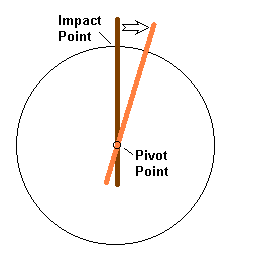
Pay attention to this picture from George Turner's article that you mention:

http://www.thearma.org/spotlight/GTA/motions_and_impacts_files/image001.gif

Now if given a pivot point you calculate the angle of the blade vs the the motion of it you get.... ZERO! Nothing! Nada! As we say in Spain “cero patatero” (zero potato) You get no angle! you get no slicing effect at all!!! And it makes perfect sense.

Of course, the movement of a sword strike is not as perfect as the one shown in the picture but it is very close and anyway, one important thing, the slicing effect the strike might have would favor straight blades vs curved ones!!! After all, the slicing effect considered as the perpendicular movement of the blade to the direction of the strike can be achieve much easier if the blade is straight. The curvier the more energy would be lost trying to slice in a different direction of the natural movement of the blade. So if you use a saber or katana the tomato-slice effect as define previously would not help much... just guessing now, but perhaps that's the reason why guillotines are straight blades.

When I consider the theoretical matter in my calculations as non-elastic, I did not have in mind the slicing effect at all (which is not that important for cutting and I am determine to convince you on this) I was rather thinking in a guy with a mail and a very thick soft pad behind. Such material would take any cut and any sword would only scratch it since it would absorb all the energy from the strike.
In fact, I think flesh and bones is close to the theoretical staff I am using for calculations but, in any case, that theoretical matter I am using is a fair ground to test geometries; giving no prior advantage to any blade geometry.

But I said for cutting strikes the slicing effect does not matter... How about thrusting? Well, you're right, in this case the slicing effect does exist on matter not so mathematically ideal as the one I have been using for my calculations. I neglected that effect assuming is was far more important the amount of energy needed to beat the resistance of the body. Since I showed that that energy was the same regardless the geometry, I think that questioning the geometry based on the slicing effect is a fair problem to think about. In fact, in my previous calculations I kept looking at the geometry and I said that a center tip was better since, given the same thrusting power, allows you to have a thicker tip, and thus, a tougher one.

I have recalculated the problem considering the slicing effect when thrusting. If we accept that slicing the knife 2 inch on the tomato has double the slicing power of 1 inch an so on... Then I formulate the amount of extra slicing power you get moving the tip from one side of the blade to the other based on the "guillotine" angle it takes. The formula goes like this:

((b-d)/cos(atan(h/(b-d)))-(b-d))+(d/cos(atan(h/d))-d);
simplifying
d*sqrt(h^2/d^2+1)+(b-d)*sqrt(h^2/(b-d)^2+1)-b

Where h is height of the tip, b is the base of the blade and d is the distance the point have from one side of the blade which values go from zero to b.

The shape is parabolic-like and its minimum point is place at:

d=b/2

Well, in this case, the point gets its higher slicing power values when it is place at one side of the blade (like katanas) and its lower point or slicing power is placed right in the middle of the blade (when d = b or d = zero).

For example, for a tip with a base of 1 unity and a height of 1 unity you get an extra 14.41% slicing power by placing the tip in one of the sides of the blade (katana like) losing no thrusting power but having its tip weaker that if placed in the middle of the blade.

So the best geometry for thrust if the slicing effect is important and you can afford to weaken the tip would be something like this (guillotine-like tip):

http://chineseswords.freewebspace.com/catalog.html
http://thomaschen.freewebspace.com/images/songzmd.jpg

Just a note, this are not Japanese blades actually but Chinese. Japanese gave them later its characteristics curvature.

OK, if centering the tip gives it strength and moving the tip to a side give an extra slicing power... what would be the best geometry for the tip of a blade?

I have to say at this point that I really was hoping the centered tip to have more slicing power to save me from more calculations hahaha... :lol: anyway, given this situation we need to compare again two scenarios to decide what is the best geometry for thrusting.

Now let's imaging that a blade cannot hold an angle smaller than alpha for its tip cause an smaller angle would weaken it too much and would break when thrusting. So if we now by experience that value of alpha, what would be the best position to acquire the best slicing power? Well, to keep the comparison fair we would assume both blades to have the same amount of steel (same area) but in this case they will not have the same length in order to maintain the same area in both blades.

By fortune, now is very easy to see that a centered tip will have both, better thrusting power and higher slicing power that if we place the tip to any side of the blade. Since both blades have the same area the centered tip blade will have to be longer, but in this position the slicing factor angle will be bigger giving more slicing effect, the thrusting power will also be greater due to a smaller base of the blade.

All in all, calculations keep pointing as the bes thruster, and now the best slicing effect tip, the old good long swords like this:

http://www.tritonworks.com/content/images/albion_talhoffer2.jpg

And for cuts with slicing effect, this effect will be bigger than in curved blades too! Wow, I should buy one hahaha :lol:

Well, this was another long post, sorry but I do not know how to say this with less words without being more confusing. Nonetheless it would be cool to put all this theory to test in a laboratory; theory only shows a path.

Maxime Chouinard
Posts: 72
Joined: Wed Sep 24, 2008 11:46 am

Postby Maxime Chouinard » Sun Jan 04, 2009 4:01 pm

The results are interesting, although mathematics are not my forte. But I can't help thinking that there are variables that are not accounted for. How would you explain the results of Michael Edelson's test in which the katana surpassed the longsword in the cutting test on jack?

User avatar
Vincent Le Chevalier
Posts: 166
Joined: Mon Dec 31, 2007 5:18 am
Location: Paris, France

Postby Vincent Le Chevalier » Sun Jan 04, 2009 4:46 pm

Francisco Urbano García wrote:Pay attention to this picture from George Turner's article that you mention:

http://www.thearma.org/spotlight/GTA/motions_and_impacts_files/image001.gif

Now if given a pivot point you calculate the angle of the blade vs the the motion of it you get.... ZERO! Nothing! Nada! As we say in Spain “cero patatero” (zero potato) You get no angle! you get no slicing effect at all!!! And it makes perfect sense.

But here the blade is straight, so of course the slicing effect is not apparent ;)

I think you have in mind that it's the curvature of the blade at the impact point that matters. I don't think it's the case; most curved blades are still way less curved than what they are meant to cut. It's the cumulated curvature that matters, from handle to impact point, because this gives you the angle between the edge and the motion.

See this picture:
Image

I have drawn a curved sword impacting a target, and a sort of equivalent guillotine blade in light gray. The motion of the sword is circular, centered on the pommel end. The trajectory of the impact point is illustrated by the arrow. The dashed line could represent a straight blade swung in the exact same way.

I grant you that the angle is not that big, but it's there and can give a slightly different behaviour to the curved blade. Of course if you add a slicing technique it gets bigger, the difference in angle will probably remain the same curved vs. straight, but maybe the effect increases?

I think this is a part of the explanation of the jack test results you mentionned, Maxime... The rest probably lies in differences in mass distribution.

About the thrust. I don't know if it's really the length of the edge that matters; I think it's the direction of the edge relative to its speed that matters. The more angle you have, the more slicing you get. Figuring out the exact dependency is not that easy, but maybe if you did that you'd find the sharp symmetric tip has a slight advantage. This seems to be born out by the shape of the vast majority of thrusting weapons (not just swords but also spears and arrows...).

Francisco Urbano García
Posts: 43
Joined: Sun Nov 30, 2008 9:37 pm

Postby Francisco Urbano García » Mon Jan 05, 2009 4:00 am

Maxime Chouinard wrote:The results are interesting, although mathematics are not my forte. But I can't help thinking that there are variables that are not accounted for. How would you explain the results of Michael Edelson's test in which the katana surpassed the longsword in the cutting test on jack?


Well the math results completely agree with that, what the maths says is that when cutting the whole thing, like chopping heads, bamboo, etc... the straight blade will require no more energy than the curved one.

In other words, the cutting bamboo shows could be done with a straight katana without any extra effort.

What the math shows is that the initial part of the cut is easier for a curved blade, that is why in any cut test where you don't cut the whole thing curved blade will have an advantage.

Francisco Urbano García
Posts: 43
Joined: Sun Nov 30, 2008 9:37 pm

Postby Francisco Urbano García » Mon Jan 05, 2009 6:03 am

Vincent Le Chevalier wrote:
But here the blade is straight, so of course the slicing effect is not apparent ;)

See this picture:
Image

I have drawn a curved sword impacting a target, and a sort of equivalent guillotine blade in light gray. The motion of the sword is circular, centered on the pommel end. The trajectory of the impact point is illustrated by the arrow. The dashed line could represent a straight blade swung in the exact same way...


Nice picture Vincent, looking at it I just realize a couple of things:

1- When I said the angle is zero in straight blades I should had add that the edges had to be parallel to each other for that to be true; in a triangle shape blade the angle is not zero and we have a "guillotine" effect.

2- The curved blade has a "guillotine" effect too, but not due to its motion but its geometry.

If you want to calculate how much "guillotine" effect has a blade just divide the portion of the cutting blade by the straight with zero angle line perpendicular to the motion. In the case of a straight blade this would be alfa-angle-lenght/(cos(angle)*alfa-angle-length), in the case of a curved blade the rate would be arc-of-circumference/zero-angle-length

as long as this two rates are equal, the curved blade will have no more "guillotine" effect than the straight sword!

Just I wonder if this is the reason to go from parallel edges like gladius swords to more triangle shape ones like this:

http://albion-europe.com/images/AB/Albion/SL/TheLate15thCBastardSword/squire-bastard1a.jpg


Vincent Le Chevalier wrote: Of course if you add a slicing technique it gets bigger, the difference in angle will probably remain the same curved vs. straight, but maybe the effect increases?


If the strike has a slicing motion that adds to the geometry of the blade, I would say it benefits more the straight blade since you only need to draw the sword in straight line and, with a curve sword, you should draw the sword following the curvature of the blade... Seems to me this a more awkward, difficult and unnatural way to strike.

Vincent Le Chevalier wrote: I think this is a part of the explanation of the jack test results you mentionned, Maxime... The rest probably lies in differences in mass distribution.


That's why it is better to test geometries to use a straight katana vs a curved katana; this way the mass distribution would not be something to consider. But again, for cutting the whole thing straight blades will do just as good, though now I should add that the straight blade should be triangle-shaped to match the slicing effect of the curved katana. Mmm... Though the mass distribution might favor the katana since the triangle-shaple blade will be lighter the closer to the tip. Mass distribution is something I did not consider in the formulas... Oh my God :roll: (Well, not quite, everything still stands if you consider all blades with the same mass distribution) :wink:

Vincent Le Chevalier wrote: About the thrust. I don't know if it's really the length of the edge that matters; I think it's the direction of the edge relative to its speed that matters. The more angle you have, the more slicing you get. Figuring out the exact dependency is not that easy, but maybe if you did that you'd find the sharp symmetric tip has a slight advantage. This seems to be born out by the shape of the vast majority of thrusting weapons (not just swords but also spears and arrows...).


Oh no no, you're right, the length does not matter, I just pointed out that, with the same amount of steel (area) you would need a longer blade to keep the tip centered with the same angle.

Well, actually I figure out that dependency so I can say that, with tips with the same angle, you get both the higher slicing and thrusting effect if that tip is centered.


Return to “Research and Training Discussion”

Who is online

Users browsing this forum: No registered users and 31 guests


Note: ARMA - The Association for Renaissance Martial Arts and the ARMA logo are federally registered trademarks, copyright 2001. All rights reserved. No use of the ARMA name or emblem is permitted without authorization. Reproduction of material from this site without written permission of the authors is strictly prohibited. HACA and The Historical Armed Combat Association copyright 1999 by John Clements. All rights reserved. Contents of this site 1999 by ARMA.